
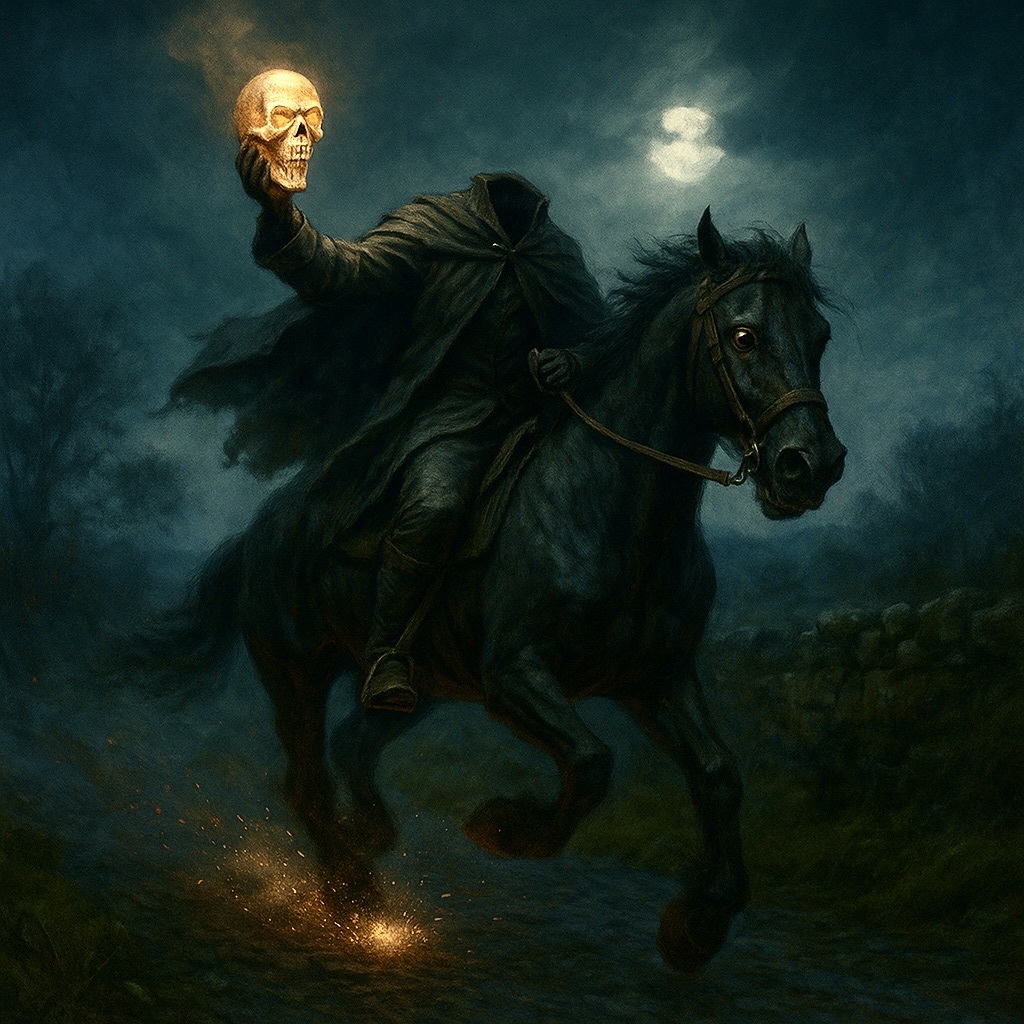
There are stories that follow you home no matter how fast you run, legends that live not just in the land where they were born but in the very marrow of those who hear them. Among Ireland’s many ghosts, banshees, and fair folk, none chills the blood quite like the Dullahan: the headless horseman who carries his own skull, a harbinger of death galloping across the emerald hills. To glimpse him is to know that death is near, to hear his call is to feel your heart sink, and to speak of him is to brush against that thin veil between life and the inevitable shadow that comes for us all.
The Dullahan is not just a figure of fright; he is a reminder of mortality, of fate, and of the way human beings have always personified the inescapable truth of death. Ireland’s oral traditions have preserved him for centuries, whispered in the flicker of peat fires and retold in the misty lanes of rural towns. He is terrifying, yes, but he is also deeply human in the sense that he embodies what we fear most: the loss of control, the coming of an end we cannot escape, and the image of death itself riding toward us in the night.
The description of the Dullahan is unforgettable. He rides a black horse, fierce and muscular, its nostrils flaring with sparks and its hooves striking fire against the earth. In his hand — not upon his shoulders — rests his head, grotesque and otherworldly. The skin is pale and decayed, the flesh stretched tight, with a wide grin carved permanently into its face. The eyes glow with an unholy light, scanning the night, searching for souls to claim. His head is said to have the consistency of moldy cheese, a detail both grotesque and haunting, because it brings the myth down from the lofty air of terror into the sickeningly tangible realm of decay.
Wherever the Dullahan stops, someone is destined to die. He does not need to speak; a mere point of his bony finger seals a person’s fate. Sometimes, however, he calls the name of his victim, and the sound is enough to extinguish life itself. Doors and locks cannot stop him, for no barrier can hold back death. He is both spirit and force, a being who transcends walls and gates as easily as breath passes through lungs. The Dullahan does not linger, does not chase for sport. He arrives, he marks, he takes, and he is gone.
But where did this terrifying image come from? Scholars trace the Dullahan back to Celtic mythology, where he may have been an incarnation of Crom Dubh, a fertility god who demanded human sacrifice. When Christianity spread through Ireland, the old gods were suppressed, demonized, or transformed into darker legends. Crom Dubh’s bloody worship may have morphed into tales of the Dullahan, who no longer demanded offerings but instead carried the image of death itself. Over time, his story blended with folklore about fairies, banshees, and the restless dead, crystallizing into the figure we know today.
The Irish countryside, with its fog-wrapped moors, stone ruins, and hidden lanes, was fertile soil for such a legend. In a land where famine struck often and mortality was never far from daily life, the Dullahan became not just a story but a cultural embodiment of the fragility of existence. He reminded villagers that life was fleeting, that death did not negotiate, and that the moment of one’s end was always out of human hands.
Yet, for all his terror, the Dullahan is not invincible. Folklore insists he fears only one thing: gold. A single golden object, whether a coin or trinket, can drive him away. This detail is striking, for it suggests a lingering human hope — that something of earthly value might hold back death. But the irony is sharp: gold may repel him in the tale, but no real wealth can keep mortality from claiming us. The Dullahan is an equalizer, a reminder that death does not care if one is rich or poor, young or old. His horse gallops for all.
Think for a moment about the symbolism of carrying one’s own head. To be headless is to be powerless, but the Dullahan subverts this. He is not robbed of his head but commands it, carrying it like a lantern. The head glows, it sees, it directs. It is death turned mobile, portable, weaponized. In many cultures, to lose the head is to lose identity and soul. But in Ireland’s Dullahan, the head becomes the very instrument of fear. He rides without it, proving that what we think makes us human is not what holds sway in the realm of the supernatural.
The Dullahan’s tale echoes outward into wider culture. Washington Irving’s “The Legend of Sleepy Hollow” famously introduced a headless horseman to American readers, and while the Hudson Valley tale is distinct, its DNA traces back to Ireland’s shadowy rider. Immigrants carried their stories with them, and in the fertile imagination of early America, the Dullahan adapted, blending with local fears to become Ichabod Crane’s terrifying pursuer. Today, every Halloween in the U.S., children see images of pumpkin-headed riders, not realizing they are looking at Ireland’s legacy galloping through history.
But unlike the playful or spooky adaptations that populate modern pop culture, the original Dullahan remains deeply grim. He is not a villain to be fought or defeated. He is inevitability given form. When villagers heard horse hooves echoing on lonely roads at night, they prayed not to hear their name whispered in the dark. When shadows moved near graveyards or crossroads, people clutched golden trinkets, desperate for protection. The Dullahan reminded them that life was borrowed, fragile, and never fully theirs.
Modern readers may find in the Dullahan an allegory for the things that pursue us now. The black horse might be time itself, galloping faster than we wish. The head with its fixed grin might be the reminder of our mortality, a face we must all one day wear. The gold that drives him away might represent the distractions we cling to — wealth, technology, endless consumption — in hopes of postponing the inevitable. But like all distractions, they cannot last. The rider always comes.
The Dullahan’s power lies not just in fear but in fascination. Death has always drawn human imagination, because to speak of it is to admit our helplessness. The Irish, with their gift for storytelling, wrapped that helplessness in imagery vivid and unforgettable: fire-breathing horses, rotting skulls, silent riders pointing bony fingers. They made death visible, audible, and unforgettable. That is why the Dullahan endures — because he rides not just through Irish fields but through the universal landscape of human fear.
And yet, the story is not without a kind of beauty. In its way, the Dullahan legend is honest. It strips away illusion. It says: death is coming. No locks will keep it out, no walls will keep it back. But it also says: you are not the first, and you will not be the last. We all share this fate. There is a strange comfort in that universality, in knowing that every hoofbeat, every whispered name, ties us together in the human journey.
So on October 8, when the tale of the Dullahan is remembered, we are reminded that folklore is never just entertainment. It is survival in story form. It is our attempt to wrestle with truths too large to face in silence. The Dullahan gallops not just across the roads of Ireland, but across our imaginations, forcing us to look at the one thing we cannot escape. And in his grotesque visage, his grinning skull, we might just see the reflection of our own deepest fears.
Perhaps the most chilling thought of all is this: if the Dullahan rides tonight, and his horse sparks fire against the stones outside your door, will you dare to look? Or will you close your eyes and hope the whisper is not your name?
Because when death rides, it carries its own head — and it always knows where it’s going.