
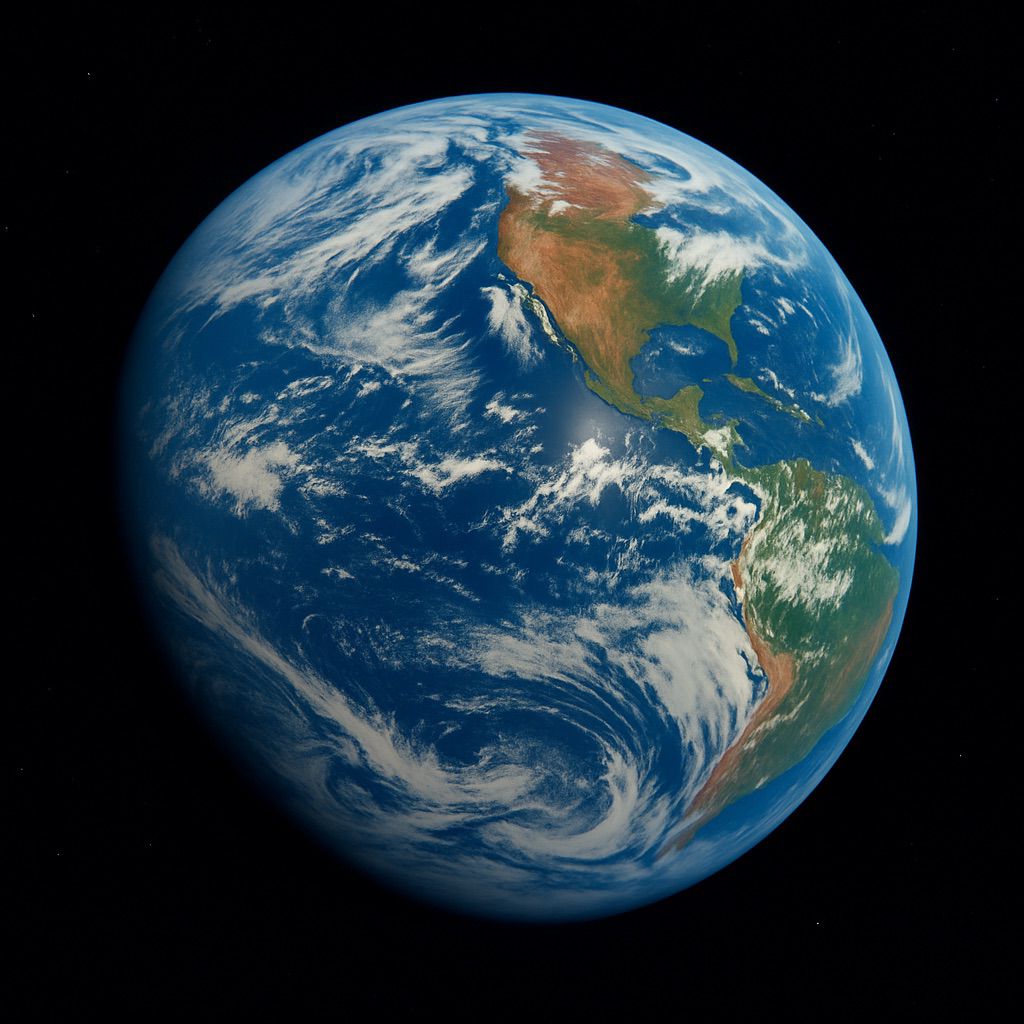
The first color photograph of Earth taken from space is one of those rare moments in human history when technology, curiosity, and sheer wonder converge into a single image that changes how we see ourselves. Before that moment, our understanding of Earth was rooted almost entirely in maps, globes, paintings, and imaginations shaped by the blurry black-and-white photographs from earlier missions. The idea of our planet floating freely in the vastness of space was understood intellectually, perhaps even emotionally, but it had not yet been felt in the visceral, undeniable way that only a photograph can deliver. When that first true color image emerged, it did more than document a scientific achievement — it reshaped human identity, perspective, and the spiritual understanding of our place in the universe.
The story begins at a time when the space age was still young. Rockets had only recently begun piercing the upper atmosphere, satellites had just started orbiting the planet, and astronauts were still learning how their bodies responded to the strange ballet of weightlessness. Much of what we now consider foundational knowledge about spaceflight didn’t even exist yet. These were the years when every mission was an experiment, every image was a revelation, and every successful orbit felt like a small miracle. The idea that one day a spacecraft would be able to capture Earth in full color — blue oceans, swirling white clouds, and the rich brown and green textures of land — was something scientists hoped for but did not yet fully expect. Color photography in space required not just engineering expertise but a deep understanding of how film responded to radiation, vacuum conditions, unpredictable lighting, and developing methods back on Earth.
Before this breakthrough, the earliest images of Earth taken from space looked ghostly and distant, mostly grainy monochrome snapshots that hinted at detail rather than displaying it. They were scientifically important, of course, but they lacked the emotional punch that comes from seeing our home the way the universe sees it. Those images helped meteorologists, researchers, and cartographers, but they didn’t inspire the average person. They didn’t evoke awe or humility or that strange tightening in the chest that happens when we see something truly beautiful. The first color photograph changed all of that in a single moment — suddenly Earth wasn’t an abstract concept but a living world suspended in darkness, radiant with color. It was home, captured in a way that no one had ever seen before.
The spacecraft that captured that first landmark image was more than a tool of exploration; it was a lens through which humanity learned to look at itself differently. The astronauts and engineers who helped bring that image into existence understood the magnitude of their mission, even if they didn’t fully grasp the cultural shockwave that would follow. Some later described the experience of seeing Earth from space as profoundly emotional — a feeling of fragile interconnectedness, as though every border, every conflict, every disagreement on Earth seemed insignificant when viewed from a viewpoint hundreds of miles above. The color photograph transmitted that very feeling to millions back on the ground. For the first time, people who would never travel to space could share, in a small way, the astronauts’ awe.
What made the image so emotionally powerful wasn’t just its beauty. It was its vulnerability. Hanging against the endless black canvas of the cosmos, Earth appeared both majestic and delicate. The atmosphere — that thin blue halo that protects every living thing — looked fragile enough to break with a fingertip. The continents, typically divided on political maps, blended into one another organically. The oceans looked impossibly vast, their blues deep and calming. Clouds swirled in hypnotic patterns, revealing a planet in constant motion. And perhaps most striking of all was the absence of human divisions — no fences, no highways, no city borders, no nations. It was our world reduced to its purest, most essential form.
Scientists marveled at the photographic clarity, the accuracy of the colors, and the wealth of data the image provided. Meteorologists studied cloud formations. Oceanographers examined the spread of marine hues. Geologists compared landmasses to existing maps. But beyond the scientific realm, the photograph became something else entirely: an icon. Newspapers printed it on their front pages. Magazines ran special editions. Classrooms hung posters so students could gaze at the planet that held everything they knew. People began to understand Earth as a living ecosystem rather than a collection of isolated regions. Environmental consciousness — which already existed but had not yet reached the mainstream — suddenly had a powerful, irrefutable symbol.
NASA, at the time, recognized the significance but perhaps underestimated just how culturally influential that single photograph would become. They viewed it first and foremost as a technical success, a triumph of engineering and mission planning. But the public saw something transcendent: a reminder that Earth is unique, fragile, and interconnected. This photograph paved the way for later images like “Earthrise” and “The Blue Marble,” which carried the torch of environmental awareness into new generations. Yet the first color image remains special because it broke the barrier first — the moment when the cold technical frontier of space exploration transformed into a source of human reflection.
For many people who saw that photograph in the years following its release, it created an almost spiritual reaction. Religious leaders referenced it in sermons. Poets wrote verses inspired by it. Philosophers debated its implications. Psychologists noted that people often described feeling a sudden global empathy, a shared sense of belonging to a world far larger than their daily routines. Even those who usually felt disconnected from science or space exploration found themselves staring at the image longer than expected, wondering about their place on a planet that looked so small and so precious.
The photograph also transformed how nations viewed each other. During a period marked by Cold War tensions, global competition, and ideological battles, the image of Earth as a unified sphere helped soften perspectives. It didn’t erase political conflicts, of course, but it introduced something new — the idea that preserving the planet might be a shared goal greater than any ideological struggle. Environmental movements gained traction. Scientific diplomacy expanded. Governments began discussing global cooperation on issues like pollution, conservation, and atmospheric research. It’s not an exaggeration to say that the first color photograph of Earth planted the seeds of the modern environmental movement.
Artists were equally captivated. Painters attempted to recreate the colors and curvature of Earth. Photographers studied the play of light and shadow across the planet’s surface. Designers incorporated the globe into posters, album covers, educational material, and advertising. The photograph became part of the visual language of the late 20th century — a symbol of unity, fragility, and hope. It continues to inspire artists today, appearing in galleries, digital designs, and multimedia installations that explore humanity’s relationship with nature and the cosmos.
But beyond the art, science, and philosophy, the image had a deeply personal meaning for many ordinary people. It reminded them that Earth, despite its conflicts and complexities, is a shared home. Many described feeling a renewed appreciation for nature, for life, for the simple act of breathing air under a protective sky. Some said the photograph made them want to travel, to see the world’s beauty firsthand. Others said it made them realize how much needed to be protected — forests, oceans, wildlife, and the fragile ecosystems that sustain life. That first color image didn’t come with a speech or a manifesto, but its message was clear nonetheless.
Looking back now, decades after that image was taken, it remains a powerful symbol of what humanity can achieve when driven by curiosity and cooperation. It reminds us that exploration is not only about discovering the unknown — it’s about understanding ourselves. Every subsequent mission that photographed Earth built upon the legacy of that first color image, but none of them can truly replicate the impact of seeing our world in color for the very first time.
Today, as high-resolution satellite imagery has become commonplace, we sometimes forget how revolutionary that original photograph was. We scroll past modern satellite pictures on our phones without thinking twice. But the first color photograph still stands apart because it marked the moment when humanity earned its first true portrait — not as individuals, nations, or cultures, but as a species. A single world. A single home. A tiny blue orb floating in the infinite dark, radiant with life.
And that is why the first color image of Earth remains so profoundly important. It didn’t just show us what our planet looks like; it showed us who we are. It reminded us that despite all our differences, we share something extraordinary — a breathtakingly beautiful world unlike any other we know. It is fragile, vibrant, alive, and deserving of protection. All of that meaning began in a single moment when a spacecraft captured a photograph that forever changed how we see ourselves.