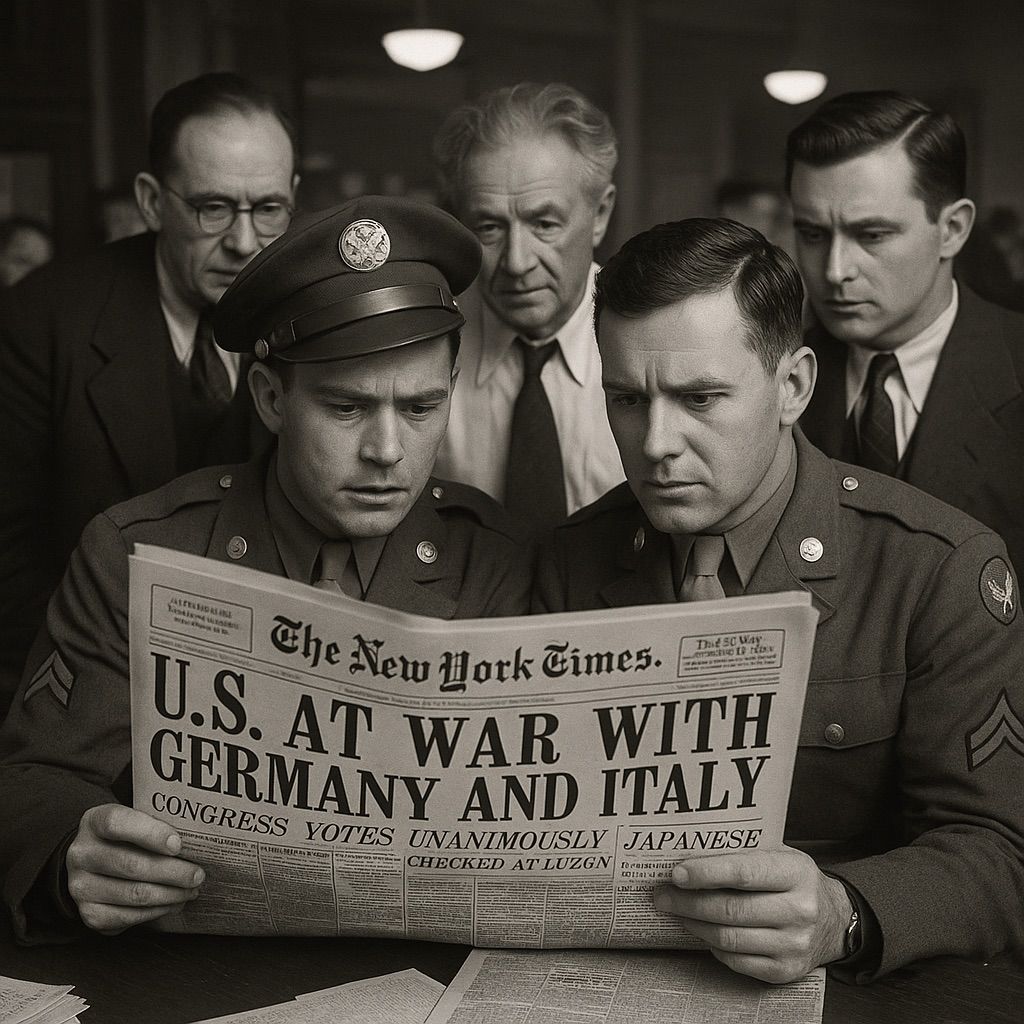
The winter of December 1941 settled heavily over Washington, London, Berlin, and Rome, but the cold did little to mute the shockwaves already rolling across the world. The United States had barely begun to process the devastation of Pearl Harbor—smoldering ships still leaked oil into Hawaiian waters, families were still being notified of loved ones lost, and the nation was only beginning to shift from the mindset of distant observer to active combatant—when yet another blow arrived. On December 11, 1941, Germany and Italy, under Adolf Hitler and Benito Mussolini, declared war on the United States, thrusting America formally into both the Atlantic and Pacific theaters of World War II. Their declarations expanded the conflict from a fractured, uneven international crisis into the fully global war it would become, forever redefining the twentieth century and reshaping the world’s political future.
To understand why Germany and Italy chose that moment to declare war on a country far more industrially powerful than themselves, one must trace the arc of the increasingly volatile atmosphere that had been building across the globe since the 1930s. Germany’s grievances after World War I were not merely emotional—they were strategic, economic, and purposeful. Hitler rose to power on promises to overturn the Treaty of Versailles, restore German pride, and rebuild the military machine that had been shattered in 1918. In a few short years, he dismantled democratic institutions, rebuilt the Luftwaffe, reintroduced conscription, and pushed the boundaries of diplomacy as far as Europe would allow. He annexed Austria, carved up Czechoslovakia, and molded the Nazi state into an engine designed for territorial expansion.
Italy, under Mussolini, shared similar ambitions but lacked the same military capacity. Mussolini dreamed of restoring the glories of ancient Rome, imagining a new Italian empire stretching across the Mediterranean and into Africa. His ventures into Ethiopia and Albania were attempts to stake Italy’s claim as a modern imperial power, even though Italian forces consistently lacked the skill, equipment, and organization of their German counterparts. But Mussolini’s ego demanded prestige, and aligning himself with Hitler offered the illusion of strength he could not produce on his own. Together, Germany and Italy formed a partnership that had as much to do with ideological alignment as it did with shared political fantasies of domination.
While war consumed Europe, the United States had watched from afar, hopeful that the Atlantic Ocean could remain a shield. Franklin D. Roosevelt understood that Germany’s aggression threatened global stability, but the American public—still scarred by the memory of World War I—wanted no part in another foreign war. Roosevelt walked a careful line, slowly edging the U.S. closer to the Allies, supplying Britain, supporting China, and quietly preparing for the possibility that neutrality would not last forever. The Lend-Lease Act was the clearest sign that the U.S. was no longer an impartial observer. American factories roared to life, producing tanks, aircraft, ammunition, and supplies for the nations resisting Hitler’s advance. The U.S. Navy found itself increasingly involved in escorting Allied convoys across the Atlantic, sometimes exchanging fire with German U-boats. Though America had not yet declared war, it was already drifting in that direction.
Yet despite Germany’s growing aggression, it was Japan’s decision to attack Pearl Harbor that finally forced America into the conflict. Japan had been expanding across East Asia for years, driven by militaristic ambitions and a desire to secure resources that its island nation could not produce. China suffered under Japanese occupation, and Southeast Asia braced for the same fate. When Japan swept into French Indochina, the U.S. responded with sanctions, including a crippling oil embargo. In Tokyo, Japan’s military government viewed the embargo as an existential threat. Without oil, their empire would collapse. A preemptive strike on the United States, they believed, would neutralize American influence long enough for Japan to seize the raw materials of Southeast Asia.
The attack on Pearl Harbor shocked the world. Americans who had once insisted on staying out of foreign wars now stood united in outrage. Roosevelt’s speech on December 8 declared the date as one that would live in infamy, and Congress swiftly approved a declaration of war against Japan. But for Hitler and Mussolini, seeing the U.S. locked into a Pacific war offered an enticing strategic illusion. They believed America would be too preoccupied fighting Japan to make meaningful contributions to the European theater. Moreover, Germany badly underestimated the industrial and military capacity of the United States. Hitler misread the moment entirely. He assumed that by declaring war on the U.S., he could draw Japan into a war against the Soviet Union, forming a united three-front assault that would break Stalin. That miscalculation would be one of the most significant turning points of the war.
Thus, Hitler and Mussolini formally declared war on the United States on December 11. Their speeches were full of bravado, ideological vitriol, and Nazi mythology about inevitable victory. They painted the United States as a decadent, capitalist nation incapable of sustaining a prolonged military campaign. They underestimated American resilience, industrial might, and the unity that Pearl Harbor had inspired. What they triggered instead was a mobilization unlike anything the world had ever seen. The U.S. economy—already humming from Lend-Lease production—shifted fully into wartime mode. Women entered factories, men lined up at recruiting offices, universities turned into research hubs, and automotive plants converted to produce aircraft and artillery.
Germany and Italy found themselves facing a nation that not only had massive human and industrial resources but also unparalleled logistical capability. The U.S. could build ships faster than Germany could sink them, could produce aircraft at quantities no Axis power could match, and could supply its allies with food, fuel, and weapons while simultaneously replenishing its own forces. The declarations of war that Hitler and Mussolini believed would divide the Allies instead unified them with unprecedented resolve.
As American involvement expanded, major turning points in the war began to shift momentum. In North Africa, U.S. and British forces pushed back the once-formidable Afrika Korps. In Italy, Allied troops fought up the peninsula, eventually toppling Mussolini’s regime. On the Eastern Front, the Red Army slowly reversed Germany’s advances, culminating in catastrophic losses for Hitler at Stalingrad and Kursk. And in the Pacific, the U.S. Navy, having turned the tide at Midway, began the long island-hopping campaign that would carry American forces ever closer to Japan.
By 1944, the full consequences of Hitler’s miscalculations were evident. American troops landed in Normandy, opening the long-awaited Western Front. The Allies closed in on Germany from both east and west, and Italy, having surrendered in 1943, became a battleground between German occupiers and Allied liberators. Hitler’s dream of a thousand-year Reich crumbled under the overwhelming weight of coordinated Allied offensives. Mussolini met a grim end at the hands of Italian partisans, and Germany surrendered in May 1945.
In the Pacific, the U.S. faced an enemy unwilling to surrender even in hopeless circumstances. Fierce battles on Iwo Jima and Okinawa revealed the staggering human cost of invading Japan itself. Truman’s decision to authorize the atomic bombings of Hiroshima and Nagasaki remains one of the most consequential and controversial decisions in world history. Japan surrendered shortly after the bombings, bringing World War II to its end.
The world that emerged from the ashes of the war bore little resemblance to the one that had existed in 1939. Germany was divided, Italy had abandoned fascism, the United States and the Soviet Union rose as superpowers, and the global order—politically, militarily, and ideologically—shifted dramatically. The United Nations was formed in the hope of preventing future conflicts, though the Cold War would soon cast a new shadow over international relations. For millions of families across continents, the war left scars that would never fully heal. And for historians and citizens alike, the conflict became a testament to the dangers of unchecked aggression, ideological extremism, and catastrophic miscalculation.
Looking back, the declarations of war by Germany and Italy seem almost surreal—acts of political arrogance and strategic blindness that sealed the Axis powers’ fate. They expected a fractured, reluctant America; instead they awakened a nation whose industrial strength and determination would help dismantle fascism and reshape the global balance of power. The world today still lives with the echoes of those December days when one nation recovering from the shock of Pearl Harbor suddenly found itself drawn fully into a war on two fronts, a war that would fundamentally rewrite the course of history.