On the night of October 8, 1871, the city of Chicago went to sleep under clear skies, unaware that within hours, flames would transform their lives, their homes, and their future forever. By dawn, the city would be a sea of fire, a hellscape of wood, wind, and despair. It became one of the most infamous urban disasters in American history—the Great Chicago Fire. Though historians still debate its exact origins—popular legend blames Mrs. O’Leary’s cow kicking over a lantern—the consequences are beyond dispute. In just two days, a thriving metropolis of nearly 300,000 people was reduced to ash and rubble. And yet, out of that devastation, Chicago would rise again, stronger, prouder, and more determined than ever to etch its name into history.
To understand the magnitude of the disaster, one must picture Chicago in the 1870s. It was a booming city, an industrial powerhouse and a vital hub connecting the Great Lakes to the Mississippi. The city was alive with the sound of trains, factories, and opportunity. Immigrants poured in, businesses thrived, and fortunes were made. But beneath the promise lay danger. Chicago was built largely of wood—houses, sidewalks, even streets. After months of drought, the city was a tinderbox. Add in strong winds off Lake Michigan, and the conditions were perfect for catastrophe.
The fire began in a barn on DeKoven Street, but within minutes, it leapt to neighboring buildings. Fueled by wooden structures and dry conditions, the flames grew into an unstoppable beast. Eyewitnesses described a sky turned orange, buildings exploding into sparks, and firestorms leaping across the river as if mocking attempts to contain them. The city’s fire department, though brave, was overwhelmed. Exhausted from battling another blaze the night before, they lacked both manpower and equipment. The flames moved faster than men, consuming block after block in minutes.
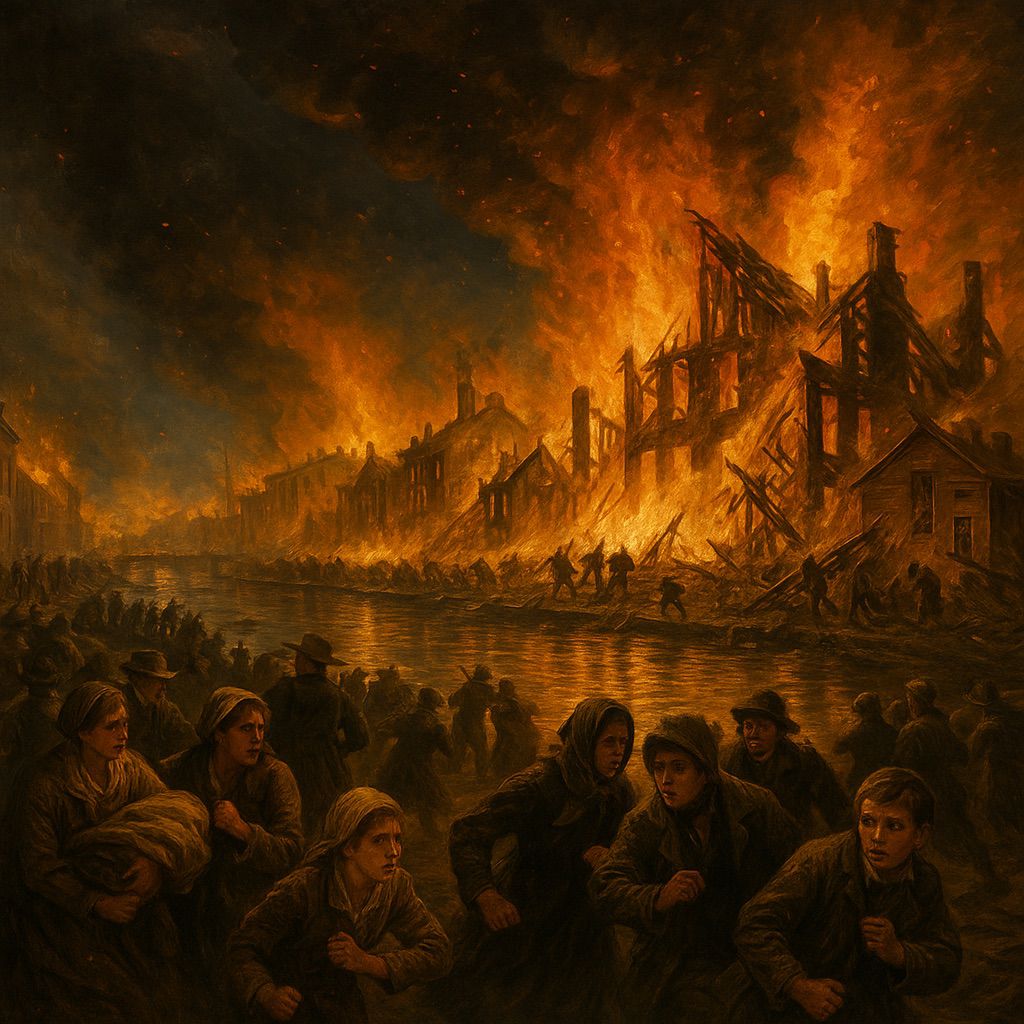
By midnight, the fire had crossed the South Branch of the Chicago River. By morning, it roared through the city’s heart, devouring banks, businesses, churches, and homes alike. The wind fanned embers into fiery whirlwinds, tossing sparks onto rooftops blocks away. People fled with whatever they could carry—children, pets, Bibles, photographs—anything that could be saved in a moment of panic. Horses stampeded through the streets, wagons overloaded with families and their possessions jammed the roads, and panicked crowds surged toward the river, some jumping into the water to escape the inferno.
The fire showed no mercy. It consumed the courthouse, the Palmer House Hotel, and even the Chicago Tribune building. It burned rich and poor alike, making no distinction between mansions and shanties. The heat was so intense that it melted iron, turned brick to powder, and warped the very earth. By the time rain finally helped douse the flames on October 10, over 17,000 buildings had been destroyed, 100,000 people left homeless, and nearly 300 lives lost. The city smoldered like a corpse, its skyline a jagged silhouette of chimneys and ruins.
But Chicago’s story did not end in ashes. In many ways, it began anew. Out of the ruins came resilience. Survivors set up makeshift shelters, churches opened their doors, and donations poured in from across the nation and the world. Relief trains arrived with food, blankets, and supplies. Even Queen Victoria of Britain sent aid. Out of tragedy, solidarity grew.
More importantly, the fire forced Chicago to rethink itself. The wooden city gave way to a city of stone, steel, and innovation. New building codes demanded safer, sturdier construction. Architects flocked to the city, eager to reimagine its skyline. In the decades that followed, Chicago became a laboratory of modern architecture, the birthplace of the skyscraper, and a symbol of what resilience could achieve. The city that once lay in ruins would later host the World’s Columbian Exposition of 1893, dazzling the globe with its rebirth.
And yet, behind the triumph lies the human heart of the fire. Imagine a mother clutching her children, running barefoot across burning streets. Picture families huddled along the lakefront, watching their city vanish in flames. Imagine the firemen, their faces blackened with soot, swinging axes against impossible odds. These were not just statistics—they were human lives, their pain and bravery written in fire and ash.
The Great Chicago Fire is not just a tale of destruction but of transformation. It reminds us that even in our darkest hours, the seeds of rebirth are sown. Chicago rose from the flames not diminished but renewed, proving that a city’s spirit is stronger than its structures. October 8, 1871, was the night Chicago burned. But it was also the night Chicago learned it could endure anything, even the fire itself.