
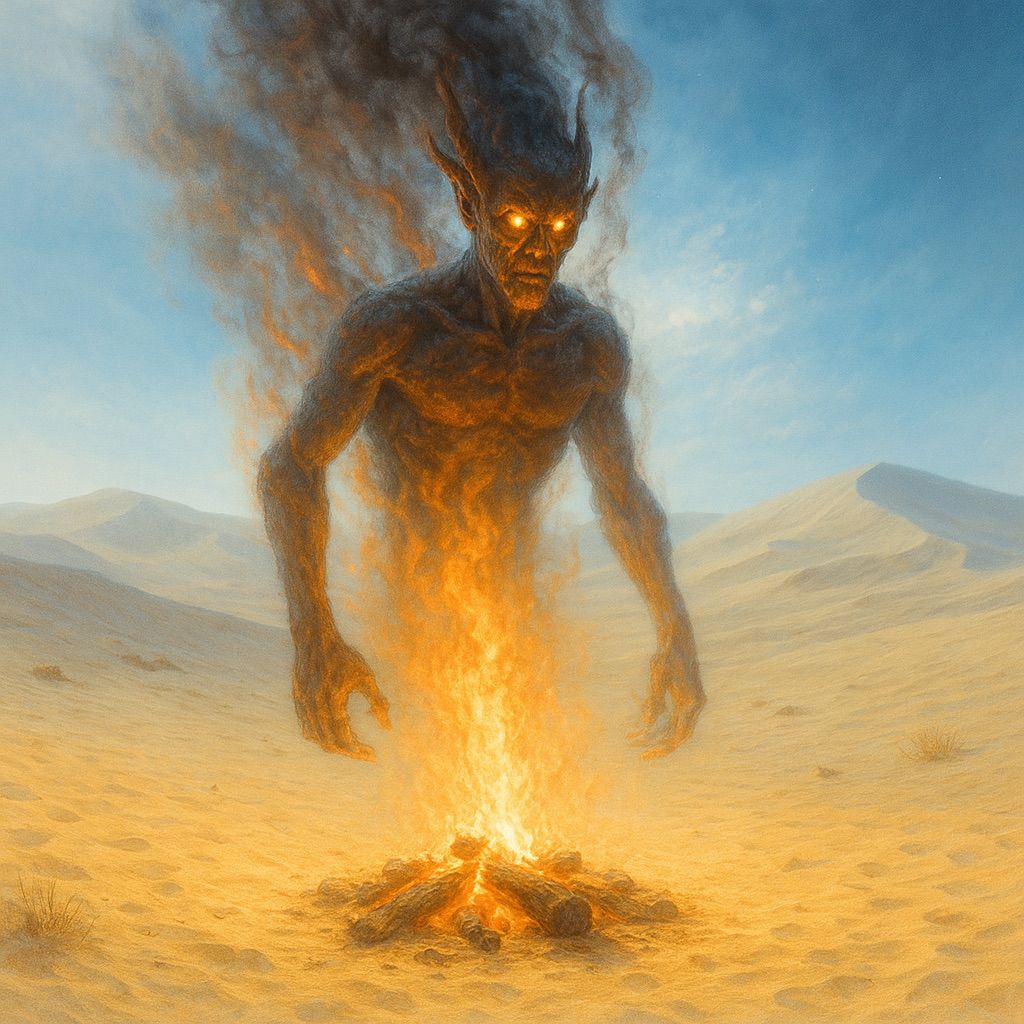
There are stories that flow like wind, unseen but powerful, brushing across generations and deserts, carrying with them the echoes of fire and fear. Among the most enduring and complex of these tales are those of the Jinn — supernatural beings born of smokeless fire, existing in a realm parallel to ours, feared, revered, and woven into the very cultural fabric of the Middle East. Unlike many creatures of myth that belong firmly to legend, the Jinn occupy an ambiguous space. For millions, they are not merely characters in folklore but realities, unseen presences that shape destiny, haunt lonely places, and sometimes share the world with humans in ways both miraculous and terrifying.
The Jinn’s origin story begins in the Qur’an, which describes them as created by Allah from smokeless fire, a substance unlike the clay of humans or the light of angels. This positioning sets them apart immediately: neither divine nor human, but something in between — free-willed, intelligent, and capable of both great good and unimaginable evil. They are said to live in their own societies, with families, communities, even faiths, some Muslim, some Christian, some pagan, mirroring the diversity of human belief. Yet what most fascinates is their liminality: they exist unseen, yet they are everywhere. They are whispered about in marketplaces, feared on desert roads, and invoked in prayers of protection.
To speak of Jinn is to speak of possibility — possibility that the world is not entirely ours, that our loneliness is not as complete as we think. It is also to speak of danger, for Jinn are not to be trifled with. They can possess, deceive, torment. They can inspire madness or grant hidden knowledge. They embody both wish and curse, miracle and menace.
The Jinn are not monsters in the Western sense; they are complex beings with emotions, desires, and flaws. Some are mischievous tricksters who lead travelers astray in the desert. Others are terrifying predators who feed on human fear. Still others are benevolent, protectors and guides who may reward respect with blessings. The richness of the lore comes from this variety. Unlike the singular vampire or werewolf, the Jinn are a spectrum, from demons to allies, from gods of old transformed into new stories to whispering companions that sit invisible beside us.
One of the most famous tales that captured the imagination of the world is found in One Thousand and One Nights, where Jinn appear as both helpers and villains, from the mighty Ifrit imprisoned in bottles to the trickster spirits who grant wishes but twist them to ruin. Western audiences embraced the image of the Jinn as “genie,” a being bound to lamps and obliged to serve. But this playful, wish-granting caricature is a shadow compared to the raw fear Jinn inspire in the Middle East. There, to even speak of them is risky. In some cultures, people avoid saying “Jinn” at all, preferring euphemisms like “those ones” or “the hidden ones,” lest the word itself draw their attention.
Deserts are the natural stage of the Jinn. In folklore, they dwell in desolate places: abandoned ruins, empty wells, crossroads where no birds sing. To travel at night through the sands is to risk brushing against their realm. Fires flicker in the distance where no people live; voices echo on the wind, calling travelers by name. Entire tribes told stories of people vanishing into the dunes, claimed by the Jinn. But they are not confined to deserts — in urban centers too, tales abound of possession, of voices heard in empty houses, of inexplicable illness attributed to Jinn interference. Their presence expands wherever human imagination fears the unknown.
Possession is among the most feared interactions with Jinn. When someone becomes afflicted, their body is said to host a spirit that manipulates thoughts, speech, and actions. Traditional healers — often reciters of Qur’anic verses — are called upon to exorcise the being, coaxing or commanding it to depart. These rituals are not just spiritual acts but cultural dramas, blending faith with folklore, psychology with performance. To this day, such practices persist, bridging ancient belief with modern anxiety.
Yet not all Jinn are antagonistic. Stories abound of humans who strike pacts with them, gaining knowledge or power in exchange for loyalty or ritual observance. Some artisans and poets even claimed inspiration flowed from Jinn muses, whispering words and songs into their ears. This duality — destructive and creative — makes Jinn a paradox that fascinates across centuries. They are feared, yes, but they are also revered, even respected as beings of immense capability who remind humans of the unseen mysteries of creation.
There is also a deeply human dimension to Jinn stories: they are reflections of our inner fears, desires, and temptations. In a time before psychology, possession explained madness. In a time before science, mysterious illness could be traced to Jinn influence. In a time when loneliness weighed heavy on desert travelers, voices in the wind were not imagination but company — eerie, dangerous company, but company nonetheless. Jinn stories helped communities understand the unexplainable, turning chaos into narrative, uncertainty into cultural structure.
Modernity has not banished them. Even today, Jinn loom large in Middle Eastern life. Families warn children not to wander near abandoned wells. Construction workers hesitate to build over ruins, lest they disturb ancient Jinn dwellings. Films and TV dramas explore Jinn possession with as much fervor as Western horror does with ghosts. The legend evolves, but it does not fade. In fact, in an age of globalization, Jinn have entered the global imagination, appearing in novels, movies, and online forums, their aura spreading far beyond their origin.
But perhaps the most haunting part of the Jinn story is how they embody freedom. Angels are bound to divine will, humans to mortality, but Jinn are unbound. They live long, invisible lives. They choose faith or rebellion. They can love, hate, create, or destroy. They are the mirror opposite of us — not flesh but fire, not seen but hidden, yet as flawed and varied as humanity itself. In this way, they are terrifying because they are so familiar. They are us, but freer, stronger, and untethered.
Picture this: a lone traveler crossing the sands at dusk, his camel plodding beneath the endless horizon. The air cools as night approaches. He sees a flicker of light ahead — a fire in the emptiness. Relieved, he approaches, hoping for company. But as he draws near, the fire vanishes. The silence deepens. Then, from the dunes, laughter — not human, not kind. His blood runs cold. He turns back, but the path is gone, the stars rearranged. He whispers a prayer, clutching a talisman of protection. He does not call them by name. He knows better.
This is the power of the Jinn: they live where imagination meets fear. They are the figures that step into silence, the presence we sense when alone, the shiver that comes not from cold but from awareness of being watched. They are supernatural, yes, but they are also profoundly psychological, living in the hidden corners of human thought.
So on October 9, when the Jinn’s legend is remembered, we are reminded that humanity’s greatest stories are not about creatures apart from us, but about beings that reflect our own struggles — with freedom, with temptation, with unseen forces that shape our lives. The Jinn endure because they are more than monsters. They are metaphors for everything we cannot control, everything we fear might whisper just out of sight, everything we suspect might be real after all.
And maybe, just maybe, when the wind blows tonight and a whisper seems to call your name, you’ll hesitate before answering. Because what if it isn’t the wind?