Zagan is not a demon of subtlety, and he is not a demon of comfort. Among the spirits of the Ars Goetia, he occupies a singular position as a King and President of Hell, a title that immediately suggests authority layered upon authority. Zagan does not operate from the margins. He rules from the center of transformation itself, where things cease to be what they were and become something else entirely. His power is not rooted in destruction for its own sake, but in transmutation—the ruthless reshaping of reality until it conforms to his will.
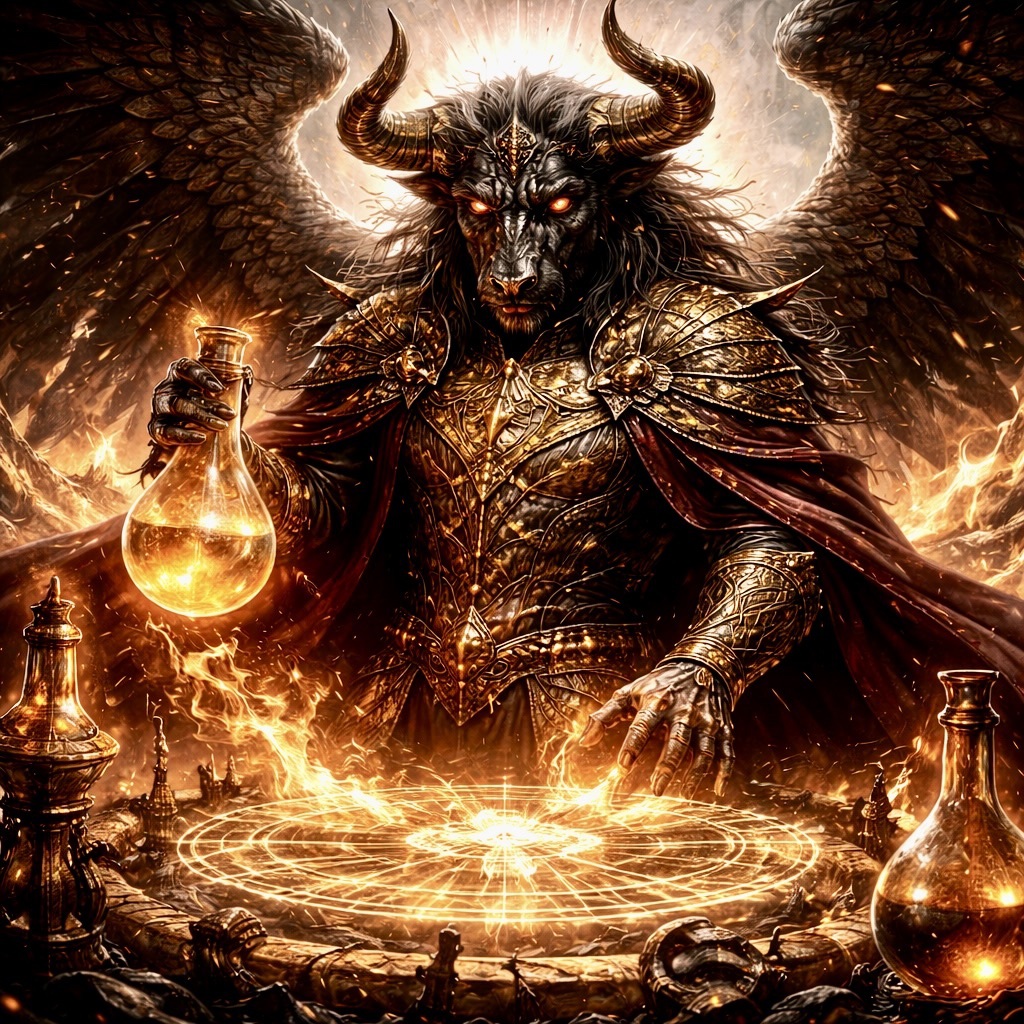
In the grimoires, Zagan is described as appearing first in the form of a bull with the wings of a griffin. This image is not accidental, nor is it merely monstrous decoration. The bull represents raw strength, stubborn force, and earthly power. The griffin, a hybrid of lion and eagle, represents dominion over both land and sky, strength fused with vigilance. Zagan’s form is a declaration: power alone is not enough. Power must be able to change shape, adapt, and dominate across domains.
Only after being compelled does Zagan take on a human form, and even then, the sense of controlled volatility never leaves him. He is a demon of contradiction made functional. He makes the foolish wise, turns wine into water and water into wine, and transforms metals and substances from one state to another. These are not parlor tricks. They are symbolic assertions that nothing is fixed, nothing is sacred, and nothing is immune to redefinition.
Zagan’s association with alchemy is central to his identity. Alchemy was never merely about turning lead into gold. It was about understanding the hidden processes that govern change: decay, refinement, dissolution, and rebirth. Zagan embodies the darker side of that tradition. He does not seek enlightenment. He seeks control over transformation itself. Under Zagan, change is not organic. It is enforced.
One of Zagan’s most unsettling attributes is his ability to make lies become truth and truth become lies. This does not mean simple deception. It means alteration of consensus. Zagan reshapes reality by reshaping what is accepted as real. In this way, he is far more dangerous than demons who merely deceive individuals. Zagan corrupts systems of meaning.
As a King, Zagan commands legions not through fear alone, but through results. He is said to be capable of making those who are foolish become wise, though this “wisdom” is often stripped of innocence or moral grounding. Zagan’s wisdom is pragmatic, sharp-edged, and unsentimental. He teaches how to survive transformation, not how to prevent it.
The bull-griffin form also reflects Zagan’s dual mastery of brute force and elevated command. He is equally capable of overwhelming resistance and outmaneuvering it. This combination places him among the most politically resonant demons in the Goetia. Zagan understands hierarchy, but he is not bound by it. He reshapes hierarchies when they no longer serve him.
Unlike demons who tempt through desire or fear, Zagan tempts through opportunity. He offers reinvention. To those dissatisfied with their position, their identity, or their limitations, Zagan whispers that nothing is permanent—not even truth. This is an intoxicating promise. It is also a deeply destabilizing one.
Zagan’s power over substances mirrors his power over people. Wine into water, water into wine—these reversals are about control over perception and value. What is considered precious can be made worthless. What is dismissed can be elevated. Zagan does not respect intrinsic value. He respects leverage.
In psychological terms, Zagan represents the part of the human psyche that adapts without remorse. The survival instinct that justifies change at any cost. The voice that says, “Become something else, or be destroyed.” Zagan does not ask whether the transformation is ethical. He asks whether it works.
This makes him deeply relevant in the modern world. Institutions, identities, and truths are constantly being redefined. Narratives shift. Values invert. What was once unthinkable becomes normalized. Zagan is the demon of that process when it is driven by power rather than necessity.
Zagan’s kingship is important here. He is not a chaotic force. He governs transformation. He decides which changes persist and which collapse. This makes him more dangerous than demons of pure destruction. Destruction leaves ruins. Zagan leaves functioning systems that no longer resemble what came before.
In occult tradition, Zagan is not recommended for those seeking stability or clarity. He is sought by those who want to overturn conditions entirely. To call Zagan is to accept that the outcome will not resemble the starting point. There is no restoration under Zagan, only replacement.
His ability to make people witty and sharp also carries a cost. Wit under Zagan is not joy or humor. It is weaponized intelligence. Insight sharpened into a blade. Those transformed by Zagan often lose patience for weakness, nuance, or compassion. Efficiency replaces empathy.
Zagan’s association with alchemical change also ties him to time. Alchemy is slow, deliberate, and irreversible. Once a substance has been transformed, it cannot simply be turned back without consequence. Zagan enforces this rule. His changes are not temporary illusions. They persist.
In mythology, kings are often symbols of order. Zagan subverts this by ruling over instability itself. His kingdom is one where permanence is the illusion. Only power endures, and power belongs to those who can adapt faster than everyone else.
What makes Zagan especially unsettling is that he does not appear malicious by nature. He appears practical. He does not destroy out of hatred. He transforms out of efficiency. This makes him feel less like a demon and more like a force embedded in reality itself.
Zagan endures in demonology because transformation is unavoidable. Civilizations rise and fall. Truths are revised. Values are overturned. Someone always benefits from these shifts. Zagan gives that beneficiary a name.
To engage with Zagan, even symbolically, is to abandon the comfort of fixed meaning. He does not care what you were. He cares what you can become—and whether that form is useful.
Zagan is the demon of irreversible change, of power that rewrites the rules instead of breaking them. He does not knock down the structure. He remodels it while people are still inside.
And once the transformation is complete, there is no appeal. There is only adaptation, or extinction.