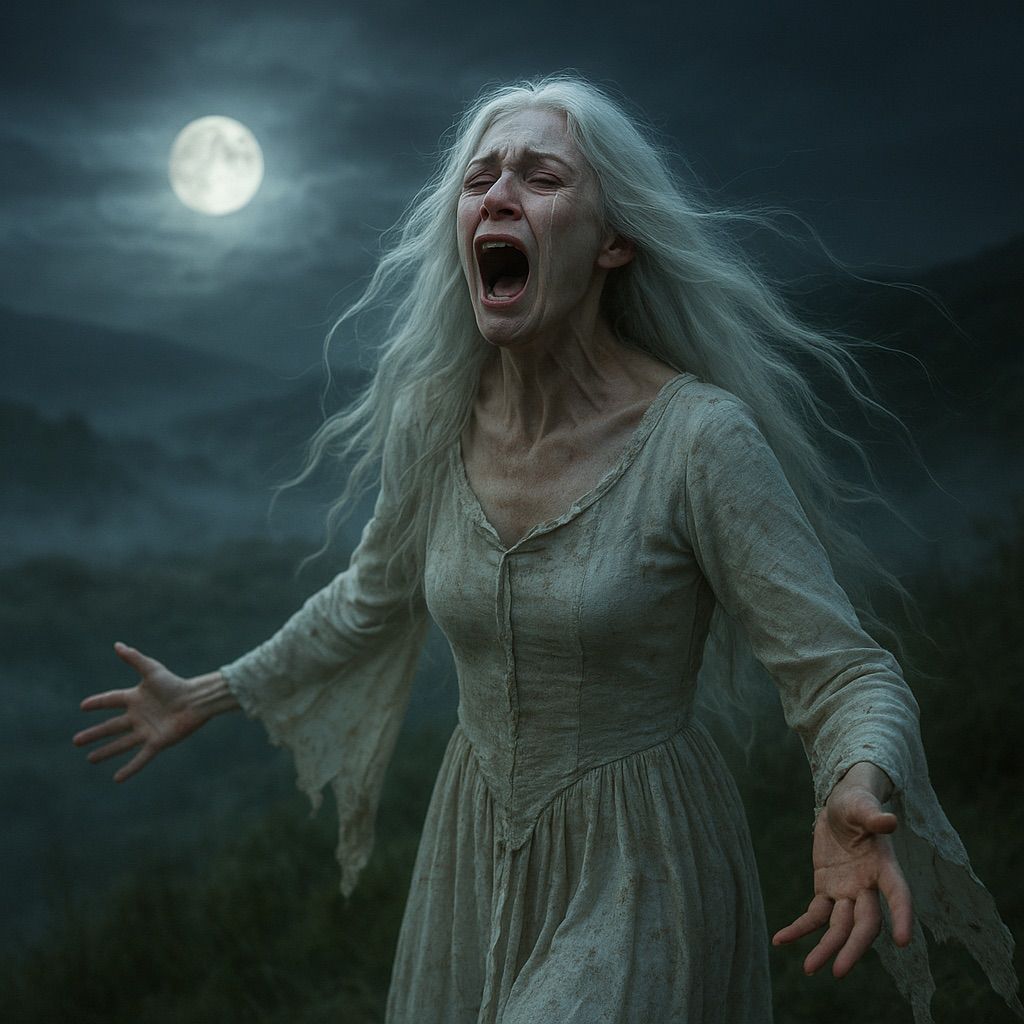
There are few sounds in the world more unsettling than a scream that does not belong to the living. A scream that is not rage, not fear, but pure lament—a cry from somewhere beyond the veil, raw and chilling enough to freeze the marrow of your bones. In Ireland, that sound has a name, and for centuries it has been the herald of death. The banshee, the wailing woman of Irish folklore, is one of the most enduring figures in Celtic mythology, a spirit whose keening shriek is said to foretell the passing of a family member. She is not a monster in the way vampires or werewolves are; she does not attack, she does not kill. She simply mourns. But in that act of mourning, she becomes terrifying, because she reminds us of what is unavoidable. She is not the bringer of death, but its messenger, and sometimes that is more frightening than death itself.
The origins of the banshee lie deep in Ireland’s past, rooted in ancient mourning traditions. In old Gaelic culture, professional women mourners called keeners would attend funerals, wailing and singing dirges to honor the dead. Their voices, powerful and unrestrained, carried grief in a way that words could not. Over time, the role of these keeners merged with myth, becoming otherworldly. The banshee was imagined as a spectral keener who appeared not at funerals, but before them, lamenting for those about to die. This evolution of folklore shows how culture and imagination intertwine—what was once a human custom transformed into a supernatural omen, one that has haunted Irish imagination for generations.
Descriptions of the banshee vary wildly. Some say she appears as a pale, red-haired woman with flowing white or green robes, her eyes red from endless weeping. Others describe her as a withered hag cloaked in black, her face hidden by a veil. Still others claim she is not one woman at all, but a host of spirits, each tied to certain Irish families, wailing for their kin across generations. In some tales, she combs her long silver hair with a ghostly comb—a detail that became so ingrained in superstition that to find a comb on the ground in Ireland was once considered a dangerous omen, a lure from the banshee herself.
What remains constant across the stories, however, is the sound. The banshee’s cry is not simply a scream; it is described as a keening, an eerie, mournful wail that pierces the night and unsettles the soul. It is a sound that cannot be mistaken for wind, for animals, or for human grief. It is something otherworldly, something that belongs to the thin space between life and death. To hear it is to know that death is near, and that knowledge is its own form of horror. People may not have feared the banshee as a predator, but they feared her all the same, because her presence meant loss, and loss is the deepest fear of all.
Unlike many other supernatural beings, the banshee is not tied to violence or malice. She is not a demon, nor does she harm those who see her. In many ways, she is a tragic figure, trapped in eternal mourning. Some legends even suggest she is the ghost of a woman who died in childbirth, cursed to wander and wail for eternity. Others say she is a fairy woman, bound to the mortal families she serves. This ambiguity gives her a haunting complexity. Is she evil? Is she a guardian? Or is she simply a force of nature, like a storm or a plague, existing outside human notions of morality? The banshee occupies this liminal space, neither friend nor foe, but forever entwined with our most intimate fear—the loss of those we love.
Stories of banshee encounters are numerous, passed down through families in Ireland and across the Irish diaspora. A farmer hearing a piercing cry in the distance, only to learn the next morning that his neighbor had died. A family kept awake by a wailing outside their window, discovering by dawn that a beloved elder had passed away. These stories are often told not as myths, but as lived experiences, recounted with the gravity of truth. The banshee’s cry, whether imagined, dreamt, or truly heard, has shaped the way many Irish people interpret death—not as an abrupt shock, but as something whispered by the wind, foreshadowed by a voice older than time.
The banshee also serves as a cultural symbol of grief itself. Ireland has a long and complicated relationship with mourning, marked by centuries of famine, emigration, and loss. The Great Famine of the 19th century saw entire villages decimated, families torn apart, and death becoming a daily reality. In such a landscape, the figure of the banshee made sense. She gave voice to the nation’s sorrow, embodying the collective grief of a people who knew too well the sting of death. Her wail was not only an omen—it was a reflection of lived experience, a supernatural echo of the cries that already haunted Irish air.
In literature and popular culture, the banshee has continued to evolve. Writers from W.B. Yeats to modern horror novelists have drawn on her legend, each shaping her into different forms—sometimes ghostly, sometimes fairy, sometimes demon. In film and television, she appears in horror anthologies and fantasy epics, often depicted as a terrifying harbinger with a scream that shatters glass. Yet even in these dramatized forms, her essence remains intact: the sound, the warning, the inevitability. Unlike many mythological creatures that lose their edge when translated into fiction, the banshee retains her core power because her story taps into something primal. Every one of us, across every culture, has feared the moment when death comes close. The banshee is simply that fear, given a face and a voice.
But perhaps the most haunting aspect of the banshee is not her connection to death, but her humanity. Unlike ghouls, zombies, or demons, she mourns. She feels. Her cry is not laughter or mockery, but lament. That human element blurs the line between monster and mourner, making her all the more unsettling. We fear her not just because she announces death, but because she feels it with us, amplifying grief with her eternal voice. There is something unbearable in the thought that the universe itself keens when someone dies, that existence is not indifferent but mourns alongside us in a voice we cannot silence.
Humanizing the banshee means seeing her not as a figure of cruelty, but as a symbol of empathy woven into horror. In her cry, we hear the echoes of mothers, wives, and daughters who have mourned for centuries. We hear the raw, universal sound of love colliding with loss. And though we fear her, perhaps we also need her. She reminds us that grief is not weakness, that mourning is as much a part of life as laughter. She is not just a herald of death, but a guardian of memory, ensuring that no passing goes unacknowledged.
The banshee’s endurance as a legend proves her resonance. Today, people may not truly believe a spirit wails outside their windows, but the metaphor lives on. Any sound that pierces the night, any dream of a voice that feels too real, any sudden chill in the air—these are moments where the banshee still lingers in imagination. She survives not because we fear her literally, but because we recognize her symbolically. Death will always come, and grief will always follow, and in that certainty, the banshee will always have a place.
So, if you ever find yourself in Ireland on a foggy night, walking along a lonely road where the mist clings to the fields and the silence feels heavy, listen carefully. If you hear a sound rising above the quiet—a cry, mournful and strange, too sharp to be the wind—you might just be hearing the echo of a legend that has outlasted centuries. The banshee will not harm you. But she may remind you of mortality in a way no words can. And in her wail, you might hear not only fear, but the echo of every loss humanity has ever known.