There are monsters that lurk in the forests, waiting in silence, and then there are monsters that lurk within us, whispering in our veins, gnawing at the edges of our souls. The Wendigo, that infamous cannibalistic spirit of Algonquian lore, is both. It is a creature made of frost and famine, but also of greed and insatiable desire. To speak of the Wendigo is to speak not just of a beast in the woods, but of the human capacity for hunger without end — the hunger that devours everything and leaves nothing behind. On October 7, when whispers of this chilling legend rise, we find ourselves staring at more than just a myth; we are staring at the shadow in the mirror.
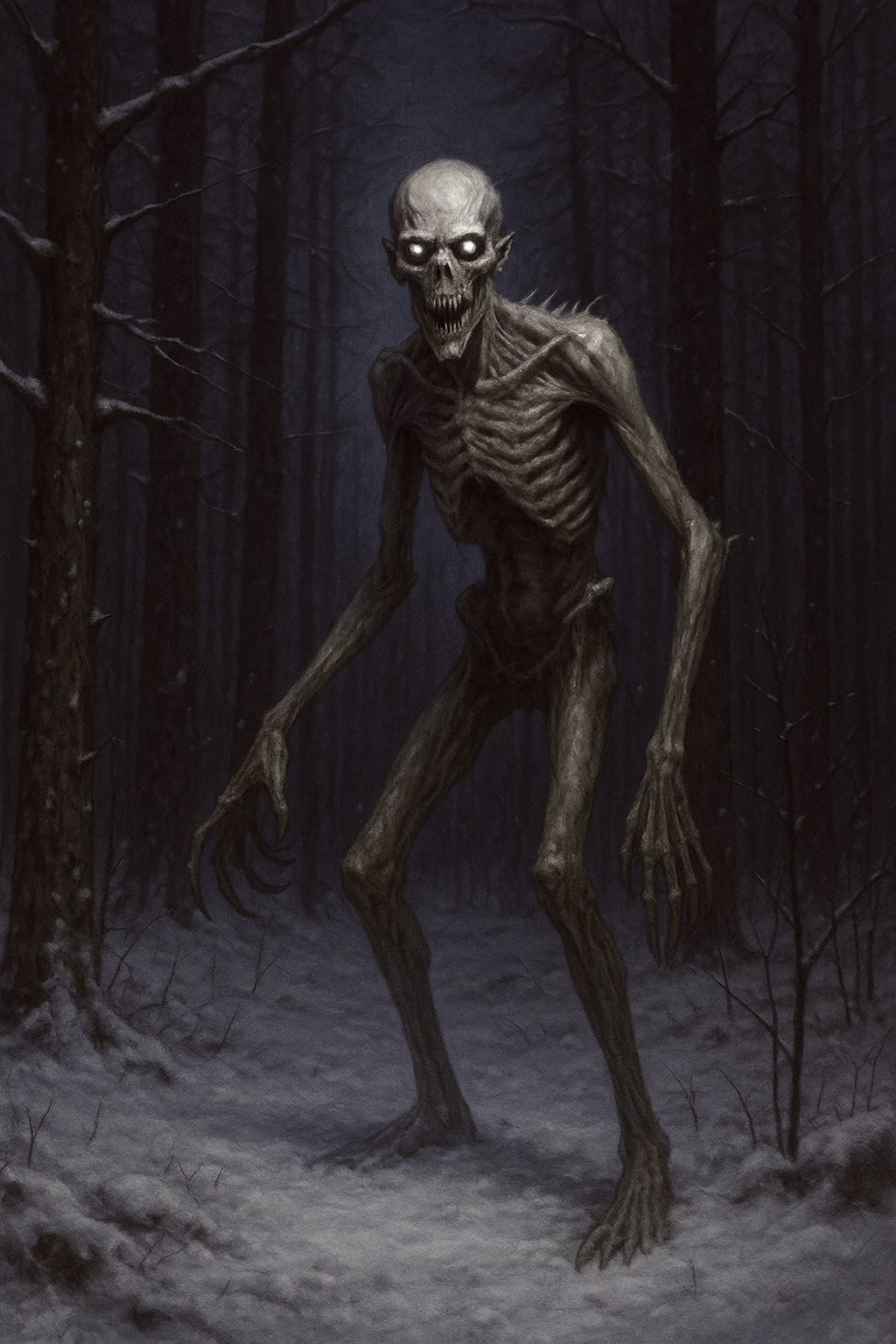
The story begins in the snowy landscapes of North America, where winters were not merely inconvenient but life-threatening. To the Algonquian-speaking peoples of the Great Lakes and boreal forests, survival hinged on community, balance, and respect for the land. Yet when food grew scarce and the cold became merciless, desperate choices haunted human hearts. Out of this crucible of survival and moral boundaries emerged the Wendigo: a skeletal, emaciated figure with skin stretched tight over bones, lips chewed away, eyes sunken but burning with an icy fire. It was said to be taller than the tallest pine, gaunt as death itself, yet impossibly strong, a being forged of starvation and sin. It craved flesh, but more than that — it craved endlessly, forever hollow.
The Wendigo legend carried with it a moral gravity. It wasn’t just a campfire story told to frighten children. It was a warning, a cultural safeguard. In times of hunger, when snow buried the land and the deer had vanished, people were tempted by the unthinkable: cannibalism. The Wendigo myth served as a shield against such impulses. To eat human flesh was not simply taboo; it was to invite possession by the Wendigo spirit, to transform into a ravenous beast doomed to wander the wilderness in eternal hunger. It was a way of saying: “Even when the world grows cruel, there are lines we do not cross.” The myth turned survival into a moral battleground, one where the human soul was at stake.
But the Wendigo is more than folklore; it is a mirror held up to human greed. Stories tell us that even those who already had enough could fall prey to its curse. A hunter who hoarded food while others starved might attract its shadow. A leader who demanded more than his share could become Wendigo. Thus, the legend expanded beyond hunger into a commentary on greed itself — greed that consumes community, greed that turns abundance into famine. The Wendigo was not just about eating flesh; it was about the insatiable appetite for more, no matter the cost. In this way, it remains a legend frighteningly relevant to the modern world.
Imagine the scene: a small Algonquian village buried beneath drifts of snow, families huddled in bark-covered lodges, fires sputtering against the biting cold. Outside, the trees groan with frost, and the night air carries a silence so profound it presses against your chest. Then, far off, a scream — not animal, not human, but something stretched thin between the two. Elders whisper the word no one wants to hear: Wendigo. The children draw closer to their mothers. Hunters clutch their spears. Somewhere in the darkness, something impossibly tall shifts between the pines. Its hunger is a palpable force, a storm rolling in. That imagery alone explains why the Wendigo survives as one of the most terrifying figures in North American folklore.
European colonists who heard the stories were quick to fold the Wendigo into their own catalog of demons and devils, but to the indigenous peoples, it was never so simple. This was not just a monster of the forest — it was a spiritual condition, a sickness of imbalance. Anthropologists later coined the term “Wendigo psychosis” to describe cases in which individuals, often during periods of famine, became obsessed with cannibalistic thoughts or claimed to be transforming into Wendigos. While the diagnosis itself is controversial and largely dismissed today, the fact remains that the legend had power not only as metaphor but as lived psychological reality. People truly believed in its ability to possess. Fear itself became flesh.
The Wendigo’s physical description varies, yet the essence is constant: hunger incarnate. Some tales paint it as a giant towering over trees, with heart made of ice, lips frozen to its teeth, breath steaming with death. Others envision it gaunt, corpse-like, its bones pressing through skin, its joints twisted by starvation. Always, it is hollow, a walking famine. Its voice is said to echo with the howling wind, its step cracking ice with every stride. And worst of all: when it eats, it never grows full. Its belly stretches, but its hunger grows deeper. The Wendigo is a paradox of endless consumption. It is capitalism before capitalism, addiction before drugs, a timeless allegory for the dangers of wanting more than enough.
Consider the modern parallels. Our world today is overflowing with abundance, yet starvation and greed walk side by side. We consume oceans of resources, forests, oil, animals, and each other’s time, all while the hunger for more never ceases. If the Wendigo was once a spirit warning against cannibalism during famine, it now feels like a metaphor warning against our collective consumption. We devour, and devour, and devour, yet satisfaction never comes. In this light, the Wendigo is not just a North American monster. It is a global truth.
But let us return to the woods, because folklore thrives not in abstraction but in story. In one tale, a hunter returns to his village after weeks in the snow. He is gaunt, but his eyes are bright, too bright. He carries meat, plenty of it, yet he does not say from where it came. Soon, the people notice his lips are torn, as though chewed. They hear him whisper at night of voices in the wind. And when children disappear, there is no doubt. He has become Wendigo. The villagers burn him, but even as the flames consume his flesh, a shriek escapes, rising into the storm, carrying the hunger forward. In another story, travelers lost in a blizzard hear footsteps behind them. They look back and see nothing but whiteness. Yet the snow is stamped with massive prints, each step twice the size of a man’s. By morning, one of their party is gone, taken silently in the night. These stories endure because they capture primal fear: the fear of cold, hunger, and betrayal from within.
The Wendigo also embodies transformation, a theme deeply resonant in human myth. To become Wendigo is to cross the threshold between human and monster, to let hunger erase humanity. This is not unlike werewolf tales in Europe or vampire legends elsewhere, but the Wendigo’s transformation is more brutal. It is not a curse delivered by bite or magic. It is born of choice — the choice to consume flesh, to surrender to greed. That makes it terrifyingly intimate. Any person, given the wrong conditions, could fall.
In contemporary culture, the Wendigo has leapt from oral tradition into film, literature, and video games. It appears in horror movies, from low-budget Canadian slashers to Hollywood thrillers. It haunts episodes of shows like Supernatural and Hannibal, and it lurks in games like Until Dawn. Yet something curious happens in these retellings: the Wendigo often becomes just another monster, stripped of its moral depth. Its connection to greed, to famine, to cultural survival is reduced to jump scares. This dilution risks robbing the legend of its richness. But for those willing to dig deeper, the Wendigo remains as meaningful as ever — a reminder that horror is never just about fear, but about what we fear in ourselves.
Perhaps that is why the Wendigo endures. Because it speaks to the dark corners of our own appetites. It is easy to laugh at tales of giants with icy hearts, but harder to deny the metaphor. Who among us has not wanted more than we need? Who has not felt hunger — for food, for wealth, for recognition — that gnawed even when satisfied? The Wendigo lives in that gnawing. It is the whisper that nothing is ever enough.
So on October 7, when its legend is remembered, let us pause. Let us see the Wendigo not just as a monster in the woods, but as a cautionary tale that belongs to us all. It is the voice that warns against devouring one another, against letting greed hollow us out until we are but skin stretched over bone, wandering through life without end or purpose. The Wendigo is the frozen shadow at the edge of campfire light, the hunger that will not be fed. And maybe — just maybe — it is waiting for us to finally listen.
Because the Wendigo is not just a creature of Algonquian lore. It is a reflection of humanity’s deepest fear: that we will consume ourselves into extinction, and that our hunger will follow us, eternal and unsatisfied, into the cold.