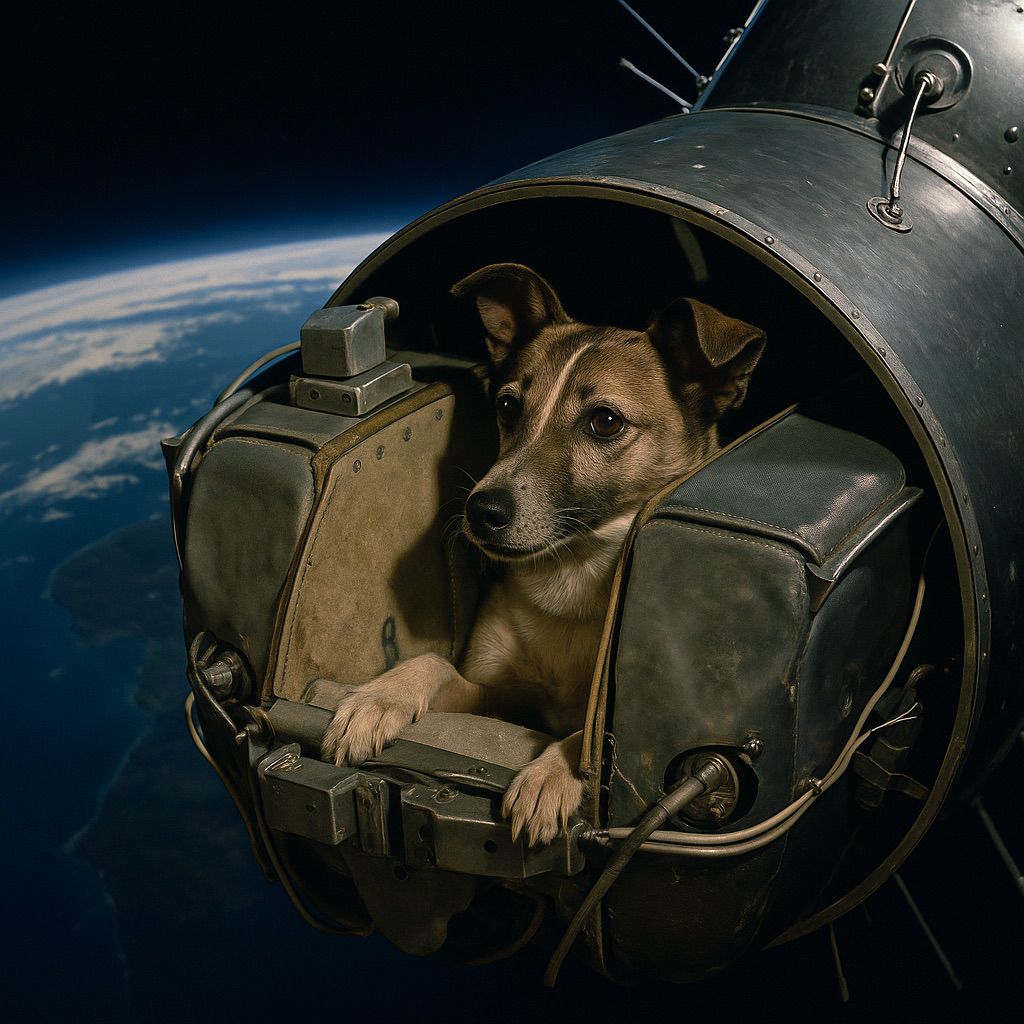
On November 3, 1957, the world looked up and gasped as a tiny speck of light passed silently across the night sky. That speck was Sputnik II, a metal capsule launched by the Soviet Union, carrying not only instruments and technology but a small, trembling life: Laika, a stray dog from the streets of Moscow who became the first living creature to orbit Earth. Her journey was not just about science or politics. It was about humanity’s hunger for the stars, our ability to dream beyond the possible, and our willingness—sometimes cruelly—to sacrifice the innocent in pursuit of progress. Laika’s story, at once inspiring and heartbreaking, lives on as a reminder that the Space Race was not merely a clash of nations but a deeply human tale of ambition, courage, and loss.
The launch of Sputnik II came only a month after Sputnik I shocked the world as the first artificial satellite. The Cold War had transformed space into a battlefield of prestige. The United States and the Soviet Union, locked in ideological rivalry, sought to outdo each other not only in weaponry but in the heavens. Sputnik I had been a triumph, but Soviet leaders wanted something even more spectacular to celebrate the 40th anniversary of the Bolshevik Revolution. They demanded another launch—this time with a living passenger, to prove that space travel was not only possible for machines but for organisms. Scientists had mere weeks to design and build a spacecraft capable of supporting life. Into this frantic rush stepped Laika, a small, mixed-breed dog with a calm temperament and no idea she was about to become immortal.
Laika was plucked from the streets of Moscow, a stray chosen precisely because she had survived the hardships of hunger and cold. The scientists believed such resilience would make her better suited for the harsh conditions of space. Gentle and obedient, she quickly won the affection of the technicians who trained her. They fed her, comforted her, and even grew attached, despite knowing the grim truth: there was no plan for her return. Sputnik II had no re-entry technology. Laika was a pioneer destined never to come home. Many of the scientists later admitted the weight of this knowledge haunted them. They cared for her, but they also betrayed her, sending her to a fate sealed by politics and urgency.
The training was grueling. Laika was confined to increasingly small spaces to simulate the cramped capsule. She was subjected to the roar of rocket engines and the shaking of simulated launches. Electrodes were attached to her body to monitor vital signs. Yet, through it all, she endured with the quiet patience of a creature who trusted the humans around her. One technician recalled crying as he placed her in the capsule, whispering apologies she could never understand. Laika wagged her tail, unaware she was stepping into history.
When the rocket thundered to life on November 3, the world below watched with awe. Sputnik II soared into orbit, carrying not only Laika but humanity’s first attempt to send life beyond Earth’s grasp. Radios and newspapers buzzed with the news. The Soviet Union trumpeted its triumph: a dog in space, circling the globe, proof of Soviet supremacy in the race for the cosmos. In the United States, the launch deepened anxiety and galvanized efforts to catch up, planting seeds for NASA and the Apollo missions. Laika had become more than a dog. She was a symbol, a living ambassador of human ambition.
Inside the capsule, Laika’s reality was far from glorious. Sensors recorded her heartbeat tripling during launch, her body trembling with fear. The cramped metal box allowed no freedom, no relief. She was alone, with only the hum of machinery and the pull of weightlessness. For years, the Soviet Union claimed she survived for several days before dying painlessly. Decades later, it was revealed the truth was harsher: Laika died within hours, likely from overheating and stress. She never saw the Earth turn blue and green below her. She never lived to complete the mission she had unwillingly accepted.
Yet Laika’s sacrifice was not in vain. Data from Sputnik II helped scientists understand how living organisms responded to spaceflight, paving the way for future human missions. Yuri Gagarin, the first man in space in 1961, followed the path Laika had charted. Every astronaut, cosmonaut, and space traveler who has since ventured beyond Earth owes something to that little dog who gave her life. Laika’s story became part of the mythology of the Space Race, a tale told in classrooms, museums, and memorials. Statues of her stand in Russia today, honoring her as a hero.
But Laika’s story also forces us to ask uncomfortable questions. Was it right to sacrifice her? Was progress worth the life of a trusting dog who had no say in her fate? Some argue that great leaps often demand sacrifice. Others insist that Laika’s journey was unnecessary cruelty, a political stunt rushed to score points in a Cold War competition. What cannot be denied is that Laika’s story humanizes the otherwise cold language of rockets and satellites. She reminds us that behind every breakthrough lies flesh and blood, joy and pain, trust and betrayal.
To humanize Laika’s journey is to picture her as more than a data point. Picture the little dog curled in her capsule, her ears twitching at the strange hum of machinery. Picture the scientists stroking her fur one last time, torn between pride and sorrow. Picture children across the world gazing at the night sky, imagining a dog riding among the stars, their hearts filled with wonder. Laika became a bridge between worlds: the animal and the cosmic, the innocent and the ambitious, the personal and the political.
Her story continues to resonate because it is timeless. Even now, as we dream of colonizing Mars or exploring distant galaxies, we confront the same questions Laika raised in 1957: how much are we willing to sacrifice for progress? How do we balance ambition with compassion? What does it mean to be human in a universe where our reach exceeds our wisdom? Laika’s lonely voyage was both triumph and tragedy, and in its paradox lies its enduring power.
When we look up at the night sky today, dotted with satellites and stations, we might think of Laika. Not as a symbol of propaganda or a footnote in science, but as a living creature who trusted us and paid the ultimate price. Her legacy is not only in the data she provided but in the empathy she inspires. She teaches us that exploration is not only about technology but about values, about remembering that progress without humanity is hollow.
On November 3, 1957, Laika was launched into space and into legend. She did not return, but in a way, she never left us. Her spirit orbits still, not in a metal capsule but in the hearts of those who remember her, who see in her story both the brilliance and the folly of human ambition. She was a stray who became a pioneer, a dog who became a star.