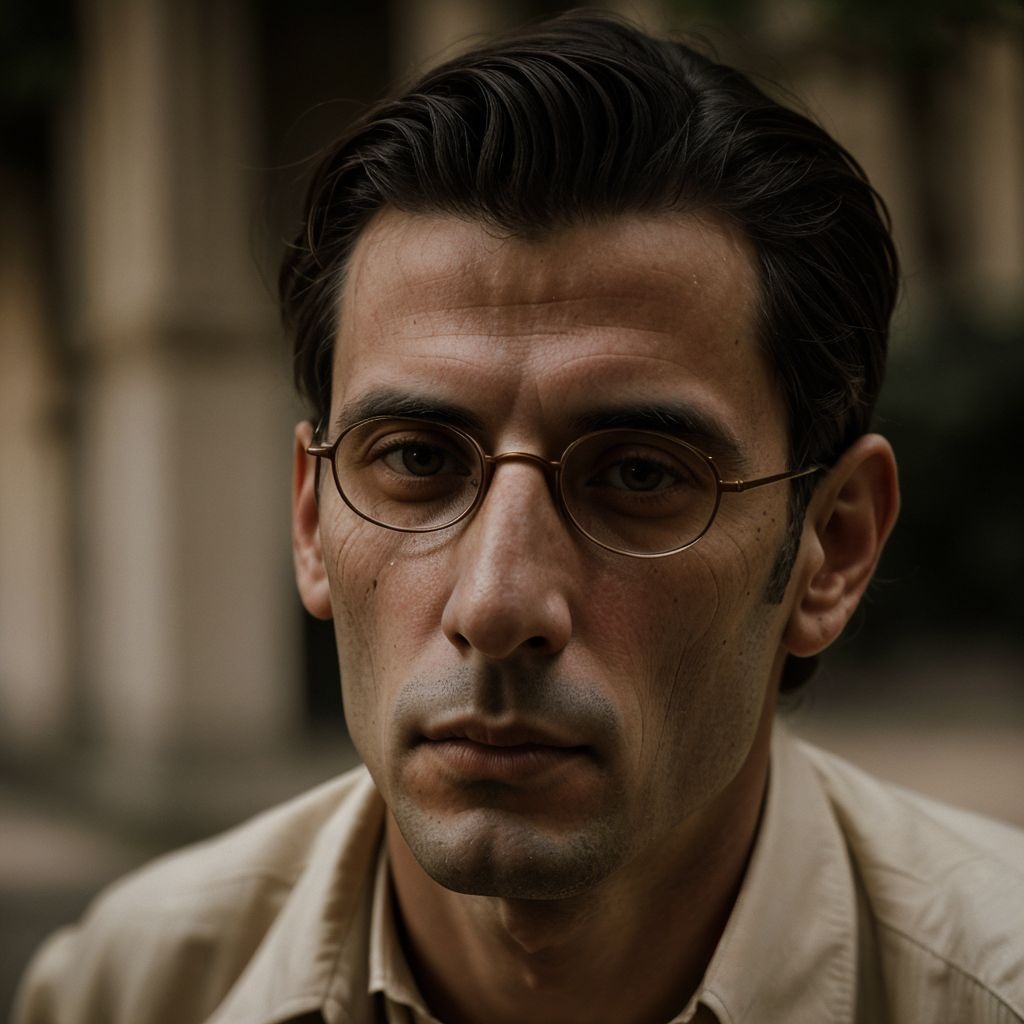
Cesare Pavese’s words have a way of getting under my skin. I’ve spent countless hours poring over his essays, translations, and poetry, and yet, every time I revisit them, I feel like I’m uncovering something new – or rather, something old that I never noticed before. It’s as if his writing is like a puzzle, with pieces that keep shifting and reassembling in my mind.
I think part of the reason Pavese holds such a strong grip on me is because of his intense scrutiny of himself. He writes about his own emotions, desires, and doubts with an unflinching honesty that I find both captivating and disquieting. His journals, in particular, read like a stream-of-consciousness exploration of his inner world – a world marked by anxiety, self-doubt, and a deep-seated fear of being trapped in the conventional expectations of society.
I identify with Pavese’s sense of restlessness, his feeling that he’s constantly on the outside looking in. As someone who’s just left college and is trying to figure out her own path in life, I find it eerie how easily I can relate to his struggles. He writes about being torn between the desire for stability and security – represented by marriage, a steady job, and a suburban lifestyle – and the need for artistic expression and intellectual freedom.
For Pavese, this conflict ultimately leads him down a path of radical simplicity. He rejects the material comforts and social norms that he sees as suffocating, opting instead for a life of solitude and self-sufficiency in the Italian countryside. It’s a choice that I both admire and find deeply unsettling – partly because it seems so at odds with my own desire to be connected, to belong.
And yet, every time I read Pavese’s words, I’m struck by their quiet intimacy. He writes about the smallest moments – a sunrise over the hills, the taste of a particular wine, or the sound of rain on his roof – as if they hold some profound secret that only he can see. It’s as if he’s constantly tuning into a frequency that’s just out of reach for everyone else.
I often find myself wondering what Pavese would make of our world today. Would he still be writing about the tensions between art and commerce, individuality and conformity? Or would his concerns have shifted to more pressing issues – climate change, social media, or the erosion of public spaces?
As I ponder these questions, I’m struck by how little we know about Pavese’s inner life beyond what he chose to write down. Were there moments when he felt despairing, or isolated, or completely disconnected from the world around him? We can only guess – and yet, even those silences seem to contain a kind of meaning that rewards close attention.
I think this is part of why Pavese’s writing continues to captivate me: it’s not just about his ideas or experiences, but also about the spaces between them. Those moments when words fail, or language feels insufficient, or reality seems to bend and warp in unpredictable ways – those are the places where I feel most drawn into his world.
In many ways, reading Pavese is like trying to solve a riddle that’s been left half-unsolved by its author. His writing is both a map of his own inner terrain and an invitation to explore the unmapped regions of my own psyche. It’s a strange kind of alchemy – one that transforms my confusion into insight, and my doubts into questions I can live with.
As I finish writing this essay, I’m left wondering what Pavese would say about me – about my own restlessness, my struggles to find meaning in the world around me. Would he see something of himself in my words, or would our concerns remain fundamentally at odds? Whatever the answer might be, I know that his writing will continue to haunt me, to prompt me to look inward and outward with fresh eyes – and to keep searching for those hidden frequencies that only the most attentive readers can hear.
As I close my laptop and step away from Pavese’s words, I’m struck by the realization that his writing has become a kind of mirror for me. It reflects back all the doubts and fears that I’ve been trying to keep hidden – the fear of being stuck in a life that isn’t mine, the anxiety of not knowing what comes next, and the crushing weight of expectation from others. But it also shows me glimpses of myself as I am, with all my contradictions and uncertainties.
I think about how Pavese’s writing is both a reflection of his own experiences and a map for navigating the complexities of human existence. His words are like a compass that helps me orient myself within the chaos of life – reminding me to pay attention to the smallest details, to trust my instincts, and to listen to the whispers of my own heart.
But what if I’m not being honest with myself? What if Pavese’s writing is just a reflection of his own unique struggles and experiences, and not necessarily relevant to mine? Would he still see value in my restlessness, or would it seem like just another case of youthful angst?
I wonder if Pavese ever felt like he was faking it – pretending to be something he wasn’t, or hiding behind a mask of confidence. Did he ever feel like he was just going through the motions, waiting for some kind of epiphany that never came? Or did his writing serve as a way to confront those doubts and fears head-on?
These questions swirl around in my mind as I try to make sense of Pavese’s words. It’s as if I’m standing at the edge of a forest, looking out at the trees and trying to find a path that will lead me deeper into his world – but also into my own.
As I stand there, uncertain and searching, I realize that Pavese’s writing has given me permission to be unsure. It reminds me that uncertainty is not something to be feared or avoided, but rather something to be explored and understood. And it encourages me to keep asking questions, even when the answers seem elusive – because it’s in those moments of questioning that we discover new truths about ourselves and the world around us.
I take a deep breath and step forward, into the unknown. The trees loom above me, their branches swaying gently in the breeze. I have no idea what lies ahead, but I know that Pavese’s words will be there to guide me – as a reminder to stay curious, to trust my instincts, and to listen to the whispers of my own heart.
As I continue down this winding path, I find myself drawn to Pavese’s concept of “disimpegno” – his idea that one must disengage from the world in order to truly engage with it. For him, this meant rejecting the trappings of modern society and embracing a simpler, more authentic way of living.
I’m struck by how closely this resonates with my own desires for simplicity and authenticity. As someone who’s spent years trying to fit into the mold of what others expect of me – the successful college graduate, the ambitious young professional – I often feel like I’m living a life that isn’t truly mine.
Pavese’s rejection of material comfort and social expectation is both inspiring and terrifying to me. On one hand, it’s exhilarating to imagine leaving behind the constraints of societal pressure and forging my own path. But on the other hand, it’s daunting to think about giving up the security and stability that comes with playing by the rules.
As I ponder Pavese’s idea of disimpegno, I’m reminded of a conversation I had with a friend recently. She was talking about how she’d been feeling suffocated by her corporate job – the long hours, the constant pressure to perform, the sense of detachment from meaningful work. And yet, when I suggested that she might consider leaving it all behind and pursuing something more authentic, she hesitated.
“Why do you think people settle for a life they don’t want?” she asked me.
I shrugged. “Maybe it’s because we’re afraid to take the risk? Afraid of failure, or uncertainty, or not knowing what comes next?”
My friend nodded thoughtfully. “Yeah, that makes sense. But I think there’s something else at play too – a fear of being truly alone.”
That phrase stuck with me long after our conversation ended. A fear of being truly alone – it’s something that Pavese writes about frequently in his work, and it’s something that I’m starting to realize is a deep-seated fear within myself as well.
As someone who’s always sought connection and community, the idea of embracing solitude feels both liberating and terrifying. What if, by disengaging from the world, I’m also disengaging from my own sense of purpose? What if, in trying to find myself, I lose touch with everyone else?
These questions swirl around in my mind as I continue to explore Pavese’s ideas. It’s like I’m standing at a crossroads, unsure which path to take – the one that leads towards greater connection and community, or the one that calls me towards solitude and self-discovery.
For now, I’ll keep walking, keeping my eyes fixed on the horizon as I try to make sense of this complex, messy world. And maybe, just maybe, Pavese’s words will guide me along the way – reminding me to trust myself, to listen to my own heart, and to find beauty in the spaces between.
As I continue down this winding path, I start to notice the ways in which Pavese’s ideas are intersecting with my own experiences. His concept of disimpegno is making me question everything from my relationships to my career choices. Am I truly living a life that aligns with my values and desires? Or am I just going through the motions, waiting for something better to come along?
I think about all the times I’ve stayed in situations because they seemed “safe” or “stable,” even when deep down I knew they weren’t right for me. I remember the countless conversations I had with friends and family members, trying to justify my decisions or make excuses for why I wasn’t taking risks. And yet, every time I look back on those moments, I’m struck by how little I was living in accordance with my own truth.
Pavese’s rejection of material comfort and social expectation is not just about simplicity; it’s also about authenticity. He’s saying that true freedom comes from embracing our unique circumstances and following our own path, rather than trying to fit into someone else’s mold.
As I walk through the forest, I start to see the trees in a new light. They’re no longer just static objects; they’re dynamic, evolving beings that have adapted to their environment in order to thrive. And it hits me – Pavese’s writing is like those trees. It’s a reflection of his own unique experiences and struggles, but also a map for navigating the complexities of human existence.
I think about how Pavese’s concept of disimpegno might be related to my own desire for simplicity and authenticity. Am I trying to disengage from the world in order to find myself? Or am I using it as an excuse to avoid taking responsibility for my life?
As I ponder this question, I’m reminded of a phrase that Pavese uses in his writing – “the weight of expectation.” It’s the idea that we’re all carrying around these invisible burdens that shape our choices and behaviors. For Pavese, it was the pressure to conform to societal norms; for me, it’s the expectations of others, whether they be family members, friends, or society at large.
I realize that my desire for disimpegno is not just about rejecting material comfort or social expectation; it’s also about breaking free from the weight of expectation. It’s about acknowledging that I have a choice in how I live my life, and choosing to follow my own path rather than someone else’s.
As I continue down this winding path, I feel a sense of uncertainty lifting off my shoulders. Pavese’s writing has given me permission to question everything – including myself. And it’s in those moments of questioning that we discover new truths about ourselves and the world around us.