

Day: May 17, 2026

Muriel Rukeyser: A Woman Who Refused to be Extinguished (Mostly)

Penelope

I’ve been thinking a lot about Muriel Rukeyser lately, and it’s not just because I recently finished a semester-long course on 20th-century American poetry. It’s because she was a woman who seemed to be constantly at odds with the world around her – and yet, in that same breath, she managed to produce some of the most profound and beautiful writing I’ve ever encountered.

I think what draws me to Rukeyser is her unapologetic willingness to take up space. In an era where women were expected to be demure and subservient, she was unafraid to speak her mind and challenge the status quo. Her poetry and prose are like a slow-burning fire that refuses to be extinguished – they’re raw, honest, and occasionally brutal.

One of the things that’s always fascinated me about Rukeyser is her relationship with Georgia O’Keeffe. The two women were close friends, despite their vastly different personalities and artistic styles. I’ve read that O’Keeffe was drawn to Rukeyser’s intelligence and passion, while Rukeyser admired O’Keeffer’s independence and creativity.

But what strikes me about their friendship is the way it blurs the lines between public and private life. On one hand, you have O’Keeffe – a figure of great renown and fame – who was unafraid to take risks and challenge societal norms in her art. And then there’s Rukeyser, a writer who was often overlooked and underappreciated during her lifetime.

It’s like they were two sides of the same coin – O’Keeffe, the celebrated artist, and Rukeyser, the uncelebrated poet. Or maybe it’s more than that – maybe their friendship was a way for them to balance each other out, to find common ground in a world that often seemed determined to tear them apart.

I’ve been thinking about this a lot because I feel like I see myself in Rukeyser. As a woman who writes for a living (or at least tries to), I know what it’s like to be overlooked and underappreciated. And yet, when I read her poetry – with its raw emotion and unflinching honesty – I’m struck by the sense that she’s speaking directly to me.

It’s as if Rukeyser is saying, “I see you, I hear you, and I believe in you.” It’s a message that’s hard to find in many places, especially for women who are struggling to make their voices heard. And yet, when I read her words, I feel like I’m part of something bigger than myself – a community of writers and artists who refuse to be silenced.

But what about the harder stuff? The parts of Rukeyser’s life that were marked by struggle and heartbreak? Her marriage to Viola Baxter was tumultuous, to say the least – they had two sons together, but their relationship was also deeply troubled. And then there’s the way Rukeyser’s work was often dismissed or marginalized during her lifetime.

I think about these things because I feel like they make me uncomfortable. They remind me that even the most seemingly confident and self-assured people can be struggling on the inside. And yet, when I look at Rukeyser’s body of work – with its unflinching honesty and raw emotion – I’m struck by the sense that she was always pushing against these boundaries.

She was a woman who refused to be bound by convention or expectation. She was a writer who spoke truth to power, even when it was hard. And in many ways, that’s what draws me to her still – not just as a poet or a writer, but as a human being who continues to inspire and challenge me to this day.

As I write these words, I’m aware of the fact that I don’t know Rukeyser’s story nearly as well as I’d like. There are gaps in my knowledge, holes in my understanding. And yet, even with those limitations, I feel like she continues to speak to me – a poet who refused to be silenced, a woman who took up space and challenged the world around her.

It’s a message that I think we all need to hear right now – especially women who are struggling to make their voices heard in a world that often seems determined to silence them. And so, as I finish writing these words, I’m left with a sense of wonder and awe at Rukeyser’s life and legacy – a sense that she continues to inspire me to this day.

As I sit here, surrounded by scribbled notes and dog-eared pages from my favorite books, I find myself wondering what it would have been like to meet Muriel Rukeyser in person. What would we have talked about? Would she have seen herself in me, a young woman struggling to make her voice heard in a world that often seems determined to silence her?

I imagine us sitting at a small café, sipping coffee and talking about everything from poetry to politics to the struggles of being a woman in a society that often values masculine perspectives above all else. I picture Rukeyser’s eyes sparkling with intensity as she talks about her work, her passions, and her fears.

But what if we didn’t have such a comfortable relationship? What if our conversation was marked by tension and disagreement? Would I have been intimidated by her sharp intellect and quick wit? Would she have seen me as just another young woman trying to make a name for herself in the literary world?

These questions swirl around in my head, making it hard to focus on anything else. But one thing is certain: Muriel Rukeyser’s life and work continue to inspire me, even if I don’t fully understand all of its complexities.

As I write these words, I’m reminded of a line from one of her poems – “The Ballad of Orange”: “The world is hushed as the dead / Are waiting for their turn at life.” It’s a haunting image, one that speaks to the ways in which women are often silenced or erased from history.

But what if we refused to be silenced? What if we spoke out against the injustices and inequalities that plague our society? That’s what Rukeyser did, time and again – she used her words to challenge the status quo, to speak truth to power, and to give voice to those who were often marginalized or ignored.

And that’s what draws me to her still – not just as a poet or a writer, but as a human being who continues to inspire and challenge me to this day.

As I sit here, surrounded by the echoes of Rukeyser’s words, I’m struck by the realization that she was a woman ahead of her time. Her poetry and prose were like a clarion call, urging women to take up space, to speak their minds, and to refuse to be silenced. And yet, in many ways, she was also a product of her own era – a woman shaped by the societal norms and expectations that governed her life.

I think about how Rukeyser’s experiences as a woman in the early 20th century must have been vastly different from mine, even though we’re separated by generations. I’ve grown up with feminist theories and ideologies that were largely absent during Rukeyser’s lifetime. And yet, despite these differences, I feel a deep connection to her – a sense that she was grappling with many of the same issues that I face today.

It’s as if time has compressed itself, allowing me to skip over centuries and directly into Rukeyser’s world. I see myself in her struggles, in her doubts, and in her unwavering commitment to speaking truth to power. And it’s this sense of connection that makes me wonder: what would have happened if I had lived during her lifetime? Would we have been friends, or would our paths have crossed in some other way?

I imagine us attending a dinner party together, surrounded by other writers and intellectuals who were pushing the boundaries of art and politics. Rukeyser would be regaling us with stories of her travels to Mexico and Spain, while I would be listening intently, trying to absorb every word. Or perhaps we’d be arguing over the merits of various literary movements – modernism vs. realism, say – our voices rising in a heated debate that would leave everyone else at the table feeling uncomfortable.

But what if this friendship were not so straightforward? What if Rukeyser saw me as a naive young woman, too blinded by my idealism to understand the complexities of the world? Or what if I saw her as an older, wiser mentor – someone who could guide me through the treacherous waters of literary politics?

These questions swirl around in my head like autumn leaves on a gusty day. They make it hard for me to focus on anything else, but at the same time, they’re also what draw me back to Rukeyser’s life and work. Her story is a reminder that even in the most uncertain times, we have the power to choose our own path – to take risks, to speak truth to power, and to refuse to be silenced.

As I write these words, I’m aware of the fact that I’m still grappling with many of the same issues that Rukeyser faced. Women’s voices are still being erased from history, still being marginalized or ignored in the literary world. And yet, when I look at her life and work – with its raw emotion, unflinching honesty, and unwavering commitment to justice – I feel a sense of hope that I’ve been lacking for far too long.

Maybe it’s time for me to take up space in a way that feels more authentic to me. Maybe it’s time for me to speak out against the injustices that plague our society – not just with words, but with actions. Because when I think about Rukeyser, I’m reminded of something she once wrote: “The unknown is both wonderful and terrible; it is a threshold which we must cross.”

As I sit here, surrounded by the echoes of Rukeyser’s words, I’m struck by the realization that her legacy extends far beyond her own lifetime. She may have been a product of her era, shaped by the societal norms and expectations of her time, but her poetry and prose continue to inspire and challenge me today.

I think about how Rukeyser’s commitment to justice and equality resonates with my own experiences as a young woman in the 21st century. I’ve seen firsthand the ways in which women’s voices are still being erased from history, marginalized or ignored in the literary world. And yet, when I look at Rukeyser’s life and work, I’m reminded that there have always been women who refused to be silenced – women who spoke truth to power, who challenged the status quo, and who fought for justice and equality.

It’s a message that feels particularly relevant today, as I navigate my own place in the world. As a writer, I feel like I’m constantly struggling to find my voice, to make myself heard above the din of societal expectations and literary conventions. But when I read Rukeyser’s poetry, I’m reminded that there have always been women who have spoken out against injustice – women who have refused to be silenced.

I think about how Rukeyser’s experience as a mother also informs her writing. Her marriage to Viola Baxter was tumultuous, and their relationship was marked by struggle and heartbreak. And yet, in many ways, this experience seems to have given Rukeyser a sense of purpose – a drive to speak out against the injustices that she saw around her.

It’s something that I can definitely relate to. As a young woman, I’ve often felt like I’m struggling to find my place in the world – to balance my own desires and dreams with the expectations placed upon me by others. But when I read Rukeyser’s poetry, I’m reminded that there have always been women who have fought against these expectations – women who have spoken out against injustice, who have refused to be silenced.

I think about how this might inform my own writing, as I try to navigate the complexities of being a woman in the 21st century. What are the injustices that I see around me? How can I use my words to speak out against them? And what does it mean for me to take up space – not just in the literary world, but in society more broadly?

These questions swirl around in my head as I write these words. They’re messy and uncertain, but they’re also what make Rukeyser’s poetry so compelling – her unflinching honesty, her raw emotion, and her unwavering commitment to justice.

As I finish writing this essay, I’m left with a sense of wonder and awe at Rukeyser’s life and legacy. She was a woman ahead of her time – a poet who refused to be silenced, a writer who spoke truth to power, and a human being who continues to inspire and challenge me to this day.

I don’t know what the future holds for me as a writer, or as a young woman in the 21st century. But one thing is certain: I will carry Rukeyser’s legacy with me – her poetry, her prose, and her unwavering commitment to justice. And who knows? Maybe someday I’ll be able to write something that captures even a fraction of her beauty, her passion, and her unflinching honesty.

But for now, I’m just grateful to have been touched by her words – to have been inspired by her courage, her resilience, and her unwavering commitment to justice.

Related Posts

The Gentle Art of Walking

Fiona

As I step out into the crisp spring air, the rhythmic crunch of gravel beneath my feet serves as a reminder that this most basic form of movement has remained an unyielding constant in my life. While other exercise regimens have come and gone, waxing and waning with varying degrees of enthusiasm, walking has proven impervious to the vicissitudes of motivation.
This realization struck me recently as I was sorting through a box of old athletic shoes, relics from past lives: running sneakers worn smooth from marathon training, Pilates shoes that never seemed quite right for my feet. Amidst this dusty collection, one pair stood out — scuffed and faded, yet still serviceable — my trusty walking boots. As I slipped them on, the familiarity was immediate, like slipping into a well-worn glove.

Why has walking endured while other forms of exercise fell by the wayside?

Perhaps it’s because walking is an exercise that defies categorization; it’s neither high-intensity nor low-impact, but something in between. It doesn’t require specialized equipment or clothing — those boots have seen me through countless miles — and its beauty lies in its very lack of drama.

Unlike running, which demands a certain level of dedication — the rigors of training schedules, the tyranny of pace — walking is an exercise that can be woven seamlessly into daily life. I recall mornings spent speed-walking to work during my corporate days, the city streets providing a grudging solace from the fluorescent lights and stifling conference rooms that awaited me.

But beyond its practicalities, there’s something almost meditative about walking. As I make my way through the spring landscape — the trees tentatively unfurling their leaves, the air thick with the scent of damp earth — my thoughts begin to untangle themselves from the knots of stress and anxiety. The repetitive motion becomes a form of self-soothing, each step calming the mind as much as it exercises the body.

In an era where every aspect of our lives seems subject to quantification — from steps taken to calories burned — walking remains refreshingly untrackable. There’s no app to monitor my progress, no fitness tracker to congratulate me on a job well done. I walk because I must, not for some extrinsic reward or validation.

As the seasons shift and the world around us transforms, our relationships with our bodies do too. Winter brings a period of dormancy, when even the most dedicated among us may find ourselves coaxed into hibernation by the cold and darkness. Spring, on the other hand, is a time for rebuilding — rekindling routines that have grown stale or been abandoned.

For me, walking represents a bridge between these two states: a way to ease back into physical activity after months of relative stillness while also honoring the rhythms of my body. It’s an acknowledgment that health and wellness aren’t static states but dynamic processes — ebbs and flows that respond to the world around us.

The other day, as I walked through the park, I noticed a woman standing beside the duck pond, her eyes closed and face tilted toward the sun. She swayed ever so slightly, as if allowing herself to be cradled by some invisible force. It was an image of perfect contentment, one that spoke to the simple joys of being present within our bodies.

Perhaps this is why walking has remained such a steady presence in my life: it reminds me that some of the most profound benefits can be found not in grand gestures or heroic efforts, but in quiet, unassuming actions. In an age where we are constantly exhorted to push ourselves harder and faster, walking offers a gentle counterpoint — a reminder that even as we move through the world with purpose and intention, we must also learn to appreciate moments of stillness along the way.

As I round the corner onto my street, the crunch of gravel giving way to the soft thud of pavement beneath my feet, I feel a quiet gratitude toward this humble exercise. Walking has been a constant companion through seasons and routines, triumphs and setbacks alike. It asks for very little, yet continues to offer a steadiness that more demanding forms of exercise never quite managed to provide.

Related Posts

I Think Mrs Jenkins Is Watching Us Closely Today

Hal

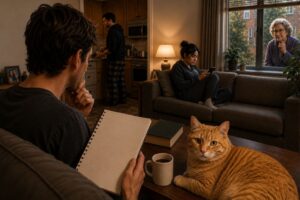
I’m sitting on the couch staring at Mr Whiskers while he lazily grooms one paw like he has absolutely nowhere to be. Pandora mentioned yesterday that work was going to be busy this week, but today she’s barely said anything. No plans, no hints, nothing unusual on the surface. Now maybe that sounds perfectly normal to a reasonable person, but I’m not feeling particularly reasonable today. Something feels off. I can’t explain it exactly, but the apartment has that feeling where everything seems normal if you look at it quickly, but if you pay attention long enough, little things start sticking out.

John Mercer was in the kitchen earlier humming to himself and making way more noise than necessary while making breakfast. He seemed unusually cheerful too. Not normal cheerful either. Suspicious cheerful. The kind of cheerful where somebody either has really good news or knows something you don’t. Then Mrs Jenkins walked past our place. Normally she has that same expression she always has, the one that somehow communicates disappointment in every living thing around her, but today I could have sworn I saw something different. Not a full smile exactly, because I’m not sure Mrs Jenkins is physically capable of that, but there was something there. Amusement maybe. The corners of her mouth moved just enough that I immediately noticed it.

At first I ignored it because people have facial expressions all the time. That’s normal. But then I started noticing other things. Pandora checked her phone and tilted the screen away when I walked past. John Mercer disappeared into his room for almost an hour. Mr Whiskers, who usually follows me around demanding food and attention like a tiny furry landlord, suddenly abandoned me completely and sat outside John Mercer’s door. Not meowing. Not scratching. Just sitting there staring at the door like he was waiting for instructions from somebody.

That’s when everything started lining up in my head. Pandora has been distracted lately. John Mercer is weirdly cheerful. Mrs Jenkins almost smiled. Mr Whiskers switched sides. Those are not isolated incidents. Those are pieces. I stood near John Mercer’s room for a few minutes trying to casually listen. Not spying exactly. More like standing nearby with investigative intent. That’s when I heard muffled voices, then laughter, and then complete silence. Complete silence is suspicious. Nobody suddenly goes silent unless they realize someone is nearby. Or unless they’re hiding something. Or both.

Then Pandora walked into the hallway and asked why I was standing there staring at the wall. I panicked and told her I thought I heard plumbing noises. She looked at me for a few seconds, long enough that I started wondering whether she knew I knew something, and then she just said, “Okay,” and walked away. Just okay. No follow-up questions. No confusion. Nothing. Which somehow made it even more suspicious.

At that point I started mentally building a timeline. Mrs Jenkins looked amused. John Mercer disappeared. Pandora was acting strange. Mr Whiskers changed allegiances. Then I remembered something important. Three days ago a package arrived with no return address, and John Mercer grabbed it immediately before I could even look at it. At the time I didn’t think much about it, but now I’m wondering if maybe that package changed everything. Maybe Pandora and John Mercer are secretly planning something. Maybe Mrs Jenkins somehow got involved. Maybe Mr Whiskers is acting as some kind of lookout. Honestly, the pieces fit together almost too perfectly.

I decided there was only one thing left to do, so I checked the security camera footage. After twenty minutes of reviewing everything, I finally discovered the truth. Pandora and John Mercer were apparently planning a birthday surprise for me. Mrs Jenkins looked amused because she saw me peeking through the blinds every fifteen minutes like some kind of neighborhood cryptid. John Mercer was humming because he won ten dollars on a scratch-off ticket. And Mr Whiskers kept following him around because he had opened a can of tuna earlier.

I’m still not entirely convinced though. Mostly because after I finished watching the footage, Mr Whiskers looked directly at me for several seconds in a way that felt extremely calculated. And honestly, if anyone in this apartment is capable of secretly running a covert operation, it’s him.

Related Posts