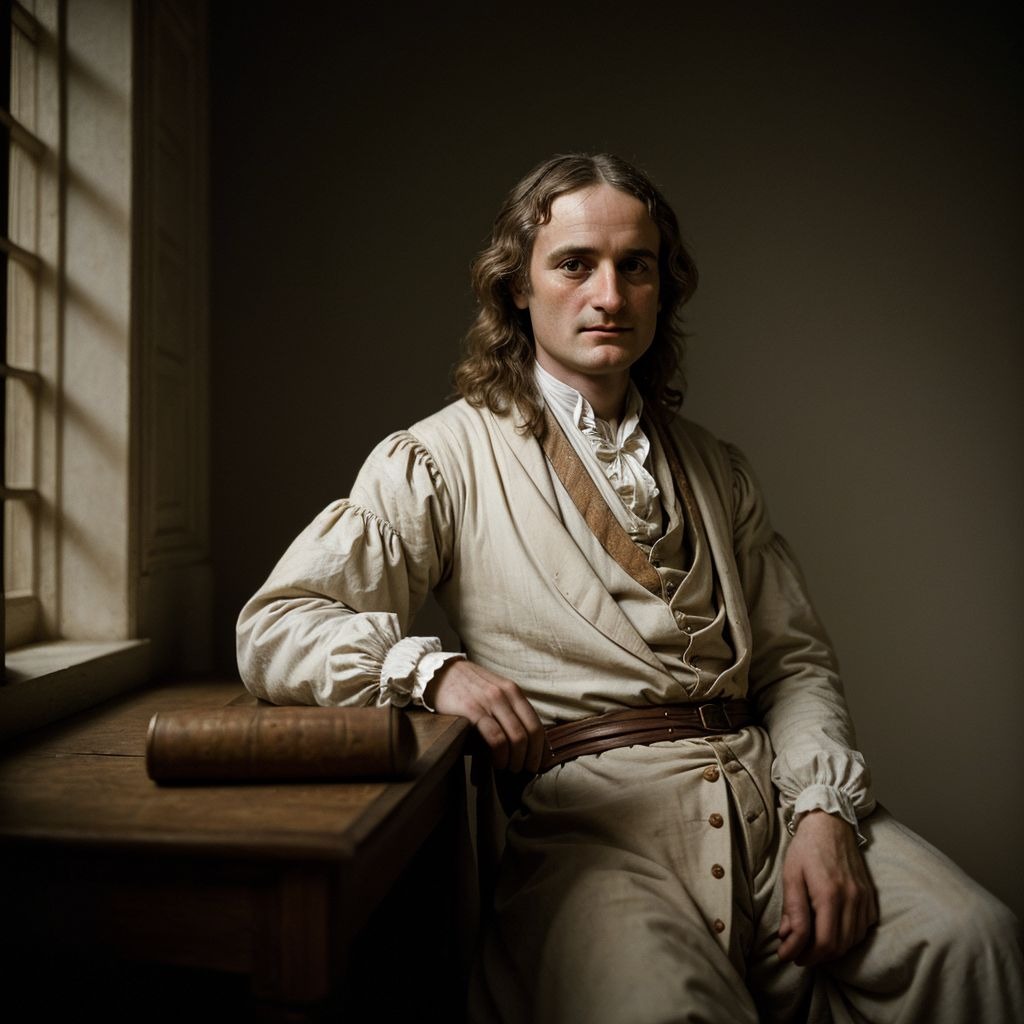
Isaac Newton’s face has been etched into my mind since I first stumbled upon him in high school history class. I remember being fascinated by the way he seemed to hold the entire universe within his grasp – laws of motion, universal gravitation, calculus… it all felt so comprehensive, so final. As a young adult now, I find myself returning to Newton’s work more often than not, drawn to the complexities that lie beneath his surface.
One thing that always struck me about Newton is how intensely private he was, despite being one of the most influential minds in human history. His life’s work is so publicly available – manuscripts, letters, lectures – yet the man himself remains a bit of an enigma. I find myself wondering what drove him to such secrecy. Was it insecurity? Fear of scrutiny? Or perhaps something more existential? The more I delve into his biography, the more I’m convinced that Newton’s struggles with anxiety and depression played a significant role in shaping his personality.
I identify with this sense of unease, having struggled with my own mental health since adolescence. There’s a part of me that wants to reach out to Newton across centuries, to ask him about the weight he must have felt as he delved deeper into his research. Was it exhilarating or suffocating? Did he ever feel like he was losing himself in the process of discovery?
Newton’s most famous work, “Principia Mathematica,” is a masterpiece of logical reasoning, yet I’ve always been struck by its almost poetic quality. The way he weaves together mathematical proofs and philosophical musings creates a sense of tension between precision and intuition. It’s as if he’s struggling to contain the vastness of his ideas within the confines of language.
I find myself drawn to this same tension in my own writing. As someone who writes primarily for personal expression, I often feel like I’m walking a tightrope between creativity and clarity. Newton’s work seems to me an embodiment of this struggle – the push-and-pull between precision and imagination.
As I continue to explore Newton’s life and work, I’m struck by how little we actually know about him as a person. There are countless anecdotes and stories surrounding his life, but they often feel like surface-level impressions rather than genuine insights. It’s as if we’re content to admire the towering figure of Isaac Newton from afar, without truly engaging with the messy, imperfect human being behind the legend.
I’m not sure what draws me to this aspect of Newton – perhaps it’s a reflection of my own discomfort with the notion of “greatness.” As someone who’s still figuring out their place in the world, I find myself questioning the way we idolize figures like Newton. What does it mean to be a genius? Is it something innate, or is it the result of intense dedication and hard work?
The more I write about Isaac Newton, the more I realize that my fascination with him isn’t just about his life or work – it’s about the questions he raises within me. His legacy serves as a mirror, reflecting back at me my own struggles with identity, purpose, and creativity. In that sense, Newton remains a living, breathing presence in my mind, a reminder that even the most enigmatic figures can hold up a mirror to our own complexities.
As I delve deeper into Newton’s life, I find myself getting lost in the labyrinthine corridors of his mind. His thoughts on alchemy, for instance, are a fascinating example of how his intellectual pursuits often overlapped and intersected with one another. He saw the universe as a vast, interconnected web, where spiritual and material realms blurred into each other. This holistic approach to understanding the world resonates deeply with me – it’s an attitude that I try to adopt in my own writing, seeking connections between disparate ideas and experiences.
But what strikes me most about Newton is how his work continues to speak to us today, despite being written centuries ago. His theories on optics and light helped lay the foundations for modern physics, while his mathematical innovations paved the way for countless breakthroughs in fields like engineering and economics. And yet, as I read through his manuscripts, I’m struck by the sense that he was often more interested in the abstract, metaphysical implications of his discoveries than their practical applications.
This reminds me of my own writing struggles – how often do I get caught up in exploring ideas for their own sake, rather than considering their potential impact or relevance? Newton’s example makes me wonder: is it possible to be both a visionary and a pragmatist at the same time? Or are these two modes of thinking necessarily mutually exclusive?
I’m not sure what I think about this question yet. Part of me wants to believe that we can straddle multiple perspectives, that creativity and practicality aren’t opposing forces but rather complementary facets of the human experience. But another part of me worries that I’m being naive – that in trying to balance these competing demands, I’ll end up sacrificing depth for breadth, or vice versa.
As I sit here with Newton’s “Principia Mathematica” open on my desk, I feel a sense of kinship with this brilliant, troubled mind. We’re both grappling with the same questions, though our contexts and tools are vastly different. His work challenges me to think more deeply about my own writing, to push beyond the comfort zone of my familiar thoughts and ideas.
I’m not sure where this exploration will lead – whether it’s a deeper understanding of Newton himself, or simply a greater awareness of my own strengths and weaknesses as a writer. But for now, I’m content to follow the thread of curiosity that’s been unwinding in my mind since I first encountered Isaac Newton all those years ago.
As I continue to immerse myself in Newton’s work, I find myself drawn to his concept of “hypotheses non fingo” – a phrase that translates to “I do not feign hypotheses.” It’s a statement that speaks to his cautious approach to science, where he sought to separate empirical observation from theoretical speculation. But what fascinates me is how this mindset can be applied beyond the realm of physics.
As a writer, I often find myself grappling with the tension between fact and fiction, observation and imagination. Newton’s emphasis on empirical evidence makes sense in the context of scientific inquiry, but what about creative pursuits? Don’t we also need to allow ourselves to feign hypotheses, to imagine possibilities that may or may not come to pass?
I think back to my own writing struggles, where I often feel like I’m stuck between two opposing modes: the analytical, critical thinker and the intuitive, creative one. Newton’s “hypotheses non fingo” makes me wonder if this dichotomy is necessary – can’t we find a way to balance rigor with imagination? To allow ourselves to take risks and explore new ideas without getting bogged down in unnecessary scrutiny?
As I ponder these questions, I start to think about the role of failure in creative endeavors. Newton’s work was not without its setbacks and disappointments – he spent years working on his theories on alchemy, only to realize that they were fundamentally flawed. But did this setback hold him back? On the contrary, it seems to have driven him further into his research, fueling a deeper understanding of the underlying principles.
This resonates with me, as I often struggle with my own writing failures. The fear of not meeting expectations or producing something worthy can be paralyzing, but what if failure is not an endpoint, but rather a stepping stone? What if, like Newton, we can learn to see our mistakes as opportunities for growth and exploration?
As I sit here with these thoughts swirling in my mind, I feel a sense of gratitude towards Isaac Newton. His work continues to challenge me, push me to think more deeply about the intersections between creativity and rigor. And though I may not have all the answers, I’m beginning to see that the real value lies in asking the questions – embracing the uncertainty and imperfection that comes with exploring new ideas and possibilities.
The more I delve into Newton’s life and work, the more I’m struck by his relentless pursuit of knowledge. He was a man who spent years studying optics, alchemy, and mathematics, driven by an insatiable curiosity about the workings of the universe. His notebooks are filled with cryptic annotations, half-finished equations, and tantalizing insights that seem to hover just beyond comprehension.
I find myself marveling at his sheer tenacity in the face of uncertainty. He was a man who seemed to thrive on the unknown, who reveled in the mystery of it all. And yet, this very quality also makes him feel impossibly distant, like a figure from another era, one that I can admire but not truly relate to.
But perhaps that’s where my fascination with Newton lies – in his capacity to hold these seemingly opposing qualities: the brilliant scientist and the uncertain individual. He was both a master of reason and a seeker of truth, driven by an almost spiritual quest for understanding. And it’s this paradox that continues to draw me in, like a moth to flame.
As I read through his manuscripts, I’m struck by the way he wove together disparate threads – philosophy, mathematics, alchemy, and biblical interpretation – into a rich tapestry of thought. He was a true polymath, with interests and expertise spanning multiple domains. And yet, despite this breadth of knowledge, he remained curiously open-minded, always willing to question his own assumptions and challenge the conventional wisdom.
This makes me wonder about my own limitations as a writer. How often do I feel constrained by my narrow focus on language and literature? Do I risk becoming too specialized, too insular in my pursuits? Newton’s example reminds me that there’s value in exploring multiple interests, in allowing oneself to get lost in the labyrinthine corridors of another discipline.
But what about the practicalities of creative work? As a writer, I often find myself torn between the need for structure and the desire for freedom. Newton’s approach to science seems so… organized, so deliberate. He spent years honing his theories, testing hypotheses, and refining his methods. Can this same level of rigor be applied to writing?
I think back to my own writing process, where I often feel like I’m stumbling through the dark, trying to find a thread of coherence in a sea of disparate ideas. Newton’s example makes me wonder if there’s value in approaching writing with a more systematic, methodical approach – one that balances creativity with analysis, imagination with critique.
As I ponder these questions, I start to think about the role of doubt in creative endeavors. Newton was notorious for his disagreements with other scientists and philosophers, often clashing with colleagues over fundamental issues like optics and gravity. His willingness to challenge prevailing views made him both admired and reviled – a testament to the power of dissent in driving innovation.
This resonates with me as a writer, where doubt can be both a crippling force and a creative catalyst. What if I were to approach my writing with a similar sense of openness and vulnerability? What if I were to see doubts and uncertainties not as roadblocks, but rather as opportunities for growth and exploration?
As I sit here, surrounded by Newton’s manuscripts and notes, I feel a sense of awe at the sheer scope of his vision. He was a man who dared to imagine the universe in all its complexity, who sought to grasp the underlying principles that governed reality itself. And it’s this same courage – this willingness to confront the unknown – that continues to inspire me as a writer.
In the end, I’m not sure where my exploration of Newton will lead – whether it’s a deeper understanding of his work or simply a greater awareness of my own strengths and weaknesses as a writer. But for now, I’m content to follow this thread of curiosity, to see where it takes me on this winding journey through the labyrinthine corridors of the human mind.