There are certain nights in the human imagination that have always carried a weight heavier than the ticking of hours, nights where the line between the known and the unseen trembles, and where stories slip from whispers into firelit truths. Halloween is one of those nights, but it has a twin, a darker mirror rooted not in the fall’s decay but in spring’s awakening. That night is Walpurgis Night, the evening of April 30th, when bonfires blaze across hillsides, when witches and spirits ride the winds in ancient tales, and when humanity’s fascination with both darkness and light collides in ritual, legend, and celebration. To understand Walpurgis Night is to step into a tapestry woven from pagan fires, Christian saints, medieval fears, and cultural reinventions that still burn in Europe to this day. And when we look at it closely, it is also to understand something deep and unshakable about ourselves: our longing for transformation, our craving for catharsis, and our need to stand on the edge of mystery.
The name itself seems deceptively simple. Walpurgis Night comes from Saint Walpurga, an 8th-century English missionary whose feast day was celebrated on May 1st. She was revered for her healing and for spreading Christianity through the dark forests of Germany, and her canonization connected her memory to the rhythms of the agricultural year. But as with so many Christian saints, her name fell onto an already ancient calendar of pagan celebrations. Long before anyone had heard of Saint Walpurga, Europeans were lighting fires on the last night of April to mark the turning of the seasons. These were not holy feasts in the Christian sense but rites of fertility, protection, and renewal. The Celts called it Beltane, a festival of fire and fertility, where cattle were driven between great bonfires to ensure health and prosperity. Across northern Europe, echoes of the same seasonal celebration existed. When Walpurga’s feast collided with these bonfires, the night became something unique: a hybrid of Christian remembrance and pagan revelry, a time to both celebrate light and confront darkness.
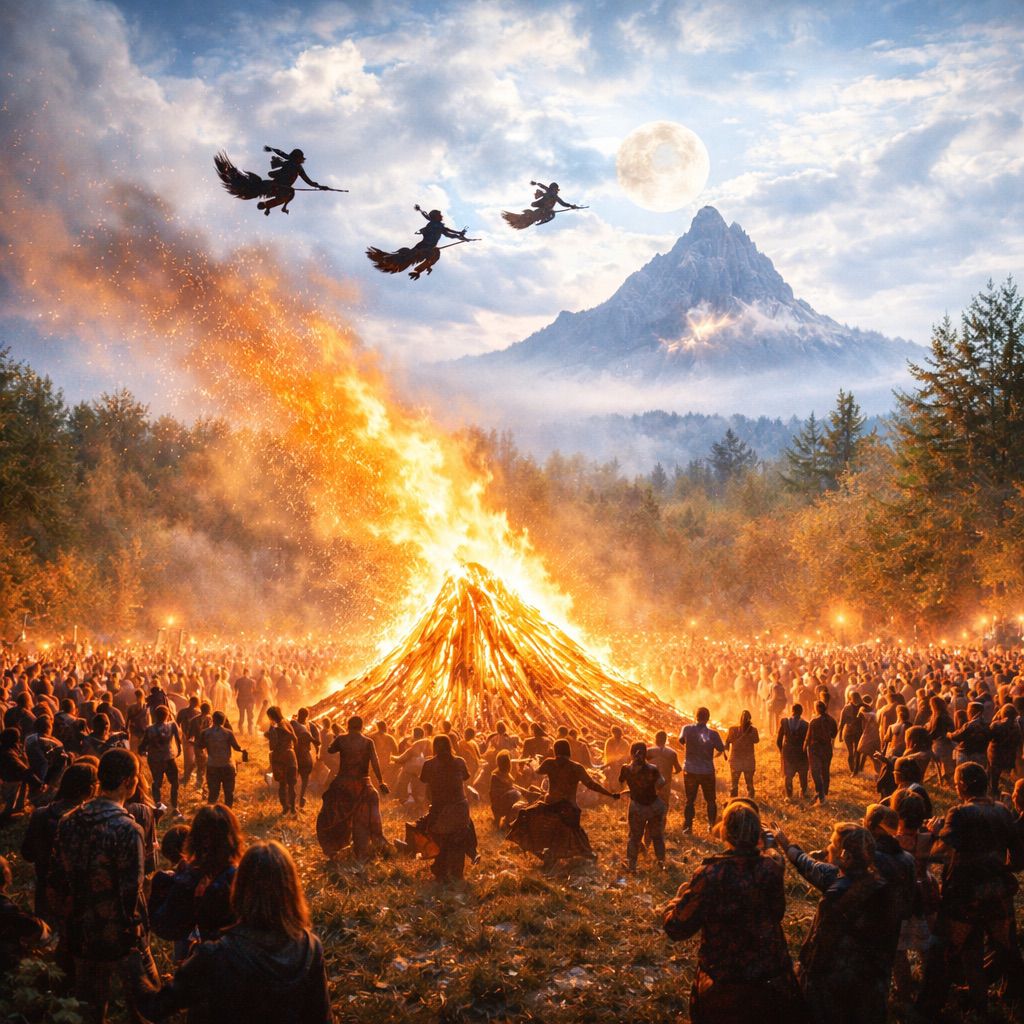
Yet if you listen closely to the stories that arose, you will hear whispers of something more sinister than just cattle and crops. In German folklore, Walpurgis Night became known as the evening when witches would fly to the Brocken, the highest peak in the Harz Mountains. There, they would gather in a great sabbath, meeting with the devil himself. The imagery is haunting and iconic: storm-clouds swirling around the mountaintop, silhouettes of women astride broomsticks, wild laughter carried on the wind. The Brocken is notorious for its atmospheric illusions — shadows cast on the mist that appear enormous and spectral, known as the “Brocken specter.” For villagers centuries ago, these sights must have looked like confirmation that witches truly danced in the sky on this night. Goethe captured this vision in his Faust, where Walpurgisnacht is a wild, chaotic scene of witches, spirits, and devils celebrating their feast. It is not a quiet holy evening but a riotous carnival of the infernal.
And here we see why Walpurgis Night carries such magnetic appeal even now. It is the springtime counterpart to Halloween, the night when the veil between worlds is said to thin. Where Halloween marks the descent into winter, Walpurgis is the threshold into summer, each a pivot between light and darkness. Both are nights of inversion, when the natural order trembles, when fires are lit to push back the unknown, and when people are allowed — even encouraged — to dance with danger, if only symbolically. For villagers centuries ago, the firelight of Walpurgis was more than just warmth; it was protection against witches, demons, and disease. For modern celebrants in Sweden, Finland, Germany, and beyond, the bonfires are still lit, but now they serve as symbols of community and continuity, a chance to gather after the long winter and celebrate survival.
But there’s always been a duality here. Walpurgis Night is not just about fear, nor just about joy — it is about both together. It is about recognizing that growth comes with risk, that fertility comes with chaos, that the forces of life are always tangled with the forces of death. In this way, Walpurgis speaks to something primal in us. We still crave moments where we can acknowledge the shadow without being consumed by it. We still love to scare ourselves with ghost stories, to imagine witches riding the wind, to laugh nervously at the thought of devils walking among us. Walpurgis Night provided — and still provides — a socially sanctioned outlet for that fascination.
Think of the symbolism. On April 30th, bonfires flare against the sky, great towers of flame reaching upward as if challenging the heavens. People dance, sing, drink, and laugh. The stories say witches also dance that night, but whether you believe that or not, the imagery remains powerful. Fire cleanses, fire protects, fire transforms. You walk away from the bonfire changed, even if only in spirit. It is an exorcism of winter, a summoning of summer, and in some interpretations, a flirtation with the underworld. And in today’s world, where ancient festivals often feel like quaint relics, Walpurgis remains surprisingly raw. Go to Germany on that night and you will still see the bonfires crackle. Go to Sweden and you will hear choirs singing to the spring, while students drink and cheer. Something in us refuses to let go of this ritual.
In the medieval mind, Walpurgis was serious business. It was not just witches dancing in misty mountains but a real threat. The Church warned against the dangers of this night, connecting it to devil worship, pagan rebellion, and female independence. Women gathering in the woods were suspect; the old midwives and healers could be branded as witches. The result was fear, suspicion, and persecution. Yet ironically, the very attempt to stamp out the “witches’ sabbath” only made it stronger in cultural memory. The more the authorities denounced Walpurgis, the more it lingered in the popular imagination as a time of wild, dangerous revelry. And so it remains.
What is striking is how this night has traveled through time without losing its fire. In literature, Goethe gave it immortality. In music, composers from Mendelssohn to Berlioz have captured its wild, stormy essence. In modern paganism, it has been revived as Beltane, a celebration of fertility and fire. In popular culture, it is often described as “the other Halloween,” a second chance each year to revel in the supernatural. And though it is far less commercialized than October 31st, perhaps that gives it more authenticity. It is not about costumes and candy but about fire, fear, and freedom.
The human side of Walpurgis is the most compelling. Imagine a villager hundreds of years ago, standing on the edge of a firelit crowd. He hears the crackle of the flames, feels their heat on his skin. He looks to the dark forests and wonders what stirs in the shadows. Maybe he tells himself it’s just the wind, but maybe he believes witches ride the sky. He pulls his cloak tight and joins in the singing, because on this night, everyone is united against the unknown. Or picture a group of students in modern Sweden, gathering around a fire, drinking, laughing, singing old songs. They may not believe in witches, but the thrill is the same — a thrill that comes from knowing you are standing in a tradition that stretches back a thousand years. That continuity is magic in itself.
The viral appeal of Walpurgis Night lies here. It is dramatic, it is eerie, it is beautiful, and it connects us to something elemental. It invites us to step into the dark not to stay there, but to emerge renewed. It lets us play with fire without burning, to dance with demons without selling our souls. And in a world that often feels sterile, predictable, and over-lit, that kind of ritual is irresistible.
So when April 30th arrives, light a fire if you can. Tell the story of Walpurgis Night. Whisper about witches flying to mountaintops. Read Goethe’s Faust and feel the chaos of his Walpurgisnacht. Or simply stand under the night sky and imagine what your ancestors must have felt — the awe, the fear, the laughter. Because Walpurgis Night isn’t just history. It’s a reminder that sometimes we need to face the shadows in order to celebrate the light.