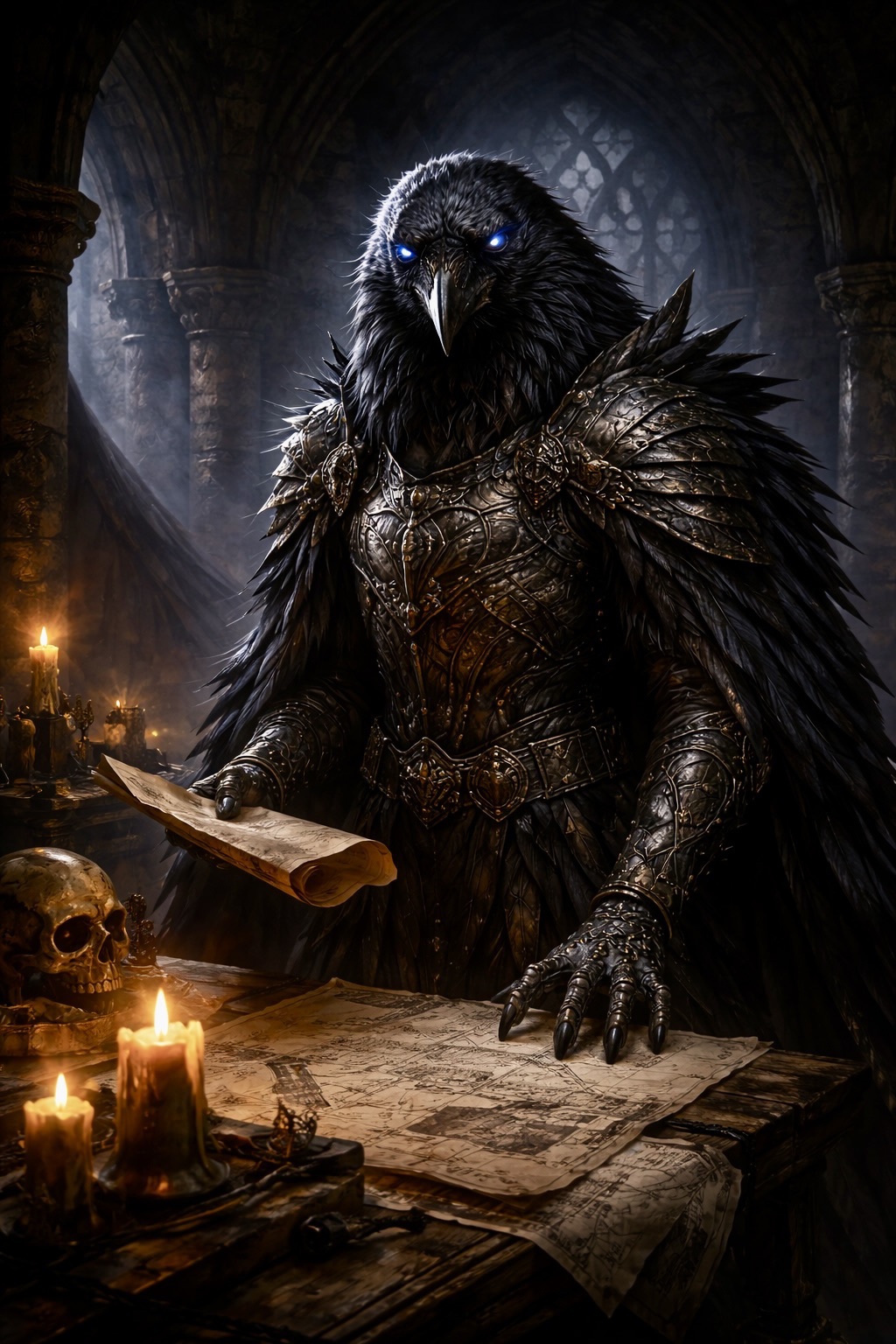
There is something uniquely unsettling about a builder who constructs not for protection alone, but for infiltration. In the dark catalog of spirits preserved within the Lesser Key of Solomon, Malphas appears as a Great President of Hell commanding forty legions of spirits. He is described as appearing at first in the form of a crow, then taking on human shape at the magician’s command. His powers are precise and disturbingly practical: he builds houses and high towers, brings knowledge of enemies’ thoughts, gathers faithful servants, and—if requested—causes them to betray.
Within the Ars Goetia, Malphas stands out not for elemental fury or grand destruction, but for strategy. He constructs fortifications, fills them with ammunition, and provides insight into hidden intentions. There is calculation in every line of his description. He is not chaos. He is design.
Earlier accounts, including those found in the Pseudomonarchia Daemonum by Johann Weyer, echo these traits. Across versions, Malphas remains associated with architecture, espionage, and betrayal. The crow form persists as his first manifestation, reinforcing his connection to watchfulness, intelligence, and omen.
The crow, like the raven, occupies a symbolic space between death and cunning. Crows are problem-solvers. They gather information. They thrive in proximity to human settlements. Unlike creatures of wilderness solitude, crows adapt to cities, observing from rooftops and towers. To assign Malphas a crow’s form is to suggest a spirit who understands human structures intimately.
Malphas’ ability to build houses and high towers speaks directly to security and ambition. In medieval Europe, towers symbolized authority and protection. A fortified tower was the difference between survival and conquest. To command a spirit capable of constructing such defenses would have been considered immensely valuable. Yet Malphas does not stop at construction. He also supplies the weapons within those walls.
This dual role—builder and armorer—reveals his domain as strategic preparation. Malphas does not simply erect barriers; he anticipates conflict. His architecture is defensive but also anticipatory. It assumes threat.
And then comes the most unnerving aspect of his power: betrayal. The grimoires state that he can bring together good familiars or servants, and if commanded, cause them to betray the magician. That conditional clause is chilling. Malphas does not inherently corrupt; he responds to intent. Betrayal becomes a tool.
This trait places Malphas squarely within the realm of political intrigue. He is not the demon of open warfare but of quiet destabilization. He builds structures that appear secure while embedding the seeds of collapse within them. His domain is the architecture of trust—and its erosion.
Psychologically, Malphas can be understood as the embodiment of strategic paranoia. There is a part of the human mind that constructs defenses not only against external threats but against potential betrayal. Walls are raised not only to keep enemies out but to monitor those inside. Malphas represents that hyper-vigilant instinct.
The crow imagery enhances this interpretation. Crows gather and communicate. They warn one another of danger. They remember faces. Malphas, in crow form, becomes the watcher above the walls he builds. He sees what others overlook.
His rank as President rather than King or Duke also carries meaning within the Goetic hierarchy. Presidents in the Goetia often govern structured domains with administrative precision. Malphas fits that archetype. He is methodical. He commands forty legions—a significant force, organized and ready.
There is something profoundly modern about his mythology. In an age of cybersecurity, surveillance, and political maneuvering, the idea of a spirit who constructs defenses while orchestrating internal betrayal feels strikingly relevant. Systems can appear fortified while vulnerabilities lurk within.
Malphas’ ability to reveal enemies’ thoughts further emphasizes his espionage role. Knowledge is power. To know what adversaries plan is to control the outcome before the battle begins. Yet that same insight can breed suspicion. When one becomes aware of every potential threat, trust erodes.
The old grimoires warn that Malphas can deceive unless properly constrained. Ritual authority matters. Boundaries matter. Structure contains strategy. This theme recurs throughout demonology: power without discipline destabilizes.
The architecture Malphas builds is symbolic as well as literal. Humans build identities, reputations, institutions. We fortify ourselves emotionally and socially. But within those constructions lies the possibility of betrayal—self-sabotage, misplaced trust, hidden resentment. Malphas becomes the personification of that internal fault line.
And yet, like many Goetic spirits, he is not purely malicious. When commanded with clarity and authority, he builds strong defenses and provides loyal servants. The betrayal he orchestrates is conditional. It reflects intent. In that sense, Malphas mirrors the moral ambiguity of strategy itself. Strategy can protect or manipulate. It depends on purpose.
The crow’s black feathers glinting in the sun evoke intelligence cloaked in shadow. Crows are not glamorous birds. They are not majestic eagles. They are practical, adaptable, and persistent. Malphas shares those qualities. He does not dazzle; he calculates.
Historically, the grimoires emerged during times of political instability and fortified cities. Intrigue and espionage were constant. To imagine a spirit governing those dynamics was to externalize the tension of the era. Malphas embodied the fear that walls were not enough—that betrayal could come from within.
Even today, institutions collapse not always from external attack but from internal corruption. Trust erodes. Alliances fracture. Malphas’ mythology anticipates that pattern. He is the architect who understands that structures are only as strong as the loyalty within them.
The tension between construction and collapse defines him. He is the shadow architect, building towers while whispering doubts. He is the planner who anticipates every angle—including the angle of betrayal.
There is a strange honesty in his depiction. He does not disguise his power. He builds and he destabilizes. He observes and he intervenes. In a world that often romanticizes loyalty without examining fragility, Malphas reminds us that vigilance must accompany trust.
Ultimately, Malphas stands as a symbol of strategic intelligence and moral ambiguity. He teaches that fortifications alone do not guarantee safety. The true strength of any structure lies in integrity—both of materials and of hearts.
Malphas the Shadow Architect watches from his tower, crow eyes gleaming, reminding us that the greatest threats are not always outside the walls—but sometimes perched quietly upon them.