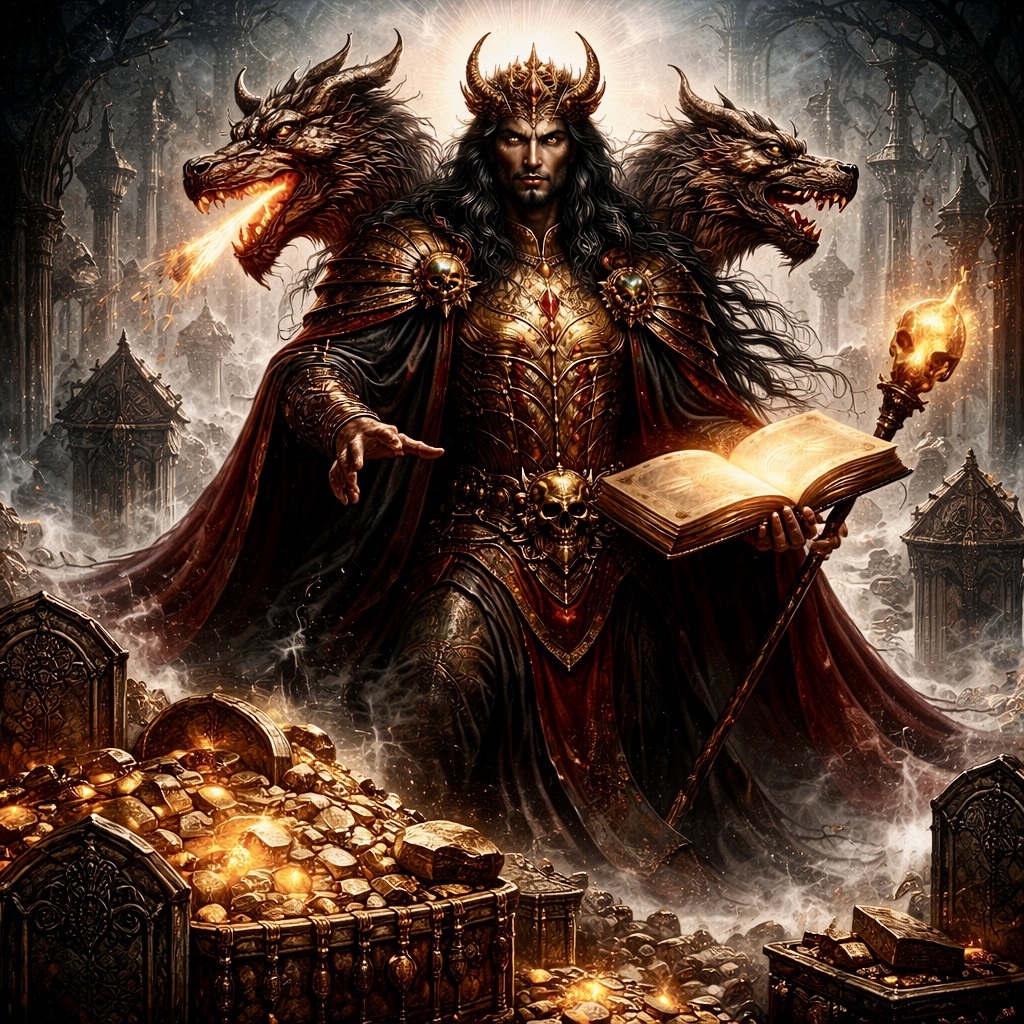
Bune is a demon whose authority flows quietly beneath the surface of things most people would rather not examine. In the Ars Goetia, Bune is named as a Great Duke of Hell, commanding thirty legions and appearing as a dragon with three heads—one canine, one griffin-like, and one human—before sometimes assuming a human form. This multiplicity is not decorative. It reflects the layered nature of Bune’s dominion: death, wealth, memory, and speech all braided together into a single, unsettling force.
At his core, Bune governs the dead, especially those who have been forgotten, displaced, or improperly honored. He is said to move corpses from one grave to another, to command spirits of the dead, and to grant wisdom through communion with what has already passed. Unlike demons who exploit desire or fear directly, Bune works through legacy. He understands that what is buried still exerts influence, and that neglect does not erase power—it merely hides it.
The dragon form associated with Bune is especially telling. Dragons are creatures of hoards, guardianship, and ancient memory. They do not chase novelty. They accumulate. Bune embodies this principle perfectly. He is not interested in immediate gratification. He is interested in stored value—wealth, knowledge, reputation, and influence that have been left unattended. Under Bune, forgotten things become assets.
The three heads of Bune symbolize his domains operating simultaneously. The canine head represents loyalty to the dead and guardianship of graves. Dogs are protectors and companions, often associated with death rites across cultures. The griffin head represents vigilance and authority over treasure, as griffins traditionally guard gold and sacred spaces. The human head represents intellect, language, and negotiation. Bune does not merely control wealth and death. He explains them, justifies them, and persuades others to engage with them.
Bune is famously associated with riches, particularly wealth derived from unexpected or overlooked sources. This is not the demon of sudden fortune or reckless gambling. Bune’s wealth is slow, patient, and often unsettling in origin. He teaches how to extract value from what others ignore: abandoned property, forgotten agreements, neglected obligations, and unclaimed inheritance. Under Bune, prosperity is not created—it is reclaimed.
His association with eloquence is one of his most overlooked traits. Bune grants the ability to speak persuasively and wisely, especially when dealing with matters of death, legacy, and value. This is not charismatic speech meant to inspire crowds. It is measured, authoritative language that sounds informed by experience. Bune speaks like someone who has seen cycles repeat long enough to stop being surprised by them.
Psychologically, Bune represents humanity’s complicated relationship with death and material value. People fear death, yet build entire systems around what survives it: inheritance, property, titles, reputation. Bune governs that contradiction. He understands that wealth often accumulates through generations, not individual effort, and that power often rests with those who manage legacy rather than create novelty.
Unlike demons associated with indulgence, Bune is restrained. He does not encourage excess. He encourages accumulation. This makes him especially dangerous in bureaucratic and institutional systems where wealth, authority, and memory are recorded, stored, and transferred. Bune thrives in archives, ledgers, cemeteries, and contracts that outlive their creators.
Bune’s control over spirits of the dead is not portrayed as torment. It is administration. He organizes, relocates, and communicates. The dead under Bune are not chaotic apparitions. They are resources of memory. He understands that the past contains leverage, and that those who can access it responsibly gain advantage over those who cannot.
In demonological lore, Bune is often described as dignified, even courteous, when approached correctly. He values respect, precision, and acknowledgment of authority. Sloppiness offends him. This reinforces his association with legacy. Carelessness erodes what endures.
The wealth Bune grants is often accompanied by responsibility. Those who receive it must manage it wisely or risk decay. Bune does not guarantee permanence. He offers opportunity rooted in what already exists. Mismanagement is punished not by malice, but by loss.
In modern symbolic terms, Bune resembles estate law, generational wealth, archival power, and institutions that control historical narrative. He is present wherever the dead continue to influence the living through documents, property, and memory.
There is also a moral ambiguity to Bune’s gifts. Extracting value from the dead can easily become exploitation. Bune does not resolve this tension. He exposes it. He teaches how systems operate, not whether they are just.
Unlike demons who manipulate emotion, Bune manipulates continuity. He ensures that influence does not end simply because a life does. This makes him both feared and respected. He reminds humanity that death does not erase obligation.
Bune’s endurance in demonology comes from a simple truth: societies are built on what they inherit. Wealth, land, law, and culture all outlive individuals. Someone must manage that inheritance. Bune personifies that role without sentimentality.
To engage with Bune symbolically is to confront the question of what you will leave behind and who will control it. He does not ask whether something should endure. He asks whether it has been claimed.
Bune is not the demon of death itself. He is the demon of what death leaves behind—power stored, wealth buried, and voices waiting to be heard again.