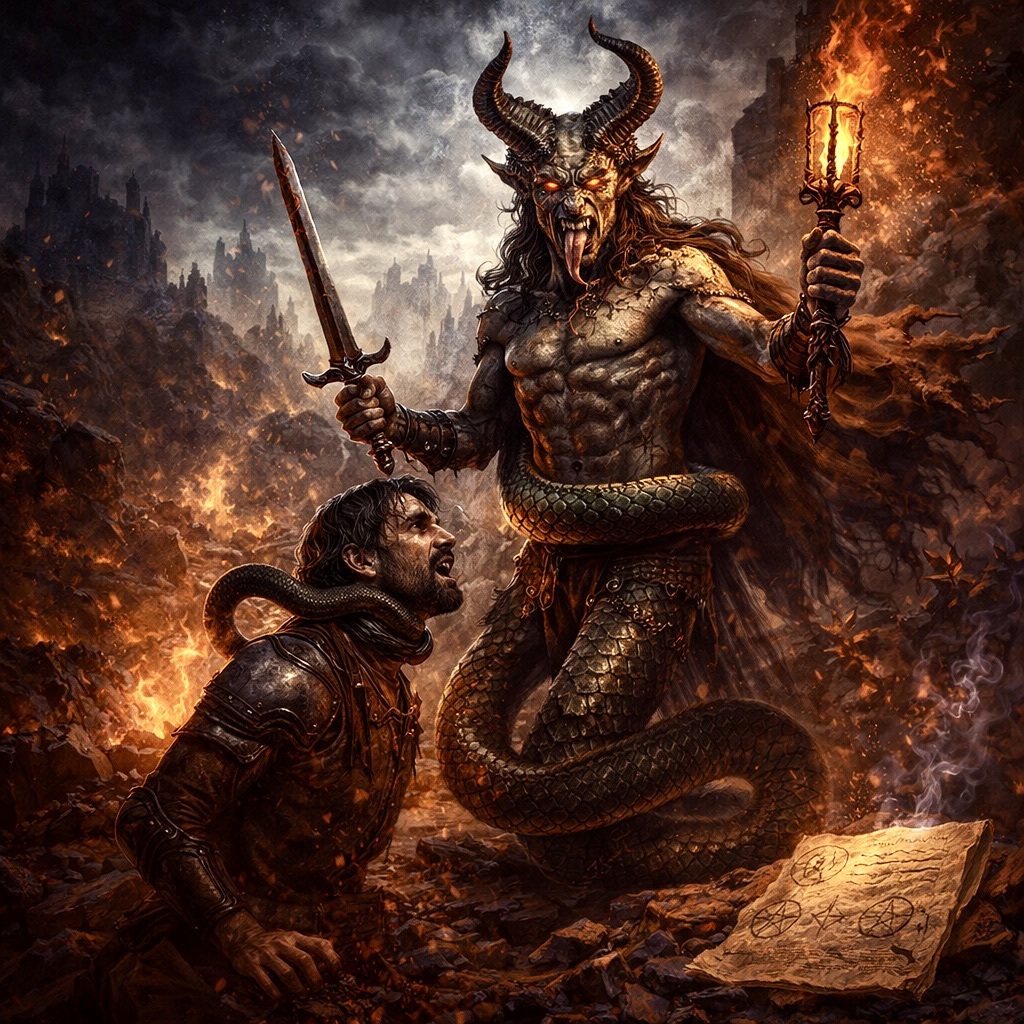
Among the many figures described in the ancient grimoires of demonology, few carry the same strange mixture of menace and wisdom as Botis. His name appears in the Ars Goetia, the first and most famous section of the seventeenth-century grimoire The Lesser Key of Solomon, a book that catalogs seventy-two spirits believed to inhabit the infernal hierarchy. These spirits were said to have been bound by King Solomon himself, forced to reveal their names, powers, and ranks. Each demon in the text possesses unique abilities—some command storms, some bring wealth, others sow deception or inspire knowledge. Botis occupies an unusual place among them. He is described as both a President and an Earl of Hell, commanding sixty legions of spirits, and his abilities revolve not around destruction but revelation. Botis is said to tell of things past, present, and future, and perhaps even more intriguingly, to reconcile friends and enemies.
The image of a demon capable of ending conflict is curious. Demonology usually portrays infernal spirits as creators of chaos and corruption, yet Botis appears almost diplomatic in his abilities. According to the grimoires, he begins his appearance as a hideous viper—an ancient symbol of cunning and hidden knowledge—but when commanded by a magician, he transforms into a human form with large teeth and horns, carrying a sharp sword. The transformation itself is significant. It reflects the belief that truth often begins in darkness and distortion before revealing itself clearly. The serpent form embodies secrecy and danger, while the human form suggests communication, negotiation, and clarity.
The serpent has always held a complex role in mythology. In Western tradition, serpents symbolize deception and temptation, but they also represent wisdom and renewal. The serpent shedding its skin became an ancient symbol of rebirth. In Greek mythology, serpents were associated with prophecy and healing. The staff of Asclepius, wrapped by a serpent, remains a symbol of medicine even today. Botis’s initial form as a viper aligns him with this long history of serpentine symbolism. Hidden knowledge coils quietly beneath the surface, waiting to strike when the moment is right.
When Botis assumes human form in the grimoires, he carries a sword. Swords have always symbolized authority, judgment, and truth. In medieval iconography, the sword was often associated with justice, capable of cutting through lies and deception. When combined with Botis’s reputation for revealing truths across time, the sword becomes an emblem of discernment. It suggests that Botis does not merely reveal information; he separates truth from illusion.
The idea that a demon might possess knowledge of past, present, and future reflects humanity’s ancient fascination with prophecy. Across cultures, people have sought guidance about the future through oracles, visions, and supernatural intermediaries. The Oracle of Delphi in ancient Greece offered cryptic prophecies believed to come from the god Apollo. Norse mythology described seers who could glimpse the threads of fate. In medieval Europe, astrology and prophecy were taken seriously by rulers and scholars alike.
Botis appears within this long tradition as a figure associated with foresight. Yet unlike divine oracles, his position within the infernal hierarchy suggests that knowledge itself was sometimes viewed as morally ambiguous. Knowing the future could be empowering, but it could also be dangerous. Medieval theologians often warned that seeking forbidden knowledge might lead individuals away from divine guidance.
The Renaissance period, when grimoires like The Lesser Key of Solomon gained popularity, was a time of intense intellectual curiosity. Scholars studied ancient texts from Greece, Rome, and the Islamic world, rediscovering philosophies and sciences that had been forgotten in Europe. This era produced extraordinary advancements in art, astronomy, and mathematics. At the same time, it also fueled fascination with occult knowledge.
Magicians who practiced ceremonial magic believed they could communicate with spiritual entities to obtain hidden wisdom. These practitioners were often highly educated individuals—scholars, priests, or noblemen who blended theology with mystical experimentation. To them, spirits like Botis represented gateways to knowledge beyond human perception.
Rituals for summoning such spirits were elaborate and precise. Practitioners would draw protective circles inscribed with sacred names, burn specific incenses, and recite invocations written in Latin, Hebrew, or other ancient languages. The purpose of these rituals was to compel the spirit to appear and answer questions without harming the magician. In this context, Botis was often sought for guidance about disputes, alliances, and political tensions.
The ability attributed to Botis to reconcile friends and enemies is perhaps his most intriguing characteristic. It suggests that the spirit possessed not only knowledge but also influence over human relationships. Conflict has always been one of the central forces shaping history. Wars, rivalries, and betrayals have determined the fate of nations. The idea of a supernatural mediator capable of restoring peace would have been extremely appealing to rulers and advisors navigating dangerous political landscapes.
Yet there is also a symbolic interpretation of this ability that resonates deeply with human psychology. Conflict often arises from misunderstanding, pride, and fear. Reconciliation requires clarity—the ability to see the truth of a situation from multiple perspectives. Botis, as a revealer of truth, becomes a metaphor for the process of understanding that resolves disputes.
When hidden motives are exposed and misconceptions corrected, enemies sometimes discover that their conflict was built on illusion. In this way, Botis represents the moment when truth cuts through confusion and reveals the possibility of peace.
This symbolic interpretation aligns with the transformation from serpent to human described in the grimoires. At first, knowledge appears frightening and alien. Truth can be uncomfortable, even threatening. Yet once revealed clearly, it allows communication and resolution.
Throughout history, individuals who acted as mediators between opposing sides were often regarded with a mixture of suspicion and respect. Diplomats, advisors, and negotiators possessed the ability to influence events quietly yet profoundly. Botis’s mythology echoes the role of such figures. He does not command armies or destroy cities. Instead, he alters the course of events through knowledge and understanding.
The rank attributed to Botis—both Earl and President—reinforces this idea of authority through wisdom. In the hierarchical structure of the infernal realm described in demonological texts, each rank carried specific responsibilities. Presidents were believed to govern legions of spirits and oversee specialized domains of knowledge or influence. Earls commanded loyalty and power similar to noble titles within human societies.
Botis commanding sixty legions of spirits suggests that his influence extends far beyond a single task. Each legion might represent different aspects of knowledge, observation, or communication. In symbolic terms, this reinforces the idea that truth emerges from many sources rather than a single perspective.
Modern interpretations of demonology often approach these figures as archetypes rather than literal beings. From this perspective, Botis embodies the archetype of revelation and reconciliation. He represents the moment when individuals confront uncomfortable truths and transform conflict into understanding.
Carl Jung’s concept of the shadow provides a useful framework for understanding such archetypes. The shadow represents aspects of the self that individuals prefer not to acknowledge—hidden fears, desires, or contradictions. Confronting the shadow requires courage because it forces individuals to confront truths they would rather ignore.
Botis’s serpent form mirrors this shadow element. It represents hidden truths coiled beneath the surface of consciousness. When confronted and understood, these truths can transform into clarity and wisdom.
Another intriguing aspect of Botis’s mythology is his connection to time. The ability to reveal past, present, and future places him outside the ordinary flow of events. Time has always been one of humanity’s greatest mysteries. Philosophers and scientists have struggled for centuries to understand whether time is linear, cyclical, or something far stranger.
Ancient cultures often imagined time as a tapestry woven by unseen forces. Norse mythology described the Norns, beings who spun the threads of fate. Greek mythology featured the Moirai, who measured and cut the threads of life. In these traditions, knowledge of time’s patterns was associated with supernatural beings.
Botis fits naturally into this tradition as a figure capable of perceiving events across temporal boundaries. His knowledge of the past reveals causes, while his insight into the future reveals consequences. Together, these perspectives provide the clarity necessary to resolve conflict.
Modern readers might interpret this ability metaphorically. Understanding the past allows people to avoid repeating mistakes, while anticipating future consequences encourages wiser decisions. In this sense, Botis becomes a symbol of historical awareness and foresight.
Leadership often requires precisely these qualities. Effective leaders study history to understand patterns of success and failure. They analyze current conditions carefully and attempt to predict future outcomes. When disputes arise, they seek solutions that consider both past grievances and future stability.
Botis’s mythology therefore reflects qualities associated with wisdom rather than malevolence. While he remains part of the infernal hierarchy in demonological texts, his abilities emphasize knowledge, diplomacy, and foresight.
This ambiguity is characteristic of many figures within occult traditions. The boundary between good and evil was not always portrayed as simple or absolute. Spirits could possess both helpful and dangerous qualities depending on how they were approached.
Such complexity mirrors the nature of knowledge itself. Information can empower or mislead depending on how it is interpreted. Truth can heal relationships or deepen divisions depending on how it is revealed.
The sword carried by Botis symbolizes this double-edged nature. A sword can defend or destroy. It can protect justice or enforce tyranny. In the same way, truth can illuminate or wound.
The enduring fascination with figures like Botis suggests that people continue to grapple with these themes. Even in modern society, conflict often arises from hidden motives and misunderstood intentions. Diplomacy requires patience, empathy, and careful analysis of information.
When disputes escalate, the ability to uncover truth becomes invaluable. Investigative journalists, historians, and mediators perform roles not unlike the symbolic function attributed to Botis. They reveal facts that reshape narratives and encourage reconciliation.
Stories about supernatural arbiters of truth resonate because they reflect a deep human desire for clarity. In moments of conflict, people often wish for an impartial figure who can reveal what truly happened and guide opposing sides toward resolution.
Botis embodies that wish in mythological form. He stands as a figure who sees beyond illusion and speaks with authority about events across time.
The imagery associated with him—serpent transformation, sword of judgment, knowledge of past and future—creates a powerful symbolic portrait of truth itself. At first it appears frightening, like a viper emerging from darkness. Yet once understood, it becomes a tool capable of restoring balance.
Perhaps this is why Botis remains one of the more intriguing spirits within the Ars Goetia. Unlike demons associated purely with temptation or destruction, he represents a more nuanced idea: that knowledge, even when unsettling, can lead to peace.
In the end, Botis’s mythology reminds us that truth has always carried both power and responsibility. It can expose deception, reveal hidden motives, and transform enemies into allies. But it must be wielded carefully, like the sword he carries.
For those who seek understanding in times of confusion, the story of Botis offers a timeless message. Truth may first appear as something dangerous and unsettling, coiled like a serpent in the dark. Yet when brought into the light, it possesses the extraordinary ability to change the course of human relationships—and perhaps even the course of history itself.