Throughout the strange and shadowed traditions of medieval demonology, certain names appear again and again in the pages of grimoires that attempted to catalog the supernatural world. These texts, written by scholars, mystics, and occultists across centuries, described hierarchies of spirits believed to inhabit invisible realms parallel to our own. Among the seventy-two spirits recorded in the Ars Goetia, a section of the famous grimoire The Lesser Key of Solomon, one figure stands out for his unsettling mixture of romance, manipulation, and warlike authority. His name is Zepar, a Great Duke of Hell who commands twenty-six legions of spirits and whose influence centers on love, desire, and the complicated politics of human attraction.
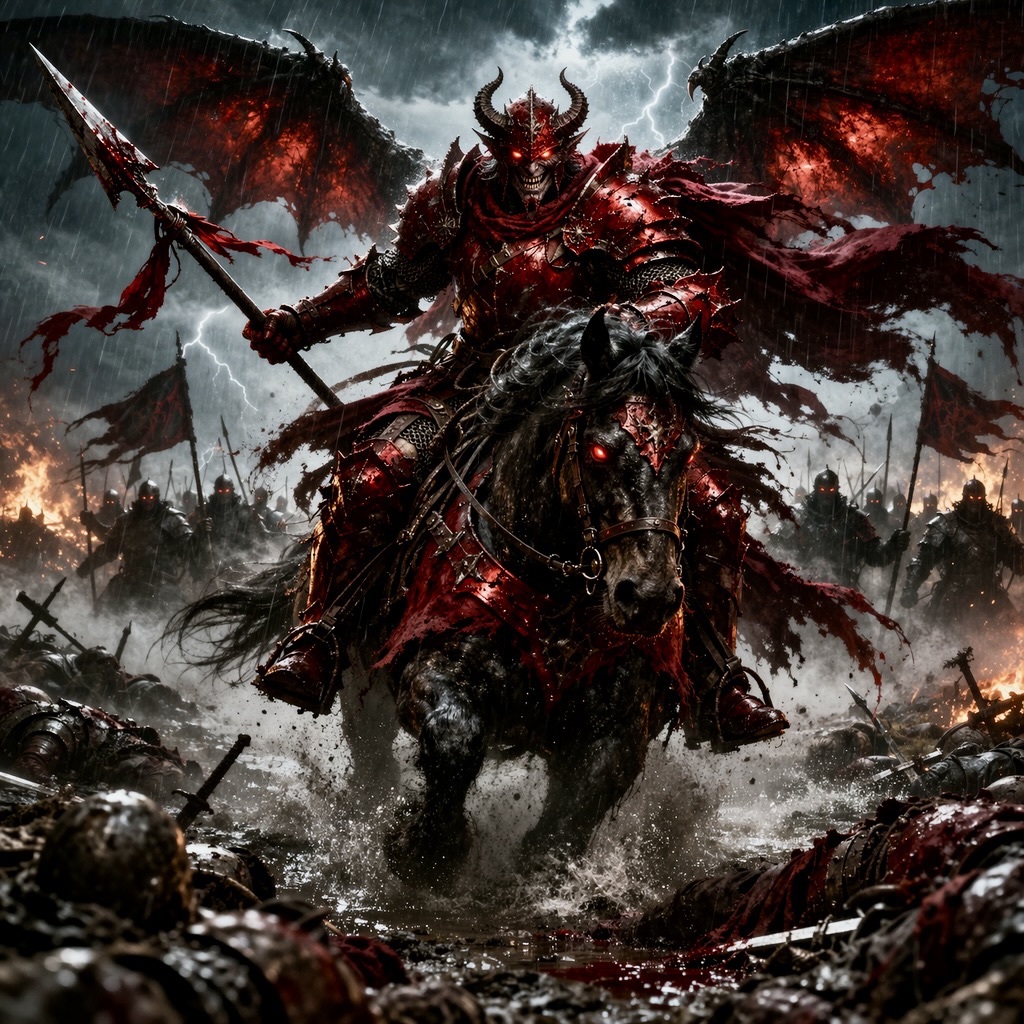
Zepar is described in the old grimoires as appearing in the form of a soldier clad in red armor. Sometimes he is depicted with wings, sometimes holding a weapon such as a spear. The imagery is deliberate and symbolic. Red armor evokes passion, violence, and intensity all at once. Unlike many demons associated with brute destruction or forbidden knowledge, Zepar operates in a far subtler arena. His power lies in influencing relationships between men and women, causing them to fall in love—or perhaps more accurately, causing attraction that may not always end well.
This strange combination of romance and warfare tells us something important about how earlier societies understood love itself. In medieval and Renaissance culture, love was rarely seen as a gentle or purely joyful emotion. Instead, it was often described using the language of battle. Lovers “conquered” hearts. Poets wrote of being “wounded” by affection. Desire was depicted as an arrow shot by Cupid or as a force capable of overthrowing reason entirely. Zepar’s soldier-like appearance captures this ancient belief that love can feel like a conflict—something fought, endured, and sometimes survived rather than calmly chosen.
The grimoires attribute a specific ability to Zepar that reveals much about historical attitudes toward relationships. He is said to cause women to love men, yet also to render them barren so they cannot bear children. This curious detail reflects deep cultural anxieties present in the societies that wrote these texts. During the Renaissance period, lineage, inheritance, and legitimate offspring were matters of enormous importance. Political alliances, family wealth, and social status often depended on marriage producing heirs. Any force that disrupted reproduction was therefore seen as deeply threatening.
In that context, Zepar becomes a symbol of relationships driven by passion rather than stability. Love without the expectation of family or lineage could be interpreted as dangerous or unnatural. The demon therefore represents the seductive but destabilizing power of desire detached from social responsibility.
To understand why figures like Zepar appeared in grimoires at all, we must look at the worldview of the people who wrote them. During the Renaissance, Europe was undergoing dramatic intellectual change. Ancient Greek and Roman texts were being rediscovered, scientific thinking was expanding, and exploration was revealing entirely new continents. Yet at the same time, belief in supernatural forces remained deeply embedded in daily life.
Scholars and magicians believed the universe was filled with invisible intelligences—angels, demons, spirits, and planetary influences—that interacted with the physical world. By studying ancient manuscripts and performing elaborate rituals, they believed it might be possible to communicate with these entities and gain knowledge or influence events.
Ceremonial magic was therefore treated almost like an experimental science. Practitioners followed strict procedures, drew protective circles, invoked divine names, and recorded the results of their rituals carefully. The grimoires functioned as manuals describing which spirits could be summoned, what powers they possessed, and how they might behave.
Within this system, Zepar held the rank of Duke. In the hierarchical structure described by the Ars Goetia, dukes were powerful commanders within the infernal realm. They oversaw legions of lesser spirits and were associated with specific domains of influence. Zepar’s domain—romantic attraction—might seem unusual compared to demons associated with storms, treasure, or warfare. Yet when viewed through the lens of Renaissance society, it makes sense.
Romantic relationships had enormous consequences during this period. Marriages determined alliances between noble families, transferred wealth through dowries, and influenced political power structures across Europe. A single affair or scandal could ignite feuds that lasted generations. Passion was not merely personal; it could reshape entire communities.
Zepar’s mythology reflects this understanding. He represents the unpredictable power of attraction that can override logic, social expectations, and even moral judgment.
Consider how often love has altered the course of history. The relationship between Cleopatra and Mark Antony reshaped the Roman world. Henry VIII’s obsession with Anne Boleyn led to England breaking from the Catholic Church and forming the Church of England. Entire wars have begun over romantic alliances or betrayals.
These historical examples illustrate why earlier societies might interpret romantic influence as supernatural. The sudden intensity of attraction often feels mysterious even today. People meet unexpectedly, develop deep feelings quickly, and make life-altering decisions based on emotional connection.
From a psychological perspective, this experience is rooted in neurochemistry. Dopamine, oxytocin, serotonin, and adrenaline flood the brain during early romantic attraction. These chemicals create feelings of euphoria, obsession, and emotional bonding that can override rational thinking. To individuals living centuries ago without knowledge of neuroscience, such powerful sensations might easily appear as external influence.
Zepar therefore becomes a mythological explanation for something deeply human: the overwhelming nature of desire.
Yet the demon’s association with barrenness adds a darker dimension to his symbolism. Passion without long-term stability can lead to heartbreak, jealousy, and social disruption. The grimoires warn that interactions with infernal spirits often produce unintended consequences. This caution reflects a broader moral message present throughout Renaissance demonology.
Many grimoires were written by scholars who believed magic should ultimately serve divine wisdom rather than selfish desire. Demons could provide knowledge or influence, but they were also considered dangerous because they might manipulate human weaknesses.
Zepar’s domain—romantic desire—was one of the most powerful weaknesses of all.
His depiction as a soldier reinforces this idea. Soldiers operate within systems of strategy, discipline, and command. By portraying Zepar as a warrior rather than a monstrous creature, the grimoires imply that desire itself follows patterns and tactics. Attraction may seem spontaneous, but it often unfolds through subtle signals, shared experiences, and emotional vulnerability.
The red armor associated with Zepar carries multiple layers of meaning. Red has long symbolized both love and violence. It is the color of roses given to lovers and the color of blood spilled in battle. In mythology and art, red often represents the intensity of human emotion—whether passion, anger, or courage.
Zepar wearing red armor therefore suggests that love and conflict are not entirely separate experiences. Relationships often involve negotiation, misunderstanding, and emotional struggle. Even the most joyful romance can contain moments of tension or uncertainty.
In literature throughout history, love stories frequently mirror battlefield narratives. Shakespeare’s plays are filled with lovers overcoming obstacles, rivalries, and misunderstandings. Epic poetry from ancient cultures often intertwines romance with warfare.
Zepar embodies this fusion of emotional and martial symbolism. He is the general commanding armies of desire.
Another interesting aspect of Zepar’s mythology is the number of legions under his control. The Ars Goetia states that he commands twenty-six legions of spirits. In demonological texts, legions represent vast numbers of subordinate entities carrying out the will of their leader.
Symbolically, these legions may represent the countless subtle influences that shape romantic attraction. Small coincidences, shared conversations, mutual interests, and emotional timing all contribute to the formation of relationships.
Consider how many tiny events must align for two people to meet and develop affection. A conversation begins in a crowded room. A chance introduction occurs through a friend. Two strangers happen to sit beside each other during a journey. Each of these moments can alter the trajectory of entire lives.
In mythological terms, Zepar’s legions could be imagined as the invisible forces guiding such encounters.
Yet demonology also warns that not all attraction leads to happiness. Passion can become obsession, and relationships built on impulse may collapse under pressure. The barrenness associated with Zepar serves as a reminder that not all love stories lead to stable futures.
This theme appears frequently in folklore and literature. Many tragic romances begin with intense attraction but end in sorrow. Stories like Romeo and Juliet illustrate how powerful emotions can override reason and produce devastating consequences.
Zepar’s mythology captures that dangerous edge of desire. He is not a gentle matchmaker guiding people toward lifelong companionship. Instead, he represents the spark that ignites attraction regardless of outcome.
In modern occult traditions, interpretations of demons like Zepar have shifted significantly. Rather than viewing them as literal supernatural beings, many practitioners see them as archetypes representing aspects of human psychology.
From this perspective, Zepar symbolizes the primal force of attraction itself. He embodies the moment when desire emerges suddenly and reshapes perception.
Psychologists often describe attraction as a combination of biological instinct, emotional compatibility, and environmental influence. Yet despite extensive research, the precise reasons people fall in love remain partly mysterious.
Even today, individuals struggle to explain why one person feels irresistibly compelling while another does not. Compatibility involves subtle factors such as body language, tone of voice, shared values, and unconscious psychological patterns.
Zepar’s mythology dramatizes this mystery. He stands as the invisible general orchestrating the battlefield of emotion.
The enduring fascination with demonology reveals something profound about human curiosity. Ancient grimoires were attempts to map the unseen forces believed to influence everyday life. While modern science has replaced many supernatural explanations, the questions behind those beliefs remain.
Why do people feel sudden attraction? Why do some relationships flourish while others fail? Why do powerful emotions sometimes override logic and long-term planning?
These mysteries continue to shape human experience.
Zepar’s story also reflects a deeper philosophical idea: that desire itself is neither purely good nor purely evil. It is a force that can inspire creativity, connection, and joy, but also jealousy, obsession, and conflict.
In mythology, such forces are often personified as powerful beings because they feel larger than individual control. Love, ambition, anger, and curiosity have all been depicted as gods or demons throughout human history.
Zepar represents one of those forces—an embodiment of passionate attraction and the unpredictable consequences that follow.
Even in an age of neuroscience and psychology, the emotional intensity of romantic connection can still feel supernatural. People describe meeting someone and feeling as though their entire world has shifted. Decisions that once seemed obvious suddenly become uncertain.
That moment—the spark of attraction that disrupts ordinary life—is the domain of Zepar.
The grimoires portray him as disciplined and orderly despite his association with passion. This detail reminds us that emotions, however chaotic they appear, often follow recognizable patterns. Attraction emerges from complex interactions between biology, environment, and experience.
Zepar’s soldier-like composure suggests that even the wildest emotions operate within hidden structures.
Ultimately, the figure of Zepar stands as a fascinating intersection of mythology, psychology, and cultural history. He reflects humanity’s attempt to understand one of its most powerful and unpredictable experiences.
Love can feel like destiny, accident, or magic depending on perspective. It can build families, inspire art, and shape civilizations. It can also create heartbreak, jealousy, and social upheaval.
The ancient demonologists who wrote about Zepar recognized that desire carries both creation and destruction within it. Their solution was to personify that force as a warrior in crimson armor—commanding invisible armies that move quietly through the human heart.
And somewhere in the endless intersections of human lives, where strangers meet and attraction sparks without warning, the legend of Zepar continues to echo in the oldest mystery of all: why one heart chooses another.