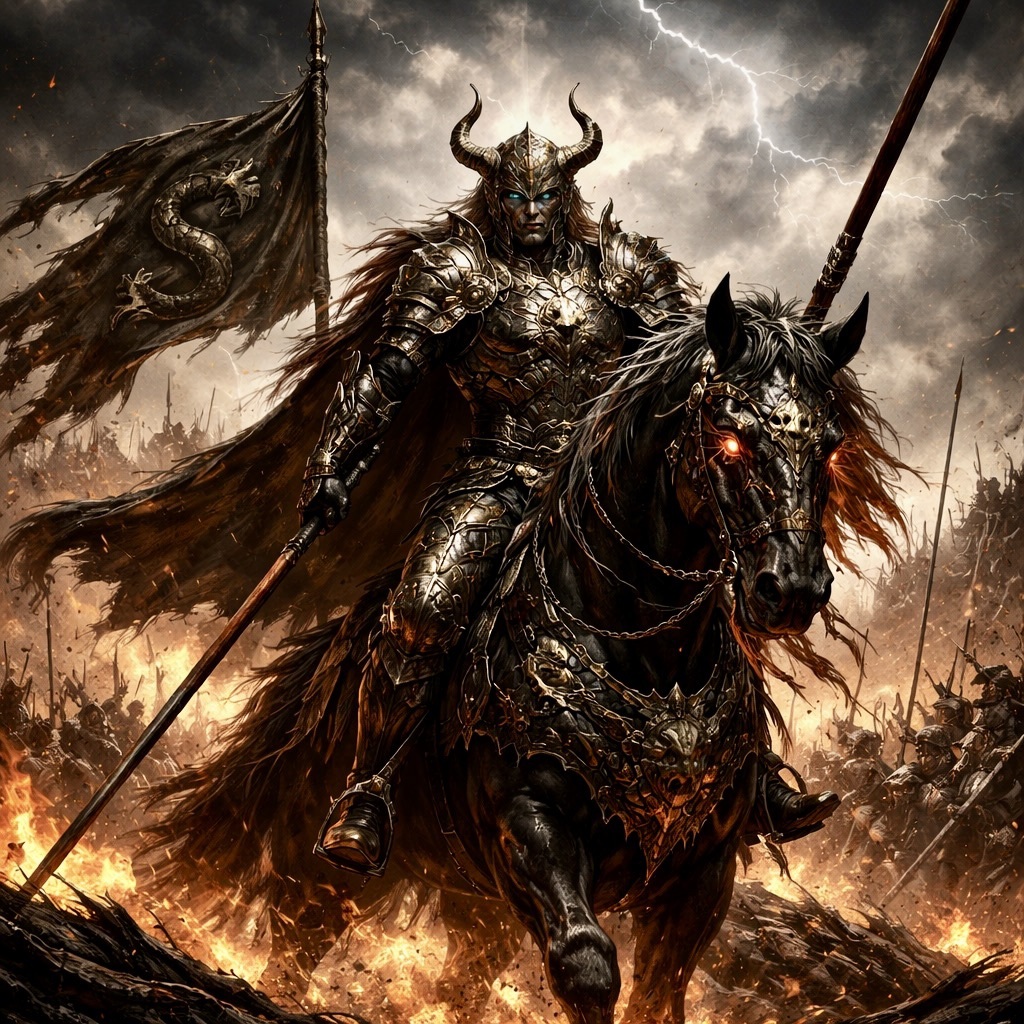
Within the dark and mysterious pages of medieval demonology, certain figures stand apart not merely for their terrifying appearance but for the roles they play in shaping the unseen forces of conflict and strategy. Among the seventy-two spirits cataloged in the Ars Goetia, the famous section of the seventeenth-century grimoire The Lesser Key of Solomon, the spirit known as Eligos—sometimes called Abigor—holds a distinctive place. Unlike demons associated primarily with temptation, wealth, or forbidden knowledge, Eligos is a figure deeply tied to warfare, leadership, and the hidden mechanics of victory and defeat. He is described as a powerful Duke of Hell who commands sixty legions of spirits and appears as a noble knight riding upon a spectral horse, carrying a lance, a banner, or sometimes a serpent.
The imagery surrounding Eligos immediately distinguishes him from many other infernal spirits. Rather than appearing as a monstrous creature of chaos, he manifests as a disciplined warrior. His armor gleams like that of a medieval cavalry officer, and his posture suggests calm authority rather than wild aggression. This detail reveals something important about how demonologists of the Renaissance understood conflict. War was not merely destruction; it was strategy, planning, and the careful orchestration of forces. Eligos embodies this strategic intelligence.
In the grimoires, Eligos is said to possess the ability to reveal hidden things—especially secrets related to warfare. He can disclose the plans of enemies, reveal the outcomes of battles, and expose the thoughts of opposing commanders. Such abilities would have been extraordinarily valuable in the political climate of early modern Europe. Wars were frequent, alliances shifted rapidly, and rulers constantly sought any advantage they could obtain.
It is not surprising, therefore, that occult practitioners imagined a spirit who could unveil the secret intentions of rival leaders. If one could learn the strategies of an enemy before the battle even began, victory might be secured without unnecessary bloodshed.
The name Abigor appears in some demonological texts as an alternate identity for Eligos, and in certain traditions the two are treated as the same entity. The name itself carries echoes of ancient languages, possibly derived from Hebrew or Latin roots associated with power and authority. Like many demonological names, its precise origin remains uncertain, which only deepens the aura of mystery surrounding the figure.
Descriptions of Eligos consistently portray him as riding a horse. Horses have long symbolized speed, nobility, and military prowess. In medieval warfare, cavalry units often determined the outcome of battles. A mounted knight possessed mobility and striking power that infantry soldiers could rarely match. By depicting Eligos as a mounted warrior, the grimoires associate him with command, mobility, and swift action.
The lance he carries reinforces this martial symbolism. Lances were weapons used in decisive charges during medieval combat. A cavalry charge could shatter enemy lines and determine the course of an entire battle within moments. The lance therefore represents precision and timing—the ability to strike exactly when conditions are favorable.
Yet Eligos is not merely a brute warrior. His most notable power lies in revealing secrets and predicting outcomes. This combination of intellect and martial skill makes him more of a strategist than a soldier. In modern terms, he resembles a military advisor or intelligence officer rather than a battlefield berserker.
Throughout history, intelligence gathering has played a crucial role in warfare. Generals rely on scouts, spies, and reconnaissance to understand the movements and intentions of their enemies. Sun Tzu, the ancient Chinese strategist who wrote The Art of War, famously emphasized the importance of knowing both oneself and one’s enemy. Without accurate information, even the most powerful army can be defeated.
Eligos’s mythology reflects this timeless principle. His supernatural knowledge represents the ultimate form of military intelligence. If a commander could consult such a spirit, they might gain insight into hidden weaknesses or impending threats.
In Renaissance Europe, where the grimoires gained popularity, warfare was becoming increasingly complex. Gunpowder weapons, professional armies, and shifting alliances transformed the battlefield. Commanders needed not only courage but also tactical insight. The idea of consulting supernatural advisors fit naturally into a worldview where spiritual forces were believed to influence everyday events.
Ceremonial magic during this era was often practiced by educated individuals—scholars, clergy, and noblemen who studied ancient manuscripts alongside theology and philosophy. They believed that spirits inhabited a structured universe governed by divine laws. By performing precise rituals, they hoped to summon these spirits and compel them to reveal hidden knowledge.
The rituals described in grimoires such as The Lesser Key of Solomon were highly elaborate. Magicians would draw protective circles inscribed with sacred names, recite invocations in Latin or Hebrew, and burn specific incenses believed to attract spiritual entities. These procedures were designed not only to summon the spirit but also to control it, preventing harm to the practitioner.
When summoned, Eligos was believed to appear calmly and speak truthfully about matters of conflict. Unlike many demons described as deceitful or mischievous, Eligos was said to provide accurate information when properly commanded.
This portrayal raises interesting questions about the moral complexity of demonology. If a demon reveals truth and helps prevent defeat, is that influence entirely evil? Medieval theologians debated such questions extensively. Some believed that demons could occasionally provide truthful information as part of a larger scheme to mislead humanity. Others argued that knowledge obtained through infernal means was inherently dangerous regardless of its accuracy.
From a modern perspective, the mythology of Eligos can be interpreted symbolically rather than literally. Instead of viewing him as an actual supernatural being, we might understand him as an archetype representing the strategic mind in times of conflict.
Psychologists and historians often describe archetypes as recurring patterns of human thought and behavior that appear across cultures. Figures such as warriors, sages, tricksters, and rulers appear in myths from every civilization. Eligos fits neatly into the archetype of the strategist—the individual who sees patterns and possibilities invisible to others.
In literature and storytelling, strategists often serve as pivotal characters who guide events from behind the scenes. They analyze situations, anticipate opponents’ moves, and shape outcomes through careful planning. Famous fictional strategists—from Sherlock Holmes to Tyrion Lannister—demonstrate how powerful intellect can be when applied to complex problems.
Eligos embodies that same strategic intelligence but within the dramatic framework of demonology.
Another intriguing aspect of Eligos’s mythology is his connection to foresight. The grimoires suggest that he can reveal the future of battles and conflicts. This ability reflects humanity’s longstanding desire to know what lies ahead. Uncertainty has always been one of the most frightening aspects of warfare. Soldiers march into battle without knowing whether they will survive or whether their cause will succeed.
Prophets, oracles, and seers appear throughout history precisely because people crave reassurance about the future. Ancient Greek generals consulted the Oracle of Delphi before launching campaigns. Medieval rulers relied on astrologers who claimed to predict auspicious moments for battle.
Eligos represents a darker counterpart to these prophetic traditions. Instead of divine inspiration, his knowledge emerges from the infernal realm. Yet the underlying human desire remains the same: certainty in the face of chaos.
The banner sometimes depicted in his hand carries its own symbolism. Banners in medieval warfare served as rallying points for soldiers. They represented the identity and honor of a particular army or kingdom. Losing one’s banner during battle was considered a devastating humiliation.
If Eligos carries a banner, it suggests authority over armies and allegiance. It reinforces his role as a commander rather than a mere warrior.
In some artistic depictions, a serpent appears alongside Eligos or forms part of his banner. The serpent is one of the most ancient symbols in human mythology. Across cultures it has represented wisdom, deception, transformation, and hidden knowledge. In the biblical tradition, the serpent embodies cunning intelligence.
By associating Eligos with a serpent, demonologists emphasize his connection to insight and strategy. Like a serpent, he observes patiently before striking with precision.
The dual identity of Eligos and Abigor also reflects the fluid nature of demonological traditions. Grimoires were copied and translated across centuries, often introducing variations in names and descriptions. Some texts portray Abigor as a separate figure, while others merge the identities completely.
Despite these variations, the core symbolism remains consistent: a mounted warrior with deep knowledge of conflict and hidden strategies.
In modern occultism, practitioners sometimes interpret spirits like Eligos as forces that influence psychological states rather than physical events. From this viewpoint, invoking Eligos might represent accessing one’s own capacity for strategic thinking and foresight.
Human beings possess remarkable abilities to analyze patterns, anticipate consequences, and adapt strategies in response to changing circumstances. Military leaders, chess grandmasters, and skilled negotiators all demonstrate this capacity.
When facing conflict—whether in business, politics, or personal relationships—individuals often benefit from stepping back and observing the situation with clarity. Emotional reactions can cloud judgment, while strategic thinking reveals alternative solutions.
Eligos’s mythology highlights the importance of this perspective. Rather than rushing blindly into battle, the wise leader studies the terrain, understands the opponent, and plans carefully.
Throughout history, the greatest commanders have shared this trait. Figures such as Alexander the Great, Napoleon Bonaparte, and Hannibal Barca achieved victories not merely through bravery but through innovative tactics and careful preparation.
The demonological image of Eligos riding calmly into battle mirrors the composure required of effective leaders. Panic and rage rarely produce good decisions. Strategy requires patience, observation, and discipline.
Even outside the context of warfare, these qualities remain valuable. Businesses compete in markets much like armies compete on battlefields. Political leaders navigate complex alliances and rivalries. Individuals manage personal conflicts that require negotiation and foresight.
In each of these situations, success often depends on understanding the hidden motivations and strategies of others.
Eligos’s mythology therefore resonates beyond the realm of supernatural folklore. It reflects enduring truths about conflict, leadership, and intelligence.
The fascination with such figures persists because they personify forces that shape human history. War and strategy have influenced the rise and fall of civilizations for thousands of years. Stories about supernatural generals and infernal advisors capture the drama and uncertainty of those struggles.
In the end, Eligos stands as a symbol of calculated power rather than chaotic destruction. His armored form, mounted on a spectral horse and carrying the instruments of war, represents the disciplined mind navigating the turbulence of conflict.
Whether interpreted as a literal demon from ancient grimoires or as a symbolic archetype of strategy, his legend reminds us that victory rarely belongs to the strongest alone. More often, it belongs to those who see clearly, plan carefully, and strike at precisely the right moment.
In the silent space before battle begins, when armies wait and the outcome remains uncertain, one might imagine the shadowy figure of Eligos riding along the horizon—watching, calculating, and whispering the secrets of war to those who dare to listen.