Among the seventy-two spirits recorded in the Ars Goetia, there are those who terrify, those who deceive, and those who command immense destructive power. And then there is Buer—a figure so unusual that he almost seems out of place among the infernal ranks. While many demons are associated with chaos or temptation, Buer is something else entirely. He is a teacher, a healer, and a guide to understanding the natural world. His presence within demonology reveals something deeply fascinating about how earlier societies understood knowledge, medicine, and the boundary between science and the supernatural.
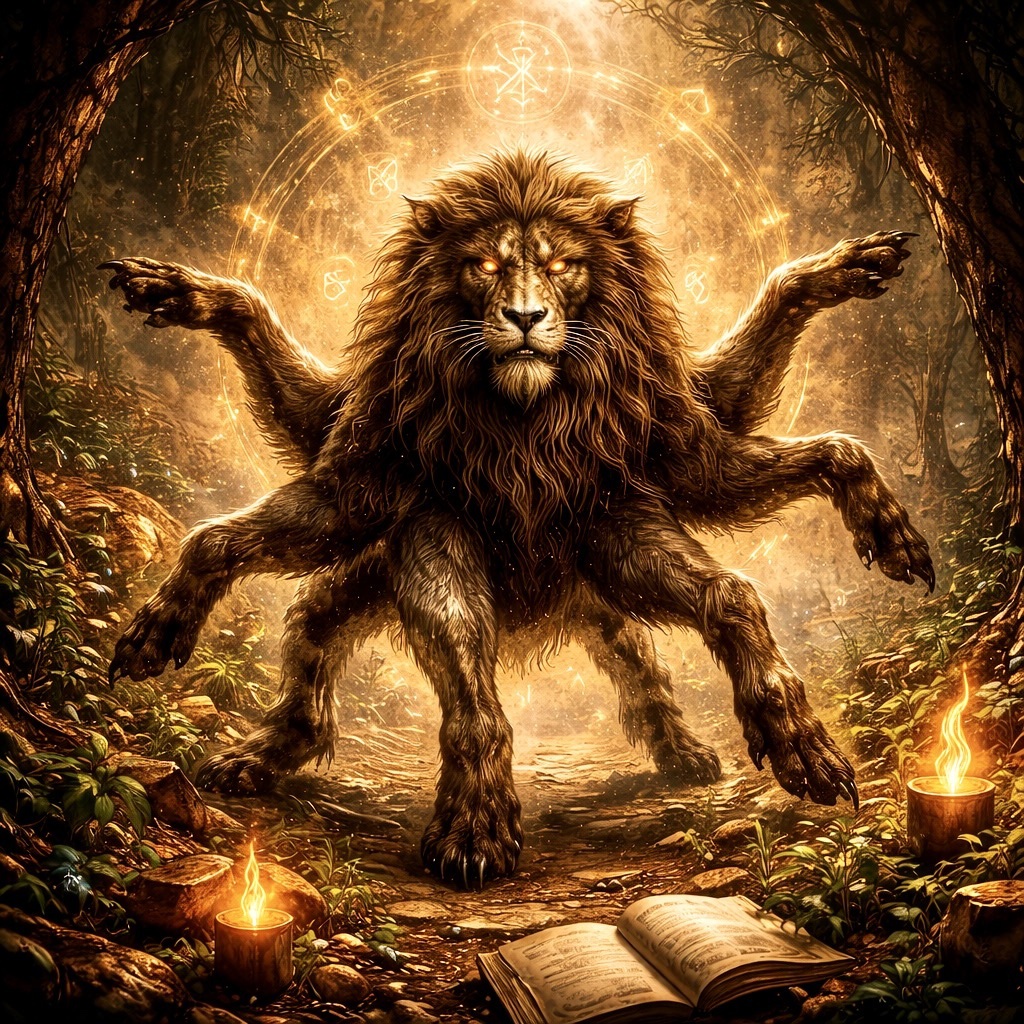
Buer is described as a President of Hell commanding fifty legions of spirits. His appearance is one of the most bizarre in all of demonology. He is said to have the head of a lion surrounded by five goat legs arranged like spokes on a wheel, allowing him to move in any direction. At first glance, this imagery feels almost surreal, even absurd. But like much of demonology, it is not meant to be taken purely at face value. It is symbolic—layered with meaning that reflects how people once understood complexity, motion, and the nature of knowledge itself.
The circular form of Buer’s body is particularly significant. The wheel has long been a symbol of cycles—of time, of nature, of life and death repeating endlessly. In ancient philosophy, the natural world was often understood as a series of interconnected cycles: seasons turning, plants growing and dying, the human body constantly renewing itself. By giving Buer a wheel-like form, the grimoires place him firmly within this worldview. He is not a disruptor of nature; he is an interpreter of it.
The lion’s head adds another layer. Lions have historically symbolized authority, strength, and command. In Buer’s case, this suggests mastery—not over armies or destruction, but over knowledge. He is not a king of war, but a ruler of understanding. His authority lies in teaching rather than conquering.
Perhaps the most striking aspect of Buer’s mythology is his association with healing. The grimoires state that he teaches natural philosophy, logic, and the virtues of herbs. He is said to cure all infirmities, particularly those affecting the human body. This places him in a category almost entirely unique among infernal spirits. While others tempt or deceive, Buer heals.
To understand why a demon would be associated with healing, we need to look at the historical context in which these texts were written. During the Renaissance, the boundaries between science, medicine, and magic were not clearly defined. Physicians studied herbal remedies alongside astrology. Scholars believed that plants, minerals, and celestial bodies all contained hidden properties that could influence health.
This field of study, often called “natural philosophy,” was the precursor to modern science. It sought to understand how the world worked through observation, experimentation, and interpretation of ancient texts. However, because knowledge was incomplete and often misunderstood, many of these studies were intertwined with mystical beliefs.
In that context, Buer becomes a representation of knowledge that sits on the edge of the known and the unknown. Healing, at the time, could feel almost miraculous. A plant that cured a disease might appear to possess magical properties. A physician who understood the body could seem like a sorcerer.
Buer’s role as a teacher of herbs is particularly important. Before modern medicine, herbal remedies were the primary means of treating illness. Knowledge of which plants could heal, which were poisonous, and how to prepare them was incredibly valuable. This knowledge was often passed down through generations, guarded carefully by those who possessed it.
By attributing this knowledge to a demon, the grimoires acknowledge its mysterious nature. Healing was not fully understood, and therefore it was seen as something that might originate from hidden or supernatural sources.
Buer also teaches logic, which may seem surprising at first. Logic is the foundation of rational thought—the ability to analyze, reason, and draw conclusions. Why would a demon be associated with such a disciplined and intellectual skill?
The answer lies in the Renaissance understanding of knowledge itself. Logic was considered a tool for uncovering truth, but truth was not always comfortable. It could challenge established beliefs, question authority, and reveal uncomfortable realities. In that sense, logic was both empowering and dangerous.
Buer embodies this duality. He offers knowledge that can heal and enlighten, but that knowledge also has the potential to disrupt. Understanding the natural world can lead to progress, but it can also challenge existing systems of power and belief.
The idea that a demon might teach philosophy and healing reflects a broader theme in demonology: that knowledge itself is morally neutral. It is neither good nor evil. Its impact depends on how it is used.
This perspective is remarkably modern. Today, we recognize that scientific advancements can improve lives while also introducing new challenges. Medicine can cure diseases, but it can also raise ethical questions. Technology can connect people, but it can also create new forms of conflict.
Buer’s mythology anticipates this complexity. He is not a villain, nor is he a benevolent guardian. He is a source of knowledge—one that must be approached with understanding and caution.
The wheel-like structure of his body also suggests movement and adaptability. Unlike a creature bound to a single direction, Buer can move freely, adjusting his path as needed. This reflects the nature of knowledge itself. Understanding is not static; it evolves. New discoveries reshape old ideas, and perspectives shift over time.
In this way, Buer represents the process of learning. It is not a straight path but a continuous cycle of observation, interpretation, and revision.
From a psychological perspective, Buer can be interpreted as an archetype of intellectual curiosity and healing. He embodies the human drive to understand the world and improve it. When people study medicine, research new treatments, or seek to understand the body, they are engaging with the same impulse that Buer represents.
Healing, both physical and emotional, often begins with knowledge. Understanding the cause of an illness is the first step toward treating it. Recognizing patterns in behavior can lead to personal growth. In this sense, Buer’s teachings extend beyond herbs and medicine into broader aspects of human experience.
Interestingly, Buer’s appearance—so strange and unconventional—may also reflect the complexity of the systems he represents. The human body is not simple. It is an intricate network of systems working together in delicate balance. The natural world is equally complex, with countless interactions between plants, animals, and environmental factors.
Buer’s form, with its multiple limbs and circular motion, mirrors this complexity. It is not meant to be easily understood. It challenges the observer, forcing them to look beyond simple interpretations.
This aligns with the nature of scientific inquiry. The deeper we look into the world, the more complex it becomes. Simple explanations give way to intricate systems that require careful study and analysis.
In medieval and Renaissance thought, this complexity often led to the belief that hidden forces were at work. Without modern scientific tools, many phenomena could not be explained fully. Disease, in particular, was mysterious and often frightening. Epidemics could spread rapidly, and their causes were not well understood.
In such a world, the idea of a spirit who could heal and explain the natural world would have been incredibly appealing.
Buer’s association with curing all infirmities suggests a form of ultimate knowledge—an understanding so complete that it can address any problem. This idea resonates with the human desire for certainty and control over illness.
Even today, medicine continues to evolve, striving toward greater understanding and more effective treatments. The quest for a cure for every disease remains one of humanity’s most ambitious goals.
Buer represents that aspiration in mythological form.
At the same time, his presence within demonology serves as a reminder that knowledge is not always comfortable. Learning the truth about something—whether it is an illness, a system, or a personal reality—can be challenging. It requires confronting uncertainty and complexity.
Buer does not simplify the world. He reveals its intricacies.
In modern interpretations, Buer is often seen as a symbol of intellectual and scientific exploration. He represents the pursuit of knowledge that leads to healing and understanding. His teachings are not limited to a specific domain but encompass a broader approach to learning.
This makes him one of the most intriguing figures in demonology. While many demons embody fear or temptation, Buer embodies curiosity and insight.
His presence suggests that the boundaries between knowledge and mystery are not always clear. What we understand today may have been considered magical in the past. What seems mysterious now may become understood in the future.
Buer exists at that boundary—where understanding begins to emerge from uncertainty.
In the end, his mythology offers a powerful reflection on the nature of knowledge itself. It is complex, evolving, and often difficult to grasp fully. It can heal, but it can also challenge. It requires patience, observation, and a willingness to explore beyond the familiar.
And like the strange, wheel-like figure moving in all directions at once, the pursuit of understanding does not follow a straight path. It turns, shifts, and adapts, revealing new perspectives with every step.
In that ever-turning motion, in the quiet search for answers and the steady progress of discovery, that is where Buer truly resides.