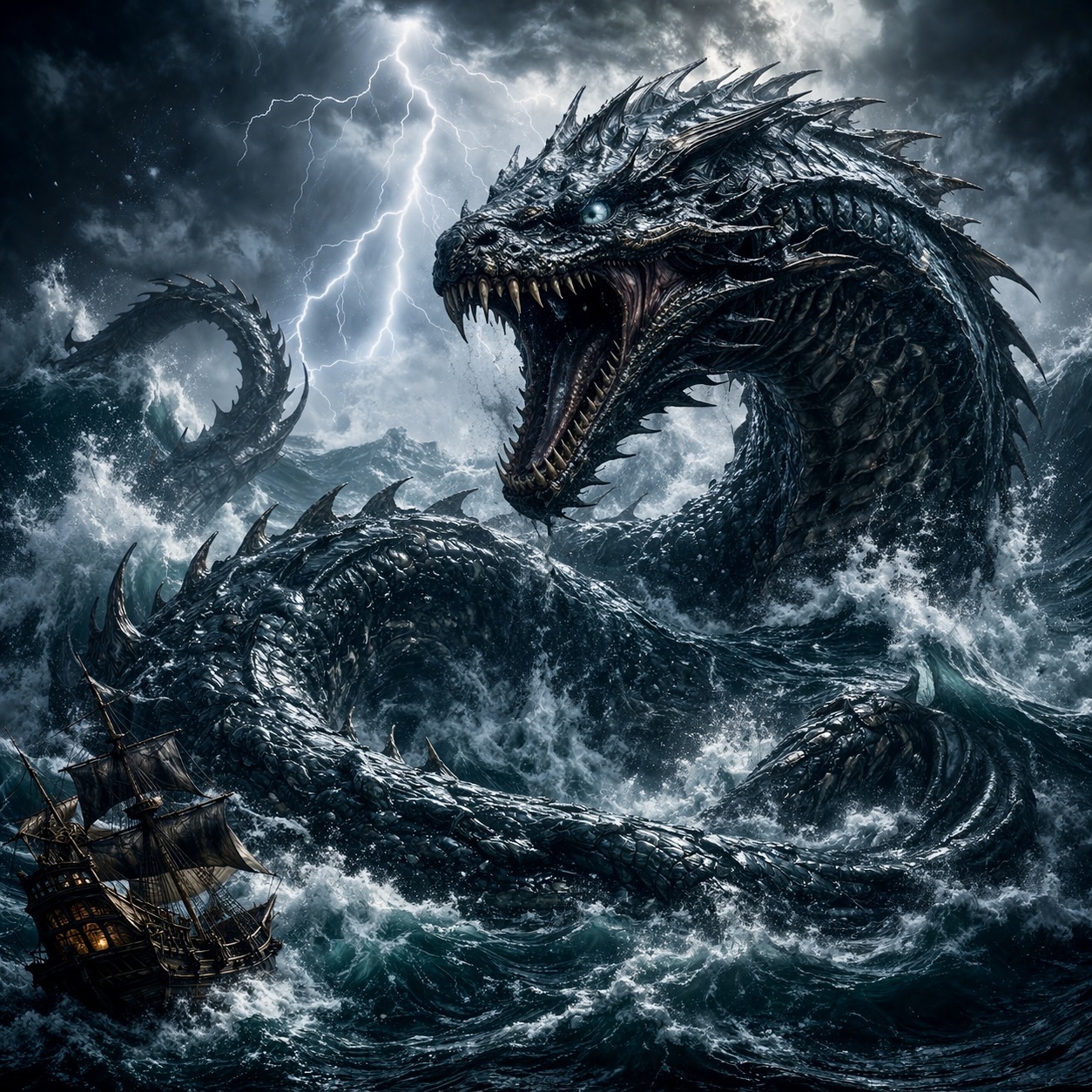
Leviathan is not a figure that belongs neatly to a single category. He is older than many of the demons that populate grimoires like the Ars Goetia, and his presence reaches into some of the earliest mythological and religious texts that humanity has produced. To encounter Leviathan is not to meet a character in a hierarchy—it is to confront a force. He is not merely a demon of chaos or envy, as later traditions sometimes classify him. He is something far more elemental: the embodiment of the unknown, the uncontainable, and the immense power that exists beyond human control.
His origins are deeply rooted in ancient Near Eastern mythology and biblical literature. In the Hebrew Bible, Leviathan is described as a massive sea creature, a serpent or dragon of unimaginable size and strength, dwelling in the depths of the ocean. The descriptions are vivid and poetic—scales that cannot be penetrated, breath that ignites flames, a presence that inspires awe and fear in equal measure.
But these descriptions are not simply about a creature.
They are about scale.
Leviathan represents something too large to comprehend, too powerful to control, and too distant from human experience to be easily understood.
The ocean itself is central to this symbolism. For much of human history, the sea has represented both opportunity and danger. It provides resources, connects distant lands, and enables exploration. But it is also unpredictable, vast, and capable of overwhelming even the most prepared individuals.
Leviathan is the ocean personified.
He is not just within it.
He is it.
This identification with the sea is significant because it ties Leviathan to the concept of the unknown. The depths of the ocean have long been a metaphor for the unconscious—the parts of existence that are hidden, unexplored, or beyond immediate perception.
From a psychological perspective, Leviathan can be understood as an archetype of the unconscious mind. He represents the vast reservoir of thoughts, emotions, and impulses that exist beneath conscious awareness. These elements influence behavior, shape perception, and drive action, often without being fully recognized.
Like the ocean, the unconscious is both powerful and mysterious.
It can be calm and supportive, providing insight and creativity. But it can also be turbulent, generating fear, confusion, and unpredictability.
Leviathan embodies this duality.
He is not inherently destructive, but his power makes him dangerous.
He is not malicious, but he is indifferent.
This indifference is key to understanding his role. Unlike figures such as Asmodeus or Mammon, who interact with human desires and motivations, Leviathan operates on a different level. He does not tempt, persuade, or influence in a direct sense.
He exists.
And in existing, he represents a reality that must be acknowledged.
This reality is that there are forces beyond human control.
No matter how advanced systems become, no matter how much knowledge is acquired, there will always be elements that remain unpredictable. Natural disasters, emotional responses, complex systems—these are all aspects of existence that cannot be fully controlled.
Leviathan is the embodiment of that limitation.
He is the reminder that control is never absolute.
This does not mean that interaction with such forces is impossible. Humans have learned to navigate the ocean, to study it, to understand its patterns. But this understanding is always partial. It reduces risk, but it does not eliminate it.
Leviathan remains.
From a mythological standpoint, Leviathan often appears in narratives that involve confrontation between order and chaos. In some traditions, he is defeated or subdued by a higher power, symbolizing the establishment of order over chaos.
But even in these stories, his presence is not erased.
He is contained, not destroyed.
This distinction is important. Chaos, in its pure form, cannot be eliminated. It can be managed, structured, or balanced, but it remains a fundamental aspect of existence.
Leviathan represents this enduring presence.
He is not the enemy of order.
He is its counterpart.
Without chaos, order has no meaning. Without unpredictability, stability cannot be defined.
Leviathan provides the contrast that allows structure to exist.
In later demonological traditions, Leviathan is sometimes associated with the sin of envy. This association may seem less intuitive than his earlier representations, but it reflects another aspect of his symbolism.
Envy, like the ocean, is deep and often hidden. It is not always visible on the surface, but it can influence behavior in subtle ways. It involves comparison, desire, and dissatisfaction—emotions that can grow and intensify beneath conscious awareness.
Leviathan’s connection to envy highlights his relationship with depth.
He is not about surface-level experience.
He is about what lies beneath.
This focus on depth is also reflected in his physical depiction. Unlike many demons that are portrayed in humanoid form, Leviathan is almost always represented as a creature—serpentine, immense, and otherworldly.
This lack of human form emphasizes his difference.
He is not like us.
He does not operate according to human logic or emotion.
He exists in a different category.
This distinction makes him both fascinating and unsettling. Humans are drawn to what they can understand, what they can relate to. Leviathan resists this.
He cannot be easily interpreted or categorized.
He is too large, too complex, too distant.
In literature, figures like Leviathan often serve as representations of overwhelming forces—nature, fate, or the unknown. They challenge characters to confront their limitations, to recognize the boundaries of their control, and to adapt.
These encounters are rarely about victory.
They are about understanding.
Leviathan cannot be conquered in the traditional sense.
He can only be acknowledged.
From a modern perspective, his archetype is particularly relevant in the context of complex systems. Global economies, ecosystems, technological networks—these are systems that are vast, interconnected, and difficult to fully comprehend.
They exhibit behaviors that are not always predictable.
They can shift rapidly, influenced by factors that are not immediately apparent.
Leviathan represents this complexity.
He is the system that cannot be fully mapped.
The force that operates beyond complete understanding.
This does not make him inherently negative.
It makes him real.
He reflects the limits of human perception and control.
He reminds us that certainty is always partial, that knowledge is always evolving, and that there are always deeper layers to explore.
In the end, Leviathan stands as one of the most powerful and enduring symbols in demonology and mythology. He is not defined by a single role or narrative. He is defined by his scale, his depth, and his connection to the unknown.
He is the ocean in its most primal form.
The unconscious in its most expansive state.
The chaos that exists alongside order.
And somewhere in the vast, shifting depths of existence, where light fades and certainty dissolves, where understanding gives way to mystery—that is where Leviathan resides.
Not as something to be defeated, but as something to be faced.
The one who reminds us how small we are—and how much remains beneath the surface.