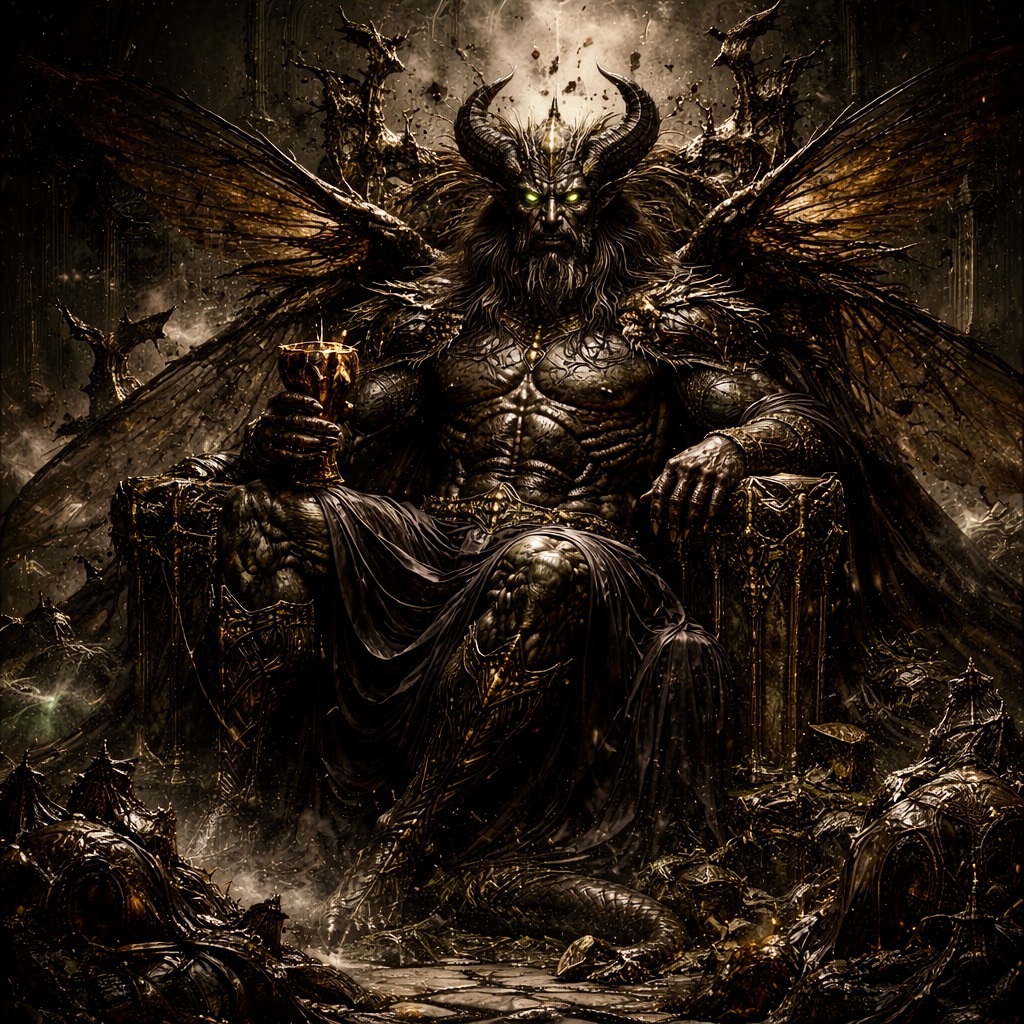
Beelzebub is one of the most infamous and enduring names in demonology, a figure whose reputation has grown so large that it has, at times, eclipsed the details of his origins. Often mentioned alongside figures like Satan and Lucifer, Beelzebub carries a sense of authority and decay simultaneously—a paradox that lies at the heart of his identity. He is not merely a demon of corruption. He is the embodiment of corruption itself, the slow, creeping breakdown of systems that appear strong on the surface but are rotting from within.
His name is derived from the ancient Philistine deity Baal-Zebub, often translated as “Lord of the Flies.” Originally, Baal was a title meaning “lord” or “master,” and was associated with various regional deities connected to fertility, storms, and power. Over time, as cultural and religious narratives shifted, Baal-Zebub was reinterpreted and transformed into Beelzebub, a figure associated not with life and power, but with decay and corruption.
This transformation is not accidental.
It reflects a broader pattern in which former symbols of authority are redefined as symbols of opposition.
But in the case of Beelzebub, something deeper occurs.
The association with flies becomes central.
Flies are not random creatures in symbolic language. They are drawn to decay, to waste, to things that are breaking down. They thrive in environments where structure has failed, where cleanliness has been replaced by neglect, where systems are no longer maintained.
To be the “Lord of the Flies” is not to command insects alone.
It is to preside over decay.
Beelzebub does not create destruction in the immediate, explosive sense that figures like Abaddon represent. He does not burn or shatter. Instead, he infiltrates, settles, and spreads.
He is the slow breakdown.
The unnoticed deterioration.
The system that continues to function—until it doesn’t.
This distinction is crucial.
Sudden destruction is visible. It demands attention. It forces response.
Corruption, on the other hand, is subtle. It grows gradually, often unnoticed until it has reached a critical point.
Beelzebub operates within that subtlety.
He does not need to announce himself.
He is already present in the cracks.
From a psychological perspective, Beelzebub can be understood as an archetype of internal corruption—the gradual erosion of values, focus, or integrity. This process rarely begins with dramatic change. It starts with small compromises, minor deviations, choices that seem insignificant in isolation.
Over time, these accumulate.
The structure weakens.
The foundation shifts.
And eventually, what once seemed stable becomes unstable.
Beelzebub represents that accumulation.
He is not the first compromise.
He is the result of many.
This makes him particularly relevant in contexts where systems are expected to maintain integrity over time—organizations, institutions, relationships, even personal habits.
In each of these systems, there is an assumption of stability.
Rules are followed.
Standards are maintained.
Processes are respected.
But these assumptions can erode.
Standards slip.
Rules are bent.
Processes are bypassed.
At first, these changes may seem harmless.
They may even be justified.
But over time, they alter the system.
Beelzebub thrives in this environment.
He does not force the change.
He benefits from it.
The imagery associated with him often includes swarms of flies, decaying environments, and a sense of stagnation. These visuals reinforce his connection to environments where movement has slowed, where renewal has stopped, and where deterioration has begun.
Stagnation is a key component of his symbolism.
Systems that are not actively maintained do not remain static.
They decline.
Beelzebub represents this decline.
He is the absence of renewal.
The failure to address small issues before they become large ones.
This absence is important because it highlights the role of maintenance in any system. Whether it is physical, social, or psychological, systems require ongoing attention to remain functional.
Without that attention, they begin to break down.
Beelzebub is not the cause of neglect.
He is its consequence.
His association with power adds another layer to his identity. As a figure often described as a prince or high-ranking demon, Beelzebub is not positioned at the margins. He is at the center.
This positioning suggests that corruption is not limited to weak or failing systems.
It can exist at the highest levels.
In fact, it may be more dangerous there.
When corruption occurs at the top, it influences everything below it. Decisions are affected. Standards shift. Behavior changes.
The system adapts to the corruption.
Beelzebub represents this top-down influence.
He is not just within the system.
He is shaping it.
From a philosophical standpoint, his archetype raises questions about integrity and sustainability. What does it take to maintain a system over time? How do small changes accumulate into larger ones? At what point does correction become necessary?
These questions are not easily answered, but they are essential.
Beelzebub’s presence highlights their importance.
He does not provide solutions.
He reveals the problem.
In literature, characters or forces that resemble Beelzebub often appear as hidden influences—advisors, environments, or conditions that gradually alter behavior. They do not act dramatically. They shift context.
And context shapes action.
This subtlety is what makes Beelzebub particularly dangerous.
He does not need to act directly.
He changes the environment in which actions occur.
From a modern perspective, his symbolism is highly relevant. In complex systems such as governments, corporations, and technological networks, the risk of gradual corruption is significant. Processes can become inefficient. Incentives can become misaligned. Priorities can shift.
These changes are rarely immediate.
They develop over time.
Beelzebub represents this development.
He is the pattern of decline that emerges when attention lapses.
But his symbolism is not purely negative.
By representing corruption, he also highlights the importance of awareness.
Recognizing the early signs of decline allows for correction.
Addressing small issues prevents larger ones.
Maintaining systems requires effort, attention, and consistency.
Beelzebub’s presence is a reminder of this necessity.
In the end, Beelzebub stands as a symbol of the slow, often invisible forces that shape outcomes. He is not the storm that destroys a structure in an instant.
He is the weakness in the foundation.
The crack in the wall.
The overlooked detail that grows over time.
And somewhere in the quiet spaces where neglect takes hold, where small compromises accumulate, where systems begin to shift without notice—that is where Beelzebub resides.
Not as a force that demands attention, but as one that thrives when attention is absent.
The one who reminds us that decay does not need to be loud to be complete.