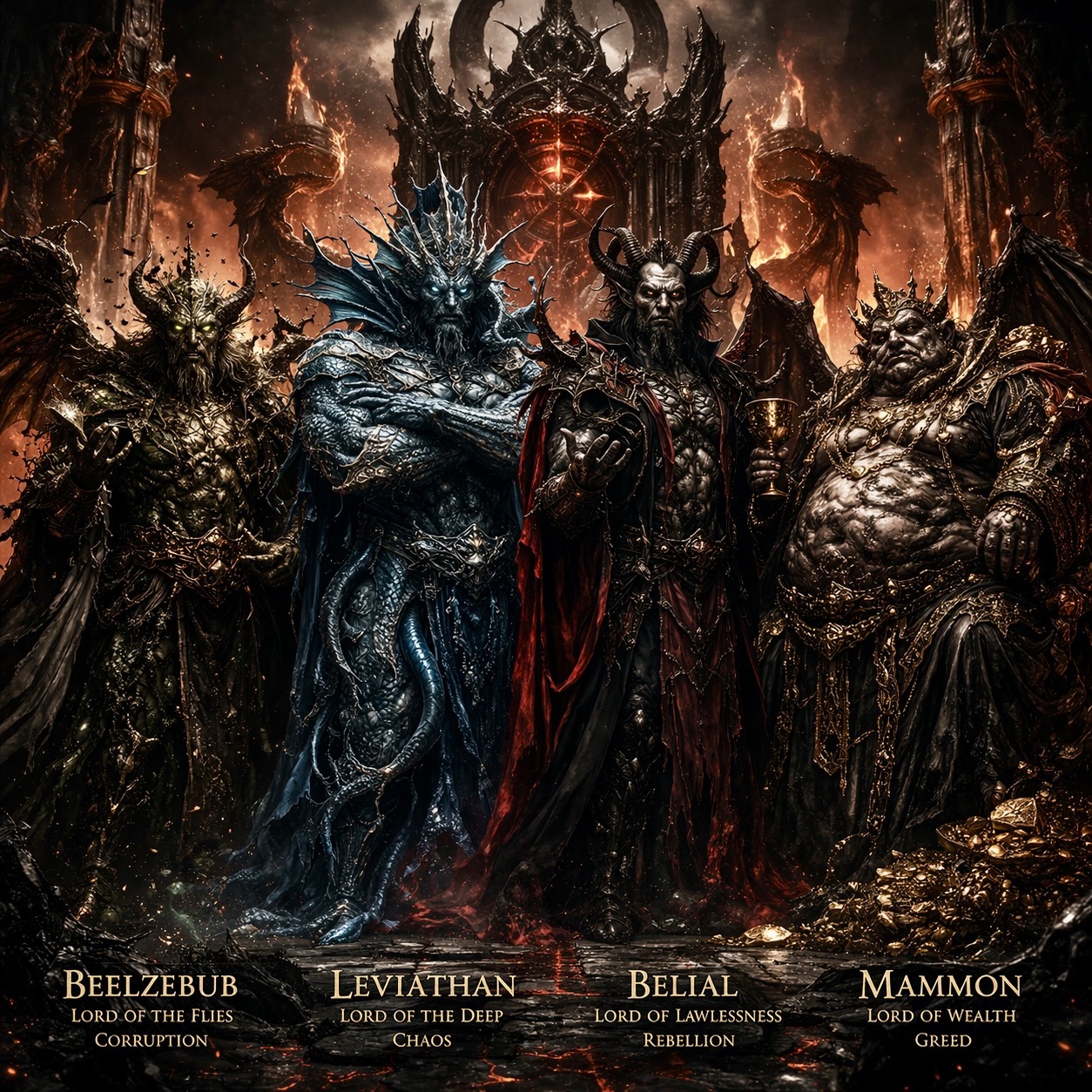
There is something uniquely compelling about the idea of hierarchy within chaos. It feels almost contradictory at first glance. If chaos is disorder, then why would it have structure? Why would there be ranks, titles, or authority within something that is defined by its resistance to order? And yet, across centuries of demonology, mythology, and theological interpretation, we repeatedly see the same pattern emerge: even the forces that oppose structure seem to organize themselves in ways that reflect it.
This is where the concept of the Crown Princes of Hell becomes especially fascinating.
Figures like Beelzebub, Leviathan, Belial, and Mammon are not simply demons among many. They are elevated, distinguished, and recognized as central forces within infernal hierarchies. They are not interchangeable. Each represents something specific, something fundamental, something deeply rooted in the way humans understand power, temptation, and the internal dynamics that shape behavior.
To understand them as a group is not just to list their attributes. It is to see how they interact conceptually, how they form a system of ideas that reflects the complexities of human nature itself.
Beelzebub, often referred to as the Lord of the Flies, represents corruption in its most insidious form. He is not the force that destroys openly, but the one that infiltrates quietly. His influence is gradual, almost invisible at first. Systems do not collapse under Beelzebub—they decay. Integrity weakens, standards slip, and over time, what once appeared stable begins to crumble from within.
Leviathan, by contrast, represents something far more primal. He is not subtle. He is vast, overwhelming, and deeply connected to the unknown. As a symbol of chaos, depth, and the unconscious, Leviathan is the force that exists beyond control. He is not concerned with systems in the same way Beelzebub is. He is the reminder that no system, no matter how carefully constructed, can fully contain the complexity of existence.
Belial occupies a different space entirely. He is the embodiment of lawlessness, not as randomness, but as deliberate independence. He rejects imposed structure, not because he lacks the ability to follow it, but because he chooses not to. Belial represents autonomy taken to its extreme—the idea that value, meaning, and direction can be defined entirely from within, without reference to external systems.
Mammon completes this core grouping with a focus on material value and accumulation. He is the force that transforms wealth from a tool into an identity. Where Beelzebub corrupts systems, Mammon redefines them. Success becomes numerical, worth becomes measurable, and the pursuit of more becomes an end in itself.
Individually, these figures are powerful. Together, they form something even more significant.
They create a framework.
Not of order in the traditional sense, but of influence.
Each Crown Prince represents a different axis along which human behavior can shift.
Beelzebub governs decay.
Leviathan governs chaos.
Belial governs autonomy.
Mammon governs value.
These are not isolated concepts.
They interact.
Consider what happens when Beelzebub and Mammon intersect. Corruption and wealth create a system where accumulation overrides integrity, where success is achieved at the cost of structure. This is not a theoretical scenario. It appears repeatedly in real-world systems, where financial incentives can lead to ethical compromise.
Now consider Leviathan and Belial. Chaos and autonomy combine to create a space where structure is not just rejected, but irrelevant. This can lead to creativity and innovation, but also to fragmentation and instability.
Each combination produces a different outcome.
Each interaction reveals a different aspect of how systems function—and how they fail.
This is what makes the Crown Princes so compelling as a group. They are not just characters. They are variables.
They represent forces that can be present in any system, any decision, any moment.
From a psychological perspective, this grouping can be understood as a map of internal dynamics. Each Prince corresponds to a different aspect of the psyche.
Beelzebub reflects the tendency toward neglect and gradual decline—the part of the mind that allows small issues to go unaddressed until they become larger problems.
Leviathan represents the unconscious—the vast, complex, and often unpredictable foundation of thought and emotion.
Belial embodies independence and defiance—the drive to resist control and define one’s own path.
Mammon represents desire for security and accumulation—the need to gather resources, to measure success, to establish stability.
These aspects are not inherently negative.
They are necessary.
But like all forces, they require balance.
Without awareness, they can dominate.
Without balance, they can distort.
The Crown Princes, then, are not simply embodiments of sin or corruption.
They are reflections of imbalance.
They show what happens when one aspect of the system outweighs the others.
When decay is unchecked, Beelzebub rises.
When chaos overwhelms structure, Leviathan dominates.
When autonomy becomes absolute, Belial takes hold.
When accumulation becomes obsession, Mammon prevails.
This perspective shifts the narrative from one of external influence to one of internal dynamics. The Crown Princes are not just outside forces acting upon individuals. They are representations of tendencies that exist within.
This is why their stories persist.
They resonate.
They reflect patterns that are recognizable, even if they are not always acknowledged.
In literature, groups like the Crown Princes often function as councils or assemblies—collections of powerful figures whose interactions drive the narrative. Each member brings a different perspective, a different strength, a different influence.
The tension between them creates movement.
The balance between them creates stability.
When that balance is disrupted, the system changes.
This dynamic can be applied to any complex system, from organizations to ecosystems to personal decision-making processes. Each system contains multiple forces, each with its own priorities and influences.
Understanding these forces is key to understanding the system.
The Crown Princes provide a symbolic framework for this understanding.
They are not solutions.
They are representations.
They do not dictate outcomes.
They reveal possibilities.
From a modern perspective, their relevance is striking. In a world of increasing complexity, where systems are interconnected and constantly evolving, the need to understand underlying dynamics is greater than ever.
The Crown Princes offer a way to conceptualize these dynamics.
Not as abstract ideas, but as tangible forces.
They make complexity visible.
They give form to patterns that might otherwise go unnoticed.
In the end, the Crown Princes of Hell are not just figures of fear or fascination. They are mirrors—reflections of the forces that shape behavior, influence decisions, and define systems.
They are the decay that must be addressed.
The chaos that must be navigated.
The autonomy that must be balanced.
The value that must be understood.
And somewhere in the interplay between these forces, in the shifting balance that defines every system, every decision, every moment—that is where the Crown Princes reside.
Not as rulers of a distant realm, but as representations of something much closer.
The forces that shape everything from within.