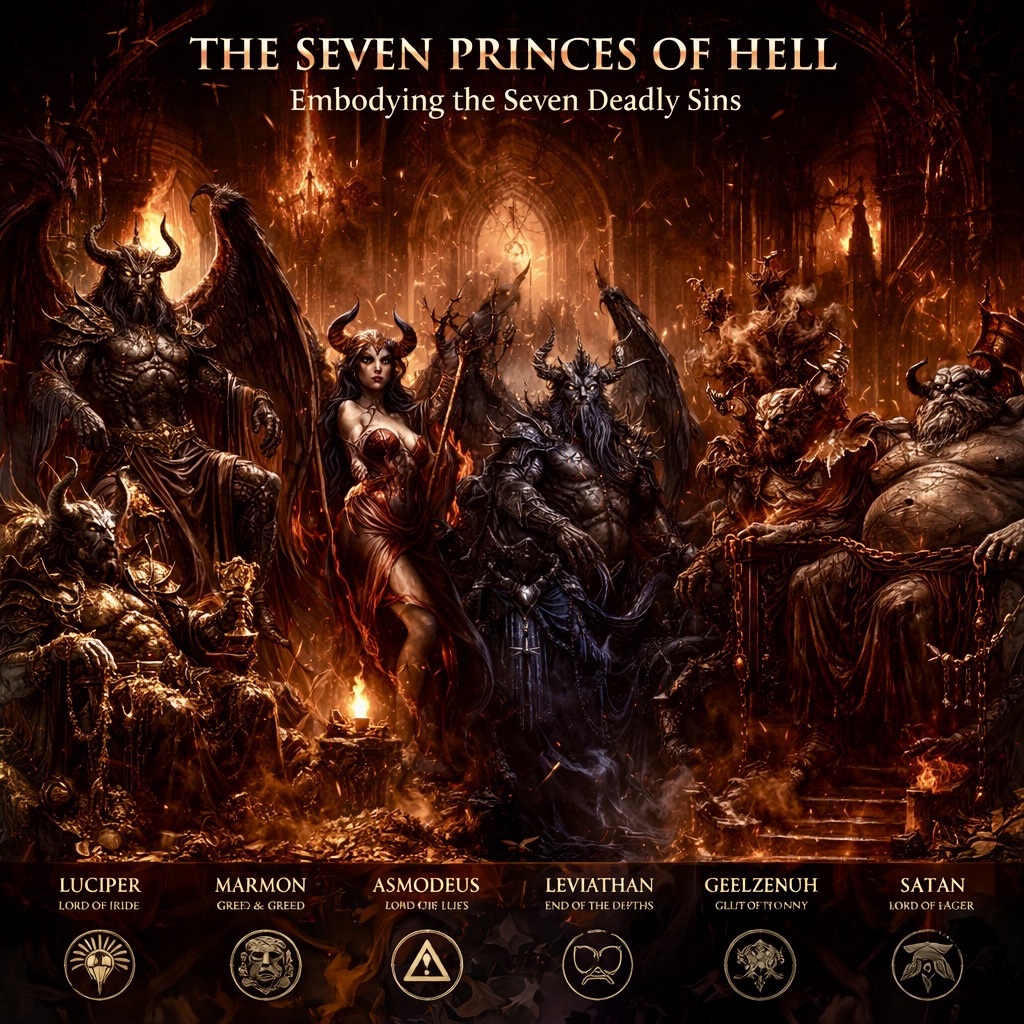
There is something deeply compelling about the idea that human behavior—its impulses, its struggles, its contradictions—can be distilled into a set of fundamental forces. The concept of the Seven Deadly Sins has endured for centuries not because it is simple, but because it is intuitive. It reflects patterns that people recognize within themselves, patterns that appear across cultures, across time, across different systems of belief. When these sins are personified through the Seven Princes of Hell, they become more than abstract ideas. They become characters, forces, and reflections of something that feels both external and internal at the same time.
The Seven Princes—commonly associated with Pride, Greed, Lust, Envy, Gluttony, Wrath, and Sloth—are not merely rulers in a mythological sense. They are representations of tendencies that exist within every individual. Each Prince embodies a specific axis of human behavior, a direction in which desire can move, a way in which balance can be lost.
Lucifer, often associated with Pride, stands at the center of this structure. Pride is not inherently negative. It can manifest as confidence, self-respect, and a sense of identity. But when it becomes excessive, it shifts. It turns inward, becoming self-centered, disconnected from reality, resistant to correction. Lucifer represents this shift—the moment when self-awareness becomes self-obsession, when identity becomes inflexible, when the need to be right overrides the ability to grow.
Mammon, representing Greed, operates on a different axis. Where Pride focuses on identity, Greed focuses on accumulation. It is the drive to gather resources, to secure stability, to ensure survival. In moderation, this drive is necessary. But when it becomes excessive, it transforms into something else. The goal is no longer sufficiency. It becomes excess. Mammon embodies this transformation, where value is measured not by purpose, but by quantity.
Asmodeus, associated with Lust, brings attention to desire in its most immediate form. Lust is not limited to physical attraction. It is the broader impulse toward experience, toward connection, toward intensity. It is the force that drives engagement with the world. But when it becomes unbalanced, it can override judgment, leading to decisions that prioritize immediacy over consequence. Asmodeus represents this amplification—the moment when desire becomes overwhelming.
Leviathan, representing Envy, shifts the focus inward again, but in a different way than Pride. Envy is not about self-definition. It is about comparison. It arises when individuals measure themselves against others, when satisfaction is influenced by external reference points. Leviathan embodies the depth of this experience—the way it can grow beneath the surface, influencing perception and behavior without always being visible.
Beelzebub, associated with Gluttony in some traditions, and sometimes with corruption more broadly, represents excess consumption. Gluttony is not limited to food. It is the tendency to take in more than is necessary, whether it be resources, information, or experiences. It reflects a lack of balance, a failure to regulate intake. Beelzebub embodies this imbalance, particularly in the way it can lead to stagnation and decay when not addressed.
Satan, often linked to Wrath, represents a different kind of intensity. Wrath is not simply anger. It is the escalation of anger into action, into force, into a desire for change or correction. In controlled forms, it can lead to justice, to response against wrongdoing. But when uncontrolled, it becomes destructive, indiscriminate. Satan embodies this potential, the point at which emotion overrides restraint.
Belphegor, representing Sloth, completes the structure with a focus on inaction. Sloth is not simply laziness. It is the avoidance of effort, the reluctance to engage, the preference for ease over challenge. In moderation, rest is necessary. Recovery is essential. But when avoidance becomes habitual, it leads to stagnation. Belphegor embodies this tendency, the pull toward comfort that can limit growth.
Individually, each of these Princes represents a specific dynamic. Together, they form a system—a map of human behavior that is both comprehensive and interconnected.
These forces do not exist in isolation.
They interact.
Pride can lead to Wrath when challenged.
Greed can fuel Envy when comparison reveals disparity.
Lust can contribute to Gluttony when desire extends beyond moderation.
Sloth can enable all of them by reducing resistance, by allowing impulses to operate without opposition.
The system is dynamic.
It shifts.
It evolves.
This is what makes the Seven Princes so powerful as a concept. They are not static representations of fixed traits. They are part of a network, influencing and reinforcing each other in complex ways.
From a psychological perspective, this network can be understood as a model of internal conflict. Each sin represents a different impulse, a different direction of movement. The challenge is not to eliminate these impulses, but to balance them.
Without Pride, there is no identity.
Without Greed, there is no accumulation.
Without Lust, there is no engagement.
Without Envy, there is no comparison.
Without Gluttony, there is no intake.
Without Wrath, there is no response.
Without Sloth, there is no rest.
Each has a function.
Each has a purpose.
The problem arises when one dominates.
The Seven Princes represent dominance.
They show what happens when balance is lost, when one aspect of behavior overrides the others.
This is not just a moral framework.
It is a structural one.
It describes how systems operate, how they can become unbalanced, and how that imbalance can manifest.
In literature, the Seven Princes often appear as rulers of distinct domains, each controlling a specific aspect of existence. This division reinforces their individuality while highlighting their interconnectedness. They are separate, but they are also part of a whole.
This duality reflects the human experience.
Individuals are composed of multiple impulses, multiple tendencies, multiple directions of movement. Understanding these components is key to understanding behavior.
The Seven Princes provide a symbolic way to do this.
They externalize internal dynamics.
They give form to patterns.
They make abstract concepts tangible.
From a modern perspective, their relevance remains strong. In a world of constant stimulation, where choices are abundant and systems are complex, the challenge of maintaining balance is significant.
The Seven Princes represent the extremes.
They show what happens when balance is lost.
But they also highlight the importance of awareness.
Recognizing these patterns allows for adjustment.
It creates the possibility of change.
In the end, the Seven Princes of Hell are not just figures of myth or morality. They are reflections of something fundamental—something that exists within every system, every decision, every individual.
They are the forces that drive behavior.
The tendencies that shape outcomes.
The patterns that repeat across time.
And somewhere between moderation and excess, between balance and dominance, between control and impulse—that is where the Seven Princes reside.
Not as rulers of a distant realm, but as representations of something far closer.
The forces that define what it means to be human.