
Among the seventy-two spirits described in the Ars Goetia, Agares stands as one of the most uniquely composed figures—an entity whose symbolism weaves together power, knowledge, movement, and control in ways that feel both ancient and strangely modern. He is not defined by chaos or deception, nor by raw destruction alone. Instead, Agares exists at the intersection of stability and disruption, communication and force, grounding and upheaval.
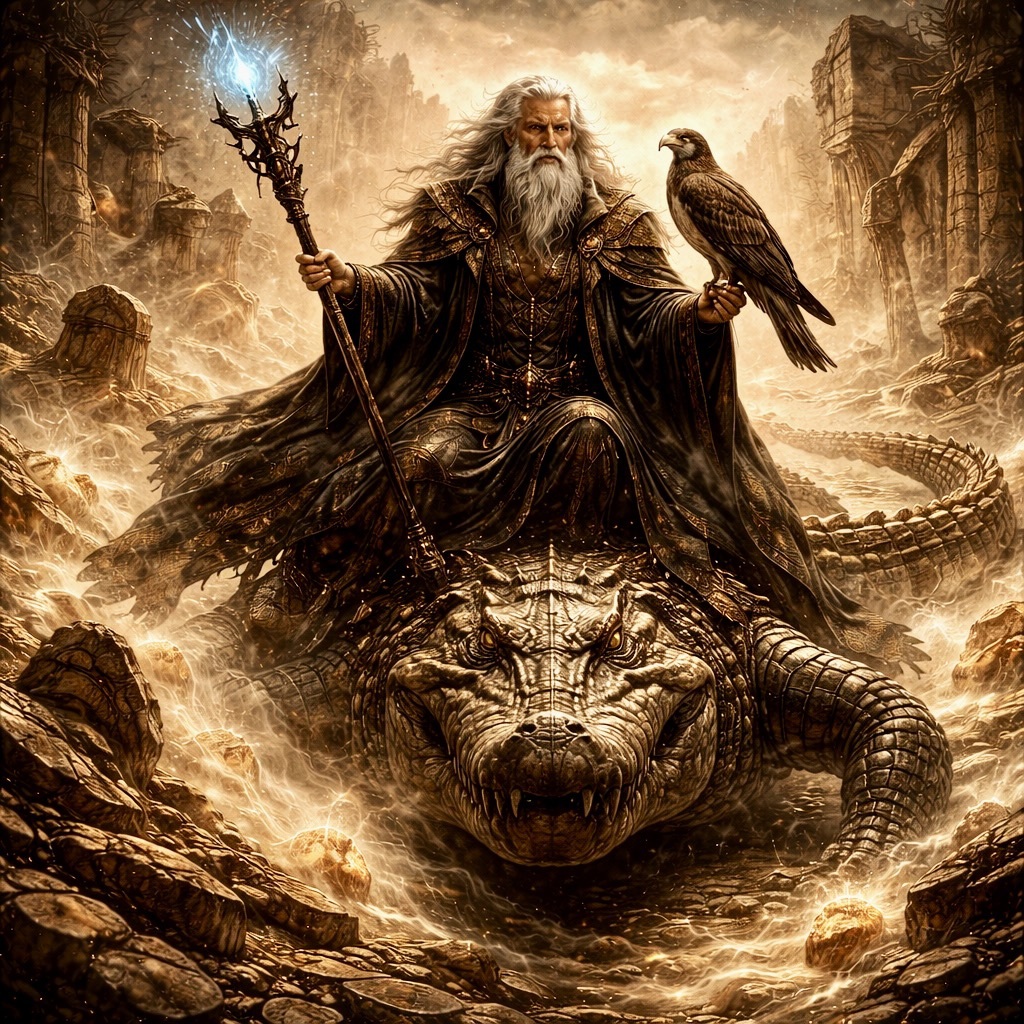
Described as a Duke of Hell commanding thirty-one legions of spirits, Agares is traditionally depicted as an old man riding a crocodile, carrying a hawk upon his fist. This image is immediately striking, not only because of its unusual composition but because of what it represents. Each element—the aged figure, the crocodile, the hawk—contributes to a layered symbolism that reveals the deeper nature of his domain.
The old man suggests wisdom, experience, and authority. He is not a reckless or impulsive figure. He has seen time pass, observed patterns, and understands how systems behave. His presence implies knowledge that has been accumulated rather than discovered suddenly.
The crocodile beneath him is equally significant. Crocodiles are ancient creatures, largely unchanged for millions of years. They represent endurance, primal strength, and the ability to remain still for long periods before acting with sudden precision. In many cultures, crocodiles are associated with hidden danger—forces that lie beneath the surface, waiting.
To ride such a creature is to command it.
Agares does not eliminate instability; he controls it.
The hawk perched upon his hand introduces another dimension. Hawks are symbols of vision, awareness, and precision. They see from great distances, identifying details invisible to others. In this context, the hawk represents perception—the ability to observe and understand from above.
Together, these elements form a cohesive image: a figure who commands both the unseen forces beneath the surface and the clarity of vision above it.
Agares’s powers, as described in the grimoires, reflect this balance. He is said to teach all languages, restore runaways, and cause earthquakes. At first glance, these abilities may seem unrelated. Language, movement, and seismic force appear to belong to entirely different domains.
But when examined more closely, a unifying theme emerges: control over movement and communication.
Language is a form of movement—ideas traveling between individuals, thoughts transformed into sound and meaning. To teach language is to facilitate connection, to enable understanding across boundaries.
Runaways represent physical movement—individuals who have left their place, often seeking something or escaping something else. To return them is to reverse that movement, to restore order.
Earthquakes, perhaps the most dramatic of his abilities, represent movement on a massive scale—the shifting of the earth itself, the disruption of what is assumed to be stable.
Agares governs all three.
He controls how things move—whether they are ideas, people, or the ground beneath our feet.
This connection is not accidental. Movement is one of the fundamental aspects of existence. Everything changes, shifts, evolves. Stability is temporary, maintained only through balance.
Agares embodies the forces that disrupt and restore that balance.
From a historical perspective, his association with languages is particularly significant. During the Renaissance, language was a key to knowledge. Latin, Greek, and Hebrew were considered essential for accessing ancient texts and religious teachings. Scholars who mastered multiple languages held a significant advantage in intellectual pursuits.
The ability to understand and communicate across linguistic boundaries was not just practical—it was powerful.
Agares’s role as a teacher of languages reflects this importance. He represents the unlocking of understanding, the breaking down of barriers that prevent communication.
But language is not just about words. It is about meaning.
Different cultures interpret the world in different ways, shaped by language, history, and experience. Understanding another language is not just about translation—it is about perspective.
Agares facilitates that shift in perspective.
He allows individuals to move beyond their own framework and understand others more clearly.
This ties directly into his ability to restore runaways. On the surface, this might seem like a simple act of control—bringing someone back to where they belong. But symbolically, it suggests something deeper.
Runaways are often in search of something—freedom, identity, escape. Their movement represents a break from structure, a departure from the familiar.
To return them is not merely to reverse that movement, but to restore connection.
Agares does not prevent movement. He redirects it.
He brings things back into alignment.
The earthquake aspect of his power introduces a more dramatic expression of this principle. Earthquakes are sudden, unpredictable, and powerful. They disrupt stability, reshaping landscapes and altering the environment.
Yet they are also part of a larger system. Tectonic plates shift constantly, and earthquakes are the result of accumulated pressure being released.
In this sense, earthquakes are not purely destructive. They are corrective.
They release tension that has built over time.
Agares’s ability to cause earthquakes reflects this role. He is not simply a force of chaos. He is a force that disrupts when necessary—when stability has become imbalance.
This aligns with broader philosophical ideas about change. Systems that remain static for too long often become rigid, unable to adapt. Disruption, while uncomfortable, can lead to renewal.
Agares represents that disruptive force.
He introduces movement where there is stagnation.
From a psychological perspective, Agares can be interpreted as an archetype of transformation through disruption. He embodies the moments when life shifts unexpectedly—when assumptions are challenged, when structures break down, and when new paths emerge.
These moments are rarely comfortable. They can feel like earthquakes—sudden, destabilizing, and difficult to navigate.
But they are also opportunities.
They create space for change.
Agares does not create these moments arbitrarily. He represents the conditions under which they occur—the buildup of pressure, the need for release, the inevitability of movement.
His connection to both language and earthquakes highlights an important truth: communication and disruption are often linked.
Miscommunication can lead to conflict. Lack of understanding can create tension. When communication breaks down, pressure builds—until it is released, sometimes dramatically.
Agares addresses both sides of this dynamic.
He enables communication, reducing the likelihood of conflict. But when conflict becomes unavoidable, he facilitates its release.
This dual role makes him one of the most balanced figures in demonology.
He is neither purely constructive nor purely destructive.
He is adaptive.
The old man riding the crocodile suggests control over time and instinct. The hawk suggests clarity and vision. Together, they form a figure that understands both the past and the present, both the seen and the unseen.
Agares does not act blindly. He acts with awareness.
In modern terms, he can be seen as a representation of systems thinking—the ability to understand how different elements interact within a larger framework. This approach is used in fields ranging from engineering to psychology to environmental science.
It involves recognizing patterns, identifying connections, and anticipating outcomes.
Agares embodies this perspective.
He sees how movement in one area affects another, how communication influences behavior, how stability and disruption are interconnected.
In the end, Agares stands as a symbol of controlled change. He reminds us that movement is inevitable, that stability is temporary, and that understanding is essential for navigating both.
He teaches that communication is not just about speaking, but about connecting. That disruption is not always destruction, but sometimes necessary for renewal.
And somewhere between the steady gaze of the hawk and the silent power of the crocodile, between the wisdom of age and the force of the earth shifting beneath our feet—that is where Agares resides.
Not as a force to be feared, but as one to be understood.
The one who moves what cannot remain still.