
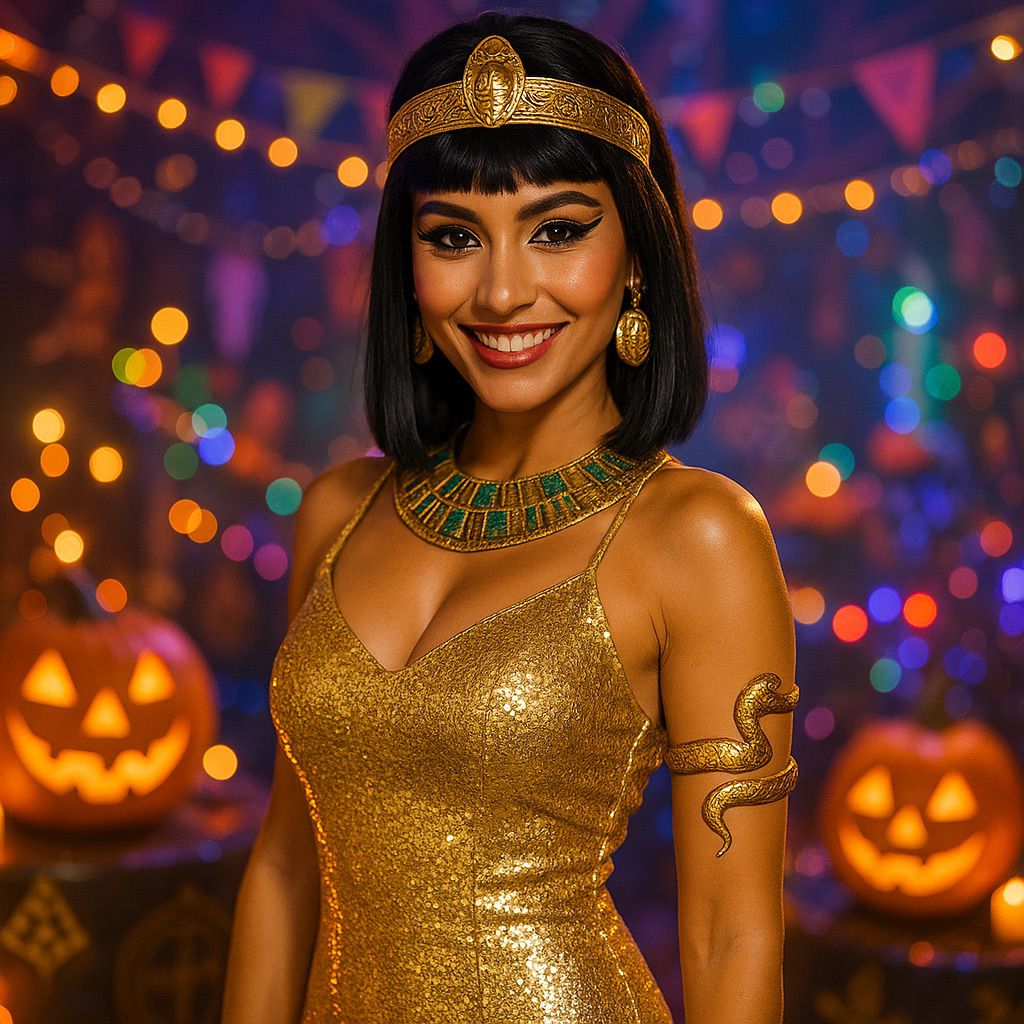
Every October, when costumes flood the streets, bars, and parties of the world, certain archetypes rise above the rest. Vampires stalk in velvet and fangs. Witches glide in black silk with broomsticks in hand. Devils sparkle in red sequins and horns. Yet among all the monsters, seductresses, and rebels of the night, there is one figure who doesn’t need claws, wings, or spells to command attention. She simply needs a golden dress, a snake armband coiled like power on her arm, and a headpiece that gleams like the desert sun. She is Cleopatra, Queen of the Nile—the woman who, more than two thousand years after her reign, still owns any room, any stage, any Halloween night she chooses to enter.
The Cleopatra Queen costume endures because it blends history with fantasy. Cleopatra herself was a figure of myth and reality, power and beauty, intellect and seduction. Historians remember her as one of the most cunning rulers of ancient Egypt, a woman fluent in politics, economics, and languages, who dared to challenge Rome’s supremacy. Pop culture, however, immortalized her as a seductress, a queen who ensnared Julius Caesar and Mark Antony with her allure. The truth lies somewhere in the middle—but that duality is exactly what makes her perfect for Halloween. She’s both real and legendary, both political and passionate, both goddess and human. Wearing Cleopatra isn’t just about looking glamorous—it’s about embodying a role that has commanded fascination for millennia.
Visually, the Cleopatra Queen costume is pure spectacle. The gold dress is the foundation, shimmering under any light like the sands of the Nile at sunset. Its fabric clings, flows, and dazzles, sculpting the body into a figure of undeniable regality. The snake armband is the perfect detail, a coil of power and symbolism—snakes represented royalty, divinity, and immortality in Egyptian culture. Worn on the upper arm, it signals authority, danger, and sensuality. And the headpiece? That’s her crown, her unmistakable signature. Whether a cobra diadem, a bejeweled circlet, or a golden band across the forehead, it frames her like a living goddess, marking her not just as beautiful, but as divine. No matter how crowded the room is, Cleopatra’s costume gleams like a beacon—every eye finds her, every camera captures her, every post featuring her goes viral.
But Cleopatra’s power isn’t just in the costume—it’s in the performance it inspires. Costumes that thrive on Halloween are the ones that allow for character, and Cleopatra is a role ready to be played. The tilt of her chin, the smolder of her eyes, the deliberate grace of her walk—all become tools of her seduction. She doesn’t need to shriek or scare. She doesn’t even need to speak. Her presence alone is enough to make people hush, to turn heads, to create an aura of awe. At parties, the Cleopatra Queen doesn’t fade into the crowd—she rules it, as if every dance floor is her throne room and every guest her subject. And online, her presence transforms into content that feels mythic: slow-motion spins of her golden gown, close-ups of eyeliner sharp enough to cut, captions declaring her “Queen of Halloween.”
Adaptability also explains why Cleopatra’s look has remained one of the most popular Halloween costumes for decades. Some lean into historical authenticity, with linen gowns, intricate beaded collars, and cobra headpieces straight out of ancient reliefs. Others glam her up with sequins, stilettos, and plunging necklines that modernize her allure. Some reinterpret her as dark and gothic, adding shadowy tones and venomous accents. Others reimagine her as futuristic, a Cleopatra reborn for a cyberpunk age, draped in metallics and LED jewels. No matter the spin, the core essence remains: Cleopatra is power, Cleopatra is beauty, Cleopatra is eternal. That flexibility ensures that she never feels stale—she always returns, always reinvents, always reigns.
The humanizing part of Cleopatra’s costume is what makes it more than just dress-up. Cleopatra, the historical figure, was complicated. She was brilliant and strategic, but also vulnerable. She lived in a world that constantly sought to diminish women, yet she carved out her legacy in stone. She’s remembered as both seductress and stateswoman, sinner and saint, goddess and mortal. That messy duality resonates with us today because we all know what it feels like to be underestimated, to be judged, to be told we’re too much of one thing and not enough of another. When someone wears Cleopatra, they’re not just wearing gold—they’re embodying that defiance. They’re saying: I contain multitudes, I can be soft and fierce, I can be beautiful and brilliant, and I will not apologize for any of it. That’s why the costume isn’t just glamorous—it’s empowering.
And on social media, Cleopatra is viral gold. Instagram feeds light up with golden shimmer when she appears, her eyeliner wings cutting sharper than any vampire fang, her poses regal enough to rival influencers and models. On TikTok, Cleopatra transitions thrive: one moment barefaced, the next moment crowned in gold, draped in sequins, staring down the camera like a goddess. On X, she trends because she isn’t just another character—she’s an icon, a cultural touchstone that everyone instantly recognizes. Cleopatra’s hashtag fills with queens of all shapes, shades, and sizes, each one taking her legacy and making it their own. And that universality, that ability to connect across generations and cultures, is what cements her as a viral staple.
Halloween is about transformation, and Cleopatra’s story is one of eternal transformation. She has been remembered, reimagined, and reborn countless times across history: in Shakespeare’s words, in Elizabeth Taylor’s eyes, in the costumes of women at Halloween parties around the globe. She proves that icons never die—they simply take new forms, shimmering in new fabrics, glowing under new lights. Every Cleopatra costume is part of that ongoing story, another chapter in the Queen’s endless reign.
So when the Halloween party reaches its peak, when the music pounds and the lights flash, watch who stands at the center. She’ll be the one in gold, snake coiled around her arm, headpiece gleaming as if it were forged by the gods themselves. She won’t need to fight for attention—it will already be hers. People will approach her, drawn like moths to flame, eager to bask in her glow. Phones will rise, flashes will pop, feeds will flood. And when the night ends and the costumes are packed away, her image will linger, her posts will spread, her reign will continue. Because Cleopatra is not just a queen of the Nile—she’s the queen of Halloween.