
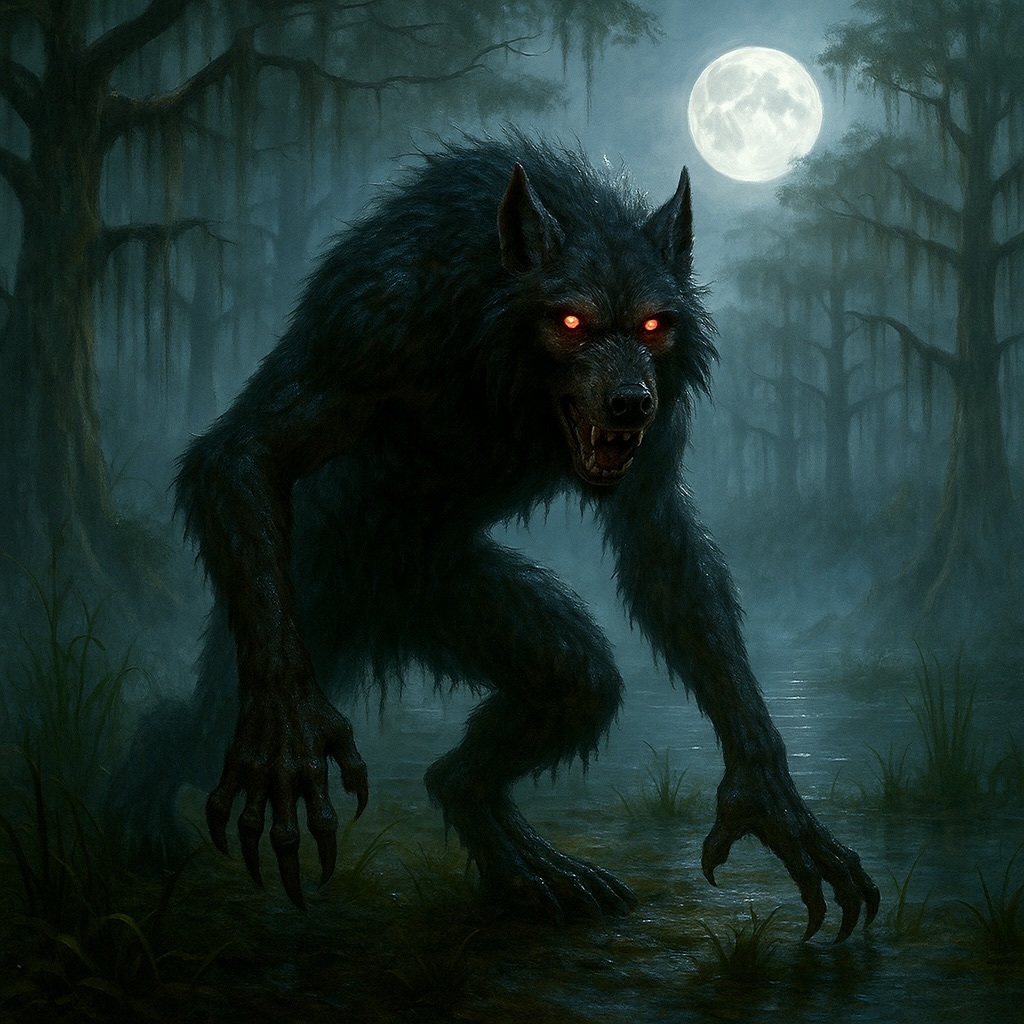
Louisiana is a land of shadows and whispers, where cypress trees twist above dark waters, where Spanish moss hangs like the hair of ghosts, and where the night carries voices older than memory. It is a place where myth and reality intermingle, where Catholic prayers brush against Creole superstition, and where every ripple in the swamp can feel like a story waiting to pounce. Among these stories, none is as feared or as beloved as the Rougarou — the Cajun werewolf. A creature of French folklore reshaped by the Louisiana bayou, the Rougarou stalks swamps and sugarcane fields, hunting not only for flesh but for souls, a living embodiment of curses, punishment, and primal fear. On October 23, when its legend is remembered, the bayou feels alive with its breath, and the moon itself seems complicit in the terror.
The Rougarou (sometimes spelled loup-garou from the French) is, at its core, a werewolf. But unlike the polished versions of werewolves we see in modern films, the Rougarou is deeply Cajun, its story infused with Catholic morality, swamp geography, and the rhythms of a culture born of both survival and faith. By day, the Rougarou may appear human, cursed to hide among neighbors. But by night, under the light of the moon, it transforms — tall, wolf-headed, with glowing red eyes and a hunger that nothing can satisfy. It stalks through cane fields, emerges from the swamp mist, and terrorizes those who cross it. Its howl cuts through the night like a warning, a sound that freezes blood and sends whole communities into prayer.
The legend was carried from France, where loup-garou tales spoke of werewolves cursed for breaking Lent or committing sins. In Louisiana, it mingled with Catholic teachings and local traditions, becoming a figure of fear but also of discipline. Parents warned children: behave, or the Rougarou will get you. Keep your Lenten fasts, or risk being cursed to wear its skin. It became not just a monster but a moral enforcer, a way to embed religious teachings into the cultural fabric. In this sense, the Rougarou was never just about the beast — it was about the community, about control, about keeping the Cajun people tied to faith and survival.
Descriptions of the Rougarou vary, which only adds to its menace. Some say it is a towering wolf-headed man with glowing eyes and claws like knives. Others say it is more wolf than man, running on all fours, its fur matted with swamp water, its growl echoing through cane fields. In some stories, it is not a transformation at all but a curse that passes from one person to another, like a dark inheritance. To be bitten by the Rougarou is not only to risk death but to risk becoming the very thing you fear. In this way, the Rougarou embodies the cyclical nature of sin: once infected, you too become the hunter, forced to carry the curse forward.
Its setting makes it uniquely terrifying. The bayou itself is a perfect backdrop for horror. The water is dark, the fog endless, the cries of unseen animals echoing through the night. Spanish moss drips from ancient oaks like spectral curtains. Crocodiles slip silently beneath the surface, their eyes glinting. To walk alone in the swamp at night is to feel constantly watched. In such a setting, the Rougarou feels inevitable, as though the land itself requires such a creature to exist. When the mist rolls in and the moon rises, it feels natural to believe something monstrous prowls just out of sight.
But the Rougarou is not only about fear — it is also about belonging. Cajun communities embraced the story as part of their cultural identity. It appears in festivals, in songs, in tales told around campfires. To speak of the Rougarou is to speak of Cajun history itself, of a people who blended French, African, Native American, and Creole traditions into something entirely unique. The Rougarou is a monster, yes, but it is their monster, woven into the DNA of Louisiana storytelling.
The Rougarou is also striking in how it blurs the line between punishment and tragedy. Some versions of the legend say that the Rougarou is a cursed soul, forced to wander as a beast for 101 days before the curse passes on. During that time, it cannot speak of its condition, and to reveal its curse is to transfer it to another. This detail makes the Rougarou less a predator and more a victim, trapped in a cycle of silence and suffering. It is not evil by choice but by compulsion, its howl less a threat than a cry of despair. This tragic element deepens the legend, making it more than a simple tale of monster and prey.
The endurance of the Rougarou shows the power of folklore to adapt and survive. Today, it appears not only in campfire stories but in popular culture: novels, TV shows, even local festivals where “Rougarou runs” keep the legend alive. Modern Cajun storytellers use the Rougarou both as a source of pride and as a way to connect to heritage. In an age where myths often fade, the Rougarou thrives because it is both universal and deeply local: the werewolf is a global symbol, but the Cajun Rougarou belongs uniquely to Louisiana.
What makes the Rougarou so compelling in the viral imagination is its blend of horror, mystery, and cultural resonance. It is a creature tied to morality, to landscape, to community. It is both terrifying and tragic, both enforcer and victim. It is a monster you can fear, but also one you can pity, because in some versions, the Rougarou is your neighbor, your friend, your relative, cursed into silence, howling in the swamp. That blend of horror and humanity makes it unforgettable.
So on October 23, when we tell the story of the Rougarou, we are telling more than just a werewolf tale. We are telling the story of the bayou itself — its fog, its faith, its fear. We are telling the story of Cajun culture, of French roots entwined with American soil, of the way monsters become markers of identity. And we are reminding ourselves that sometimes, the scariest monsters are not strangers at all. Sometimes, they are us.
And maybe, when the swamp fog curls low across the water, and the moon hangs heavy above the cypress trees, you’ll hear it — a distant howl, too deep to be a wolf, too human to be a beast. Maybe you’ll feel the Rougarou’s eyes on you, glowing through the mist, waiting for you to falter, to sin, to stray. And maybe you’ll realize the swamp never sleeps — and neither does the Rougarou.