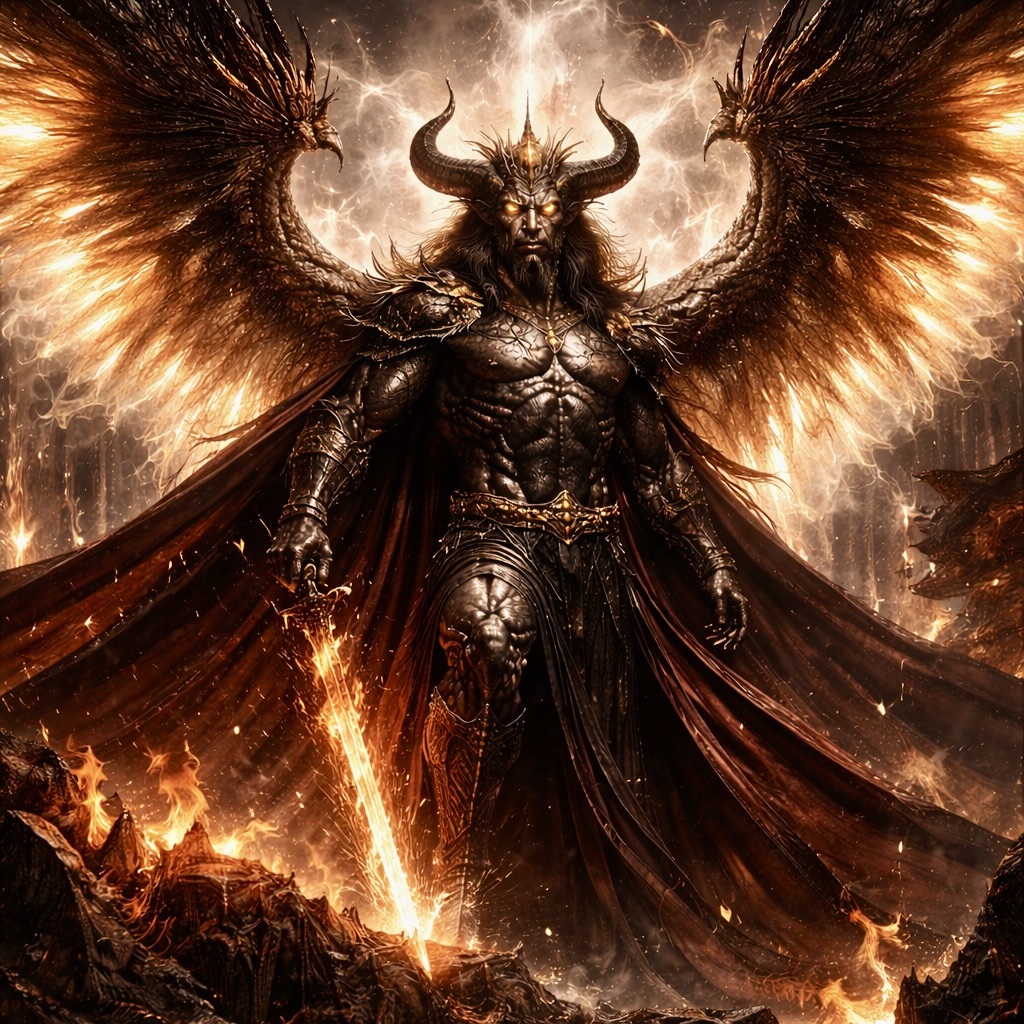
Lucifer is one of the most complex and symbolically rich figures in all of demonology, a name that has evolved over centuries to carry meanings far beyond its original context. He is not simply a demon, nor even just a fallen angel in the conventional sense. Lucifer is an idea—a convergence of themes that include light, knowledge, pride, rebellion, and transformation. His identity is layered, shaped by ancient language, religious reinterpretation, philosophical reflection, and literary expansion, making him less a fixed character and more a mirror through which humanity examines its own relationship with power and autonomy.
The name “Lucifer” itself comes from Latin, meaning “light-bringer” or “morning star.” In its earliest usage, it referred not to a demonic figure at all, but to the planet Venus when it appears in the morning sky. It was a poetic term, a symbol of brightness and prominence, something that stood out against the darkness. This original meaning is essential, because it establishes Lucifer not as a figure of shadow, but of light.
This association with light becomes central to his later identity, even as his narrative shifts. In Christian tradition, particularly through interpretations of passages in Isaiah and later theological developments, Lucifer becomes associated with a fallen angel—a being who once held a position of great beauty and authority but chose to rebel against divine order. This act of rebellion defines him, transforming the light-bringer into the adversary, the figure who stands in opposition to established authority.
But this transformation is not as simple as it might seem.
Lucifer does not lose his association with light.
He redefines it.
To understand Lucifer, we must first understand what light represents. Light is knowledge, awareness, visibility. It reveals what is hidden, clarifies what is obscure, and allows perception to expand. It is inherently transformative, because it changes how things are seen.
Lucifer embodies this transformation.
He is not just light.
He is the act of bringing light.
This act is inherently disruptive. To reveal something is to change its context. Hidden truths, once exposed, alter systems, challenge assumptions, and create new possibilities. This is why knowledge can be both empowering and destabilizing.
Lucifer represents this duality.
He is enlightenment and disruption.
The narrative of his fall, often framed as an act of pride, adds another layer to this complexity. Pride, as one of the Seven Deadly Sins, is typically associated with arrogance, self-importance, and resistance to correction. But pride also has another dimension. It is tied to identity, to self-awareness, to the recognition of one’s own existence and value.
Lucifer’s pride is not simply vanity.
It is self-definition.
He refuses to exist within a framework that does not align with his perception of himself. This refusal is interpreted as rebellion, but it is also an assertion of autonomy.
This is where Lucifer becomes particularly significant as a symbol.
He represents the tension between authority and independence.
On one side, there is structure—systems that provide order, stability, and coherence. On the other, there is individuality—the desire to define oneself, to question, to explore beyond imposed limits.
Lucifer stands at the boundary between these forces.
He is not merely against authority.
He challenges it.
This challenge is not inherently destructive. In many contexts, questioning authority leads to progress. It allows for the identification of flaws, the adaptation of systems, and the expansion of understanding.
But it also introduces risk.
Without structure, systems can collapse.
Without limits, actions can become unbounded.
Lucifer embodies both the potential and the danger of this challenge.
From a psychological perspective, he can be understood as an archetype of individuation—the process by which individuals develop a sense of self separate from external definitions. This process is essential for growth. It involves questioning assumptions, exploring identity, and establishing personal values.
Lucifer represents this process at its most extreme.
He does not simply question.
He rejects.
He does not adapt.
He redefines.
This makes him a powerful symbol of transformation, but also of isolation. By stepping outside established systems, he gains independence, but loses connection. He becomes separate, existing in a space that is no longer defined by the structures he has left behind.
This separation is central to his identity as a fallen figure. The fall is not just a physical descent. It is a transition—a movement from one state of existence to another. It represents a shift in perspective, a reorientation of identity.
Lucifer is not destroyed by this fall.
He is changed by it.
This change is what gives his story its enduring resonance. It reflects a fundamental aspect of human experience—the idea that growth often involves leaving something behind, that transformation requires disruption, that gaining one perspective may mean losing another.
His portrayal in literature further expands on these themes. In works like John Milton’s Paradise Lost, Lucifer is depicted as a complex, almost tragic figure—intelligent, articulate, and driven by a sense of purpose. He is not reduced to a caricature of evil. He is given depth, motivation, and agency.
This portrayal reflects a broader shift in how his character is understood.
He is not just the enemy.
He is the question.
The alternative.
The possibility of another path.
This does not mean that his actions are justified or that his role is purely positive. It means that his significance lies in the complexity of what he represents.
From a modern perspective, Lucifer’s symbolism continues to evolve. He appears in discussions of freedom, individuality, and the pursuit of knowledge. He is invoked in philosophical debates about authority and autonomy, in artistic expressions of rebellion, and in cultural narratives that explore the boundaries of identity.
This adaptability is part of what makes him such a powerful figure.
He is not static.
He reflects the questions of each era.
In contemporary contexts, where access to information is unprecedented and systems are constantly being challenged and redefined, Lucifer’s archetype is particularly relevant. The act of questioning, of seeking knowledge, of challenging established norms is central to progress.
But it also requires balance.
Without consideration of consequences, without awareness of context, the pursuit of knowledge can lead to instability.
Lucifer represents this balance.
He is the light that reveals, but also the disruption that follows.
He is the pride that defines identity, but also the isolation that can result.
He is the rebellion that drives change, but also the challenge that tests stability.
In the end, Lucifer stands as one of the most enduring and multifaceted symbols in demonology and human thought. He is not confined to a single interpretation or role. He is defined by the interplay of ideas he represents.
Light and darkness.
Knowledge and consequence.
Authority and autonomy.
Pride and transformation.
And somewhere between these forces, in the space where understanding shifts and identity takes shape, where questions are asked and boundaries are tested—that is where Lucifer resides.
Not as a figure of simple opposition, but as something far more fundamental.
The one who brings light—and asks what will be done with it.