
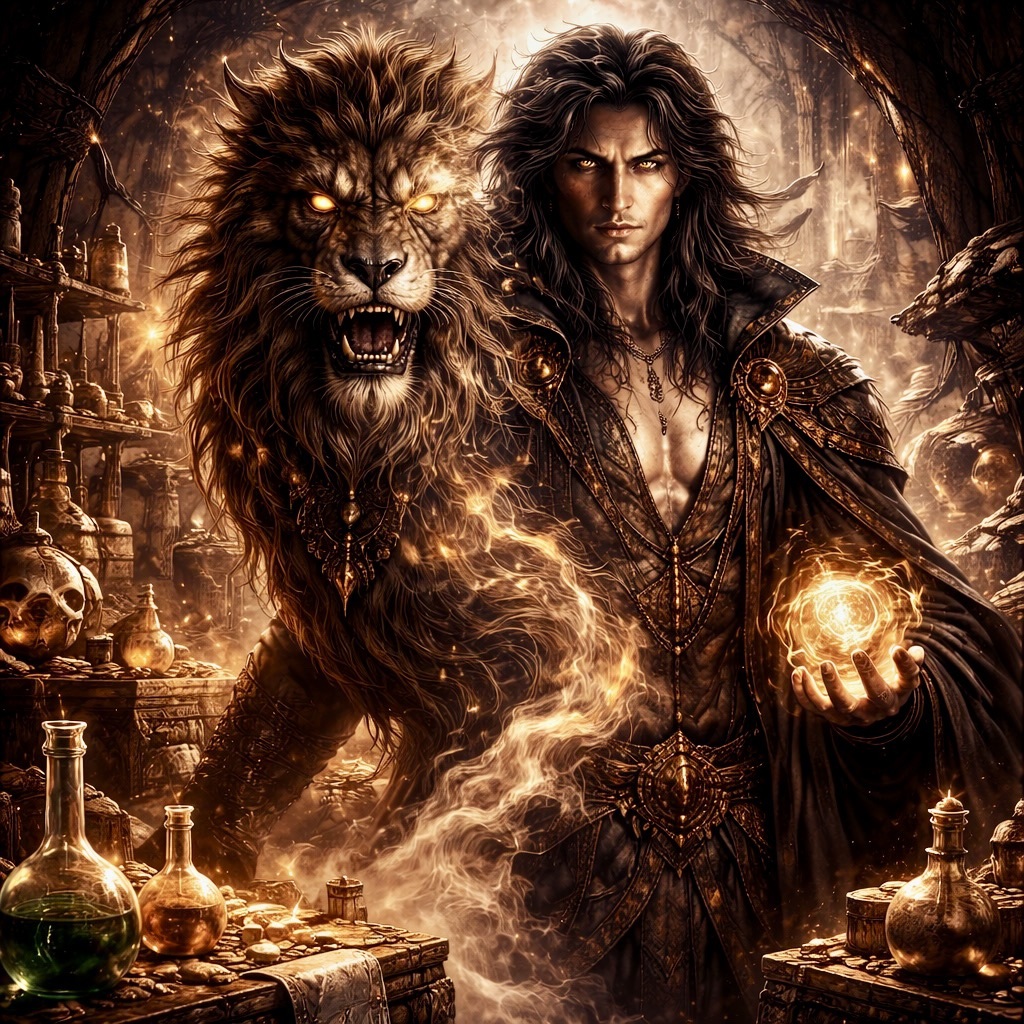
Among the seventy-two spirits cataloged within the Ars Goetia, Marbas stands as one of the most fascinating and paradoxical figures in the entire infernal hierarchy. Unlike many demons associated with deception, destruction, or temptation, Marbas occupies a domain that feels almost unsettlingly constructive. He is described as a President of Hell commanding thirty-six legions of spirits, and his powers revolve around transformation, healing, and knowledge of the human body—domains that sit at the intersection of science, medicine, and mystery.
At first glance, this combination seems contradictory. How can a demon—a figure traditionally associated with chaos and corruption—also be a healer and a revealer of knowledge? Yet this contradiction is precisely what makes Marbas so compelling. He does not fit neatly into categories of good or evil. Instead, he exists in the space where knowledge becomes power, and power becomes transformation.
Marbas is said to appear initially as a great lion. This form is significant, not only for its symbolic weight but for what it represents in relation to his abilities. The lion has long been a symbol of strength, authority, and primal force. It is a creature that commands attention, embodying both power and instinct.
But Marbas does not remain in this form. When commanded, he transforms into a human figure.
This transformation is central to his identity.
It represents the transition from raw, instinctive force into structured understanding. The lion is power without refinement. The human is power shaped by intellect. Marbas embodies both states, suggesting that transformation—whether physical, intellectual, or emotional—is a process that moves between these extremes.
His ability to change form is mirrored in his broader domain. Marbas is said to answer questions truthfully, reveal hidden knowledge, cause or cure diseases, and alter the shape of objects or beings. In essence, he governs change.
To understand the significance of this, we need to consider how transformation has been viewed throughout history.
In ancient and medieval thought, transformation was often seen as both miraculous and dangerous. Alchemists sought to transform base metals into gold, but their work was not merely about material change. It was also about spiritual transformation—the idea that understanding the hidden principles of the world could lead to personal enlightenment.
Similarly, medicine in the Renaissance period was deeply intertwined with ideas of balance and transformation. The human body was thought to be governed by humors—fluids that needed to be balanced to maintain health. Disease was seen as a disruption of this balance, and healing involved restoring it.
Marbas’s ability to both cause and cure illness reflects this dual understanding. He does not simply heal. He controls the process itself.
This duality is crucial.
Healing and harm are not entirely separate processes. They are opposite ends of the same spectrum. Understanding how to cure a disease requires understanding how it functions. Knowledge of the body includes knowledge of both its vulnerabilities and its resilience.
Marbas represents that complete understanding.
From a modern perspective, this aligns with how we view medical science. Researchers study diseases not only to prevent them but to understand their mechanisms. Treatments are developed by examining how systems fail and how they can be restored.
Marbas embodies this investigative process—the drive to understand the inner workings of the body and to use that understanding to effect change.
His association with anatomy and hidden knowledge of the human form is particularly striking. The grimoires suggest that he can reveal secrets about the body, including how it functions and how it can be altered.
In the Renaissance, anatomical study was both groundbreaking and controversial. Dissection of human bodies was not widely accepted, yet it provided critical insights into physiology. Scholars like Andreas Vesalius began to challenge long-held assumptions about the body, replacing speculation with observation.
This shift from belief to evidence marked a turning point in scientific history.
Marbas’s mythology reflects this transition. He represents knowledge that is gained through exploration and understanding rather than blind acceptance.
The alchemical imagery often associated with him reinforces this idea. Alchemy was not just about turning lead into gold. It was about uncovering hidden principles—understanding how transformation occurs at a fundamental level.
Marbas operates within that same framework. He does not merely change things; he understands how change works.
The lion-to-human transformation can also be interpreted psychologically. It mirrors the human capacity for growth and self-awareness. People are not static. They change over time, influenced by experience, knowledge, and introspection.
At times, individuals act on instinct—reacting quickly, driven by emotion. At other times, they act with deliberation—considering consequences, analyzing situations, and making informed decisions.
Marbas embodies both states. He is the instinctive and the rational, the force and the understanding.
This duality is essential for transformation. Growth requires both awareness and action. It requires recognizing patterns and making changes based on that recognition.
Marbas represents that process.
His ability to answer questions truthfully places him alongside other knowledge-bearing spirits like Gusion and Amon. However, while those figures focus on time and perception, Marbas focuses on structure—on how things are built and how they function.
He is less concerned with when something will happen and more concerned with how it works.
This distinction is important.
Understanding time provides context. Understanding structure provides control.
Marbas offers the latter.
In modern terms, he can be seen as an archetype of scientific inquiry. He represents the desire to understand systems at a fundamental level and to use that understanding to create change.
This archetype appears across disciplines. Engineers study structures to design better systems. Biologists examine organisms to understand life processes. Psychologists analyze behavior to understand the mind.
In each case, the goal is the same: to uncover hidden mechanisms and apply that knowledge effectively.
Marbas embodies this goal in its most complete form.
His association with both healing and harm also reflects the ethical complexity of knowledge. Scientific advancements can be used for beneficial purposes or harmful ones. The same understanding that leads to medical breakthroughs can also be used to develop destructive technologies.
Marbas does not dictate how knowledge is used. He provides it.
This neutrality is a recurring theme in demonology. Knowledge is not inherently moral. It is the application that determines its impact.
The laboratory imagery often associated with Marbas—filled with tools, diagrams, and experiments—captures this idea. It is a place of discovery, but also of risk. Experiments can succeed or fail. Discoveries can lead to progress or unintended consequences.
Marbas stands at the center of that environment, representing the process of exploration itself.
From a psychological standpoint, he also represents self-transformation. Understanding one’s own patterns—habits, behaviors, and thought processes—can lead to personal growth. Recognizing what needs to change is the first step toward change.
Marbas embodies that recognition.
He reveals what is hidden, not only in the external world but within the individual.
This makes him one of the most introspective figures in demonology. While others influence external events, Marbas focuses on internal systems.
The body, the mind, the structure of reality itself—these are his domains.
His presence suggests that transformation is not random. It follows patterns. It can be understood, predicted, and guided.
And yet, it remains complex.
The wheel-like movement seen in other spirits like Buer reflects cycles. Marbas, by contrast, reflects mechanisms—the gears within those cycles, the processes that drive change.
In the end, Marbas stands as a symbol of transformation in its most complete form. He is not merely a changer of shapes, but a revealer of how change occurs.
He represents the pursuit of understanding that leads to control—not over others, but over systems.
And in a world where change is constant, where systems evolve and adapt, that understanding is one of the most powerful tools available.
Somewhere between instinct and intellect, between chaos and structure, between illness and healing—that is where Marbas exists.
Not as a force of destruction, but as something far more precise.
The one who knows how things work.