
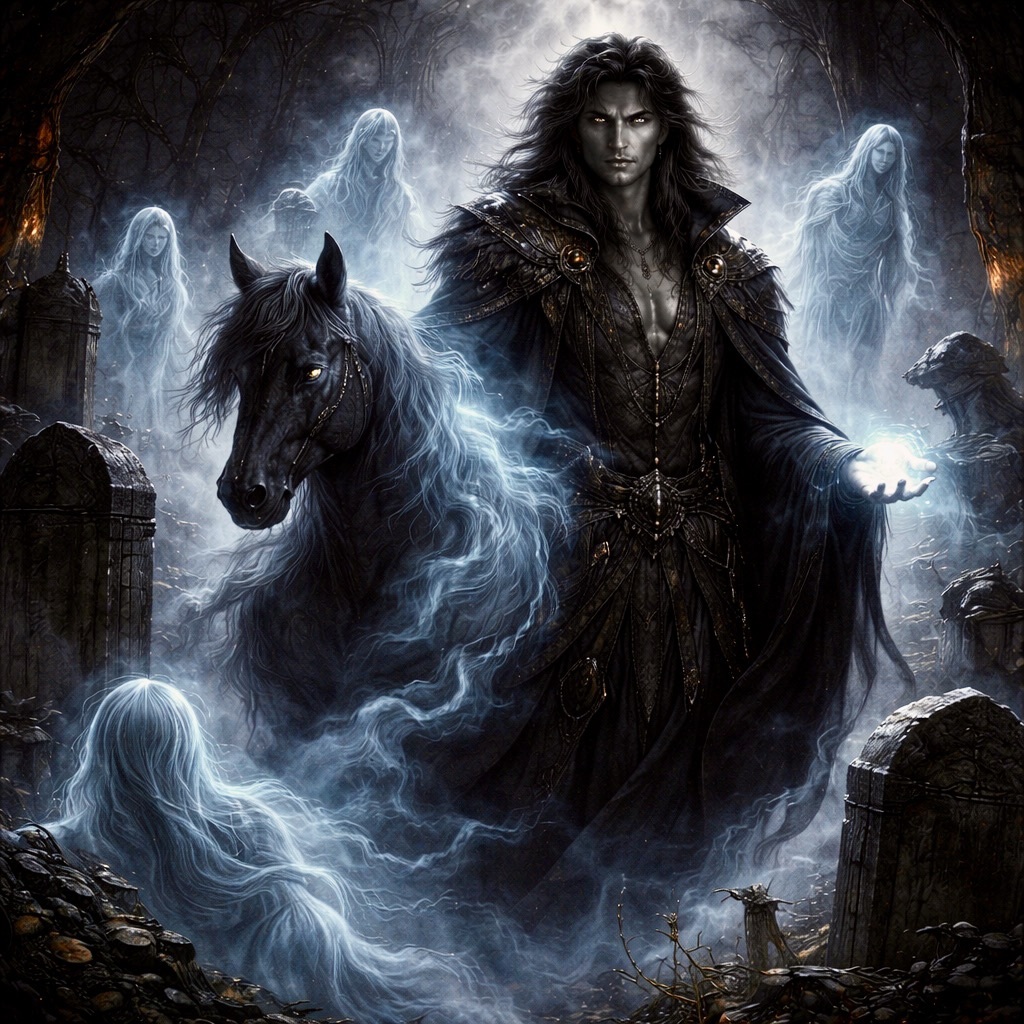
Among the seventy-two spirits recorded in the Ars Goetia, there are demons who command armies, shape desire, reveal hidden knowledge, and manipulate the natural world. Yet Samigina—also known as Gamigin—belongs to a more somber and reflective domain. He is not a figure of chaos or temptation in the traditional sense. Instead, he exists in the quiet space between life and memory, between the living and the dead, between what is known and what has been forgotten.
Described as a Marquis of Hell commanding thirty legions of spirits, Samigina is said to appear first in the form of a small horse before taking on a human shape when commanded. This transformation is subtle compared to the dramatic forms of other spirits, but it carries deep symbolic meaning. The horse, historically associated with movement, transition, and passage, suggests a being that travels between worlds. It is not a creature of stillness. It moves, carries, and connects.
When Samigina assumes human form, he becomes a communicator—a figure capable of speaking, explaining, and revealing. This dual nature reflects his core role: bridging the gap between what is gone and what remains.
The grimoires state that Samigina can summon and communicate with the souls of the dead, particularly those who died in sin or without resolution. He can answer questions about them, reveal their experiences, and bring their voices into the present.
This ability places him in a unique position within demonology. While many spirits deal with the present or the future, Samigina is deeply tied to the past—not just as a sequence of events, but as a collection of lived experiences, memories, and unresolved stories.
To understand the significance of this, we need to consider how humans relate to the past.
History is often treated as a series of facts—dates, events, and outcomes. But behind those facts are individuals, each with their own perspectives, emotions, and motivations. The past is not just what happened; it is how it was experienced.
Much of that experience is lost.
Records fade, stories are simplified, and details disappear over time. What remains is often incomplete—a fragmented version of reality.
Samigina represents the desire to recover those lost voices.
He embodies the idea that the past is not silent, that it still holds meaning, and that understanding it requires more than surface-level knowledge. It requires listening.
The imagery of spirits surrounding him reinforces this idea. These are not abstract entities; they are remnants of lives once lived. Each carries a story, a perspective, a truth that may differ from what is recorded or remembered.
Samigina does not create these voices. He reveals them.
This makes him one of the most introspective figures in demonology. His power is not about control, but about access—to memory, to history, to the unseen layers of human experience.
The Renaissance context in which the grimoires were compiled adds depth to this interpretation. During this period, there was a renewed interest in history, classical texts, and the recovery of lost knowledge. Scholars sought to understand the past not just as a series of events, but as a foundation for the present.
At the same time, beliefs about the afterlife and the nature of the soul were deeply ingrained in society. The idea that the dead could communicate with the living was not entirely foreign. It existed in religious traditions, folklore, and philosophical speculation.
Samigina’s role reflects this intersection of curiosity and belief. He represents the possibility that the past is not entirely inaccessible—that with the right approach, it can be understood more fully.
From a psychological perspective, Samigina can be interpreted as an archetype of memory and reflection. He embodies the process of revisiting past experiences, understanding them, and integrating them into present awareness.
This process is central to human cognition. Memory shapes identity. It influences decisions, behaviors, and perceptions. Understanding the past—whether personal or collective—is essential for growth.
Yet memory is not perfect. It is selective, influenced by emotion and perspective. People remember events differently, often emphasizing certain details while overlooking others.
Samigina’s mythology suggests a form of memory that is complete—unfiltered by bias or distortion.
This idea is both appealing and unsettling.
On one hand, it offers clarity. On the other, it removes the protective layers that often soften difficult truths.
Consider how people respond when they revisit past experiences with new understanding. A situation that once seemed straightforward may reveal hidden complexities. Actions that were misunderstood may take on new meaning.
This process can lead to healing, but it can also be challenging.
Samigina represents that moment of revelation.
He does not change the past. He reveals it.
The fact that he communicates specifically with souls who died in sin or without resolution adds another dimension. These are not peaceful or complete narratives. They are unfinished stories—experiences that did not reach a natural conclusion.
This focus suggests that Samigina’s role is not just about remembering, but about resolving.
Unresolved experiences often linger, both in individuals and in societies. Conflicts, regrets, and unanswered questions can persist across generations, influencing behavior and perception.
By bringing these experiences into the present, Samigina allows them to be addressed.
This aligns with modern therapeutic practices, where individuals revisit past experiences to understand and resolve them. By examining what happened and why, people can gain insight and move forward.
Samigina’s ability to summon voices from the past mirrors this process on a larger scale.
He provides access to perspectives that might otherwise remain hidden.
The transformation from horse to human also reflects this process. The horse, as a symbol of movement, represents the passage through time—the journey from past to present. The human form represents understanding—the ability to interpret and articulate what has been encountered.
Together, they form a complete cycle: movement and comprehension.
This cycle is central to learning. Experience alone is not enough. It must be understood, contextualized, and integrated.
Samigina embodies both stages.
His presence in demonology serves as a reminder that the past is not static. It continues to influence the present, shaping decisions and outcomes. Understanding it requires effort, attention, and a willingness to confront complexity.
In literature and storytelling, characters who interact with the past often undergo significant transformation. They gain insight, confront hidden truths, and emerge with a deeper understanding of themselves and their world.
Samigina plays a similar role.
He is not a force of change in the traditional sense. He does not alter reality directly. Instead, he changes perception.
And through that change, everything else follows.
The graveyard or ruin imagery often associated with him reinforces this idea. These are places where time is visible—where the past is physically present in the form of structures, artifacts, and remains.
They are spaces of reflection.
Samigina exists within these spaces, not as a figure of fear, but as a guide.
He does not demand attention. He invites it.
In modern life, the pace of change often leaves little room for reflection. People move quickly from one experience to the next, rarely pausing to examine what has come before.
Yet without reflection, understanding remains incomplete.
Samigina’s mythology highlights the importance of this process. It suggests that listening—to the past, to memory, to hidden voices—is essential for clarity.
This does not mean dwelling endlessly on what has already happened. It means acknowledging it, understanding it, and allowing it to inform the present.
In the end, Samigina stands as a symbol of connection—between past and present, between memory and understanding, between what is known and what has been forgotten.
He is not a figure of chaos or destruction, but of quiet revelation.
And in the stillness where memory surfaces, where forgotten voices begin to speak again, where the past reveals its hidden layers—that is where Samigina resides.
Not as a force that changes what was, but as one who ensures it is finally heard.