
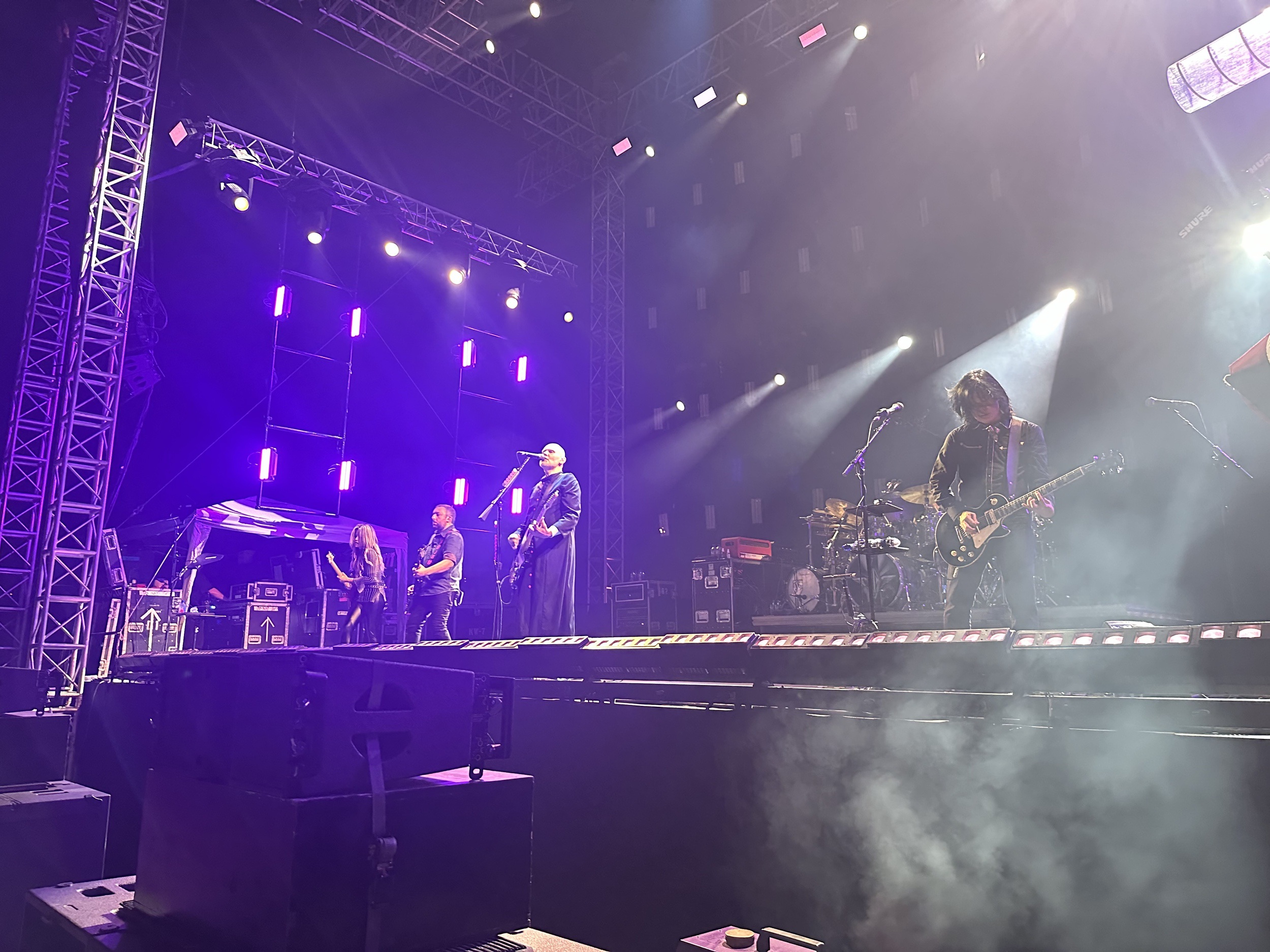
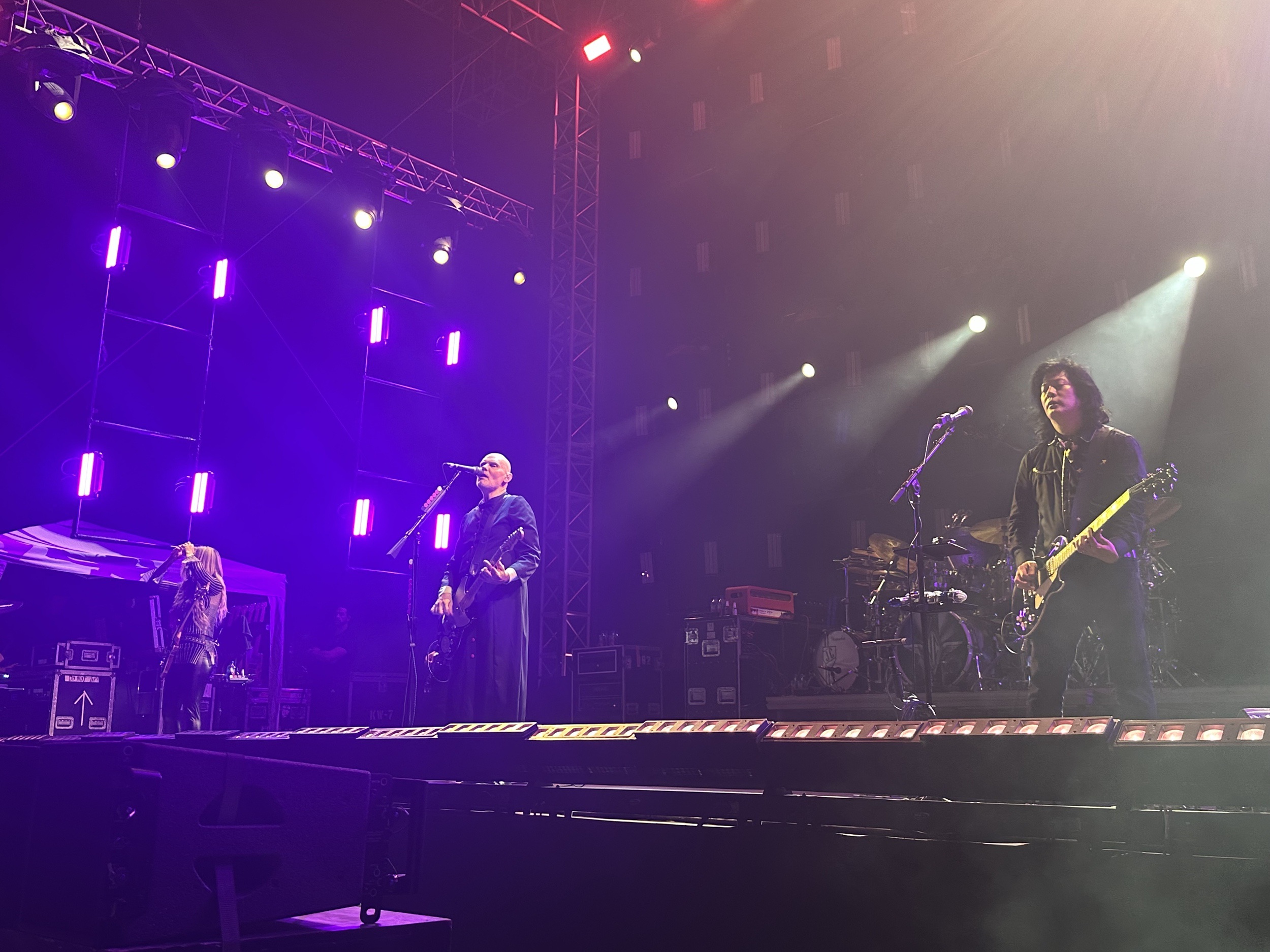
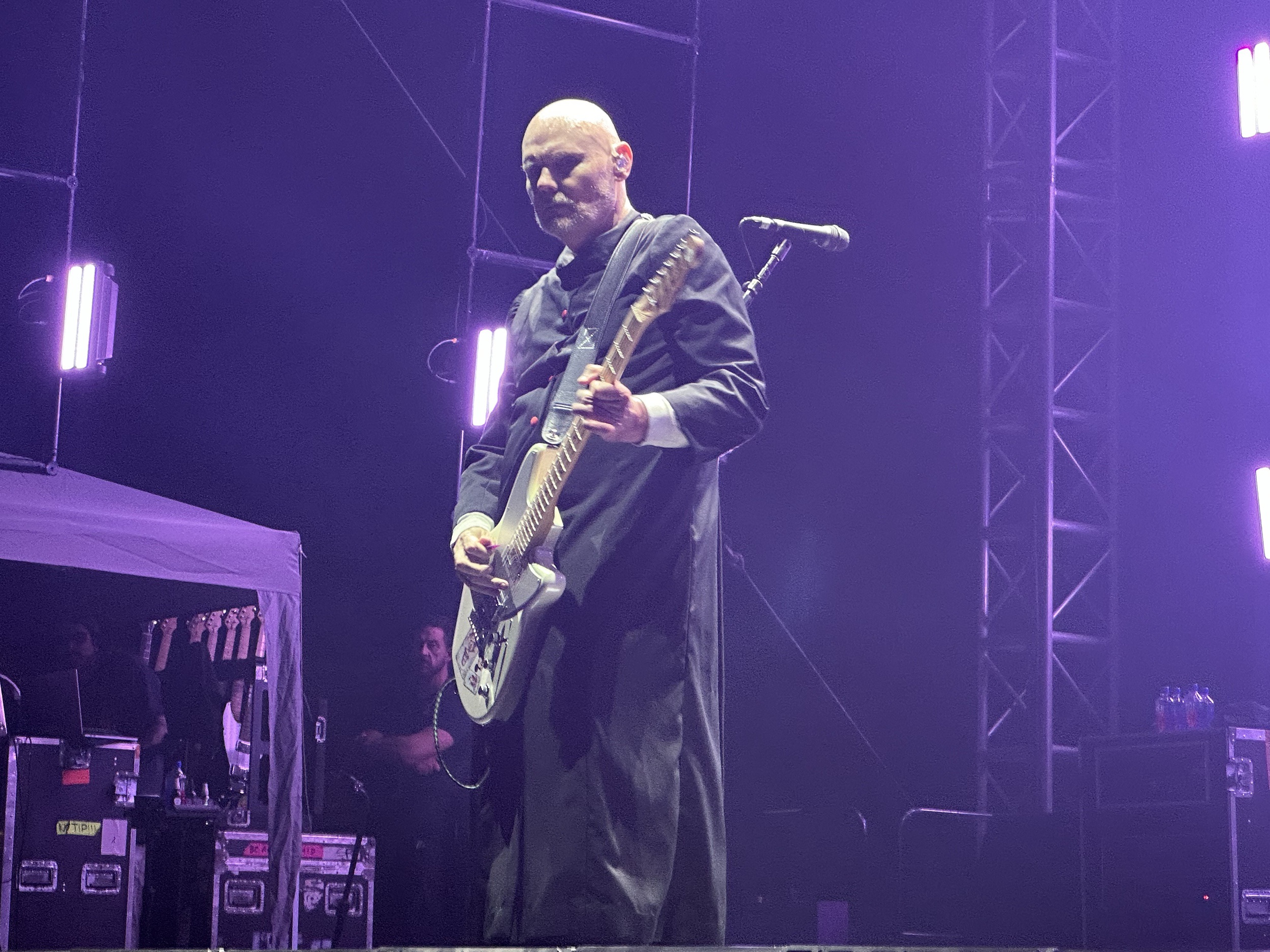
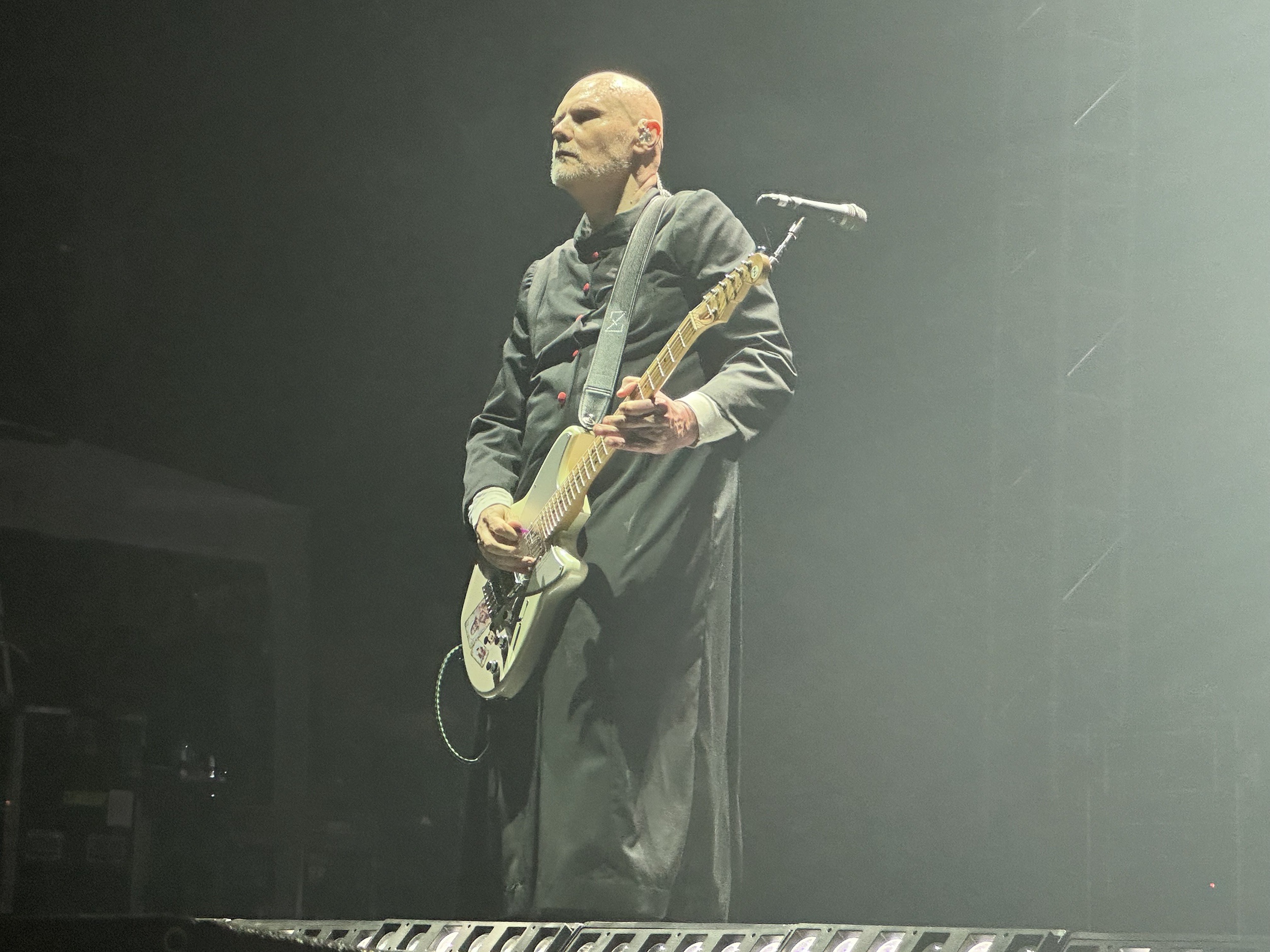
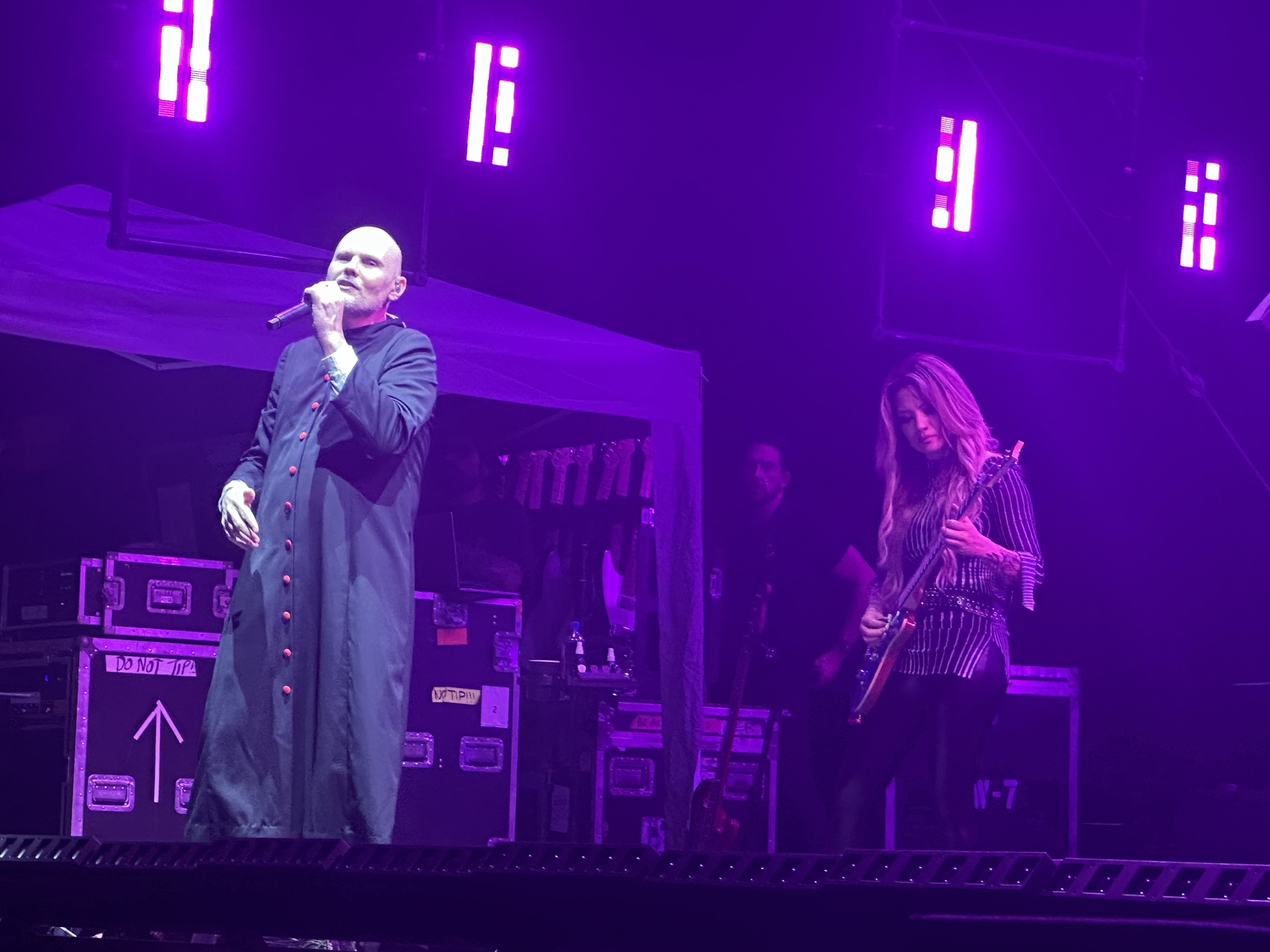
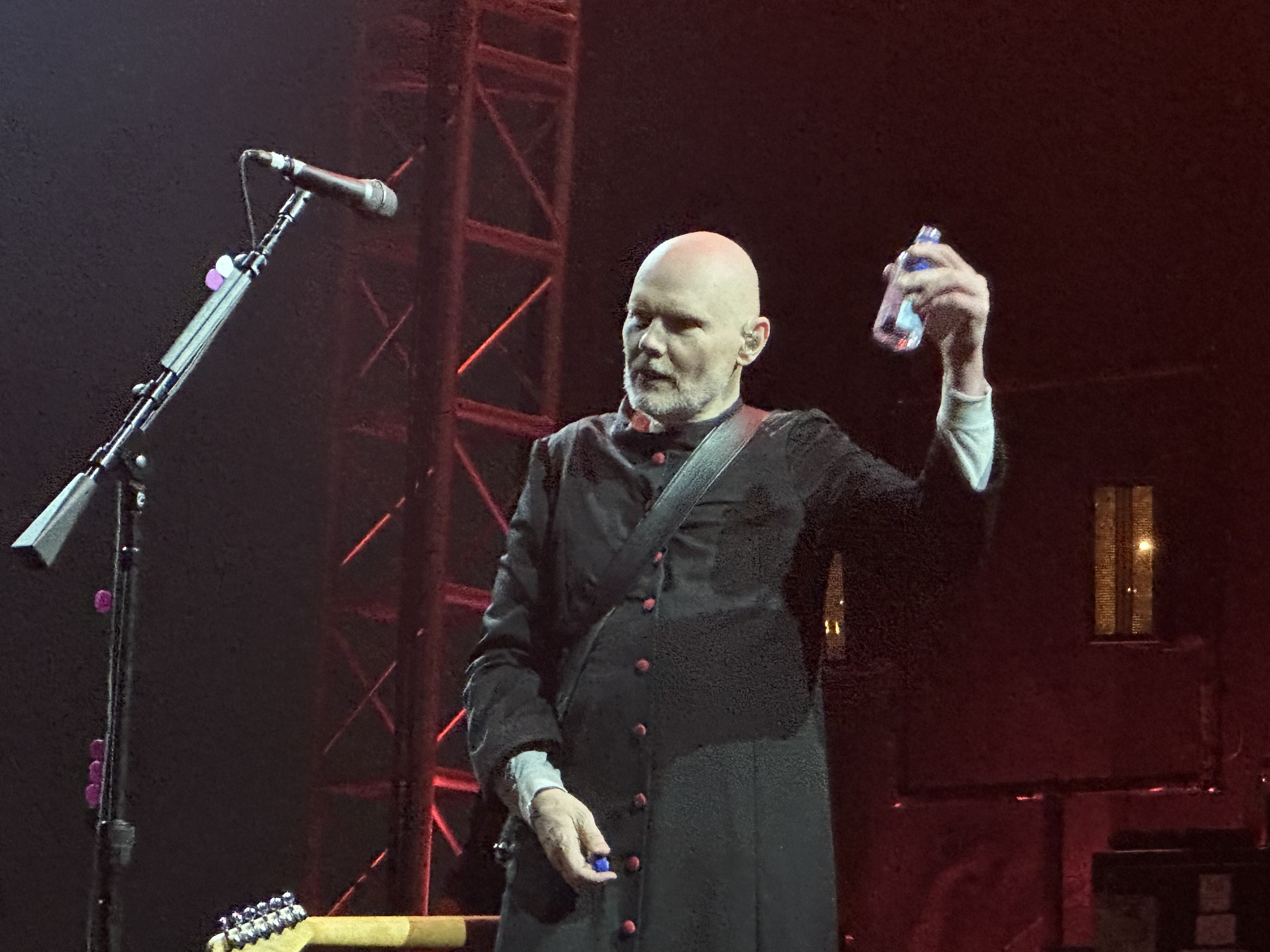
The night was warm, humid, and heavy with the scent of salt carried on a faint sea breeze. Above, the full moon hung low and luminous, watching over the thousands who gathered, its pale light washing over the stage like a celestial spotlight. The temperature didn’t seem to bother anyone — sweat clung to faces, shirts stuck to skin, but the atmosphere was electric, alive, feverish. Fans had begun lining up hours before gates opened, and by the time the first lights dimmed, the anticipation was tangible. When the Pumpkins finally took the stage, the crowd erupted with a sound that matched the magnitude of the night — a roar that could have been heard across the bay.
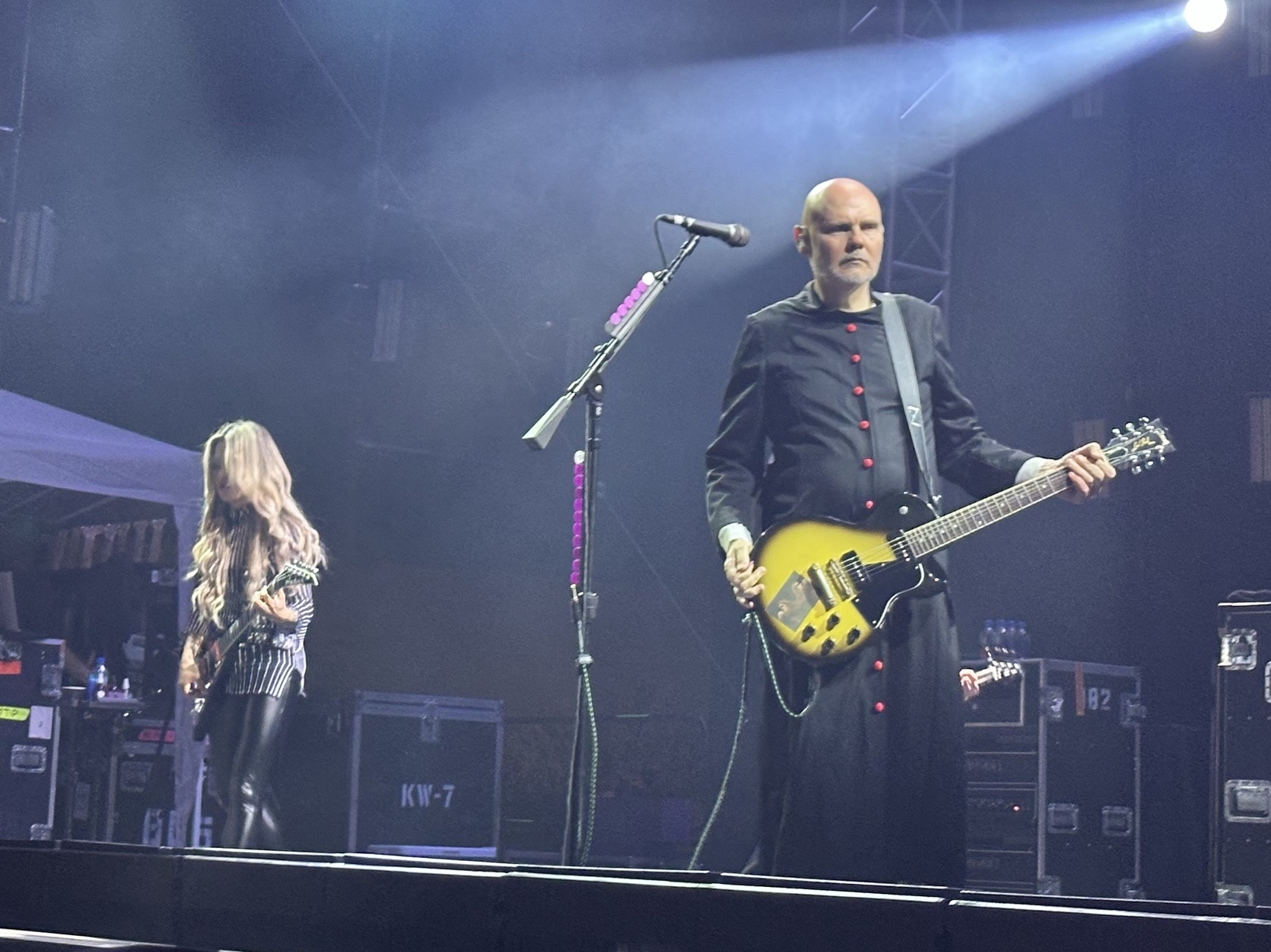
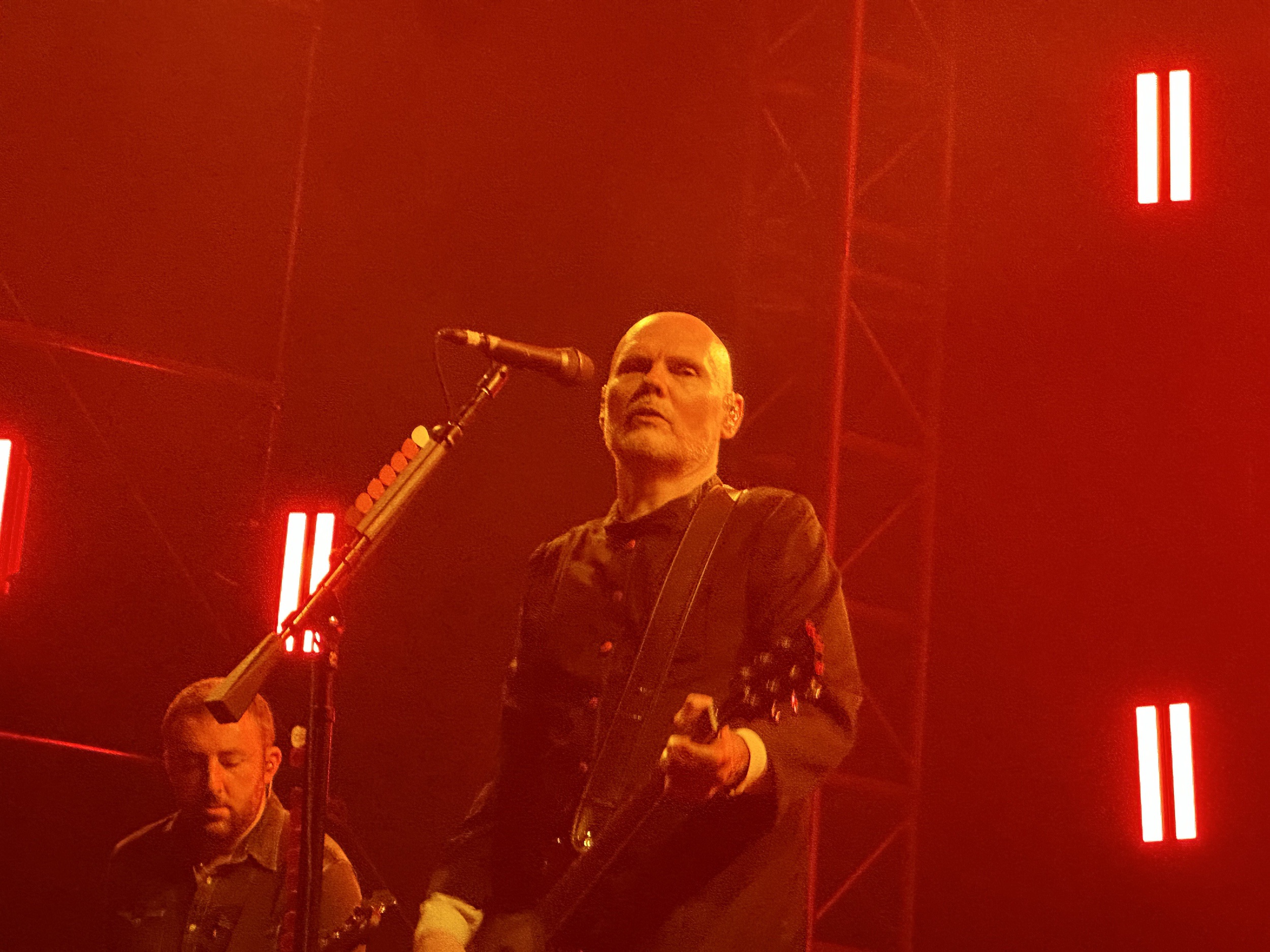
Billy Corgan emerged first, dressed in his trademark black attire — minimalist, austere, yet commanding. His presence was spectral and magnetic, his shaved head reflecting the stage lights as if he were some high priest of distortion. For decades, Corgan has been a man of contradictions — introverted yet outspoken, philosophical yet blunt, fragile yet indestructible. On this night, he seemed deeply aware of where he stood: on a stage thousands of miles from the Chicago clubs where the Smashing Pumpkins had first found their sound, now performing in the heart of the Middle East, before a crowd that spanned generations. He paused for a brief moment, looked up at the moon, and smiled faintly before gripping his guitar and launching into the opening chords of “Cherub Rock.”
The amphitheater exploded. The guitars roared with that unmistakable Pumpkins texture — layers of fuzz, shimmering harmonics, and that swirling wall of sound that could only come from their hands. The audience sang along to every word, the sound of thousands of voices bouncing off the amphitheater’s stone surfaces, mingling with Corgan’s nasally snarl: “Freak out, give in, doesn’t matter what you believe in.” Bahrain, for one night, believed entirely in that sound.
Standing just to Corgan’s left, James Iha looked effortlessly cool, as he always does — his black hair falling just right, his demeanor calm and collected. Iha has always been the band’s quiet anchor, the yin to Corgan’s fiery yang. His guitar tone shimmered with precision and elegance, his harmonies weaving through Corgan’s leads with the ease of decades spent side by side. Every so often, he turned to the audience, offered a sly smile, and nodded in rhythm, his understated stage presence commanding in its serenity. For fans who remembered the early ’90s, seeing Iha and Corgan share that space again felt like a reunion of spirits as much as musicians. Their chemistry — forged through creation, destruction, and rebirth — remains one of rock’s most fascinating partnerships.
Behind them, the powerhouse that is Jimmy Chamberlin sat poised like a coiled spring behind his drum kit. Chamberlin’s playing has always been a force of nature — intricate yet explosive, jazz-infused but thunderously heavy. As he kicked into the drum fills of “Geek U.S.A.” and “Tonight, Tonight,” the precision was surgical. Each hit landed like punctuation, propelling the songs forward with both grace and power. Under the humid Bahraini night, sweat poured down his face, but his focus never wavered. His sticks blurred under the lights, catching glints of moonlight as if he were drumming with lightning. Chamberlin remains the band’s engine — no computer, no metronome, no backing track could ever replicate his heartbeat.
To the right of the stage, Kiki Wong stood, the new addition to the lineup, her guitar slung low as she tore into riffs with energy and confidence. Her arrival had sparked curiosity among long-time fans, but within moments of the first solo, she’d earned every ounce of the crowd’s respect. Kiki’s style blended technical mastery with emotional flair — precise, expressive, and fearless. She moved across the stage with charisma and intensity, her chemistry with Iha immediate and electric. For those witnessing her first international tour with the band, it was clear that she wasn’t simply filling a vacancy — she was helping define a new chapter in the Smashing Pumpkins’ legacy.
The setlist was a masterclass in balance — a journey through time. From the roaring angst of the Siamese Dream era to the dreamlike textures of Mellon Collie and the Infinite Sadness, through the dark modern synthscapes of ATUM, every era had its moment. “1979” floated across the amphitheater like a memory resurrected; couples swayed, arms wrapped around each other, while smartphones lit up like candles across the terraces. “Tonight, Tonight” came alive under that full moon — a moment so perfect it felt scripted by the universe itself. When Corgan’s voice soared over the strings and Chamberlin’s drums built toward the climax, you could almost feel the collective heartbeat of the crowd align with the music.
As the night progressed, the Pumpkins ventured into deeper cuts — “Mayonaise,” “Drown,” “Ava Adore” — each song met with the kind of reverence normally reserved for hymns. Between songs, Corgan spoke sparingly but warmly. He thanked the Bahraini crowd for “making us feel at home in a place so far from where it all began.” He joked about the humidity, about how his guitar strings were “sweating more than I am,” and drew laughter from the crowd. It was a rare, candid side of him — relaxed, grateful, and connected.
James Iha took the mic at one point, his soft-spoken humor cutting through the atmosphere. “You know,” he said, “when we started this band, we never thought we’d be playing under a full moon in Bahrain.” The crowd roared, and he smiled. “It’s beautiful. You’re beautiful. Thanks for having us.”
Then came the thunderous drum roll leading into “Bullet with Butterfly Wings,” and the amphitheater erupted again. Even those who’d come out of curiosity — not die-hard fans — were swept into the frenzy. Every voice screamed the chorus, “Despite all my rage, I am still just a rat in a cage!” It was cathartic, primal, and unifying. The raw emotion of that song transcended decades and languages; it was as relevant in 2025 as it had been in 1995.
Under the shifting stage lights, you could see just how much the band was enjoying themselves. Kiki leaned into Corgan during solos, the two exchanging smiles; Iha moved toward Chamberlin during transitions, syncing perfectly; and Corgan himself looked more at peace than he had in years. Perhaps it was the surreal beauty of the venue — an open-air amphitheater surrounded by the sea — or perhaps it was the awareness that after thirty-five years, the Smashing Pumpkins were still here, still vital, still evolving.
At one point, the moon broke free of the thin clouds that had been drifting across the sky, casting a silvery glow over everything. Corgan glanced up and, almost instinctively, shifted gears into an impromptu solo acoustic segment. The band left the stage, leaving him alone with his guitar. “Disarm” filled the air, fragile and haunting. You could have heard a pin drop. The Bahraini night seemed to hold its breath. Every note hung in the air like a confession. When he finished, there was a beat of silence — and then thunderous applause that rolled like a wave across the amphitheater. Corgan smiled — a genuine, almost shy smile — before inviting the band back for the next surge of sound.
The energy climbed again with “Today” and “Zero,” the crowd’s chants echoing into the night. By now, everyone was drenched in sweat, but nobody cared. The band was locked in, the audience was alive, and the amphitheater had become a shared dream. When “Solara” came roaring through the speakers, the newer fans cheered just as loudly as the veterans who had lived through the Pumpkins’ ’90s heyday. The seamless blend of past and present was remarkable — proof that this band had not only survived but continued to matter.
As the concert neared its end, the Pumpkins delivered one final knockout: “The Everlasting Gaze.” The song’s grinding riff and apocalyptic tone felt perfectly suited to the vast, open sky above. The lights pulsed in rhythm, illuminating faces in the crowd — faces of teenagers hearing these songs live for the first time, and older fans reliving youth in every chord. When the last note faded, the band stood side by side, taking in the moment. Corgan spoke softly into the mic: “Thank you, Bahrain. You’ve given us something to remember forever.”
The applause was deafening. Even after they walked offstage, the crowd didn’t move. Chants of “One more song!” filled the amphitheater. After a minute that felt like an eternity, they returned — a soft, dreamy intro began to play. It was “Luna,” the perfect closer. The moon hung directly above them now, massive and radiant. “I’m in love with you…” Corgan sang, and for a few fleeting moments, it felt as though he was singing to every single person in the crowd. The song ended not with a bang, but with a sigh — gentle, intimate, transcendent.
When the house lights came up, no one rushed for the exits. People lingered, taking photos, laughing, soaking in what they had just witnessed. The amphitheater itself seemed reluctant to let go of the sound. The air was still thick with humidity, but also with something intangible — the shared awe of an experience that transcended mere entertainment. It was a communion, a reminder of why live music matters.
Outside the venue, the moonlight danced off parked cars, and the chatter of exhilarated fans filled the night. Some were still humming “Tonight, Tonight”; others debated which song had hit hardest. A Bahraini teenager wearing a vintage Smashing Pumpkins T-shirt turned to his friend and said, “That was history, bro.” And he was right.