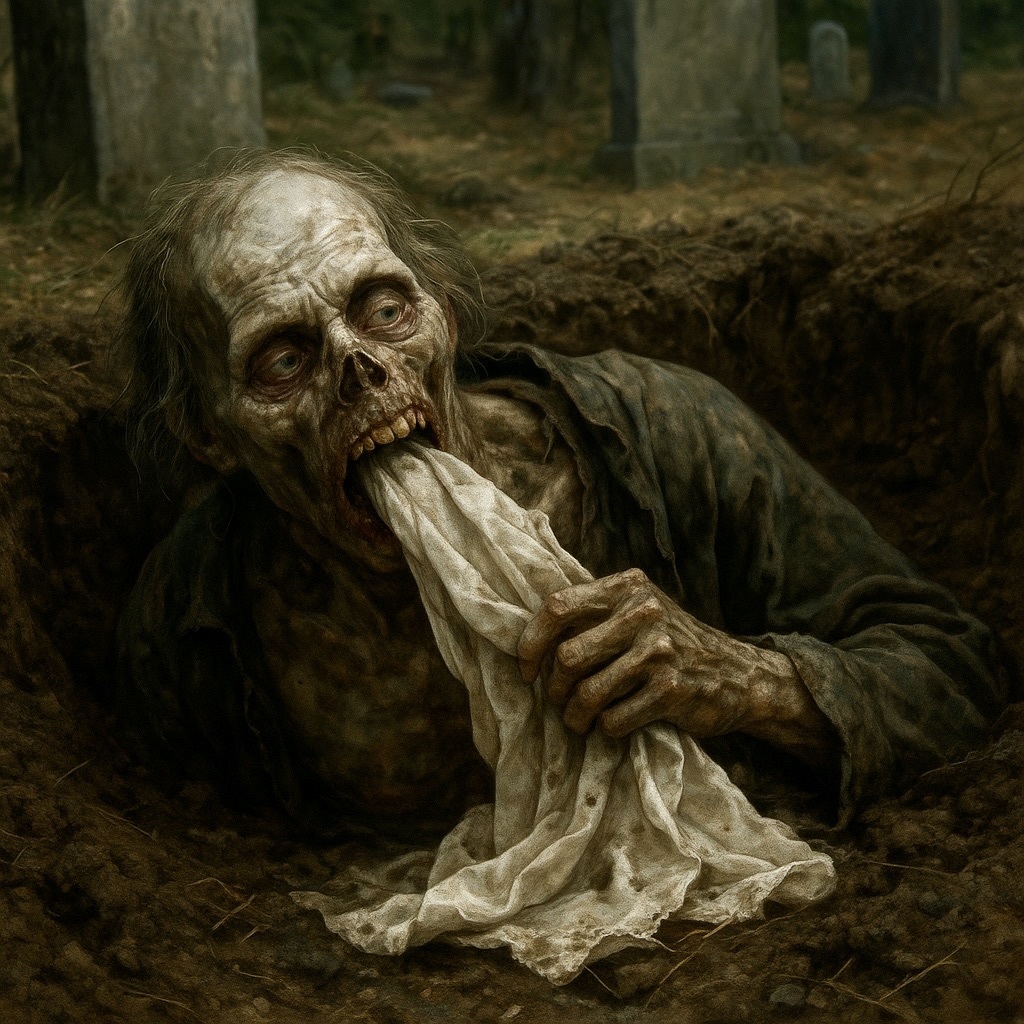
Legends tell us that the dead rest peacefully in their graves, sealed away from the world of the living. Yet in Germany, whispers in the dark claim that not all corpses stay quiet. Some stir in the soil, not to rise and walk like the vampires of Transylvania, but to consume life itself from the cold cradle of their grave. This creature is the Nachzehrer, a ghoul born not of hunger for flesh but of a twisted, invisible thirst that reaches beyond the grave. Unlike the elegant bloodsucker who slips into the night to seduce victims, the Nachzehrer remains buried, chewing its own shroud or gnawing on its own flesh, and in doing so, drains the vitality of its family, neighbors, and village. It is a monster of silence, a predator of proximity, a parasite whose grave becomes a gateway to the suffering of the living.
The very name “Nachzehrer” translates roughly to “after-devourer,” a chilling hint at its nature. In folklore, it is not a creature that attacks with claws or fangs, nor one that stalks under the moon. Instead, the Nachzehrer feeds in stillness. The idea was simple yet terrifying: if a corpse begins to chew its burial shroud, it siphons life from the people it once knew. Every bite, every grim chew of fabric or flesh, sent death rippling through the family, causing wasting sickness, sudden illness, or unexplained demise. Villages would blame epidemics and plagues not on poor sanitation or disease—concepts not yet understood—but on the hidden, hungry corpse beneath the soil. And in that ignorance grew a powerful mythology: a person could die, yet still kill.
To imagine the Nachzehrer is to picture the most disturbing inversion of death’s promise. We expect burial to be the end of suffering, the drawing down of a curtain. Yet this myth insisted that death could be a beginning of a new horror. The ghoul was said to awaken in its coffin, bloated and grotesque, chewing with relentless purpose. Some accounts claimed that while it fed, a ghastly noise—almost like the sound of chewing or sucking—could be heard in the cemetery at night. Families living near graveyards swore they heard their lost loved ones “eating” the silence, gnawing at their connection to the living. The legend took on the flavor of desperation, as communities, struck by illness, searched for something tangible to blame.
The Nachzehrer was no elegant aristocrat wrapped in velvet cloaks. It was the very antithesis of beauty. Descriptions painted it as pale, bloated, and revolting, the skin discolored with death. Sometimes, its face was contorted, mouth working endlessly at its own burial cloth. Unlike vampires who stepped into the world of the living, it remained buried, sending out its deathly influence without ever leaving the grave. There was something uniquely terrifying about this: you could not lock your doors or stay away from crossroads. The enemy was not outside your home but underneath your feet, in the earth, already waiting.
But how did one become a Nachzehrer? Folklore is often born out of fear of the unexplained, and this legend was no exception. People who died in unusual or violent ways were considered candidates. Suicide victims, those who perished in accidents, or even individuals suspected of witchcraft could all become Nachzehrer. Sometimes, those who died during epidemics were automatically feared as the source of lingering death. In some traditions, the first to die in a plague was thought doomed to feed in its grave, continuing the outbreak by gnawing away from beneath the soil. The Nachzehrer was, in this sense, both a mythic scapegoat and a cultural attempt to understand why death could spread like wildfire.
The methods to stop a Nachzehrer were as gruesome as the legend itself. Villagers, desperate to halt mysterious deaths, often resorted to exhuming corpses. Signs of bloating or blood around the mouth—common results of natural decomposition—were read as evidence of ghastly feeding. To neutralize the creature, drastic measures were taken: decapitation, burning, or staking the corpse through the chest. In some regions, the shroud itself was targeted. If the corpse was chewing the cloth, villagers would place a stone or coin in the mouth, or remove the shroud entirely. Others went further still, hammering nails through the skull or stuffing the mouth with soil to stop the chewing. These rituals, horrifying to us today, represented the desperate attempts of ordinary people to regain control in the face of illness and mortality.
At the heart of the Nachzehrer legend is the concept of invisible death. Unlike vampires, who must be invited in, or werewolves, who can be hunted by moonlight, the Nachzehrer was unstoppable in its simplicity. It did not need to move, did not need to fight, did not need to charm. It fed by existing in its grave, bound by death yet horrifyingly alive in its hunger. This invisible threat mirrored the invisible nature of disease itself. When villages were struck by tuberculosis, plague, or cholera, the unseen hand of death was explained through the unseen chewing of the Nachzehrer. Folklore filled the void where science had not yet arrived.
And yet, in its horror, there is a strange poetry. The Nachzehrer reflects our deepest fear—that death is not an end, but a continuation of suffering. The corpse becomes an extension of the grief it leaves behind, a parasite not only on life but on memory. Families mourning their loved ones might also fear them, wondering if each new cough or fever was the echo of chewing in the grave. In this way, the Nachzehrer was not only a monster but a mirror, forcing communities to confront the fragile boundary between the living and the dead.
Even today, the Nachzehrer fascinates because it speaks to timeless human anxieties. It is not the stranger who comes from the outside, but the loved one who remains a threat. It transforms grief into suspicion and mourning into terror. In modern culture, we see shades of it in zombie stories, where the familiar face of a loved one becomes a predator. We see it in our own struggles with invisible threats, from pandemics to the creeping fear of what we cannot see but know is there. The Nachzehrer endures because it touches something primal: the idea that even when buried, the dead can still reach us.
In retelling this German legend, we are not simply indulging in a ghost story. We are tracing the evolution of human fear. Before microscopes revealed germs and viruses, before medicine explained contagion, the Nachzehrer explained the inexplicable. It gave form to invisible terror, wrapped it in a shroud, and buried it in the graveyard. But like all great myths, it lingers, reminding us that the scariest monsters are not those who stalk in the night, but those we cannot see—those who exist where we think safety lies. The Nachzehrer is not just a corpse-ghoul. It is a story about helplessness, about loss, and about how we invent monsters to survive our own fear of death.
And perhaps that is why this story, even now, on an October evening centuries later, still chills the spine. For when the wind rustles leaves in a graveyard, when silence hangs heavy in the air, we wonder—do we hear the earth shifting? Do we hear the soft chew of fabric beneath the ground? Or is it only the echo of our imagination, ancient and eternal, reminding us that death is never as simple as we hope it to be?