
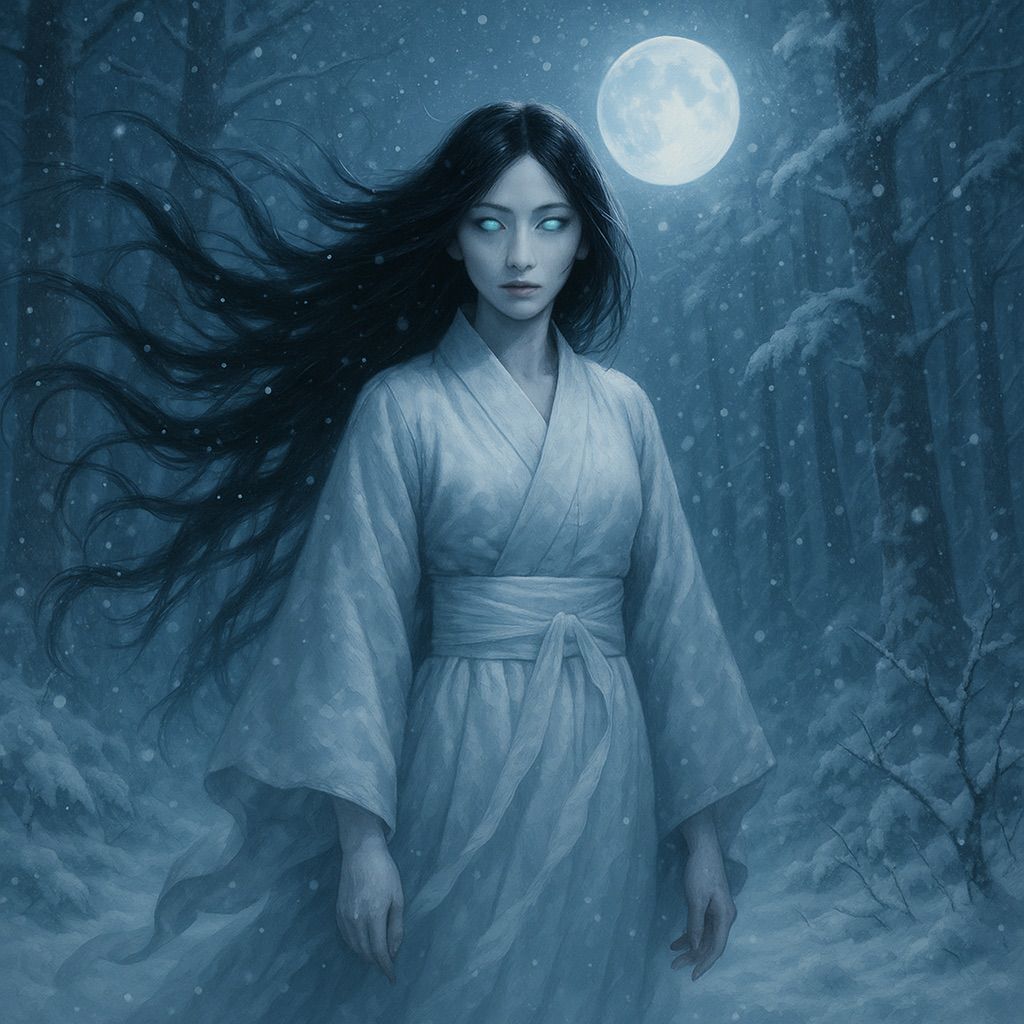
Some monsters frighten us with grotesque shapes, with claws and teeth, with blood dripping from their jaws. Others terrify in subtler ways, cloaked not in horror but in beauty, their danger hidden behind grace. In Japanese folklore, one such figure floats silently through the snow: Yuki-onna, the snow woman. She is described as breathtakingly beautiful, pale as moonlight, her hair dark against the whiteness of winter, her lips red as fresh blood on snow. But her beauty is a trap, for behind her calm, graceful face lies death. She lures travelers in blizzards, freezes men with her icy breath, and drifts away without footprints. On October 21, when her story is remembered, we are reminded that sometimes the most beautiful things in the world are also the most lethal.
Yuki-onna’s legend stretches back centuries, appearing in various regions of Japan with subtle differences. In some stories, she is a ruthless killer who delights in freezing men to death. In others, she is more complex, torn between her inhuman nature and human emotions, capable of mercy but unable to escape her deadly essence. What remains consistent is her connection to snowstorms, her haunting beauty, and her role as both a spirit of winter and a warning about desire, trust, and survival.
She is always pale, her skin translucent as if carved from ice itself. Her kimono is white, blending seamlessly with snowdrifts, making her appear as part of the storm. Her hair is long and black, contrasting sharply with her pale skin, and her eyes are said to shine like frozen stars. Some describe her with no feet, floating ghostlike over the snow, leaving no trace of her passing. To encounter her in a blizzard is to see death personified, wrapped in beauty so sharp it burns.
The origins of Yuki-onna are tied deeply to the environment. Japan’s winters, especially in mountainous regions, are harsh and unforgiving. Snowstorms could arrive suddenly, blinding travelers, freezing them before they could reach shelter. In a world without modern heating, protective gear, or reliable roads, winter itself was a killer. The Yuki-onna became a way to personify this danger — to give it a face, a story, a reason for why people vanished in the snow. In her, the cruelty of winter became a spirit, the blizzard a woman with icy breath.
Her motives vary in different tales. In some, she is pure predator. She seduces men with her beauty, lures them into the snow, then exhales a freezing breath that stills their hearts. Sometimes she drinks their life force, leaving them pale and lifeless. In other tales, she appears at the doors of houses, begging for warmth, and when admitted, she kills the family within. She is merciless, and her beauty only makes her more terrifying, because it hides the truth until it is too late.
But in other stories, Yuki-onna reveals a more tragic side. One famous tale tells of a woodcutter who encounters her in a blizzard. She spares his life, warning him never to speak of her. Later, he meets a beautiful woman, marries her, and has children. Years pass, and one night, he tells her the story of his encounter with Yuki-onna. His wife grows pale, revealing herself to be the very spirit who spared him. In some versions, she vanishes, leaving him heartbroken. In others, she stays for the sake of their children, but her true nature is forever revealed. This duality makes Yuki-onna more than just a monster. She is also a symbol of love, mercy, and the fragility of secrets.
Yuki-onna’s beauty and danger make her a fascinating figure. She embodies the idea that appearances deceive, that beauty can be lethal, that desire can lead to destruction. She reflects cultural anxieties about women, power, and sexuality. To some, she is the ultimate femme fatale — beautiful but deadly, alluring but fatal. To others, she is a tragic figure, caught between her nature as a spirit and her longing for human connection. Either way, she is unforgettable.
Her legend also speaks to broader themes in Japanese folklore, where nature and humanity are deeply entwined. Spirits like Yuki-onna remind us that natural forces are not just physical but spiritual. Winter is not only cold; it has intention, personality, danger. In this sense, Yuki-onna is not only a ghost but also a goddess of winter, a being who commands respect because she personifies the harshness of the natural world.
In modern culture, Yuki-onna has endured as one of Japan’s most iconic spirits. She appears in films, anime, manga, and literature. Sometimes she is portrayed as a horror figure, haunting snow-covered villages, her eyes glowing in the storm. Other times she is reimagined as a romantic figure, a tragic woman bound by her icy nature. Her flexibility ensures her survival in cultural memory, adapting to new forms while retaining her core: beauty wrapped in death.
Why does she resonate so deeply? Because she touches on universal fears and desires. We all know the allure of beauty, and we all fear its betrayal. We all understand the danger of nature, the way a storm can mesmerize and kill. We all fear coldness — not just of weather but of the human heart. Yuki-onna embodies all these fears, making her timeless.
So on October 21, when her story is told, it is not just about a snow woman who kills. It is about the dangers of desire, the fragility of secrets, the cruelty of winter, and the way beauty can hide death. She is both warning and wonder, terror and tragedy, a figure who drifts endlessly across snow-covered fields, her breath icy, her gaze eternal.
And maybe, when the first snow of winter falls, you’ll think of her. Maybe you’ll glance at the drifting white, and for a moment, imagine a woman in the distance, her kimono blending with the snow, her eyes fixed on you. And maybe you’ll wonder: is she watching? Is she waiting? And will she spare you, or will she breathe her icy breath until you sleep forever in the snow?