
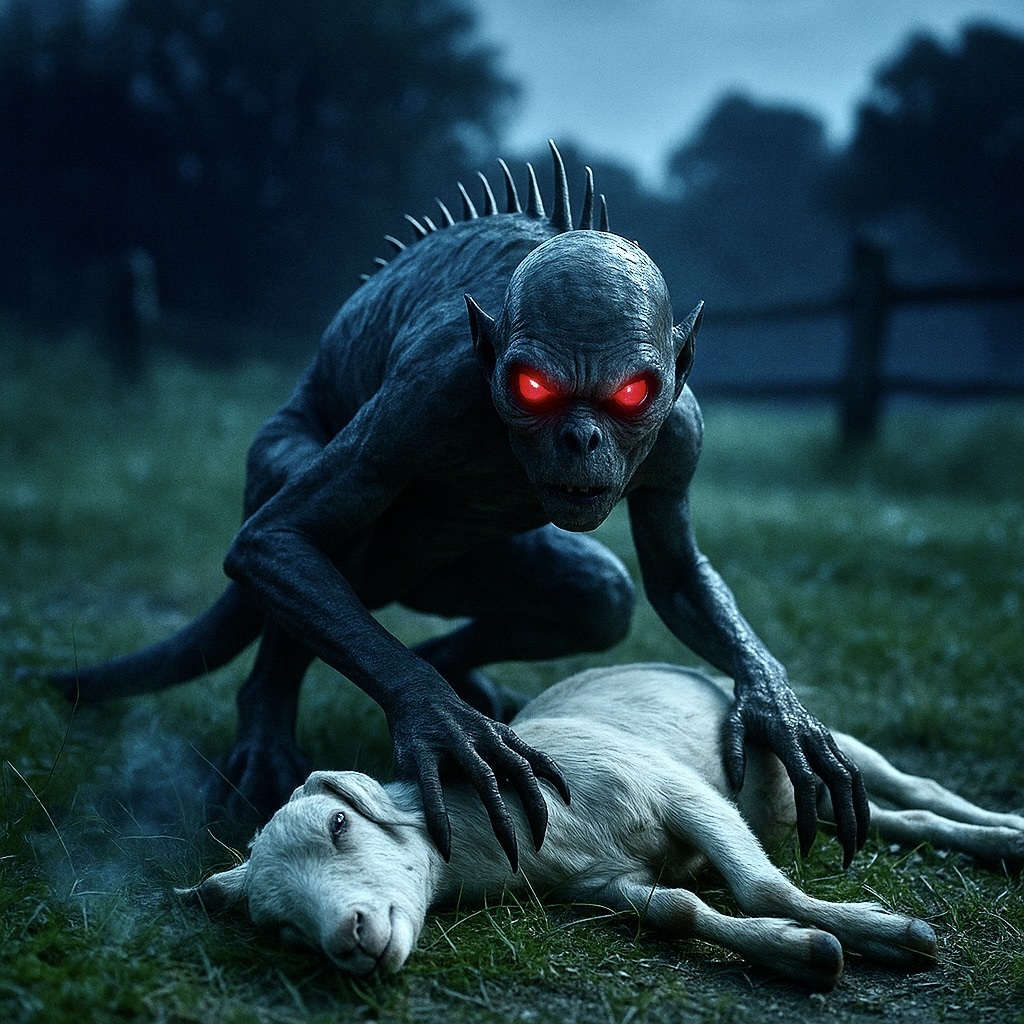
It began, as many legends do, with blood. In the mid-1990s, in the rural hills of Puerto Rico, farmers awoke to find their animals dead in the night. Goats, chickens, rabbits—drained, it seemed, of their blood. There were no torn hides, no scattered carcasses, just puncture marks on necks and lifeless bodies left behind. Whispers spread faster than the news, and soon a name was whispered too: el chupacabra—the goat-sucker. Within months, it had grown from rumor to global phenomenon, a monster that felt at once new and ancient, strange and familiar. Unlike the vampires of Europe or the spirits of Asia, this was a monster of the modern age—sighted in suburbs, catalogued by tabloids, chased by ufologists. The Chupacabra became not just Puerto Rico’s monster, but the world’s, born in the crucible of media, paranoia, and imagination.
At first, the descriptions of the creature were unlike anything the world had seen before. Witnesses spoke of a small humanoid figure, three to four feet tall, with spines or quills running down its back, glowing red eyes, and leathery gray-green skin. Some said it hopped like a kangaroo, others that it slinked like a reptile. In every account, it was otherworldly, more alien than animal. Its victims were not just killed but exsanguinated, their bodies eerily intact save for two or three puncture wounds. Farmers swore it was no dog, no coyote, no predator they had ever known. And in that void of explanation, the myth took root. The Chupacabra was born not from centuries of folklore but from the immediacy of mystery, a monster created in real time.
The timing of the Chupacabra’s emergence was no accident. The 1990s were a decade steeped in alien abduction stories, conspiracy theories, and a new global media landscape that spread tales faster than ever before. Shows like The X-Files dominated, tabloids filled their pages with UFOs and government cover-ups, and rural fear met urban fascination in a perfect storm. The Chupacabra slid neatly into this space, part cryptid, part extraterrestrial, part government experiment gone wrong. Its image spread from Puerto Rico to Latin America, then into the southern United States, and from there across the globe. The monster was new, but the story—something lurking just outside the safety of night—was as old as humanity itself.
But what made the Chupacabra different from other creatures of legend was the speed with which it evolved. Within just a few years, its appearance shifted. By the early 2000s, many sightings described not a spiny alien-like being but a hairless, mangy dog-like creature, with gaunt features, glowing eyes, and vicious teeth. Dead specimens were occasionally found, almost always coyotes suffering from mange, their fur gone, their skin sickly and tight, their bodies emaciated. Scientists explained the phenomenon as misidentification, pointing out that mange made ordinary animals appear monstrous. But by then, the legend had already outgrown explanation. The Chupacabra had become a symbol, a modern boogeyman whose truth mattered less than its story.
Puerto Rico holds the heart of that story. The island’s rich cultural tapestry of folklore already included tales of witches, demons, and spirits, blending Indigenous, African, and Spanish influences. The Chupacabra was something new, but it resonated with something deep, a sense that the land still held mysteries beyond human control. For farmers whose livelihoods were shaken by the sudden deaths of livestock, the creature was more than a story—it was an answer. In this way, the Chupacabra reflects a universal human pattern: when faced with the unexplained, we give it shape, give it a name, and through story, try to contain it.
There is something profoundly human in the way the Chupacabra spread. It was born in fear, fed by rumor, and raised by media. Each retelling made it larger, stranger, more terrifying. Children whispered about it in schools, reporters breathlessly covered each sighting, and skeptics and believers clashed in endless debate. The monster became a mirror, reflecting whatever fears a culture projected. In Puerto Rico, it was linked to economic hardship, colonial tension, and the anxieties of modern life. In the U.S., it became entangled with fears of border security and invasive threats. In each place it landed, the Chupacabra took on new meaning, its image molded by the hands of those who told its story.
And yet, for all the skepticism, the legend endures. Ask someone who has lost animals to mysterious attacks, and they will tell you it was no coyote. Listen to a witness describe what they saw, and you will hear conviction, not fabrication. Myths do not survive because they are factually true—they survive because they capture a truth deeper than fact. The Chupacabra embodies fear of the unseen predator, the sense that nature—or something beyond nature—can still surprise us, still terrify us. It is the fear of losing control, of being powerless to protect, of realizing that even in a world of satellites and science, monsters may still lurk in the dark.
To humanize the Chupacabra legend is to see the people who shaped it. The farmer in Puerto Rico who awoke to find his goats dead, the children who huddled around each other at night, the journalists chasing a story that felt alive—these are the heartbeat of the monster. The Chupacabra is not just a cryptid; it is a cultural creation, one that speaks to collective anxieties. It is what happens when fear meets imagination, when the unexplained demands explanation, and when storytelling becomes a survival tool. In this sense, the Chupacabra is less about claws and fangs, and more about us.
Even now, decades after the first reports, the Chupacabra has not faded. It appears in documentaries, horror films, urban legends, even memes. Children still whisper about it in the dark, and farmers still eye the night warily when livestock die unexpectedly. It is part of the folklore of not just Puerto Rico but the world, a monster created in the age of the internet but one that feels timeless. And as long as people fear the unexplained, the Chupacabra will remain alive in shadow, just out of sight.
Perhaps that is the most unsettling truth of all: the Chupacabra may never need to exist in flesh and blood, because it already exists in the one place monsters can never die—in human imagination. Its cry is not in the night air, but in our stories, our fears, our need to give shape to the shadows. It is, in that way, eternal.