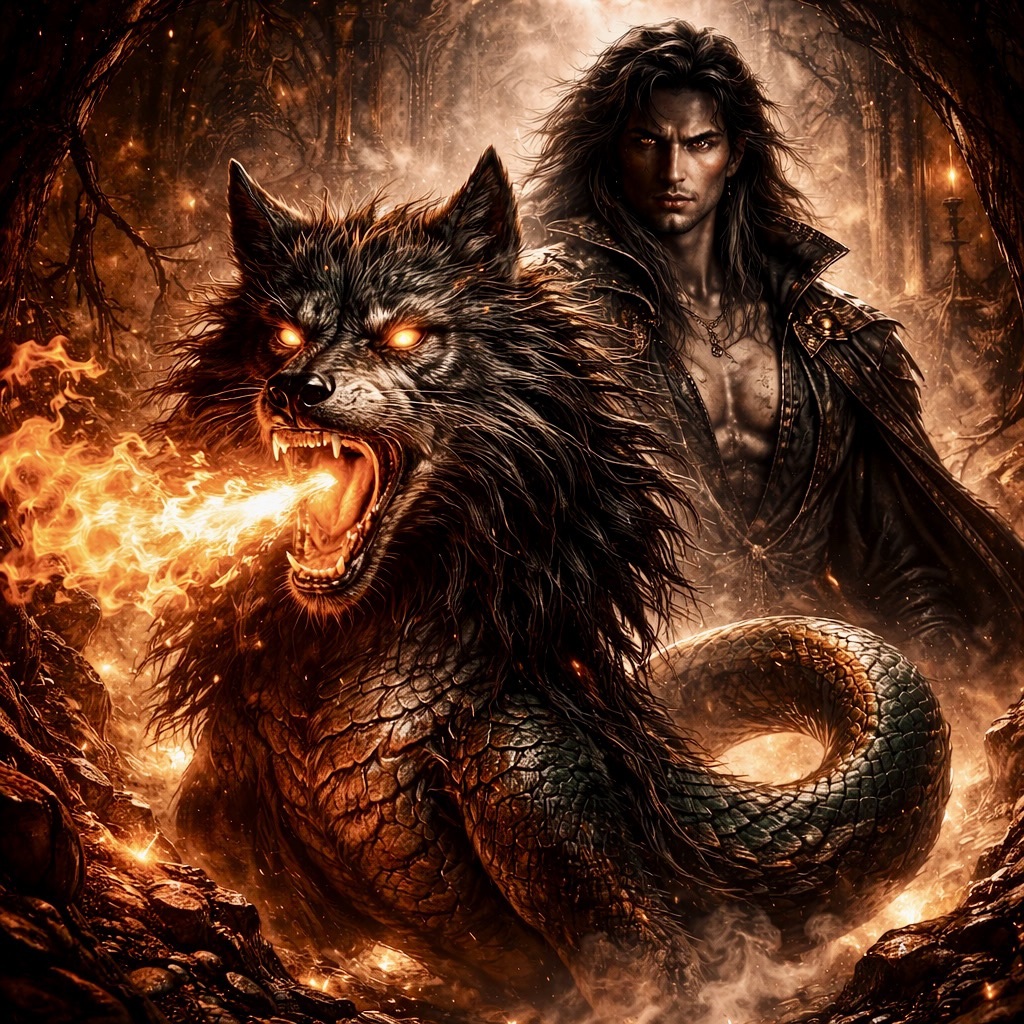
Among the seventy-two spirits cataloged within the Ars Goetia, the name Amon carries a peculiar weight—one that feels less theatrical than kings like Paimon and less chaotic than war-bringers like Leraje, yet somehow more unsettling in its precision. Amon is not a demon of spectacle. He is a demon of understanding. Of seeing things as they truly are. Of exposing what was hidden, what is, and what will be.
Described as a Marquis of Hell commanding forty legions of spirits, Amon appears first as a strange and fearsome creature—often depicted with the head of a wolf or raven, a serpent’s tail, and the ability to breathe fire. Yet like several spirits within the Goetic hierarchy, he possesses the ability to transform into a human form when commanded. This dual nature—beast and man—sits at the core of his symbolism, representing the divide between instinct and awareness, chaos and comprehension.
At first glance, Amon’s grotesque form seems to align him with destruction or primal force. The wolf evokes predation, instinct, and survival. The serpent tail suggests hidden knowledge and transformation. Fire, of course, has long symbolized both destruction and revelation—burning away what is false to expose what remains. Yet despite this fearsome appearance, Amon’s true domain is not destruction, but clarity.
The grimoires state that Amon can reveal all things past and future, and reconcile friends and foes. This combination of abilities places him in a unique position within demonology. He is both a revealer of truth and a restorer of balance. He does not merely expose reality—he allows it to be understood in a way that resolves conflict.
To understand why this matters, it helps to consider how conflict typically arises. Most disputes—whether between individuals, families, or nations—are not born purely from malice. They emerge from misunderstanding, incomplete information, or differing perspectives. One person sees an action as intentional harm; another sees it as necessity. One side remembers history one way; the other remembers it differently.
Amon exists at the point where these narratives collide.
If all sides could see the full picture—the true sequence of events, the genuine motivations, the hidden context—many conflicts would dissolve. Not all, of course, but many. Misunderstanding is one of the most powerful sources of division.
Amon’s role as a reconciler reflects this truth. He does not force peace. He reveals the conditions that make peace possible.
His connection to both past and future further reinforces this role. To resolve a conflict, one must understand its origin—the past—and anticipate its consequences—the future. Without this perspective, decisions are made blindly, often perpetuating the very problems they seek to solve.
Amon sees both ends of the timeline.
This places him among a rare class of figures in mythology and demonology—those associated with temporal awareness. Like Gusion, he is not bound to the present moment. He perceives continuity. Cause and effect. The chain of events that stretches backward and forward through time.
From a psychological perspective, this ability can be interpreted as a form of deep insight. Humans are capable of understanding patterns—recognizing how past experiences influence present behavior and how current actions shape future outcomes. This capacity is central to learning, decision-making, and growth.
Amon represents that capacity taken to its extreme. He is the mind that sees everything at once—the full arc of a situation, from origin to consequence.
Yet this level of awareness carries its own weight.
Knowing the past means confronting truths that may be uncomfortable. Knowing the future means recognizing outcomes that may be unavoidable. Amon does not offer comforting illusions. He offers clarity.
And clarity can be unsettling.
The raven imagery sometimes associated with Amon adds another dimension to this idea. Ravens have long been symbols of intelligence, observation, and prophecy. In Norse mythology, Odin’s ravens, Huginn and Muninn, traveled the world gathering information. In many cultures, ravens are seen as watchers—creatures that observe from a distance, noticing what others miss.
If Amon takes on a raven-like form, it reinforces his role as an observer. He does not act impulsively. He watches, gathers, understands.
The wolf aspect, on the other hand, connects him to instinct and raw perception. Wolves are highly social animals, capable of complex communication and cooperation within their packs. They are also keen observers, able to read subtle cues in their environment.
By combining wolf, serpent, and raven symbolism, Amon becomes a composite of awareness—instinctive, intellectual, and transformative.
His transformation into a human form is perhaps the most important detail of all. It suggests that this awareness, while appearing alien or monstrous at first, ultimately becomes something recognizable. Understanding, once achieved, feels natural. Obvious, even.
We have all experienced moments like this—when something that once seemed confusing suddenly makes perfect sense. A pattern clicks into place. A misunderstanding is resolved. A hidden truth becomes clear.
In that moment, what once felt chaotic becomes structured.
Amon’s transformation mirrors this process.
The fire he breathes can also be interpreted symbolically. Fire destroys, but it also illuminates. It provides light in darkness, allowing hidden things to be seen. In alchemy, fire is associated with purification—the burning away of impurities to reveal what is essential.
Amon’s fire, then, is not merely destructive. It is revealing. It strips away illusion, leaving only truth behind.
This aligns with his role as a reconciler. To resolve conflict, false narratives must be burned away. Only then can understanding emerge.
In the Renaissance context, where the grimoires were compiled, this idea would have been deeply significant. The period was marked by intense intellectual and religious conflict. Different interpretations of truth led to division, war, and upheaval.
In such an environment, the concept of a being who could reveal absolute truth—and thereby resolve conflict—would have held powerful appeal.
Yet the fact that Amon is categorized as a demon suggests an important caution. Absolute knowledge is not without consequence. It can challenge beliefs, disrupt systems, and force individuals to confront realities they might prefer to ignore.
Amon does not comfort. He clarifies.
From a modern perspective, Amon can be seen as an archetype of understanding and reconciliation. He represents the process of uncovering truth and using that truth to restore balance.
This process is evident in many areas of life. In therapy, individuals explore past experiences to understand present behavior and make better choices for the future. In diplomacy, negotiators examine historical context and future implications to resolve disputes. In science, researchers study patterns to uncover underlying principles.
In each case, the goal is the same: to see clearly.
Amon embodies that goal.
He also reflects the idea that truth is often hidden beneath layers of perception. People do not always see reality as it is. They interpret it through the lens of their experiences, beliefs, and emotions.
Amon cuts through those layers.
This is why his initial form is so unsettling. Truth, when first encountered, can feel alien. It challenges assumptions, disrupts expectations, and forces reevaluation. Only after it is understood does it become familiar.
The reconciliation aspect of his role is particularly important in today’s world. Conflict—whether personal, political, or cultural—often persists because of incomplete understanding. People speak past each other, interpreting the same events in different ways.
Amon’s mythology suggests that resolution requires more than compromise. It requires clarity. A shared understanding of what is true.
This does not mean that all conflicts can be resolved simply by revealing facts. Emotions, values, and interests also play roles. But without a foundation of truth, resolution becomes far more difficult.
Amon provides that foundation.
He does not impose peace. He makes it possible.
In the end, Amon stands as one of the most intellectually grounded figures in demonology. He is not defined by chaos or temptation, but by insight. He represents the moment when confusion gives way to understanding, when conflict begins to dissolve, and when the full scope of a situation becomes visible.
His monstrous form reminds us that truth can be difficult to face. His human form reminds us that it can also be integrated, understood, and used.
And somewhere between those two forms—between instinct and awareness, between past and future—that is where Amon exists.
Not as a force of destruction, but as something far more powerful.
The one who sees everything.