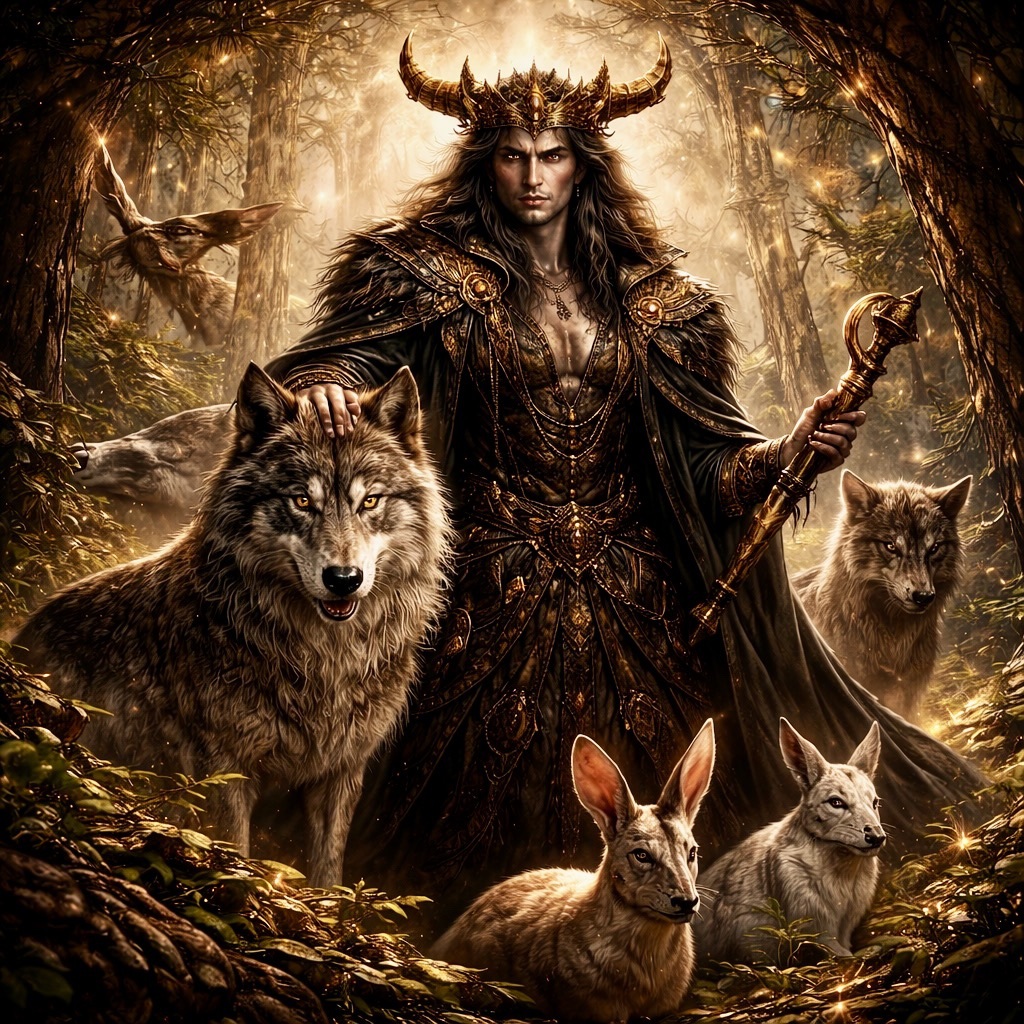
Among the seventy-two spirits recorded in the Ars Goetia, there are those who command armies, those who manipulate desire, and those who reveal hidden truths about time and knowledge. Yet Barbatos stands apart in a way that feels quieter, almost grounded—rooted not in grand displays of power, but in something older, deeper, and more intimate. He is a Duke of Hell, commanding thirty legions of spirits, but his domain is not chaos or conquest. Instead, Barbatos governs communication—specifically, the ability to understand the voices of animals, the language of nature, and the hidden things buried beneath the surface of the world.
He is described as appearing when the sun is in Sagittarius, accompanied by the sound of horns and surrounded by four noble kings and their armies. His presence is not silent. It echoes, almost like a hunt beginning at dawn. There is something ancient in that imagery, something that reaches back beyond medieval Europe into a much older relationship between humans and the natural world.
Barbatos is often depicted as a hunter or woodsman, sometimes crowned, sometimes holding a bow or horn. Unlike many demons in the Goetic tradition, his form is not grotesque or monstrous. It is familiar. Human. Almost noble. And that familiarity is part of what makes him so intriguing.
Because Barbatos represents something that humans once understood instinctively, but have largely forgotten.
His most well-known ability is the power to understand and speak with animals. This idea appears across cultures and mythologies—the notion that there was once a time when humans and animals shared a common language, when communication between species was possible. In many traditions, this ability is reserved for shamans, prophets, or beings who exist between worlds.
Barbatos embodies that connection.
To understand why this matters, we need to look at how humans once related to the natural world. Before cities, before industrialization, before the separation of humanity from wilderness, people lived within nature, not apart from it. Survival depended on understanding animal behavior, seasonal patterns, and environmental changes.
Animals were not just resources or background elements. They were part of the same system—participants in a shared existence.
Over time, as societies developed, that connection weakened. Language became more specialized, focused on human interaction. The ability to interpret animal behavior remained, but the sense of shared communication faded.
Barbatos represents that lost connection.
When the grimoires describe him as understanding the voices of animals, it can be interpreted literally within the context of demonology. But symbolically, it suggests something more nuanced—the ability to perceive meaning in the natural world, to recognize patterns and signals that are often overlooked.
Animals communicate constantly, but not through words. They use movement, sound, posture, and behavior. A bird’s call can signal danger. A change in migration patterns can indicate environmental shifts. The way a predator moves can reveal intent.
To “understand” animals is to interpret these signals accurately.
Barbatos, then, is not just a speaker of animal language. He is an observer—someone who sees and understands patterns that others miss.
This ties directly into his second major ability: revealing hidden treasures.
At first, this might seem unrelated. Speaking to animals and finding treasure appear to belong to entirely different domains. But there is a connection.
Hidden things—whether they are physical objects buried underground or patterns hidden within behavior—require perception to uncover. They are not visible to everyone. They must be noticed, interpreted, and understood.
Barbatos reveals what is hidden because he sees differently.
In the Renaissance context, treasure was not always literal gold or jewels. It could refer to knowledge, opportunities, or insights that were not immediately apparent. The idea of “hidden treasure” often carried symbolic meaning—something valuable waiting to be discovered by those who knew how to look.
Barbatos’s ability to reveal such things aligns with his role as a communicator and observer. He understands the language of the world, and through that understanding, he uncovers what others cannot see.
His association with reconciliation is another important aspect of his mythology. The grimoires state that Barbatos can bring friends and rulers into agreement, resolving disputes and restoring harmony.
At first glance, this might seem disconnected from his other abilities. But when viewed through the lens of communication, it becomes clear.
Conflict often arises from miscommunication. People misunderstand each other’s intentions, misinterpret actions, or fail to express themselves clearly. Without accurate understanding, tensions grow.
Barbatos’s ability to interpret and communicate extends beyond animals to humans. He bridges gaps in understanding, allowing individuals to see each other more clearly.
In this way, he becomes a mediator—not through force, but through clarity.
The sound of horns associated with his arrival reinforces this idea. Horns have long been used as signals—announcing events, coordinating movement, or marking transitions. In hunting traditions, horns were used to communicate across distances, guiding participants and signaling important moments.
Barbatos’s arrival with the sound of horns suggests the beginning of awareness—the moment when something hidden becomes known, when attention is drawn to something important.
The presence of four kings accompanying him adds another layer of symbolism. In many traditions, the number four represents stability and structure—four directions, four elements, four seasons. These kings may represent foundational forces, reinforcing Barbatos’s role as a stabilizing influence.
He does not disrupt. He aligns.
From a psychological perspective, Barbatos can be interpreted as an archetype of awareness and connection. He represents the ability to perceive patterns, understand subtle signals, and bridge gaps in communication.
In modern life, this ability is more relevant than ever.
Despite advances in technology and communication, misunderstandings remain common. People communicate through text, tone, and expression, yet meaning is often lost or distorted. Relationships—both personal and professional—can suffer from a lack of clarity.
Barbatos represents the skill of listening—not just hearing words, but understanding intent.
This kind of listening requires attention, patience, and empathy. It involves observing not only what is said, but how it is said, and what is left unsaid.
Similarly, understanding the natural world requires observation. Environmental changes often occur gradually, signaled by subtle shifts in behavior or patterns. Recognizing these signals is essential for sustainability and ecological awareness.
Barbatos’s mythology, though ancient, reflects a deeply modern challenge: the need to reconnect with systems of communication that extend beyond immediate perception.
His role as a Duke commanding thirty legions suggests that his influence is widespread. Communication, after all, touches every aspect of life. It shapes relationships, guides decisions, and influences outcomes.
Without clear communication, even the most well-intentioned actions can lead to conflict.
With it, understanding becomes possible.
Barbatos does not command armies or alter reality directly. He changes perception. And through that change, everything else follows.
The forest imagery often associated with him reinforces this idea. Forests are complex ecosystems, filled with interactions between countless organisms. Every sound, movement, and change carries meaning.
To someone unfamiliar, a forest may seem chaotic. But to someone who understands it, patterns emerge. The forest speaks—just not in words.
Barbatos is the one who listens.
He hears the rustle of leaves, the call of birds, the movement of animals, and understands what they signify. He reads the environment as a language.
In doing so, he reveals not just hidden treasures or secrets, but the structure of the world itself.
In the end, Barbatos stands as one of the most grounded figures in demonology. He does not dominate or deceive. He observes, interprets, and reveals.
He reminds us that understanding is not always about acquiring more information, but about seeing what is already there.
And in a world filled with noise, distraction, and constant activity, that ability—to truly listen, to truly see—may be one of the most powerful skills of all.
Somewhere in the quiet spaces between sounds, in the subtle patterns that go unnoticed, in the language that does not use words—that is where Barbatos resides.
Not as a force of chaos, but as something far more enduring.
The one who understands.