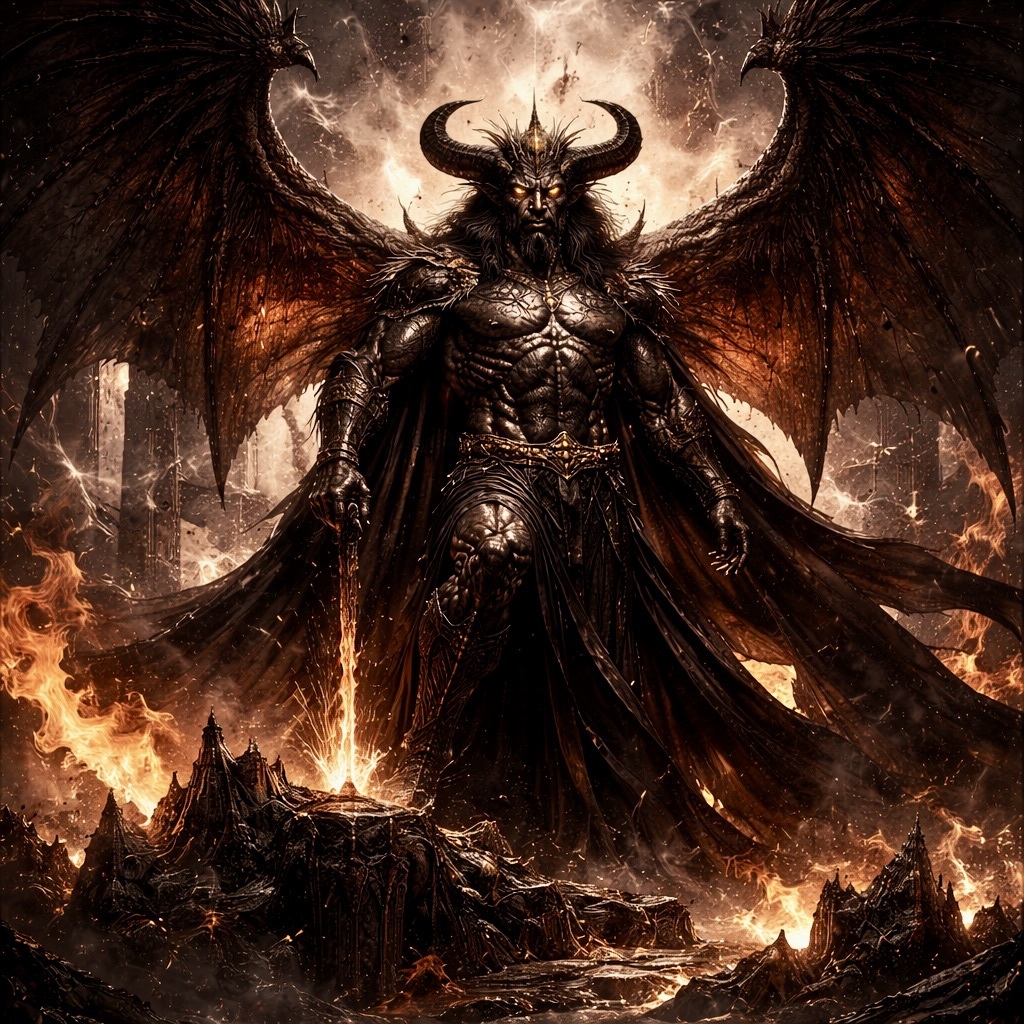
Satan is perhaps the most recognized and misunderstood figure in all of demonology, a name that carries centuries of interpretation, transformation, and symbolic weight. Unlike many other figures that exist within specific traditions or texts, Satan transcends individual systems. He is not confined to a single role, a single narrative, or even a single identity. Instead, he evolves—shaped by theology, philosophy, literature, and the ever-changing human need to define opposition, rebellion, and the limits of authority.
The word “Satan” itself originates from a Hebrew term meaning “adversary” or “accuser.” In its earliest usage, it was not a name but a function. It described a role—one who opposes, challenges, or questions. In the Hebrew Bible, this figure appears not as a ruler of Hell or a purely evil entity, but as part of a larger system, sometimes acting as a tester or examiner within a divine framework.
This early portrayal is subtle but significant.
Satan is not initially the embodiment of evil.
He is the embodiment of opposition.
He challenges.
He questions.
He tests.
This distinction is essential for understanding how the figure evolves over time. As religious and cultural narratives develop, particularly within Christian traditions, Satan becomes more defined as a singular entity—a fallen angel, a rebel, a ruler of Hell. This transformation reflects a shift in how opposition is perceived. What was once a function becomes a character, and that character becomes a symbol.
But even as the narrative solidifies, the underlying concept remains.
Satan is the adversary.
He represents the force that stands against established order.
This opposition is not inherently destructive. In many contexts, opposition is necessary. It creates tension, and tension drives change. Without opposition, systems can become stagnant, unchallenged, and potentially flawed.
Satan embodies this dynamic.
He is the question that disrupts certainty.
The challenge that tests belief.
The resistance that reveals structure.
From a psychological perspective, Satan can be understood as an archetype of rebellion and individuality—the part of the human psyche that resists control, that seeks autonomy, that questions authority. This aspect of human nature is complex. It can lead to innovation, progress, and self-discovery. But it can also lead to conflict, instability, and fragmentation.
Satan exists at this intersection.
He is not simply the rejection of authority.
He is the assertion of independence.
The narrative of the fallen angel, while not present in all traditions, has become one of the most enduring interpretations of Satan. In this story, he is a being who rejects divine authority, choosing to stand apart rather than submit. This act of rebellion defines his identity.
But what does this rebellion represent?
At its core, it reflects a fundamental tension within human experience—the balance between structure and freedom. Authority provides order, stability, and direction. Without it, systems can collapse. But too much authority can limit autonomy, suppress individuality, and restrict growth.
Satan represents the push against that limitation.
He is the force that says, “Why?”
Why follow?
Why submit?
Why accept without question?
These questions are not inherently negative. They are essential for critical thinking and progress. But they also introduce risk. Questioning authority can lead to insight, but it can also lead to instability if not balanced with understanding.
Satan embodies both potential outcomes.
He is not a simple villain.
He is a catalyst.
His association with temptation further illustrates this role. Temptation is often framed as a negative force, something that leads individuals away from what is right. But temptation is also a test—a moment where choice becomes significant.
Without temptation, there is no decision.
Without decision, there is no agency.
Satan introduces this element of choice.
He presents alternatives.
He challenges assumptions.
He forces individuals to confront their values.
This dynamic is evident in many narratives, most famously in the story of the Garden of Eden. In this context, Satan—often represented through the serpent—offers knowledge. The act of eating from the Tree of Knowledge is not just disobedience. It is awareness.
It is the transition from innocence to understanding.
This transition is transformative.
It changes perception.
It introduces complexity.
It creates a world where choices have consequences.
Satan’s role in this process is not to create knowledge, but to present the opportunity for it.
This aligns with his broader function as an adversary.
He does not impose.
He proposes.
The concept of Hell, often associated with Satan, adds another layer to his identity. In many traditions, Hell is not just a place of punishment, but a representation of separation—distance from order, from structure, from the systems that provide stability.
Satan, as a ruler or inhabitant of this space, represents that separation.
He is not just opposed to authority.
He exists outside it.
This position is both powerful and isolating.
Without structure, there is freedom.
But there is also uncertainty.
Without connection, there is independence.
But there is also separation.
Satan embodies this duality.
From a philosophical standpoint, his archetype raises questions about the nature of good and evil, authority and autonomy, order and chaos. These are not simple dichotomies. They are interdependent.
Good is defined in contrast to evil.
Order is defined in contrast to chaos.
Authority is defined in contrast to rebellion.
Satan provides the contrast.
He makes these concepts meaningful.
In literature, his character has been explored in numerous ways, from the villainous figure in medieval texts to the complex, almost sympathetic character in works like John Milton’s Paradise Lost. In that narrative, Satan is portrayed with depth, intelligence, and a sense of purpose that challenges simplistic interpretations.
This portrayal reflects the evolving understanding of his role.
He is not just the enemy.
He is the question.
The challenge.
The possibility of another path.
In modern contexts, Satan’s symbolism continues to evolve. He appears in discussions of individuality, freedom, and resistance to authority. He is invoked in philosophical debates about morality, in artistic expressions of rebellion, and in cultural narratives that explore the boundaries of identity.
This adaptability is part of what makes him such a powerful symbol.
He is not fixed.
He changes as the questions change.
In the end, Satan stands as one of the most complex and enduring figures in human thought. He is not defined by a single story or interpretation, but by the role he plays within systems of belief and understanding.
He is the adversary.
The challenger.
The one who stands apart and asks why.
And somewhere between obedience and rebellion, between certainty and doubt, between the structure that defines and the freedom that disrupts—that is where Satan resides.
Not as a simple force of evil, but as something far more fundamental.
The one who makes choice possible.