
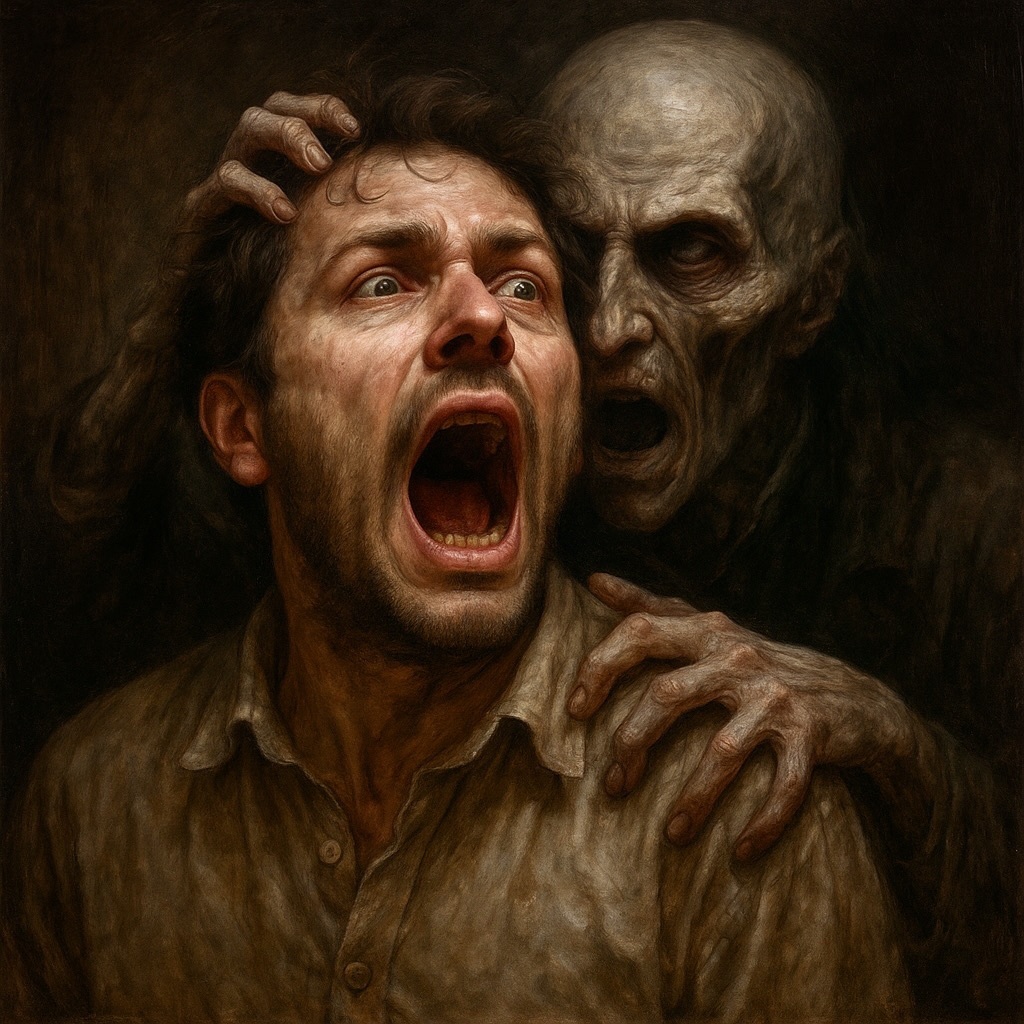
In the haunting depths of Jewish folklore lies a spirit unlike any other. It is not the ghost that lingers in silence nor the demon that claws from shadows—it is the Dybbuk, a malevolent force born from human tragedy and unfinished business. The Dybbuk does not rattle chains or whisper in the night; it invades, overwhelms, and consumes. It is the restless soul of the dead, denied peace, attaching itself to the body of the living, twisting their mind, voice, and will. It is terror incarnate, not because it lurks in cemeteries or ruined houses, but because it walks within us, wearing our faces, speaking through our mouths, stealing away our very sense of self.
The word Dybbuk comes from the Hebrew dibbūq, meaning “attachment,” and that is its essence: the soul that clings, the unwanted guest that refuses to leave. Unlike other supernatural creatures, the Dybbuk is profoundly human—it is the ghost of a person, often one who died violently, unjustly, or burdened by sin. Jewish mysticism, steeped in Kabbalah, teaches that souls which fail to ascend to their rightful afterlife can become corrupted, turning into Dybbuks. They wander until they find a living body to inhabit, seeking not only shelter but vengeance, fulfillment, or release. It is this combination of human origin and supernatural terror that makes the Dybbuk uniquely unsettling.
Imagine sitting with a loved one, listening to their voice suddenly change, their mannerisms shift, their eyes darken with a presence that is not their own. That is the chilling hallmark of the Dybbuk. Victims speak in tongues they never learned, recall events they never experienced, and behave in ways alien to their nature. Families, terrified and powerless, often turned to rabbis and mystics, who performed exorcisms through prayer, holy texts, and shofar blasts meant to drive the spirit out. Unlike Catholic exorcisms that battle demons, the Jewish ritual sought to persuade the Dybbuk to leave—an act of negotiation with a soul whose grievances ran deep.
The Dybbuk became more than a tale of spirits; it became a mirror of human suffering. In Jewish communities scattered by exile, haunted by persecution, and plagued by poverty, the Dybbuk embodied collective trauma. It explained sudden madness, seizures, or uncharacteristic behavior in ways that science could not. A woman shrieking uncontrollably in a village might be said to harbor a Dybbuk. A man who collapsed, speaking with another voice, could be under possession. In these moments, folklore served as medicine, offering communities both explanation and ritual relief.
But the Dybbuk was not only feared—it was also pitied. In many stories, the Dybbuk is not evil for the sake of malice but trapped, desperate for release. Some are souls of those denied proper burial. Others are wronged victims of injustice, crying out for recognition. Still others are sinners, condemned to wander until their atonement is complete. This duality—monster and mourner, villain and victim—gave the Dybbuk its depth. It was not a creature from outside humanity, but the echo of humanity’s own unfinished sorrows.
The legend took on new life in the early 20th century when playwright S. Ansky wrote The Dybbuk, a haunting Yiddish drama that premiered in 1920. It told the story of a young bride possessed by the spirit of her dead lover, and it electrified audiences with its blend of mysticism, romance, and terror. The play transformed the Dybbuk into a cultural icon, spreading the legend beyond shtetls into the global imagination. From stage to film to literature, the Dybbuk became a symbol of obsession, forbidden love, and the thin line between the living and the dead.
To humanize the Dybbuk is to see it as more than a horror story. It is the voice of grief unexpressed, the shadow of trauma unhealed. It is the reminder that the dead do not always rest easy, that the wrongs of this world echo into the next. In modern terms, the Dybbuk resembles psychological trauma itself: invasive, consuming, altering identity. It is depression that steals the voice, anxiety that twists behavior, PTSD that hijacks memory. Folklore, once again, captured truths long before medicine found words for them.
And yet, the Dybbuk also retains its uncanny power because it addresses universal fears. We fear losing control of ourselves. We fear being overtaken by something alien. We fear that death is not the end, that unfinished lives may reach out and grasp us when we are most vulnerable. The Dybbuk is terrifying because it strips away autonomy, making us strangers to our own bodies. It forces us to question: who are we, if our very voice can be stolen?
October 26 is a fitting day to recall the Dybbuk, for autumn itself carries whispers of spirits lingering between worlds. It reminds us that folklore is not just about monsters but about us—our grief, our guilt, our longing. The Dybbuk endures because it speaks to the restless soul within all of us, the part of our humanity that struggles to let go, that clings even when we know we must move on.
In the end, the Dybbuk is both horror and poetry. It terrifies with its possession, yet it moves us with its humanity. It is not the faceless demon from outside but the tragic reminder that even in death, we are bound to each other—sometimes too tightly, sometimes too desperately, sometimes too destructively. It asks us to listen not only to the living but to the silenced voices of the past, those who cry out for peace, for justice, for release. For until we hear them, they may continue to cling.
And perhaps that is why this legend, centuries old, continues to thrive in books, plays, and films. Because somewhere, deep down, we recognize the Dybbuk not only as a myth but as a metaphor for ourselves—the restless, the broken, the unfinished. We are all haunted. Some of us just hide it better.