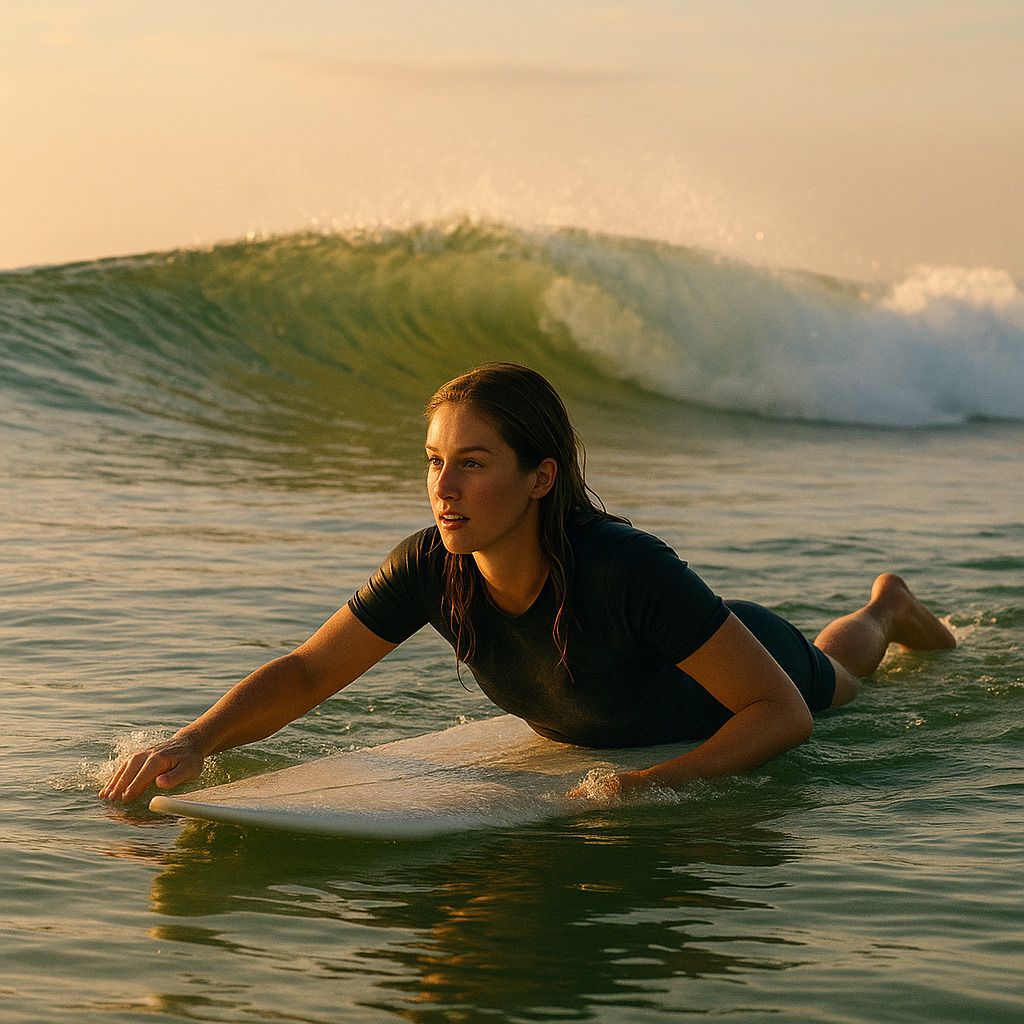
Your first day learning to surf doesn’t begin with the ocean; it starts with a feeling—the kind that pulls at you while you’re scrolling past sunrise photos and glassy waves, the kind that shows up in a stray beach breeze miles from the coast or in a song that sounds like summer. Surfing has a way of whispering to people before it shouts. If you’ve felt that tug, you’re already halfway there. The rest is learning to show up—board in hand, salt in the air, heart beating fast—and discovering what the ocean has to teach you. This is everything to expect, honestly and without sugarcoating, so your first sessions become a string of small, exhilarating wins instead of a confusing blur.
The beach is both more ordinary and more magical than you imagine on your first lesson day. There’s sunscreen in the air and coffee in the parking lot; there are sandy families and dogs that look like retired lifeguards; there are surfers who seem to know exactly where to go without ever looking up. You’ll feel new. That’s good. Being new means you can pay attention. You’ll notice the sound first—a low rolling hush underneath the gulls and chatter—waves folding, unfolding, folding again. You’ll learn that almost everything in surfing begins with listening to that sound and then matching your breath to it, the way you’d match steps with a friend on a long walk.
There’s a board under your arm. At some point you chose it, or someone chose it for you. If you want the simplest path, choose a big one—an 8- or 9-foot soft-top is a floating permission slip to learn slower and smarter. Big boards forgive wobbly stances and hesitant pop-ups; they help you find glide. You’ll feel slightly silly carrying it, like you stole a door and ran off toward the sea, but you’ll also feel the promise of all that foam: buoyancy, stability, and time to figure things out. You can chase performance later; on your first months, chase momentum.
Before you touch the water, the beach teaches your first lesson: patience disguised as preparation. You’ll wax your board (a light crosshatch on the deck where your feet and hands will go) and maybe do a few awkward pop-ups on the sand—hands under shoulders, hips forward, chest lifted, then a quick but smooth step to your feet, landing with your weight centered and your eyes forward. It will feel weird. That’s the point. Better to debug your stance in the sand than to learn the hard way while a wave is rearranging your life. You’ll also stretch—hamstrings, hips, shoulders, lower back—and feel your body ask, “So… we’re really doing this?” Yes. You are.
When you wade in, the water is never one temperature; it’s a map of microclimates. Ankles say “hello” in a sharp syllable, knees say “ahh,” waist says “oh, that’s a choice,” and then a wave smacks your ribcage and baptizes you without asking. Welcome. You’ll feel the board pull and bob. The leash will touch your ankle and you’ll wonder how people forget it’s there. They don’t, not at first. You’ll learn to keep the board between yourself and the horizon; you’ll learn to point its nose toward incoming waves so it doesn’t escape like a giant cork. Your instructor or a friend will tell you the two words you’ll hear forever: “Paddle out.”
Paddling is surfing’s true engine and first surprise: it’s less about fighting the ocean and more about learning to move with it. Keep your chest lifted just enough that your nose isn’t plowing and your lower back isn’t screaming. Look where you’re going, long strokes, fingers slightly cupped. You’ll tend to paddle too short and too frantic; imagine instead you’re slowly climbing a ladder that stretches into the horizon. Each stroke should matter. This is where you learn rhythm—like a song that measures itself in breath and distance instead of beats. If a whitewater wave approaches, you’ll “press-and-knee” or push up slightly and let the foam roll between you and the deck. You’ll get shoved back. That’s fine. You don’t win by brute force; you win by reading the ocean better.
Somewhere past the shore break, there’s a quiet lane where the waves calm down before they rise. This is the lineup, and it’s a classroom with no walls. You’ll sit or belly down and watch the water breathe—lulls, sets, shifts. That surfer over there looks relaxed? They’re not lazy; they’re scanning. What is the wind doing? Are sets arriving every few minutes with two or three larger waves? Are people catching rides on the inside or farther out by a deeper channel? You’ll see patterns. Human beings are built for pattern-spotting. It’s just that the ocean likes to shuffle the deck now and then, and part of the humility of surfing is accepting that your patterns are always provisional.
Then comes your first wave—the conversation you’ve been eavesdropping on since you waxed that board. You’re positioned a little inside so you don’t have to sprint yourself into a heart attack. You turn the board toward shore, glance over your shoulder as the bump becomes a wall, and paddle with intent. The wave lifts you like a question. Two more strokes. One more. You’ll want to stand early. Don’t. Feel the board start to slide on its own—like a shopping cart that suddenly got a motor—then pop up decisively. Hands under you, hips driving forward, eyes up, feet landing wider than you think, front foot aiming slightly forward, back foot perpendicular, knees soft. If your eyes are down at your feet, you go down. If your chest is over the stringer and you’re looking where you want to go, you stand a chance.
You’ll stand for a second or ten. It will feel like standing on a rolling coin. Your instincts will argue. One will say “freeze” and the other will scream “lean!” Try neither. Bend, breathe, and let your ankles do the listening. Surfing is a thousand tiny adjustments you don’t consciously calculate. Your eyes read the slope; your hips translate; your feet write the sentence. When the ride ends (and it will, sooner than you want), step off rather than dive headfirst, keep the board away from your body, and come up protecting your head. If you wipe out harder than expected—and you will—know that wipeouts are the price of admission, not a sign you don’t belong. Everyone pays the cover.
Etiquette enters early. It isn’t gatekeeping; it’s traffic rules so the game stays fun and nobody collects fin marks on their shins. The surfer closest to the peak has priority; don’t drop in on someone’s right-of-way. Look both ways before you paddle for a wave; if someone’s already riding, pull back. Don’t paddle straight through the face of a wave someone is surfing—go around the shoulder or through the whitewater behind them. Smile. Apologize if you mess up. People forgive beginners who are respectful. They side-eye beginners who act like the ocean is a private amusement park. Learn who’s learning around you; celebrate their rides. Surfing can be solitary, but it’s a solitary sport done in company.
You’ll discover tides. They aren’t just “high or low”—they’re energy and geometry. On some beaches, mid-tide is your friend, smoothing the takeoff zone. On others, low tide turns the shore into a conveyor belt of closeouts, while high tide gives fat, slow rollers perfect for practice. You’ll learn to notice winds: morning glass before the sea breeze kicks up; afternoons that turn the surface into corduroy. Dawn patrol isn’t a personality trait; it’s a strategy. If you’re worried about crowds, early sessions are merciful. If you’re worried about cold, a light spring suit or fullsuit is a magic cape. Wetsuits aren’t just warmth; they’re flotation and courage.
Some days, progress feels like an escalator; other days it’s like trying to exit a crowded subway going the wrong way. You’ll plateau. Accept it. Plateaus are where technique consolidates and confidence catches up. On those days, choose goals that aren’t scoreboard-based: catch three clean whitewater rides to full pop-up; paddle out without turning turtle; finish with more energy than you started. Surfing asks you to be proud of ordinary wins. That’s how extraordinary ones sneak up on you.
Gear questions will appear like pop-up ads in your brain: Should I switch to a smaller board? When does a fish make sense? What about fins? Wax? Leash length? Here’s the quiet answer: keep gear simple while fundamentals grow. Your “next board” is not a trophy; it’s a teacher. If your soft-top still challenges you when the waves are a little bigger or cleaner, it’s still the right board. When you can catch unbroken waves consistently and angle down the line—not just go straight—then a mid-length (say 7’0”–7’6”) or a funboard transition opens new doors. Fins matter, but not as much as your paddle strength and pop-up timing. Wax smells like coconut so you buy more than you need; that’s okay.
The ocean will scare you sometimes, honestly, and that’s healthy. Fear is part warning system, part performance enhancer. The trick is to aim your fear at skills instead of avoidance. If you’re scared of getting held down, practice duck-dives or turtle-rolls in small surf and learn to count calmly underwater—one breath, one number. If rips worry you, learn to spot them—darker, ruffled water moving seaward—and treat them as conveyor belts you can exit by angling sideways to the sandbar rather than sprinting directly against them. If crowds stress you, move down the beach or pick a less “perfect” peak; an imperfect wave ridden is better than a perfect wave watched.
Training creeps in without feeling like homework when you anchor it to your goals. Two or three short swims a week condition your shoulders without the mileage; a resistance band routine keeps your rotator cuffs happy; light yoga grooves pop-up mobility and lower back resilience. Balance trainers are fun but optional; better to practice controlled land pop-ups and light jogs than to collect gadgets. The best “training plan” for beginners is a session plan: pick conditions with waves you can read, sessions short enough that your technique doesn’t collapse, and a simple focus like “late pop-ups” or “angled takeoffs.” Keep a notes app log—date, tide, wind, what you learned, what to try next. It’s shockingly motivating to see your ocean diary fill up.
There’s a social map to surfing that you’ll begin to decode. Some beaches throw “localism” like a wall; others welcome like a picnic. You can’t control that, but you can control how you show up—curious, respectful, stoked for everyone’s ride, and honest about your limits. Ask a lifeguard where beginners usually go. Watch a few sets before you paddle out. If a peak has six impatient shortboarders each with hero fantasies, don’t prove anything. Walk fifty yards. An easy wave with room to breathe is a better coach than a perfect wave with sharp elbows.
And then, the best part: surfing does strange, generous things to your life outside the water. You hydrate more. You sleep better. You start checking wind forecasts before checking your email. Mornings feel like presents you open on the sand. You become the person who understands that a single amazing ride is enough to turn a hard week into a good story. When friends ask how it’s going, you don’t brag about how many waves you caught; you talk about the one you almost had, how you learned to wait, the gull that looked like it was laughing at you, and that moment when you were paddling back out and the light turned the lip of a wave into a green window and you could see right through it. You start collecting moments like that—pocket-sized miracles, salt-cured and bright.
What should you realistically expect in your first ten sessions? Expect to be tired, but from the good kind of work. Expect to be humbled, and then to laugh at yourself more sweetly than you used to. Expect one or two rides that make you yell out loud without meaning to. Expect a handful of small scrapes: wax on your rashguard, a leash burn, a tiny bruise where the board kissed your thigh. Expect to learn that sunscreen is not a suggestion and water is fuel. Expect to meet strangers who pat their boards like pets and tell you the tide is “doing something weird.” Expect to get hooked, not on the image of surfing, but on the practice: the ritual of paddling out, the way time dilates, the fact that success is partly skill and partly generosity from something bigger than you.
Over weeks and months, your expectations will change. You’ll go from “I hope I stand up” to “I hope I angle right and make that section” to “I hope I find an empty bank and work on trimming.” You’ll learn to see waves that haven’t yet revealed themselves, to feel the slight lift in the water before it’s visible, to sense how a wave wants to be ridden and to oblige it instead of demanding it be something else. That’s perhaps the secret—surfing works best when you collaborate, not conquer. You’re not putting the ocean in your pocket; you’re borrowing a moment from it.
You’ll also learn that rest days are part of the practice. Surfers love to pretend they live on a permanent sabbatical, but bodies have bandwidth. Let your shoulders recover. Take a bike ride. Watch a point break cam with coffee and notice which surfers never look rushed. Read a book about ocean currents and realize that what pushes a wave across a whole planet is the same energy that nudges your board forward in that final, perfect instant before you stand.
If there’s a single mindset that keeps beginners progressing, it’s this: surf small goals, celebrate them loudly, and stack them early. A “small goals session” might look like: paddle out and back in three times without resting on the beach; practice ten smooth sand pop-ups before paddling out; sit on the board for a full minute without putting your feet down; angle your takeoff a little instead of going straight; end session while you still feel crisp. Small wins compound. They become muscle memory. Muscle memory becomes style. Style becomes the quiet signature you’ll leave on a wave someday when you’re not thinking about anything other than how good it feels to be alive.
Someday soon you’ll have a session that replays itself when you’re trying to fall asleep. The light is maybe a little gold. You’re in the spot you picked on purpose. The set builds. You’re calm. You turn with time to spare, paddle strong, feel the lift, commit to the pop-up later than your nervous system prefers, land clean, knees soft, eyes forward. You angle slightly, the board hums, and for a breath or five you’re weightless—hanging off the edge of your old life like a person peeking into a party they’re suddenly invited to. You kick out. You lie there grinning. The next wave marches in as if nothing happened, but something did. You’ll carry it all day, all week. This is what to expect.
If you want a practical checklist in plain words, here’s the quiet version, smuggled into the paragraphs above. Start on a big soft-top—your ego can handle it and your skills will thank you. Practice pop-ups on sand until the movement feels inevitable. Paddle with long, smooth strokes and a lifted chest. Choose mellow, uncrowded peaks and learn the traffic rules early so you make friends, not enemies. Read conditions: get curious about tides, winds, and bottom contour. Exit wipeouts with calm, protect your head, and find your leash before you stand up. Train off the water just enough to keep shoulders happy and hips mobile. Log your sessions. Sleep. Repeat. Smile at strangers with boards under their arms because you already know something about their day.
And then, welcome to the long game. You’ll tinker forever—stances, timing, lines, boards, fins, beaches, friend groups, playlists for early drives, snacks for the parking lot, the perfect change of clothes, the lucky towel. You’ll become the kind of person who notices cloud texture and thinks about wind. You’ll turn into the friend who can tell, by the smell in the air thirty minutes from the coast, if the sea is warming up. You’ll collect a dozen slightly ridiculous rituals that only make sense to surfers. That’s the real expectation: surfing will fold into your life until it’s not a hobby at all, but a place where you go to become a clearer version of yourself for a little while. The surprise is that this is available to anyone who’s willing to be a beginner for long enough.
If you need one more reason to begin now, consider this: the ocean is the most patient teacher in the world. It doesn’t care how you look in a wetsuit. It doesn’t ask how much you bench. It doesn’t even mind when you shout after a tiny ride like you just won a medal. It just keeps rolling up, class after class, in simple blue lines, asking you to pay attention. Most of surfing is just that: attention paid in salty coins over and over until you’ve accidentally bought yourself a life you recognize as your own. That’s what you can expect. Everything else is a bonus.
Finally, a few practical images to carry with you into those first sessions—pictures you can pull up with your eyes closed: the long slow paddle where each stroke is a note in a song you wrote that morning; the way you look over your shoulder and feel the lift like a hand at your lower back guiding you forward; the sudden quiet right before you pop; the glitter-sparkle of water at fin level when you’re trimming; the ridiculous laugh you can’t suppress when you fall and pop up grinning anyway. Make a pocket for those moments. That’s your souvenir bag. You’ll refill it for years.
When you pack up after a session—board rinsed, leash wrapped, wetsuit hanging like a tired superhero costume—you’ll feel subjectively taller. You earned a nap. Food tastes better. The traffic home is less insulting. You might hum along to a song you would normally skip. Surfing isn’t spiritual in a grand, serious way unless you want it to be; it’s spiritual in an everyday way that helps you name the day: I went out, I tried, I fell, I learned, I stood, I felt alive. Tomorrow might be flatter, windier, busier; doesn’t matter. You learn to greet the ocean as it is, and maybe yourself that way, too. That’s the surprise at the center of this sport: you came for the waves, and you leave with a better way to live your life between them.
When you finally call yourself a surfer, nobody gives you a certificate. You’ll just notice that your car knows the route on its own, that your shoulders are stronger than your patience used to be, that your phone’s weather widget looks like a secret code, and that you don’t mind waiting anymore. Waiting becomes part of the pleasure. You wait for tide, for wind, for sets, for that one friend who’s always late, for your turn, for your wave. In a world that begs you to sprint, surfing teaches you to arrive. That might be the best thing to expect of all.