Thirst Isn’t a Plan: How to Stay Hydrated in the Sun

The sun is generous. It gives you light, warmth, color, mood—then it quietly asks for payment in water. Out on hot sand or a blazing trail, you can lose more fluid than you think long before you feel thirsty. That’s why “I’ll drink when I need to” is the Monday of hydration strategies: technically possible, practically expensive. Staying hydrated in the sun is less about chugging heroic amounts of water and more about rhythm—consistent sips, smart electrolytes, shade breaks, and foods that carry water in their cells like tiny canteens. Do it right and you get the whole day: clear head, steady energy, skin that forgives, and a body that doesn’t punish you when the heat finally eases.

Begin before the beach even begins. Pre-hydration is your opening move. In the hour before you step into the sun, aim for 300–500 ml of fluid (roughly 1–2 cups). Slow sips, not gulps. Add a pinch of salt or a squeeze of citrus if you’re a salty sweater or heading into high heat; your body retains fluid more efficiently when sodium isn’t at zero. If you’re a coffee person, enjoy it—but pair it with water. Caffeine doesn’t cancel hydration, but neither does it count for all of it.

Once you’re out there, think cadence over volume. The simplest rule that actually works: a few mouthfuls every 15–20 minutes while you’re in the sun, more during activity. Tie your sips to something you’re already doing—flipping a page, reapplying sunscreen, changing a song. A giant chug every two hours doesn’t hydrate as well as a steady trickle; your gut absorbs better in smaller, regular doses, and your mood appreciates the ritual.

Electrolytes aren’t a trend; they’re plumbing. Sweat carries out sodium, chloride, and smaller amounts of potassium and magnesium. Replace only water in heavy heat and you risk hyponatremia—too little sodium relative to water—especially if you’re out for hours. Replace only salt and you’ll still feel flat. Balance is the play. Use a light electrolyte tablet or powder (ideally ~300–500 mg sodium per liter) in one of your bottles; keep the other bottle plain water for thirst. If you dislike mixes, go “food-first”: a handful of salted nuts plus water, or sliced cucumber and tomatoes with a little salt. For a DIY sip: 1 liter water + juice of half a lemon or orange + 1–2 teaspoons sugar or honey + a small pinch of salt. It tastes like summer and behaves like science.

Temperature matters to compliance. Cold water cools the core faster and simply tastes better under a high sun. Keep one bottle in a soft cooler or wrap it in a damp towel under your umbrella; evaporation is natural air-conditioning. That said, any water you’ll actually drink is superior to the perfect temperature water you leave in the car. Make it easy: put the bottle where your hand lands.

Hydration also grows on trees. High-water snacks do double duty by bringing fluid, minerals, and fiber in one bite. Think watermelon, oranges, peaches, grapes, cucumber, bell pepper, cherry tomatoes. Yogurt cups (especially with a pinch of granola and a few berries) bring water plus electrolytes and protein. Salty crackers with hummus or avocado nudge sodium and potassium back into range. It’s not “snacking,” it’s strategy masquerading as pleasure.

Clothing and shade are hydrating, too. The less your body has to dump heat through sweat, the slower you dehydrate. Light, loose, UPF-rated fabrics and a wide-brim hat reduce the load. Take micro-shade breaks: two minutes under the umbrella can reset your core temp enough that your next 20 minutes feel like a different day. Feet in the water count as cooling, even if you’re not swimming.

Alcohol under a noon sun is the master illusionist. It makes you feel relaxed while sneaking water out the back door. If you choose to drink, bracket it with water and keep the proof low. A beer at sunset can be a poem; a string of cocktails at noon is a lecture your body will deliver later. Same with super-sugary drinks in heat: they can slow gastric emptying and make your stomach protest. Lightly sweet is the path.

Check your internal gauges without a lab. Urine color is crude but useful: pale straw is the target, dark apple juice means you’re behind. Headache, fatigue, irritability, and “my skin feels tight” are often hydration notes before they become alarms. If your heart rate stays higher than usual when you’re just walking the shoreline, or you’re suddenly clumsy, you’re likely low on fluid, salt, or both.

Different bodies, different math. Kids dehydrate faster; they’re enthusiastic movers who forget to drink. Make it a game: a sip every time a wave reaches your ankles, a sip when a cloud covers the sun. Older adults may feel less thirst even when they need water; set gentle timers or pair sips with sunscreen breaks. If you’re pregnant or nursing, bump fluids and shade time. If you take medications that affect fluid balance, follow your clinician’s guidance and keep electrolytes moderate, not maximal.

Swimmers get tricked twice—by cool water and saltwater. Being in the sea keeps skin cool, which masks thirst, and the salt on your lips can make you crave only fresh water while your body also needs sodium. After a long swim, take a few salted bites with water, even if you feel fine. Surfers and paddlers: stash a bottle at your entry/exit point and make two mindful stops, not just “one more set.”

What about the “too much water” problem? Yes, overhydration happens, but it’s rare on the beach unless you’re chugging liters of plain water for hours. The fix is balance, not fear: include some sodium, eat real food, and listen to thirst signals as the day cools. Your body is a good communicator when you learn its language.

Build a simple beach-day hydration plan and forget the spreadsheets:

Pre-game: 300–500 ml water with a pinch of salt or citrus 30–60 minutes before sun.

Pack two bottles: one plain, one with light electrolytes (or pair water with salty snacks).

Sip cadence: 3–5 mouthfuls every 15–20 minutes in direct sun; more if active.

Food-as-fluid: fruit + veg + yogurt or hummus sometime midmorning and midafternoon.

Shade cadence: two minutes under cover every 30–45 minutes in peak heat.

Reapply ritual: every sunscreen break = water + small salty bite.

Evening repair: water with dinner; a brothy soup or salad brings fluids back without effort.

If heat sneaks up anyway, respond early, not heroically. Heat cramps feel like tight calves or stomach twinges: move to shade, sip electrolyte fluid, gently stretch. Heat exhaustion brings heavy sweating, weakness, nausea, headache: cool the body—shade, fans, damp cloths on neck/armpits/groin, slow sipping. If confusion, a stop in sweating, or fainting appears, that’s heat stroke—a medical emergency. Cool aggressively and seek help immediately. Courage is cooling down, not toughing it out.

Back home, treat recovery as the last chapter. A cool shower rinses salt and lowers skin temperature; skin drinks moisturizer better afterward. Dinner can be a hydration encore: tomatoes with olive oil and salt, cucumbers with yogurt and mint, grilled fish with lemon, rice with a squeeze of lime. Sleep will come easier when your cells aren’t begging.

In the end, smart hydration isn’t a chore—it’s a pact with summer. You promise steady sips, a little salt, kind shade, and food that crunches and drips. Summer promises long golden hours where your mind stays clear and your body keeps saying yes. Thirst will always knock; you just won’t wait for it to become a shout.

Related Posts

Umbrellas and Amplifiers

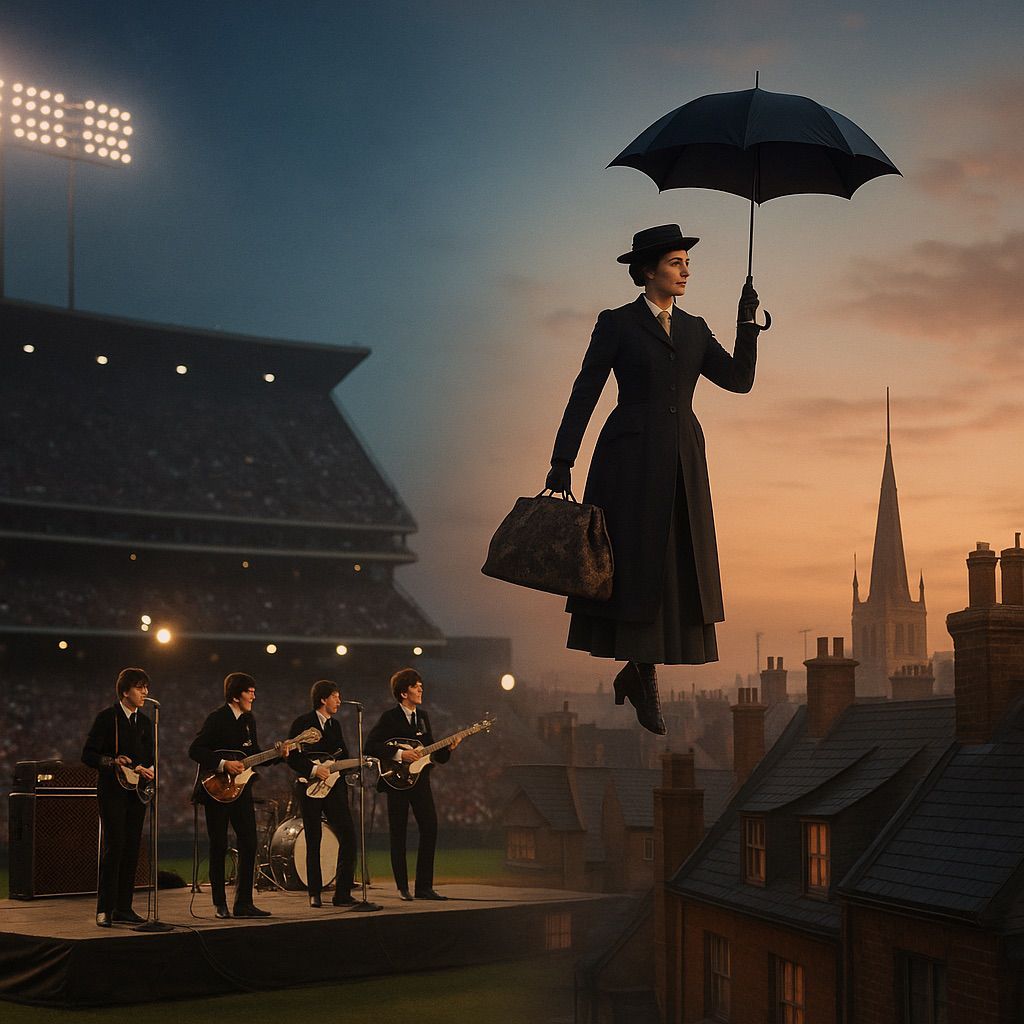
There are calendar days that feel like coin flips—two faces of the same metal, one side shine and one side grit, tossed into the air by history’s impatient hand. August 29 is one of those days. Look at it once and you see a ballpark thundering with a noise that would never be replicated quite the same way again: the Beatles, small as postage stamps at the far end of Candlestick Park, trying to throw their songs across a wind-bitten diamond while teenage awe and transistor squeals ricochet like meteors. Look again and you’re standing inside a movie palace in 1964 as a London nanny floats down from a slipping seam in the clouds and lands exactly where a family needs her, with a carpetbag’s worth of impossible solutions delivered in a voice that sounds like music smiling. One day, two tempos. One goodbye with amplifiers; one hello with a carpetbag. One crowd chanting themselves hoarse at a final concert; one crowd humbled by a film that dared to tell grown-ups to be kinder, braver, and, yes, a bit more playful. It would be easy to keep these stories in separate rooms—the rock show on the stadium’s grit, the Disney premiere in velvet shadows—but August 29 won’t let us. It insists on a single, long corridor where pop revolution and movie magic pass each other, nod, and share a secret: both of us changed how people feel about the future, and neither of us did it quietly.

Picture San Francisco first. Candlestick Park in late August, 1966. The air there never quite relaxes; it shivers even in summer, sea-salted and mischievous, taking a sweater off your shoulders just when you thought you’d warmed up. Out on the outfield grass a temporary stage stands in its own uncertainty, looking too slender to hold the decade’s heaviest fame. The Beatles arrive in a car that seems embarrassed by its cargo and step into a noise that is less cheering than weather, a jet stream of adoration pouring through every concourse and clipped by the stadium’s concrete geometry into something that wails. They have become the world’s loudest quiet men—funny, observant, sleepless, generous, overwhelmed—famous enough to be reduced to symbols and hunted by their own logistics. The Shea Stadium show a year earlier had proved a point about scale but also revealed a limit: you can’t hear a band when the band can’t hear itself. What happens on August 29 is both a concert and a decision. The setlist is a pocket of their catalog—“Rock and Roll Music,” “She’s a Woman,” “If I Needed Someone,” “Day Tripper,” “I Feel Fine,” “Yesterday,” “Nowhere Man,” “Paperback Writer,” “Long Tall Sally.” The amplification, by modern standards, is quaint: a few Vox amps, the park’s P.A., microphones befuddled by wind. Ringo’s snare sounds like a flag being flicked. The guitars skitter like dragonflies. You can hear as much crowd as band, and yet something essential makes it across—the joy of doing a thing you love in the very moment you decide to stop doing it this way.

Decisions like this do not arrive as press releases; they land in a musician’s bones as fatigue that no nap can fix, as a sense that the art is larger than the room it’s been placed in. The Beatles were tired of being décor for their own legend—tired of the shriek that swallowed chord changes, tired of death threats and segregation fights in the American South, tired of playing “I Want to Hold Your Hand” to the back wall of a baseball stadium where the usher two sections over was louder than any note they could push through the air. They were not tired of each other, not yet, not in the way that would later break their studio into corners; they were tired of a format that embarrassed the music. So they made a brave and technical choice: let the songs grow in the place where they could be carefully engineered. Touring had revealed the ceiling; the studio would open the roof. Think about what that requires—to walk off a stage you own, at the peak of a public love affair, and say, the next version of us will be invisible until it is impossible to ignore. It is not retreat. It is a tactic. It is an admission that the art you’re trying to make needs a different kind of attention than a stadium can give.

There’s a photograph from that night, one of the famous ones taken by their press officer Tony Barrow, showing the band huddled around a scrap of paper backstage, signing the date on a postcard as if notarizing their own decision. It looks almost casual—four men with pens, a bit of cardboard, jackets askew, faces half-smiling, a little sad and a little giddy. People who love the Beatles sometimes talk about their arc as if it were inevitable: start in Hamburg sweat and Cavern dust, explode into Beatlemania, then invent the modern studio album in a chain of miracles. But inevitability is what the story looks like afterward, when we’ve flattened the fear out of it. In the moment, on August 29, 1966, it looked like courage. Not the showy kind. The technical kind. The kind that says: we will trust the work and our ears; we will vanish from your applause so we can chase a sound that you don’t know you’re waiting for. Two months later, they would roll into Abbey Road and start turning the knobs toward Sgt. Pepper and everything that came with it—the orchestra swells, the varicolored tape loops, the “Being for the Benefit of Mr. Kite!” harmonium, the moaning mellotron, the bass as a lead instrument, the song as a movie in your head. People will tell you the Beatles stopped playing live because they were tired. Sure. But August 29 shows a deeper reason: they were not going to let the limits of the era become the limits of the music.

On another August 29—rewind the reel to 1964 and change coasts if you like—an entirely different kind of spectacle pulls its audience into a kind of civic charm school. The curtains open on London rooftops drawn by hand and painted by imagination. Chimneys stand like organ pipes, waiting to blow soot and melody. A wind shifts its mind. The city inhales. Down floats Mary Poppins, umbrella up like a moral compass, carpetbag in hand, hat slightly defiant, with a smile that seems to have already forgiven someone for something. “Practically perfect in every way,” she will say later, but that tidy line is only half the spell. The other half is sterner: you can be better, and it will be fun to learn. The world that welcomes her is a household in disrepair by a problem adults often fail to diagnose—Mr. Banks is very good at his job and very bad at his joy. The city around them is bright enough to hide soot and soot enough to hide tenderness. The film that unfolds from this premise is a feat of engineering disguised as whimsy: live action wed to animation without visible seams, songs that behave like lessons and lessons that behave like games, a nanny who seems to have stepped out of nineteenth-century literature and into twentieth-century cinema without losing a single ounce of agency. Disney’s “Mary Poppins,” anchored by Julie Andrews’ precision and warmth and by the Sherman Brothers’ dozen proofs that melody is the shortest distance between a stubborn adult and their inner child, offers a theme the Beatles would have recognized: there are better technologies for being human than the ones we have carelessly inherited.

Remember the songs, even if you haven’t watched in years. “A Spoonful of Sugar” is not about sweetening; it is about reframing—task becomes play when we are invited to meet it with imagination instead of dread. “Chim Chim Cher-ee” romanticizes soot at first and then quietly expands into solidarity: a sweep knows the rooftops are a commons, and a commons asks us to step lightly. “Feed the Birds” refuses spectacle and gives us a tempo of tenderness—the palace of a city-centered financial system sits across from a woman selling crumbs, and the film’s moral gravitational center tells you plainly where your heart should go. “Let’s Go Fly a Kite” is a final exam on joy shared and hierarchy softened: the father discovers that his place in the world is not a ledger but a circle made of his family’s outstretched arms. It would be easy to dismiss such narrative with grown-up cynicism, easier still to mock its sentiment as dated. But the record shows that the film’s kindness has stubborn half-life. It taught multitudes of children that the adults around them could change for the better—and taught the adults that change would require small embarrassments accepted with grace and songs stuck in their heads on purpose.

The timing matters. The mid-1960s were already humming with a kitchen’s worth of pots boiling over: civil rights demanded legal transformation, feminism began to step out of the kitchen where it had never consented to remain, the war machine was winding itself toward its ugliest efficiencies, and popular music was learning that it could be more than dancing and courtship—it could be argument and prophecy. In that climate, it might seem odd that a film about a nanny became one of the era’s cultural pillars. But look closer. What Mary Poppins proposes is not escape; it is training for a different citizenship. This is how you tidy a room and a life without throwing your neighbor into the dustbin. This is how you tell a story to a child that makes that child a partner in delight rather than a receptacle for orders. This is how you talk to a banker about value in a vocabulary that places the fragile at its center. The film’s technology—the painless stitch between live action and animation, the trick shot that makes a carpetbag’s bottom go wandering, the choreography that makes a city rooftop feel like a republic—was not showing off for its own sake. It was saying: we can build kinder illusions to teach truer truths.

Maybe that’s the link, then, between Candlestick Park and Cherry Tree Lane: both nights, August 29 taught its audiences to ask for a better technology. The Beatles asked for a better technology of listening to music together, which turned out, for a while, to be not “together” at all, but alone with headphones and liner notes, a long stare at the gatefold, a reverence toward the sequencing magic that would be drowned in a ballpark. Mary Poppins asked for better technology of listening to one another, which turned out not to be gadgets or gizmos but households practicing play like a language. One night pivoted toward four-track machines and tape loops; the other pivoted toward a kite string and a hand held at the right time. Both nights said: adjust the room if the song can’t breathe; adjust the heart if the house can’t.

The human stories inside these spectacles deserve their due. On the Candlestick stage, John wore his ironic armor a little tighter than usual; Paul kept his diplomat’s smile; George, still only twenty-three, glanced out past the cameras toward a horizon he would later chase in other ways; Ringo did what Ringo always did—keep the pocket steady and the spirits up. After the show they left in a white armored car, the kind of exit vehicle you use when you are both adored and in danger. In hotels not far away, they wrote about boredom and brilliance on hotel stationery and wondered if they were inventing or surviving. In Burbank, two years earlier, Julie Andrews had auditioned while pregnant, with a voice that could go from silver to velvet in a single syllable, and Walt Disney—part showman, part moralist, part wizard of manufacturing wonder—had bet on a film that could fail in a dozen visible ways if the tone went sour. Behind the scenes, the Sherman Brothers wrote songs that felt like they had always existed, each a little instruction manual for a life with fewer cruelties. Dick Van Dyke defied gravity with a grin; the animators learned new rules about eye-lines and shadows; the editors learned when to let a song keep the camera still. Everyone involved, both at the stadium and at the studio, knew the same professional secret: the trick is to make it look effortless when it absolutely was not.

The legacies of these August 29s are easy to trace and easy to underestimate. The Beatles, released from the physics of touring, discovered the moral of the laboratory: curiosity plus time equals breakthroughs that sound like they arrived whole. Revolver, Sgt. Pepper, Magical Mystery Tour, the White Album, Abbey Road—those projects were not only albums; they were proposals for what records could do to your sense of time. A song could be a day in a life, complete with alarm clocks and orchestral glissandos that sounded like falling through the sky. It could be a field recording from a dream. It could be a postcard from a place no one had been but everyone wanted to visit. And because they were no longer killing their ears in stadiums, they could protect those ears long enough to chase arrangements that made radio itself feel newly invented. Mary Poppins, released into a world accustomed to children’s films as confection, dared to be moral without scolding, technical without bragging, and truly intergenerational—grandparents laughed without pretending, parents cried without warning, children believed without apology. It showed a studio how to make magic look like empathy and taught the industry that spectacle earns its keep only when it is in service to a change of heart.

You can also measure these stories in the lives they quietly coached. Ask a musician what first told them that a song could be a universe and you will hear the names of Beatles albums like the catechism of a secular church. Ask a parent what taught them that routine could be a ceremony and they might hum “A Spoonful of Sugar” without noticing. Ask a school music teacher what keeps them insisting on beauty when budgets say otherwise and you will hear about a band that stopped touring so the work could get deeper. Ask a social worker what teaches a child empathy when lectures fail and you will hear about films that smuggled kindness into kids’ heads with melodies. August 29 moves through these testimonies like a ghost with good timing.

There is, inevitably, a shadow to everything we praise. The Beatles’ retreat from live performance is sometimes read as luxury—only the most famous band in the world could afford such a choice. But the point is not “do as they did” so much as “learn what they learned.” If the format betrays the work, you are allowed to choose a different room. Decades later, bands would reinvent live sound, arenas would become theaters of precision, and the Beatles themselves would reenter the world’s rooms in a different register—reissues, rooftop surprises, documentary clarity that finally let you eavesdrop properly. Mary Poppins’ primness, read unkindly, can scan as nostalgia for a Britain gentler on the surface than in policy; yet the film’s insistence on paying attention to the vulnerable remains stubbornly modern, and its belief that joy is a discipline rather than a luxury remains a counterculture all by itself. The shadows only make the lights truer. They force us to refine our praise—to say, not “perfect,” but “practically perfect in the way it moves us toward better.”

So what is August 29 asking of us now? Perhaps this: find your stadium you need to leave and your household you need to mend. If there is a room in which your best work cannot be heard, you are not required to remain because the crowd is large. Find the smaller room where the microphone is honest, the studio where collaborators hear each other, the laboratory where a failed take is an investment rather than an embarrassment. And if there is a room where the people you love have forgotten how to delight in each other, you are never ridiculous for showing up with a kite string and an invitation to the park. The Beatles teach the courage to withdraw strategically. Mary Poppins teaches the courage to engage specifically. Both teach that art is not content you consume to forget your life; it is instruction you practice to enlarge it.

In the end, a concert you couldn’t quite hear and a movie you cannot quite forget join hands across a single date on the calendar, and the handshake is firm. The boys in tailored suits walk off a stage and into a studio, and the nanny in a tailored coat steps off a cloud and into a home. One set of footsteps makes tapes hum; the other teaches feet to dance. One shows that intimacy can be engineered at scale with the right knobs and patience; the other shows that intimacy can be scaled down to a kitchen table and still alter a city. August 29 keeps whispering: make something that lasts longer than the applause. Make something that teaches the people who love it to love each other better. Make something that can be heard.

Related Posts

The Gentle Agenda: A Relaxing Beach Day Routine You’ll Actually Keep

The perfect beach day doesn’t happen by accident; it happens by intention—soft, unhurried intention. It’s less a checklist and more a rhythm you can slip into like warm water. Picture this: you arrive just as the shore exhales its cool morning breath, you set up a little sanctuary in the sand, and then the day unfolds like a long, contented sigh. No chasing the clock, no bargaining with your to-do list, just a sequence of tiny choices that stack into ease. This is a routine designed to make your time by the sea feel restorative instead of rushed, memorable instead of messy. Think of it as the beach day that takes care of you back.

Start before the sand. The evening prior, pack with a philosophy of “fewer, better.” Choose a roomy tote and anchor it with the essentials: broad-spectrum sunscreen (reef-friendly if possible), a wide-brim hat, polarized sunglasses, a light linen or cotton shirt, a large towel or quick-dry blanket, a full water bottle, hydrating snacks (fruit, nuts, cucumber slices), and a tiny pouch with lip balm, a mini first-aid strip, and wet wipes. Add one pleasure item—a paperback, a journal, a disposable film camera, or a deck of cards. Tell yourself the truth: most of the day’s joy will come from air, light, and water, not from gear. Charge your phone, then set it to Do Not Disturb for the hours you plan to be seaside. You’ll sleep better knowing morning-you won’t be sprinting.

Arrival is everything. Aim for early light when the sand is still cool and the gulls own the sky. Park your worries with the car and walk your pace down to the waterline. Stand there for three breaths and let the horizon reset your scale. Scan for an open patch with a little wind protection—near a dune or a low berm—then stake your claim with your towel. Angle it so the sun rises over your shoulder; your book and your face will both thank you. Leave shoes, take toes.

Begin with a slow ritual that tells your nervous system, “We’re safe here.” Sip water. Apply sunscreen in sections—face, neck, ears, shoulders, arms, hands, legs, feet—using deliberate strokes like you’re painting calm onto your skin. Reapply a touch of lip balm. Slip on your hat. This is a tiny ceremony of care, and it sets the tone for everything that follows. If you’re with someone you love, swap sunscreen like a kindness.

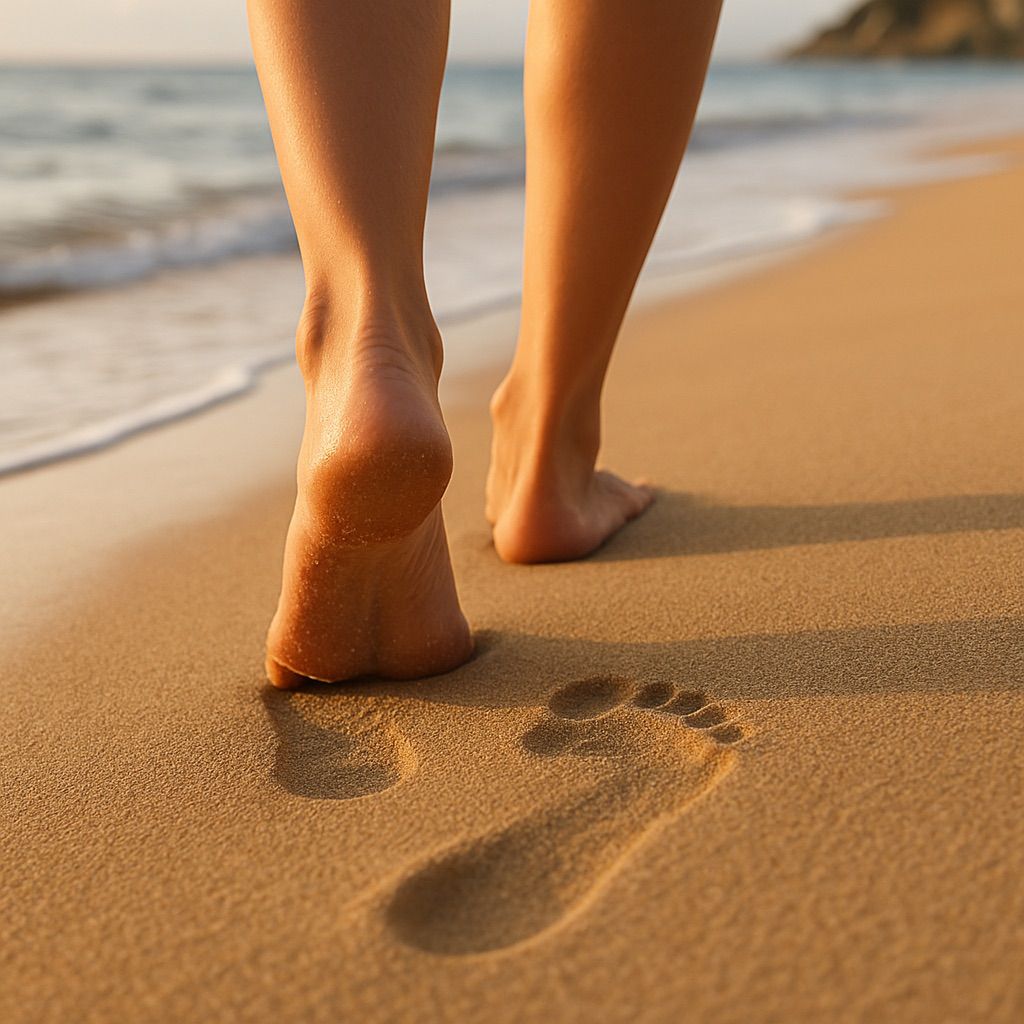
Movement comes next, but make it the kind that feels like play. Walk the waterline for ten minutes, letting the waves erase your footprints and your morning inertia. If you like a little structure, count your breath with your steps—inhale for four, exhale for six—and let your stride shorten on the soft sand, lengthen on the packed wet edge. If the water invites you, wade to your shins and let the cool shock lift any remaining sleep from your muscles. Stretch your calves, roll your shoulders, and say hello to the day the way the sea does: in gentle repetitions.

Now you’ve earned a pocket of stillness. Settle onto your towel and try a five-minute “shoreline scan.” Close your eyes and identify, one by one, the sounds that make up the beach’s orchestra: distant voices, a dog’s collar, the low engine of a fishing boat, the layered rush of waves. You’re not meditating to achieve anything; you’re simply allowing your attention to widen until your inner pace matches the outer one. When you open your eyes, the colors will look brighter, because you’ve remembered to see them.

Breakfast on the sand tastes better than breakfast anywhere else. Take small, cold, juicy bites—a peach that drips onto your wrist, a handful of berries, a wedge of melon—and drink more water than feels necessary. Salt air and sun are sneaky with hydration. If you brought coffee, sip it slowly; if you didn’t, the sea will wake you just fine. The point is not to fuel a marathon; it’s to feed contentment.

Midmorning is for alternating pleasures. Read a chapter and then swim. Journal a few lines and then nap. Put on music in your headphones for one song and then take them off so the ocean can have the floor again. Choose activities that don’t fight the setting: this is not the time to doomscroll; this is the time to notice how sunlight threads through the translucent rim of a wave. If you’re with kids, keep the plan flexible and the snacks abundant; if they build a sand fortress, be the royal court photographer, not the project manager. If you’re solo, curate a brief no-agenda window—twenty minutes where you refuse to decide what to do and simply let the day choose you.

Sunscreen intermissions are your clock. Every ninety to one-hundred-twenty minutes, reapply, drink water, and shift your towel a little to keep the sun off the same patch of skin. Think of these breaks as punctuation—the commas that let the sentence of your day breathe. While you’re at it, flip your hat, fluff your towel, shake out the sand, and take a photo of something ordinary—a corner of the umbrella, the outline of your book on the blanket, your footprints fading. These details become the memory anchors later.

When the water is friendly, swim like a seal on holiday. Wade past the small chop until the surface evens out, then float on your back and watch the sky do its slow theater. If you like a tiny workout, pick two landmarks—say, a lifeguard post and a buoy—and swim easy laps between them. Keep your stroke conversational; you should be able to name sea colors out loud without gasping. If the sea is moody or flagged unsafe, honor the flags and make the shoreline your swimming pool: walk the edge, let waves lap your ankles, and remember that caution and relaxation are close cousins.

Lunchtime should be light and lazy. Sandwiches wrapped in parchment, a small tub of olives, crisp vegetables, a handful of salty chips—simple, finger-friendly things that won’t wilt in the sun. Eat in the shade if you’ve got it; if you don’t, your hat is your dining room. Share bites. Trade fruit. If you’re with friends, set an unspoken rule that nobody talks about work for twenty minutes. If you’re alone, read the same paragraph twice because you can.

After lunch is the day’s softest chapter: the siesta hour. Tuck your phone deeper into your bag and lower your expectations all the way down to “breathe.” Lie on your side with your hat over your face or prop yourself on your elbows and drowse through the world. This is when the beach becomes a lullaby—the hum of conversations, the metronome waves, the warmth pooled in the towel. Let yourself drift. Rest is not a reward; it’s part of the routine.

When you wake, rinse the sleep with a quick dunk or a wrist-to-elbow splash. This is a good moment for a short gratitude inventory, the kind that doesn’t try too hard: the cool patch under the top layer of sand, the kid laughing three towels down, the way the horizon draws a perfectly straight line with a shaky hand. Gratitude at the beach is easy; keep it uncomplicated so your brain doesn’t turn it into homework.

As afternoon stretches, give yourself one small project that feels like play—nothing with a timer or a goalpost. Build a lopsided sand tower. Collect five stones that look like punctuation marks. Sketch the curve of the cove. Learn to throw a frisbee so the wind helps, not fights. The point is to make something fleeting and be delighted when the tide edits it. Impermanence is the coastline’s favorite teacher.

Late afternoon is your golden hour of social time. If you came with friends or family, this is the window for unhurried conversation—the kind that meanders and lands somewhere tender without forcing it. Share a story that the sea jogs loose. Tell a joke the gulls would groan at. If you’re solo, this is a generous time to text one photo to one person, then tuck the phone away again. Intimacy beats broadcast.

As the sun lowers, begin your gentle exit ritual. Pack slowly and shake sand with the patience of a monk. Refill your water bottle if there’s a fountain. Take one last look at the water—seriously look—and say a quiet thanks, even if you don’t say it out loud. Carry your trash and a little extra that isn’t yours; leave the place better than you found it. Walk back at a human pace; your car does not need you to rush.

The routine doesn’t end at the parking lot. At home, run a cool shower over sun-warm skin and let the salt rinse away like a chapter ending. Moisturize generously; your skin has been working. Make something simple for dinner—tomatoes and bread, cold noodles, grilled corn—and eat like someone who spent all day being alive on purpose. Before bed, jot down three sensory things you loved: the texture of wet sand under your heel, the smell of sunscreen and eucalyptus, the tiny silver fish you thought you imagined but then saw twice. This is how you teach your brain to notice the good and keep it.

Tomorrow’s you will remember that the best beach days are not eventful; they’re elemental. Air that moves. Water that welcomes. Light that forgives. A routine like this doesn’t constrain you; it frees you from decision fatigue so you can say yes to the parts that actually matter. You’ll find your own variations over time—the exact snack that hits the spot, the stretch that fixes your back, the song that makes the shoreline feel like a movie you’re allowed to star in. The scaffolding stays the same: arrive softly, move a little, rest a lot, hydrate often, track the sun by your sunscreen, and end with gratitude.

If all this sounds simple, that’s because it is. A relaxing beach day isn’t a production; it’s permission. Permission to be a slower creature, to let the tide set the tempo, to leave some messages unread while the gulls write nonsense in the sky. Give yourself that permission on purpose, and the shore will give you back something better than a tan: proof that ease is a skill you can practice, and a rhythm you can bring home.

Related Posts

Racing the Future, Dreaming of Freedom

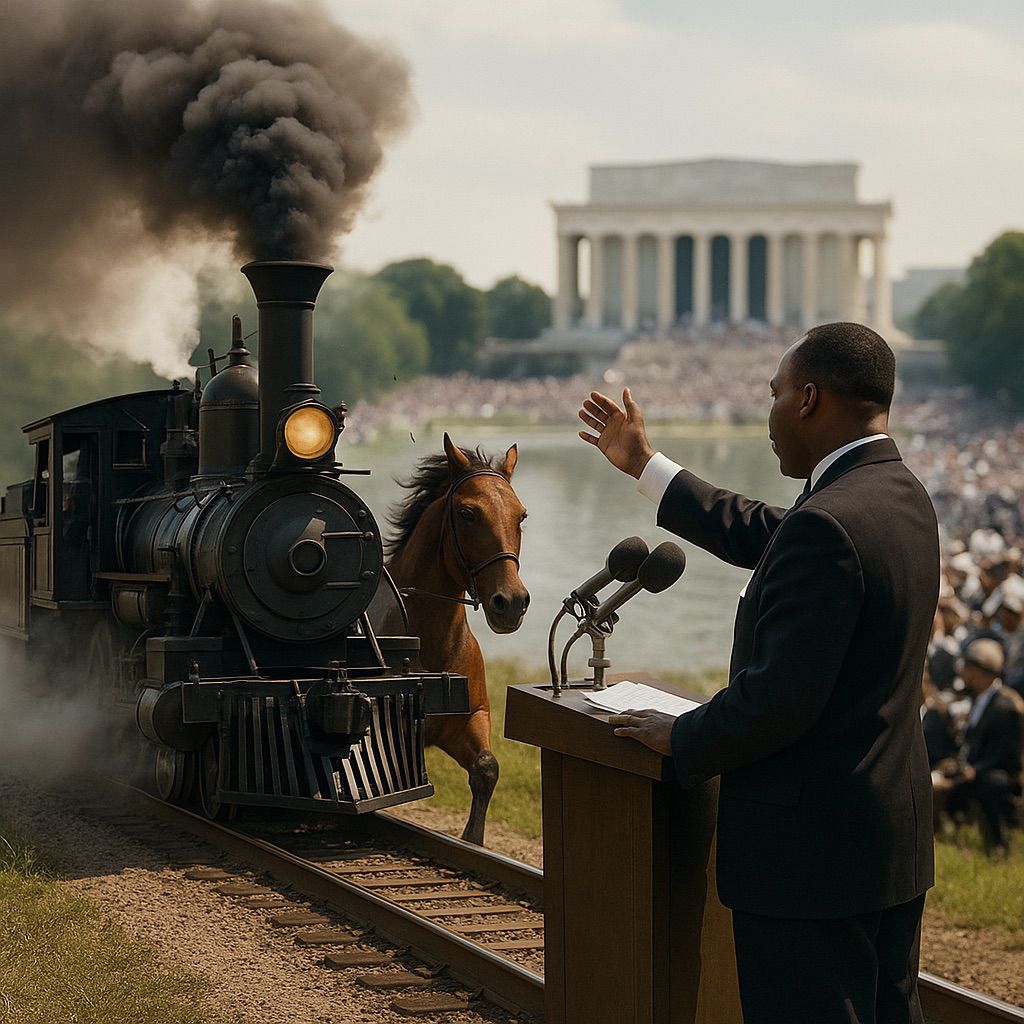
There are dates that look ordinary until you lean in and catch the hum beneath the ink. August 28 is one of those dates. On one August 28, in 1830, a tea-kettle of a locomotive nicknamed Tom Thumb lined up beside a horse on a short run of track outside Baltimore and lost a race it should have won. On another August 28, in 1963, a Baptist minister stood before a quarter of a million people at the Lincoln Memorial and gave voice to a dream so clear it still braids itself into the nation’s conscience every time we say the words. One story is comic in its immediacy—leather, steam, and a slipped belt. The other is solemn, musical, and nation-shaping. Together they tell us something about motion: how we move bodies and freight, and how we move hearts and law; how the future, when it first arrives, looks small and a little ridiculous; how justice, when it finally speaks plainly, sounds like something we had all been trying to say for generations. August 28 is a hinge. On one side, a sputtering engine challenges the familiar rhythm of hooves. On the other, a voice challenges the familiar rhythm of inequality. If the first is a fable about innovation, the second is a field manual for courage. Both are instruction.

It is late summer, 1830. The Baltimore & Ohio Railroad has laid only a few miles of iron, an audacious thread between skepticism and ambition. Peter Cooper, a self-taught inventor and businessman with a nose for the useful, has cobbled together a tiny locomotive as proof of concept. Tom Thumb is not majestic: it is a cylinder and boiler perched on a small frame, a little chimney, a hand-fed fire, and a blower that keeps the flame hungry. But when steam gathers, size is deceptive. To convince the B&O directors—men who have invested money and pride—Cooper proposes a public demonstration. A horse-drawn car pulls alongside. Wagers are whispered. The challenge is on, not because the horse is expected to win, but because spectacle is the grammar of persuasion in a young republic. The race starts. Tom Thumb coughs, hisses, and then takes the bit between its iron teeth. The crowd cheers as the car clatters forward, the horse stretching into a gallop; the engine gains, glides, and—astonishingly—leads. Then calamity of the most mundane sort: the blower belt slips. Without forced draft, the little boiler gasps; the pressure drops as if the future itself had caught a cold; the horse thunders past; the finish line arrives like a punchline. Laughter and jeers. The past appears to have triumphed. Yet anyone who has ever built something knows the private smile of proof. The point wasn’t the photo finish; it was the middle of the race—the moment when steam outran muscle and time compressed into a new shape. The B&O directors saw it and funded more track. Within a generation, locomotives stitched the mid-Atlantic to the Midwest, schedules replaced seasons, freight costs collapsed, and lives changed because a small machine, even in defeat, revealed a different possible world.

The lesson of Tom Thumb is compact but deep: failure, public and undeniable, can be the most persuasive form of success. An engine that loses can still win the argument. Ask any engineer: the first prototype’s job is to fail interestingly enough that the second prototype knows what not to be. The belt slip is almost allegorical. It suggests that the future is not foiled by big ideas so much as by small tolerances, unglamorous parts that connect power to purpose. The fix is tedious and technical, but it is also where courage lives. Progress is not a parade; it is an alignment, a sequence of refinements invisible to posterity but indispensable to it. And so the rails grow long. The whistle becomes a national sound. With every timetable printed and every bridge built, the lesson repeats: the way forward becomes common only after it has been ridiculous in public.

A different crowd gathers on a different August 28, this time in the humid capital of a country at once proud and haunted. It is 1963. The March on Washington for Jobs and Freedom did not materialize out of thin air; it was engineered by organizers who understood logistics, coalition, and risk. Bayard Rustin, precise and tireless, diagrams bus routes and restroom access, coordinates sound systems and marshals. A. Philip Randolph brings the moral voltage of decades of labor advocacy. Thousands of volunteers move like capillaries, carrying information and water through the body of the demonstration. The architecture of the day—permits, first-aid stations, food stalls—makes a city of conscience possible. And into that city walks Martin Luther King Jr., bearing a manuscript and a lifetime of sermons, marches, and cells. The stage is the Lincoln Memorial. The gaze of a stone emancipator rests on a living one. The reflecting pool holds the sky like a promise.

King’s speech climbs by steps, each phrase placed so carefully that it feels inevitable. He begins not with dream but with debt: a promissory note defaulted, a nation’s check returned “insufficient funds.” It is the language of a preacher conversant with banks and breadlines, poetry yoked to policy. He names the fierce urgency of now and refuses the narcotic of gradualism, the opiate that seduced so many well-meaning onlookers into the paradox of waiting for justice. When he says “now,” the crowd answers with its breathing. He speaks of thresholds: justice rolling down like waters, righteousness like a mighty stream. He speaks of specific places—Georgia’s red hills, Mississippi’s heat of oppression—binding abstract promise to concrete geography. Then the turn. Mahalia Jackson, friend and witness, calls from behind him: “Tell them about the dream, Martin!” He leaves the script and lands on a riff he has preached before, but never like this. The dream expands, stanza by stanza: a nation where children are judged by the content of their character, where Alabama becomes a place for little Black boys and Black girls to join hands with little white boys and white girls, where freedom rings from Lookout Mountain to Stone Mountain, from every mountainside. The repetition is hammer and lullaby. The crowd becomes the instrument. The marchers, many of whom have already been bloodied, hear not an escape but a blueprint. The dream is not a pillow; it is a set of coordinates.

The aftermath is policy and pushback, both swift. The Civil Rights Act of 1964 and the Voting Rights Act of 1965 do not fall from the sky; they are hauled by generations into law, pushed by funerals and filibusters, court orders and clipboards, training sessions and airless church basements where volunteers learn de-escalation and how to register voters in counties that require courage just to pronounce your own name at a counter. The machinery of oppression does not sit idle while statutes are signed; it reconfigures, reinventing obstacles with the slyness of a river that finds a new channel. Segregation’s signage comes down, then zoning maps do the same work with a patina of neutrality. Poll taxes and jelly-jar literacy tests retreat, then voter roll purges and precise ID rules and quietly shuttered precincts step forward. If the Tom Thumb taught us that a slipped belt can stall an engine, the years after 1965 teach that democracy has belts everywhere and saboteurs who prefer them loose. The moral keeps repeating: inspection is love. Maintenance is patriotic. What begins in a shining moment needs a schedule and a wrench.

Put the two Augusts side by side and the rhyme is clear. Both moments are demonstrations staged for skeptics. Both pivot on public proof—sightlines and sound systems, a seeing that is believing. Both reveal that progress is as much choreography as it is charisma. Cooper’s little engine runs to persuade the B&O that steam is the future; King’s words ride acoustics across water to persuade lawmakers and a watching world that justice cannot wait. Both face ridicule: one because it loses a race, the other because detractors reduce it to a lyric detached from labor. Yet both succeed because evidence, once witnessed, ripens into insistence. If we could outrun a horse, we can cross a continent. If we can call a crowd to dream in unison, we can rewrite law.

To humanize these histories, imagine a boy standing trackside in 1830, a laborer’s son clutching his father’s rough hand, torn between the familiar elegance of a horse and the comic audacity of a smoking pot on wheels. He laughs when the belt flies, but the laugh has awe stitched into it. That night he lies awake hearing the whistle in a future nobody else can hear yet. Now imagine a girl on a bus from Birmingham in 1963, knees pressed to the seat ahead, a paper bag lunch in her lap, her mother’s hand on hers every time the bus slows near a state trooper’s car. She is thirteen and has memorized snatches of scripture and court cases; she has heard dogs bark and seen windows break; she has also heard her teacher say that the law can be made to tell the truth if enough people stand where the truth is. When King’s voice slides from banknotes to the dream, she does not think of abstraction. She thinks of a drinking fountain. She thinks of a classroom. She thinks of a ballot she will one day place into a box without asking permission. The histories are public, but the courage is always personal.

The technology of Tom Thumb is quaint now—external blower, small cylinders, an open frame that looks fragile to modern eyes—but in 1830 it condensed a century of experiments into a convincing package. Steam had moved boats and mills; moving people overland, reliably and at scale, required more than fuel and fire. It demanded metallurgy, precision machining, new kinds of maps, financial instruments to pool risk and reward, and a culture willing to trust schedules. It also required a reimagining of space: hills shaved, valleys filled, tunnels bored. The railroad altered where towns grew, how newspapers traveled, which crops could go to market before they spoiled. It compressed weather and, for many, time itself. Yet we should not praise the railroad without acknowledging the shadow it cast: it quickened dispossession as well as commerce; it carried homesteaders and soldiers into lands whose treaties were honored only until they were inconvenient; it yoked capital to conquest. Technology is an amplifier. It does not absolve us of the question “Toward what?”

The rhetoric of the March is no less engineered. King’s gift is not only cadence and metaphor but structure. He builds the case, invites the verdict, and then sings the sentence we want to live under. He borrows a nation’s founding vocabulary and returns it at a better pitch, as if returning a borrowed instrument tuned for the first time. The dream sequence is not a nap; it is a moral graph with axes for dignity and opportunity. If you draw the line and it holds across neighborhoods, schools, and courts, you are pointed toward justice. If the slope flattens or drops, you know where to work. Policy follows poetry not because poetry is magic but because poetry sorts the important from the merely loud. “Let freedom ring” is a refrain, but it also functions as a checklist. Which mountainsides have we neglected? Which valleys echo back only to the few who live there? The line “we cannot be satisfied” lands like an update to a nation’s operating system, a refusal to accept a buggy release.

Pairing these stories reveals something about speed and direction. The horse is swift and sure on familiar ground; the engine is awkward until the parts align. The status quo is comfortable for those it serves; justice is ungainly until enough people shoulder it forward. In both cases, the win is not measured by the first finish line but by what becomes possible after the test. The Tom Thumb loses and yet inaugurates a century of rail. The March ends and yet inaugurates a decade of legislation and a longer arc of vigilance. Winning, properly defined, is what crowds will one day take for granted. Our task, inheritors of these Augusts, is to decide which future we want to normalize.

There is, too, a lesson about spectators and stewards. In both scenes, people come to watch. Some clutch tickets; some clutch signs. Some come to scoff; some to sing. But spectatorship is a reversible garment. The moment you decide to keep a piece of the work, you have changed categories. A B&O director becomes a builder of bridges. A marcher becomes a voter registrar, a plaintiff, a city council candidate, a teacher who folds primary sources into her lesson plans so that the next generation has receipts. If you are waiting for a permission slip to join history, August 28 has already signed it.

We live in a century as breathless as Cooper’s blower and as morally urgent as King’s “now.” The belts we must watch today are both mechanical and civic: data pipelines that warp the public square with algorithmic accelerants; precinct maps that carve the public into market segments rather than communities; school budgets that starve curiosity; a climate whose feedback loops have slipped their careful engineering; attention spans that flicker before evidence finishes clearing its throat. The maintenance recommended by both Augusts is precise: tighten the tolerances between truth and platform; rebuild the bridges between neighbors; schedule inspection for the institutions that keep the republic from overheating—local journalism, public libraries, fair courts, simple ways to vote; invent technologies whose metric of success is human flourishing rather than only speed or scale. We have tools Tom Thumb never dreamed of and a moral vocabulary King would recognize. The question is whether we will marry them with the courage of both.

Here is a small exercise in living the lesson. Pick a failure and name what it proved. Do it at work, at home, at the city council, at the school board. Refuse the seduction of embarrassment’s silence. Tell the story of the slipped belt and what you changed the next day. Pair it with a dream that refuses to shrink under ridicule. Say it out loud, write it down, and engineer toward it with the patience of someone laying track across mountains. The opposition will be real. Horses are lovely and persuasive. The status quo will show you a thousand reasons to keep cantering. But the track is already there, and the whistle you hear is not imagination. It is the sound of a country, at its best, inventing itself again.

August 28 is not a coincidence. It is choreography. It teaches that public demonstrations persuade, that dreams organize, that prototypes—mechanical and moral—deserve crowds, and that the arc between a sputtering contraption and a sentence that can govern a century is shorter than it looks when people insist on shortening it. The boy on the track and the girl on the bus are grown now, or they are our ghosts, or they are our children. Either way, they are waiting at the next curve. They want to see if we remember how to fix a belt and how to hold a note. They want to see if we can keep moving bodies kindly and moving laws justly. They want to see if we will treat the dream like a blueprint and the blueprint like a schedule. They want to see whether our laughter still holds awe.

Related Posts

The Tide Inside: Meditating with the Sound of Waves

There’s a reason the ocean keeps making poets out of ordinary people. You stand at the water’s edge and the body recognizes something older than language: a rhythm that began long before your first worry and will go on long after your last. The shoreline is a living metronome; the waves arrive, the waves recede, and somewhere inside you, a second tide begins to keep time. Meditation with the sound of waves doesn’t require special cushions or perfect posture or a guru on speed dial. It asks only that you sit down where the world is breathing and agree to breathe with it. The rest—calmer thoughts, softer shoulders, steadier heart—tends to happen as a side effect of listening.

Begin with the arrival. The beach is both public and private—a stage and a sanctuary. Even when others are nearby, you can carve out a small circle of solitude with the simple act of sitting. Choose a spot where the foam laps just short of your toes, close enough that the ocean’s voice is unmistakable, far enough that you aren’t negotiating each wave like a landlord. Let the horizon be your gentle anchor. You don’t need to stare at it; it’s enough to know it’s there, a straight line offered to a day that may have felt messy and curved.

Now let the body remember how to be comfortable. Stack your spine like driftwood that has finally found its resting place. Let your shoulders pour downward. Rest your hands in your lap or on your knees. The point is not to become a statue; it’s to become permeable. When a breeze brushes your forearms, you feel it. When gulls argue over a shell, you hear them. When the sun warms the bridge of your nose, you notice the warmth, then let it pass like a cloud of sensation. This is not the hard labor of “clearing the mind.” It is the soft, skillful art of paying attention to what is already happening without adding commentary.

The waves teach a structure older than any meditation app. Inhale with the gather, exhale with the release. As a swell draws itself together, let your breath fill, wide and easy. As it unfurls along the shore, let your breath empty, longer on the way out than the way in. The ocean shows you that exhalation is not a collapse but a gift—the moment the body gives back what it no longer needs. A few minutes of this and your nervous system starts taking notes. Your pulse steps down a gear. The tyranny of urgency thins. You begin to suspect that the present moment is, in fact, big enough to hold you.

Thoughts will still arrive, of course. The mind is not a faucet you can shut. It’s a tide pool full of darting fish. Let them swim. When you notice you’ve followed one into a crevice—planning dinner, replaying a conversation, building a castle of what-ifs—lift your attention like you’d lift your eyes from a phone, gently and without scolding. Return to the wave. Hear its first whisper, its full-throated rush, the hiss of bubbles as it pulls back. Imagine the water smoothing the sand of your thoughts in the same way it erases footprints. The trick is not to stop thinking but to stop arguing with thoughts. They can pass through. You are the beach, not the footprints.

Some days, the sea is calm and your attention slides into place like a boat into a quiet harbor. Other days, the wind is up and whitecaps pucker the surface; your mind does the same. Those are not failed sessions. They are honest ones. Let the weather be the weather. There is nothing to “achieve.” The point is coexistence, not conquest. If the surf is loud and your heart is loud, make room for a duet. If your knee aches, adjust without drama; pain is simply information delivered in a language you cannot ignore. Let comfort and curiosity be your two paddles, taking light, alternating strokes.

If you stay a little while, the world shows you its tiny miracles. Pelicans pass low, wings stiff as kites, and you can hear the small leather sound of air over feathers. The sand cools in the shadow of your knees. Far out, a line on the water darkens—a sign of a deeper band of wind or a wandering current. Your breath, once a thing you hardly noticed, becomes a confidant that keeps its promises: in, out, in, out, trustworthy as the next wave. You realize that most of what troubles you cannot survive sustained contact with a horizon.

There’s a human sweetness to this practice. The ocean accepts you without negotiation. Come anxious, come jubilant, come hollowed out by grief, come curious. Sit as the person you are and the person you hope to be will find you there. Meditation at the shoreline is not self-improvement in the punishing sense. It is self-remembering. You belong to a planet where water makes music on stone and light keeps arriving even after a hard day. The waves say: this is what continuation sounds like. You listen and your own capacity for continuation wakes up.

If you like rhythm, build one. Count quietly with the sea: inhale for three waves, exhale for three. Or link sound to sensation: when the wave crests, soften your jaw; when it breaks, release your shoulders; when it recedes, loosen your belly. If you need an anchor, lay one hand on your chest and one on your navel and let them rise and fall like small boats. If you prefer imagery, imagine breath as a tide ribboning through the body—drawing clarity in, washing static out. Simple rituals work best. The ocean is doing the heavy lifting; your job is to keep saying “yes” to it.

After a while, you might play with attention like a lens. Zoom in: hear the fizz of water threading back through sand, the tiny clatter of shells. Zoom out: hear the ocean’s whole paragraph, the layered conversation of shore and swell and wind. The nervous system loves this alternation; it trains the mind to shift focus without panic, to hold details and the big picture together. That’s a skill you’ll carry inland, where life demands the same dance—email and purpose, task and meaning, the grain and the panorama.

If you bring worries to the water, give them ceremony. On an inhale, name the weight—“tight deadline,” “family friction,” “old fear.” On the exhale, imagine laying it on the surface and watching the water carry it a few meters off, not vanished, just held by something larger than you. This isn’t magical thinking; it’s an embodied metaphor that reminds the brain it has partners. The sea is bigger than your schedule. The sky is bigger than your mood. Let them help.

Some practical kindnesses make the practice sweeter. Go early or late when the light is soft and the sand is cool. Sit where you can feel safe and unhurried. If you prefer sound without spectacle, close your eyes. If you prefer spectacle without strain, half-close them and let the horizon blur. If you’re shy, pull a hat brim low; anonymity is a kind of comfort. If sitting is hard on your hips, lean against a driftwood log or lie on a towel and let the waves become a lullaby. If you live far from the sea, use a recording of your favorite beach and a bowl of warm water for your feet; the body is wonderfully willing to believe.

Your meditation doesn’t need a hard ending. When it feels right, let your breath deepen and your eyes open fully. Take stock like a beachcomber after a storm. Notice if your thoughts are arranged more neatly on the sand. Stand up slowly; many people feel a pleasant heaviness in the limbs, like gravity has given them a reassuring pat. Carry the rhythm with you as you walk the waterline. If you want a small ritual to close, trace a circle in the wet sand with your toe and stand inside it for three breaths. When the next wave reaches in and erases the mark, let that be your bow to the moment.

What grows from this is subtle but sturdy. Meditating with the waves doesn’t make life painless. It makes you agile. You learn to meet surges without bracing and to move with recessions without sulking. You become less allergic to change because you’ve practiced with a teacher who changes on purpose and on schedule. Over time, you may find that you can conjure the shoreline in busy rooms: listen for a quiet undertow beneath the clatter of obligations, breathe by that undertow, answer from it. You will say things more slowly, and people will listen more quickly. You will feel both smaller and more connected, which turns out to be a relief.

There’s also the quiet medicine of beauty. In a culture that treats attention like currency to be harvested, spending it freely on a horizon is an act of reclamation. To look at something for no reason but wonder is to remember you are not only a producer, consumer, or competitor; you are also an animal who needs awe the way skin needs sunlight. The sound of waves is a delivery system for awe. It’s repetitive but never repetitive, the way a friend’s voice is always the same and always new. Ten minutes with that sound and the edges of your day grow rounder.

Bring others when you like. Shared silence is an underrated intimacy. Sit side by side and agree to let the water do the talking. When you rise, you won’t need to say much. Maybe you’ll point at a gull with comic timing or the thin silver of a fish leaping. Maybe you’ll just smile like co-conspirators who found a loophole in time. Children take to this easily; they meditate without the noun. Give them a “listening game” and they’ll show you levels of hearing you forgot you had. Elders, too, often relax by the sea with a speed that startles; the body remembers paths to calm even when words do not.

If the season changes and the shore grows cold, go anyway. Bundle up. The winter sea has its own grammar—quieter crowds, bigger skies, a scrim of steam where the water gives its warmth to the air. Your breath will be visible, a little flag of presence. Sit shorter, breathe slower, and let the starkness sharpen your attention. Calm is not the same as comfort; it is the confidence that you can be with what is.

One day, after many sessions or maybe just one, you’ll notice a small but telling shift. You won’t be thinking, “I am meditating to the sound of waves.” You’ll just be sitting, and there will be waves. The hyphen fades between you and the place. The line between inside and outside gets more porous, and your breath moves like weather instead of like a metered exercise. That’s not enlightenment; it’s friendship—with yourself, with the moment, with the old tide that keeps knocking and never demands that you open the door, only that you listen.

When you finally brush the sand from your palms and stand, carry two promises inland. First: you do not need an ocean to hear a tide. There is a rhythm under everything—tires on asphalt, a ceiling fan’s soft chop, your own steps on a hallway floor. Choose any of it as a companion and the world becomes a kinder room. Second: you are allowed to stop. The shore shows you that pausing is not a failure of momentum; it is the mechanism by which momentum becomes sustainable. Waves rest between their efforts. You can, too.

Walk away and notice how the day feels slightly retuned, like a guitar string brought into harmony with itself. Perhaps a problem looks less like a wall and more like a bend in the path. Perhaps your kindness is closer to the surface. Perhaps nothing noticeable changes, and still you feel steadier, the way a boat feels steadier when it points into the swell. Keep this practice simple and let it be imperfect. Return to the water when you can and to the memory of water when you cannot. Let the sea’s sentence keep writing itself through you: come close, breathe, let go, return.

Related Posts

Boom and Brag: From Krakatoa’s Fury to the World’s Greatest Feats

There are certain dates in history that refuse to be forgotten, not because they were chosen for celebration, but because something happened—so loud, so spectacular, so absurd, that the world had no choice but to listen. August 27 is one of those days. It is a date born of chaos and curiosity, destruction and delight. On one end of the spectrum, it marks the anniversary of one of the most catastrophic volcanic eruptions in recorded history—the 1883 explosion of Krakatoa, which quite literally tore an island apart and sent shockwaves around the planet. On the other end, it gave birth to something infinitely more playful yet profoundly human: the launch of the Guinness Book of World Records in 1955, a catalog of the incredible, the ridiculous, and the astonishing achievements that define human eccentricity. At first glance, these two events seem to sit at polar extremes—one a violent force of nature, the other a celebration of human oddities. But as we begin to peel back the layers, we find they share more than just a date. They both embody an insatiable force—one of natural power, the other of human ambition. Both reshaped the way we look at the world. And in their own ways, they remind us that records—whether geological or Guinness—are meant to shake the ground beneath us.

The morning of August 27, 1883, did not begin peacefully for the residents of the Sunda Strait between the islands of Java and Sumatra. In the days leading up to it, the Krakatoa volcano had been rumbling ominously, spewing ash clouds and small explosions into the sky. But nothing could have prepared the world for what came next. At precisely 10:02 a.m. local time, the earth beneath Krakatoa buckled and unleashed a sound so loud it ruptured eardrums forty miles away. The blast was heard over 3,000 miles from its source. People in Perth, Australia and on Rodrigues Island near Mauritius thought they were under attack. The sound, which reverberated around the globe multiple times, remains the loudest sound ever recorded in human history. And that was just the beginning. The explosion released the equivalent force of 200 megatons of TNT—four times the energy of the most powerful hydrogen bomb ever detonated. It obliterated more than two-thirds of the island, creating a caldera beneath the ocean surface and sending massive chunks of earth skyward. Pyroclastic flows and ash clouds annihilated everything in their path. Hot gas incinerated coastal villages. A series of tsunamis followed, the largest cresting at over 120 feet, wiping out over 165 coastal towns and villages in a matter of hours. The death toll reached an estimated 36,000 people—though many suspect it was far higher due to the number of unrecorded casualties among indigenous populations and seafaring crews.

But Krakatoa’s devastation wasn’t confined to its local geography. The ash it spewed into the atmosphere affected the entire planet. Global temperatures dropped by over 1.2 degrees Celsius for months. Sunsets turned blood red as far away as Europe and North America. People wrote poetry about the eerie, copper-colored skies. Edvard Munch later claimed the red skies in his painting “The Scream” were inspired by the post-Krakatoa light displays. The eruption didn’t just alter landscapes; it etched itself into the collective human psyche. It was, in many ways, our first modern encounter with a global environmental shock—our introduction to the idea that what happens on one island can reverberate through the entire atmosphere. And it was terrifying.

Yet, out of the ash, a strange form of awareness arose. Scientists, artists, and everyday people began to grasp the interconnectedness of our planet. News of the disaster spread via telegraph and early cable networks, making Krakatoa one of the first truly global news events. The blast wasn’t just heard—it was felt by a world that was only beginning to understand itself as a whole. In that sense, Krakatoa was a record-breaker. The loudest sound. One of the deadliest natural disasters. A defining moment of scientific realization. It was a high-water mark of natural ferocity—and one we never forgot.

Now fast forward 72 years to another August 27. The world is a different place—at peace after the horrors of World War II, fascinated by consumerism, and increasingly obsessed with facts and trivia. In Dublin, a man named Sir Hugh Beaver, then managing director of Guinness Breweries, found himself in a spirited debate about which game bird was the fastest in Europe. Unable to find the answer in any reference book, he realized something: there was no definitive guide for settling disputes like this. No central record of the best, the fastest, the strongest. Nothing to verify the kinds of barroom arguments that cropped up among friends or coworkers. That idea fermented, just like a good stout, until it bubbled into the creation of something entirely new—the Guinness Book of Records.

The first edition, published on August 27, 1955, was humble—just 198 pages, given away as a marketing promotion. But it caught fire. People were enthralled. Here was a book that didn’t just catalog the expected—tallest mountains or longest rivers—it dove headfirst into the bizarre and the brilliant. Longest fingernails. Most spoons balanced on a face. Largest collection of rubber ducks. Heaviest twins to ride a motorcycle. Fastest time to eat a bowl of pasta with no hands. These weren’t just statistics—they were proof of humanity’s insatiable desire to push limits, even ridiculous ones.

The Guinness Book tapped into something primal. The same need that drove people to climb Everest or walk on the moon also drove them to stuff marshmallows in their mouths or pogo stick up a flight of stairs. Why? Because they could. Because someone, somewhere, might be watching. Because it feels good to be the best at something, even if it’s something nobody else ever thought to try. It wasn’t about utility. It was about individuality. About visibility. About leaving a mark on a world spinning too fast to remember anyone for long. In an era before social media and viral fame, the Guinness Book was a gateway to immortality. You didn’t need to be rich, powerful, or even sane. You just needed to do something first, fastest, or freakiest—and prove it.

Over time, Guinness World Records became an institution. It morphed from a quirky publication into a global phenomenon, with TV shows, live events, and an army of adjudicators measuring everything from the largest pizza to the fastest marathon run by a person in a mascot costume. It grew beyond the book, but never lost its soul. It’s still about wonder. Still about pushing boundaries. Still about asking the question, “What else is possible?” And when you look at it that way, it begins to feel oddly similar to Krakatoa. Not in content, of course—but in impact. Because both moments—one born of destruction, the other of curiosity—captured the world’s attention in a way that few things do.

They disrupted normalcy. They made us look up. They made us talk. And maybe most importantly, they made us measure. Krakatoa made us measure sound, force, death, and planetary consequence. Guinness made us measure speed, strength, length, height, weirdness, and wit. Both events revealed that measurement is how we make sense of awe. One awed us with terror. The other with delight. And both taught us that records, whether made by lava or human labor, are how we track the edges of the possible.

It’s poetic, in a strange way, that both these milestones landed on the same calendar day. Because they tell the same story from two different mouths. One says, “Nature is bigger than you.” The other says, “But you are capable of more than you think.” Together, they form a full sentence. A truth. A warning and an inspiration. Krakatoa reminds us to be humble. Guinness reminds us to be bold. And August 27 stands as the balancing point between the two.

So next time you flip past this unassuming date, stop. Remember that this day saw the sky fall and the human spirit rise. That it bore witness to the power of nature and the absurdity of ambition. That it gave us a reason to fear—and a reason to cheer. It is a date carved in ash and printed in ink. A day of boom and brag. A day to be remembered.

Related Posts

Whispering Shores: Underrated Beaches in Europe You’ll Wish You’d Found Sooner

There’s a point in every coastal journey where the map fades and the sea begins to speak for itself. It sounds like pebbles rolling in a gentle tide. It smells like pine warmed by a noon sun. It looks like a tiny crescent of sand that never made a “top 10” list, a place where you can hear your own footsteps and the faint clink of a fisherman’s tackle somewhere around the headland. These are Europe’s underrated beaches—the quiet edges that don’t go viral, that don’t rent out entire summers to influencers, that don’t require an alarm clock battle to claim two meters of sand. They’re the bays you remember years later because you shared the water with five people and a curious cormorant. They’re the places where the coffee is strong, the bread is warm, and the salt dries on your skin before you make it back to the car. This is a love letter to those beaches—and a guide to finding them—written for travelers who prefer a whisper to a shout.

Start in Portugal, but step around the obvious. The Algarve’s cliffs are famous for good reason, yet just a little north of the postcard coves sits Alentejo’s wild littoral, where beaches stretch so long they become a mood. At Praia da Amália, a narrow path threads through eucalyptus and descends to a small amphitheater of sand framed by slate rock. A waterfall sometimes tumbles directly onto the beach, fresh water etching a cold ribbon through the warm Atlantic. Fishermen pick their way across the headland, their silhouettes crisp against the sky. It’s a place that doesn’t care whether you came for a selfie; it cares only that the tide keeps time. Drive a bit farther and you’ll reach Praia de Aberta Nova, a wide, golden sheet where the dunes move like sleeping animals. There’s nothing to do but walk, swim, and become the kind of person who unlearns urgency.

Hop east to Spain, but not to the Costa crowded. On Menorca, the least performative of the Balearics, the south coast hides miniature paradises reachable by pine-scented trails. Cala Trebalúger is one of the loveliest—milk-blue water, chalky sand, and a silent river mouth where you can rinse the salt from your hair with fresh water. The hike in keeps it modestly empty even in high summer; the reward is a cove that feels sketched by a minimalist architect. Menorca’s secret is proportion: cliffs high enough to hush the wind, sand wide enough to spread lunch, water shallow enough to invite even cautious swimmers. If you arrive at noon, the sea looks like it’s plugged into a light socket; if you stay until late afternoon, it downgrades to a perfect, expensive teal.

France’s Mediterranean is famous for a certain kind of glamour—yachts, rosé, and sun loungers priced like limited-edition sneakers. But the country also guards pockets of quiet that feel like revelations. On the Côte Vermeille, where the Pyrenees tumble into the sea near the Spanish border, you’ll find Plage de Paulilles, a pebbled arc with water clear as a bell. The headlands cradle it from the Mistral, and the surrounding Bay of Paulilles is a protected landscape. Swimmers cut slow lines along the buoys while families picnic under tamarisk trees. A small museum nods to the site’s history as a dynamite factory; the sea, eternally unbothered, just keeps being blue. Farther west in Brittany, Plage de l’Île Vierge (Crozon Peninsula) is a northern miracle: spruce and maritime pine, chalk cliffs, and water so translucent it looks like a trick of latitude. It’s proof that “Mediterranean color” can happen hundreds of miles from the Med, if the geology is right and the clouds are feeling kind.

Italy may be the motherland of la dolce vita by the sea, but its coasts still hold secrets. In Puglia, the Gargano Promontory hides Vignanotica, a long ribbon of white pebbles below chalk cliffs stippled with caves. The pebbles sing underfoot when the waves retreat—one of those small, perfect sounds you only notice when you’re not jostling a crowd. On Sardinia, everyone knows about La Pelosa’s electric shallows; far fewer make the dusty drive to Cala Domestica, a double-bay on the island’s southwest edge where an old watchtower guards a bowl of sand the color of toasted bread. A side path leads through a buttonhole in the rock to a secret secondary inlet; swim there alone and you feel like the first person to read a footnote and understand its importance.

Across the Adriatic, Croatia’s Dalmatian Coast has coastline so chopped and intricate that solitude is almost a guarantee if you’re willing to look. On Brač, walk past the tail-end of Zlatni Rat’s famous spit to Lovrečina Bay, where a shallow, sandy floor (rare in Croatia) invites barefoot ambling far from shore. Olive groves press close to the water, and a small church ruin keeps quiet watch. On Dugi Otok, Sakarun’s white-sugar sand is known, but the nearby coves—Pantera Bay, Veli Žal—often feel like their own private rehearsals: same glassy water, fewer witnesses. If you like your beaches with a side of lunar drama, sail to the Kornati archipelago, where beige domes rise from a cobalt sea and the line between land and water seems negotiated anew each morning.

Montenegro is smaller than some European provinces but punches well above its weight in coastline drama. Past Budva’s energy, past Sveti Stefan’s cinematic fame, you’ll reach Queen’s Beach (Kraljičina Plaža), a short, graceful curve tucked beneath red cliffs and Aleppo pines. In the morning, the sun sets the limestone glowing; by late day, the water turns a kind of bruised sapphire. A sense of hush holds here, partly because access is limited, partly because the mountains draw the sound upward rather than outward. Dip under and you can hear your heartbeat, steady as a metronome.

Greece, of course, could supply an entire atlas of “underrated.” On the Ionian island of Kefalonia, Antisamos is a stunner—pebbles so white they bleach the light, slopes of green that cascade into indigo water. But drive thirty minutes and hike another ten and you’ll find Koutsoupia, a long, crescent cove reachable only by a coastal path. The sea shifts through a painter’s swatch book—lapis, cyan, peacock—while goats graze the terraces above. On Crete’s south coast, Agiofarago lies at the mouth of a short gorge: tall walls, a narrow beach, and water that looks poured from a bottle. If you go in the morning, you might share it with climbers and a monk from the nearby cave-chapel; by afternoon the wind combs the surface into silky lines.

Venture north to Albania, where the Riviera south of Vlorë is still inventing its tourism story. Gjipe Beach might be the headline: a sandy throat at the mouth of a dramatic canyon, reached by a thirty-minute walk or a bouncy 4×4 track. The sea is Ionian-clear; the cliffs vault straight up like cathedral walls. There is just enough infrastructure to get a cold drink, not enough to make the landscape feel compromised. Keep driving to Borsh, where an almost endless strand of pebbles unrolls along olive groves and fig trees, the smell of grilling fish drifting on evening air. Albania’s gift is scale without saturation: big views, small crowds.

In Slovenia, two dozen kilometers of coastline punch above their length. Moonstone-colored Piran leans Venetian, but the quieter swimming platforms east of town let you slip into jade water with the church bell as your metronome. A short jog inland delivers you to salt pans where flamingos sometimes draw gossip-pink lines across the horizon. It’s not a “beach” in the sandy sense; it’s better—a daily life politely interrupted by the sea.

Sicily’s little cousin islands hold the key for anyone who hears “underrated” and thinks “ferry schedule.” On Favignana, Cala Rossa is rightly adored, but Cala Azzurra often feels roomier and just as vivid, with pale slabs stepping into glass. On Pantelleria, there’s almost no sand at all—just lava terraces, hot springs, and water so inky blue it seems unreal. Swim at Cala Gadir, then soak in the ancient thermal pools as locals discuss capers, wind, and gossip with equal expertise.

The Black Sea, often left out of glowing travel prose, deserves its own song. Bulgaria’s northern cap hides Bolata, a small horseshoe of sand at the mouth of a river, backed by rust-red cliffs. The water is usually as mild as a secret, and fishermen’s huts lend the cove a hand-built humility. In Romania’s Danube Delta, beach becomes delta becomes wetland; at Sfântu Gheorghe, you can lie on a strand that feels like an unrolled ribbon at the edge of a biosphere, pelicans drafting across an enormous sky.

Even the British Isles, which some imagine as a catalog of weather rather than beaches, keep aces up their sleeve. On the Isle of Harris in Scotland’s Outer Hebrides, Luskentyre wears Caribbean colors on a Gaelic face: dunes, machair wildflowers, pale sand, and a sea that would be fully tropical if someone nudged the thermostat. On a clear day, the island of Taransay floats in the distance like a memory. Cornwall’s north coast has Portheras—once off-limits due to leftover wartime debris, now carefully cleared and watched over by locals who prefer it to stay a little secret. Arrive at low tide and the slate outcrops sketch tidal pools you could stare into for hours.

What binds these beaches is not a single aesthetic but a shared temperament. They are modest. They make you work just enough—an extra bus, a last dirt track, a walk under pines—so that arrival feels earned. They ask for low volume, a small footprint, and a willingness to adjust your plans to the weather’s. In return, they give you silence measured in waves, stars unbothered by nightclub glare, and the luxury of time that doesn’t feel monetized. These are beaches that give you your curiosity back.

How to find your own? Ignore hashtags and stare at topographic maps. Look for where a road stops short of the coast, then for little footpaths that trust you to be polite. Ask a baker where they swim after work. Follow fishermen in the early morning, not too closely; they know the coves that hold clean water after a blow. Pick a national park over a town beach, a shoulder season over a headline month, a north-facing bay in a south wind. Learn the local word for “cove,” “inlet,” and “pebble”; languages often hide the landscape in plain sight.

There’s also etiquette, the unspoken constitution of hidden places. Pack out your lunch and your pride. Leave stones on cairns and shells where they belong. Keep music in your headphones and drones in their cases; some views aren’t improved by a soundtrack or a buzz. If a beach is reached by a path through private olive groves, walk quietly and wave at the farmer. If you find a turtle nest marked with sticks, keep your towel elsewhere and your evening strolls at a respectful distance. The point of an underrated beach is that it remains itself after you leave.

The truth, of course, is that no beach stays “underrated” forever. The world’s curiosity is inexhaustible; discovery is the internet’s favorite hobby. That’s not a reason to hoard names, only a reason to share them carefully and to travel like a guest. The goal isn’t to keep places secret—it’s to keep them whole. If you fall in love with a cove, ask not just “How do I tell people about this?” but “How do I help this endure?” Sometimes the answer is as simple as carrying a small trash bag. Sometimes it’s as human as buying lunch from the family tavern with the faded sign and the best tomatoes you’ve ever tasted.

By the time you fold your towel and walk back up the trail, the day will have rearranged you. Your shoulders will be salted and a little pink around the edges. Your phone will be politely forgotten at the bottom of your bag. You’ll taste anise from the biscuit the café owner insisted you try, and you’ll be thinking about the way the water changed color every time a cloud drifted past. You won’t remember a single queue or reservation system, because there weren’t any. You will, however, remember the feeling—the one that arrives when the world is quiet enough to hear the tide choose its stones. That’s the currency of underrated beaches, and it spends well in memory.

So go. Choose the map’s margins, the places that need no marketing department. Bring strong legs, soft shoes, and a promise to leave nothing behind but a flattened patch of grass where you picnicked. Wade out until the sea lifts you, then float and watch the clouds trade secrets with the hills. If you’re lucky, a local dog will adopt you for the afternoon, a seal will surface like a polite question mark, and you’ll understand what the old travelers meant when they said a good shoreline teaches patience. Europe is full of these quiet teachers. Find one before everyone else remembers how to listen.

Related Posts

Votes and Toilet Rolls: The Unexpected Twin Triumphs

It’s strange how the calendar rarely tells us what’s important. August 26 doesn’t come bearing fireworks or fireworks’ anticipation. It doesn’t mark a new season or host a universally celebrated holiday. It’s just a hot day on the edge of summer in the United States. But to history? To culture, and comfort, and the human pursuit of dignity and choice? August 26 is a double-helix of revolution. One strand belongs to a hard-won, century-spanning struggle: the ratification of the 19th Amendment to the U.S. Constitution in 1920, finally granting women the right to vote. The other, curiously humble and chronically overlooked, is the introduction of commercially sold toilet paper, a product that—although rarely poeticized—changed the hygiene, health, and privacy standards of the modern world. Together, these two unrelated events might seem an odd pairing, yet they both speak volumes about the human condition. About how we fight for power and how we reach for comfort. About the great and small revolutions that define civilization. They both carry the same quiet echo: “I matter.” One says, “I matter in society.” The other says, “I matter in private.” So let’s go backward before we go forward and ask ourselves: How did women win the right to vote? Why did it take so long? And why on earth should we even pause to appreciate something as pedestrian as toilet paper? The answers, as it turns out, tell us more about ourselves than we might expect.

Rewind to the early 19th century, an era draped in corsets and heavy silence. In a country building itself with bold ideals but brittle execution, women were mostly confined to roles of domesticity and obedience. They couldn’t vote. They couldn’t hold office. In many places, they couldn’t even own property or keep their wages. To be a woman was to be legally invisible. But the seeds of change had already been planted. Across oceans, industrialization was changing how people lived and worked. Injustice, exposed under the light of expanding literacy and transportation, grew harder to ignore. The abolitionist movement picked up steam, and as women joined the call to end slavery, many of them—ironically—were told to sit down and be quiet. That pushback lit a fuse. If they were good enough to fight for human freedom, why weren’t they good enough to have some themselves? In 1848, a band of women gathered in Seneca Falls, New York, and held what is now remembered as the first women’s rights convention in the United States. Elizabeth Cady Stanton, one of the movement’s leading minds, drafted the Declaration of Sentiments, a document that mimicked the structure of the Declaration of Independence but added the radical line that “all men and women are created equal.” The convention was a spark, but the fire would take decades to catch. The opposition was ferocious. Critics said women were too emotional, too delicate, too simple-minded to weigh in on politics. Others claimed voting would corrupt their purity, that the sacred domain of motherhood would be tarnished by the dirty business of elections. And yet, suffragists pressed on. They organized. They wrote. They marched. They were arrested. Some were force-fed in prison during hunger strikes. Others stood silently outside the White House with signs shaming President Woodrow Wilson for ignoring their plight. Slowly, they chipped away at the edifice. Some states began granting limited suffrage. Wyoming, famously, gave women full voting rights in 1869—decades ahead of the rest. But it wasn’t until the crucible of World War I that the movement gained irreversible traction. As men went to war, women filled their roles in factories, farms, and fields. They didn’t just prove their capability—they rubbed the world’s nose in it. To deny them the vote afterward seemed both cruel and absurd. On August 18, 1920, Tennessee became the final state needed to ratify the 19th Amendment, thanks to a single legislator—Harry Burn—who had planned to vote against it but changed his mind after receiving a note from his mother urging him to do the right thing. Eight days later, on August 26, the amendment was certified. It became law. Women had the right to vote—not just in Wyoming or California, but nationwide. For the first time, nearly half the adult population of the country had their voices legally acknowledged. But it wasn’t a perfect victory. Black women, Native American women, Asian American women, and Latinas continued to face racism and voter suppression in the form of poll taxes, literacy tests, and outright intimidation. It would take decades more civil rights battles for the idea of “universal suffrage” to inch closer to reality. Still, August 26 marked a tectonic shift. It wasn’t just about ballots. It was about belonging.

Now take a hard left turn. Let’s talk about bathrooms. We laugh, we wince, we blush. But behind closed doors, the way we relieve ourselves and clean up afterward is central to health, comfort, and dignity. For centuries, humans used whatever they had—stones, shells, leaves, animal fur, even hands. In ancient Rome, a communal sponge on a stick served entire public bathrooms, rinsed off in a bucket between uses. The concept of personal hygiene was largely shaped by geography, culture, and status. Water was common in parts of Asia. The bidet gained popularity in Europe. But paper? That was rare, precious, and reserved for writing. Enter Joseph Gayetty, an American inventor who, in 1857, introduced the first commercial toilet paper in the United States. He called it “medicated paper for the water closet” and claimed it could cure hemorrhoids. It came in flat sheets, not rolls, and was sold in packages bearing his name on every sheet—an early and awkward version of branding. Despite his efforts, the product didn’t catch on. People were used to using newspaper and catalog pages, which were free. It took another few decades, and a few industrial innovations, for toilet paper to go mainstream. In the 1890s, the Scott Paper Company launched rolled toilet paper—the version we now know and often take for granted. Still, there was stigma. Ads tiptoed around the product’s function, using euphemisms like “hygienic tissue” or “comfort paper.” Social taboos made it nearly impossible to market directly, especially to the Victorian middle class. Nevertheless, the product spread. Indoor plumbing and the rise of consumer culture in the early 20th century helped normalize it. By the 1920s, toilet paper was a fixture in American households, quietly revolutionizing the way people experienced one of life’s most basic routines. Its impact was enormous but invisible. Sanitation improved. Skin health improved. Privacy became sacred. It might not carry the emotional weight of the vote, but it shares a philosophical root: personal dignity.

And so we arrive again at August 26, a day that lives in contradiction and harmony. One milestone was public and political, the other private and practical. One required decades of protest, the other decades of production and consumer persuasion. But in their own ways, they each redefined what it means to live with agency. The right to vote lets you speak. The right to clean yourself with dignity lets you live. Both are statements. Both are declarations that say, “I deserve better than what I’ve been given.” It’s easy to idolize one and mock the other, to see the vote as heroic and toilet paper as trivial. But to do that is to miss the point. Revolution doesn’t always come with fanfare. Sometimes, it comes with a signature on a document. Sometimes, it comes with a soft roll on a shelf. And sometimes, they come on the same day.

We don’t live in a world anymore where we must pick between big ideas and small comforts. We’re allowed to want both. To have both. To vote and to wipe. To scream in the streets and to shut the door behind us. That’s what modernity has offered—not just freedoms, but the freedom to be whole. To be complex. To demand justice and demand two-ply. Women’s suffrage was a political earthquake. Toilet paper was a silent reformation. And August 26? It holds both legacies in its hands. It reminds us that dignity is layered. It tells us that the fight for human rights exists not only in law books and courtrooms, but in the quiet, daily rituals of being human. We commemorate it not because it changed everything at once, but because it made change possible—both in the voting booth and in the bathroom.

The legacy continues. Today, we still fight for voting rights. We still fight for bodily autonomy. We still fight to have our voices heard in both public forums and private lives. And whether that means casting a ballot or reaching for comfort, we honor the same principle: respect for self. So on August 26, take a moment. Reflect on the women who wouldn’t take no for an answer. Reflect on the inventors and innovators who turned daily routines into humane experiences. Celebrate the ballot and the bathroom. Celebrate the loud victories and the quiet ones. Because history, when told honestly, is full of both. And the future? That’s ours to shape—vote by vote, roll by roll.

Related Posts

Emerald Lights, Endless Trails

On August 25, America learned two different ways to believe. In 1916, Congress created the National Park Service, a quiet sentence that would teach an entire country to treat mountains, canyons, coral reefs, and battlefields like family heirlooms: not for hoarding, but for sharing. Twenty-three years later, in 1939, a movie slipped from sepia into Technicolor, and audiences gasped as Dorothy Gale stepped over a threshold and into a world that insisted dreams could come true in shoes you already owned. One founding promised that the real Emerald Cities—valleys and geysers and long, breathing prairies—would be kept for the generations yet to lace their boots. One film promised that the courage, heart, and brains needed to cross any wilderness were already within reach. The date is a hinge between stewardship and story, a reminder that wonder needs both a place to live and a reason to matter.

Think first of the Park Service, born into an America that was busy becoming modern. Railroads had braided the coasts together; automobiles were re-sculpting weekends; billboards and skylines competed to tell you where to look. Yet in the background—older than any headline—stood the unpurchased astonishments: geysers that threw time into the air, stone arches like doorways that forgot their doors, redwoods with the patience to forgive our hurry. Before the Service, parks existed as a scattered promise—Yellowstone here, Yosemite there, a handful of monuments and reservations stitched unevenly into a quilt of good intentions. The Organic Act of August 25, 1916 threaded them, gave them a single caretaker with a paradoxical job: keep the wild wild, and still invite the world to visit. Preserve unimpaired; provide for enjoyment. Two imperatives that jostle like siblings and, on good days, hold hands.

For a century that paradox has been the Service’s craft. Rangers translate geology into sentences and silence into safety briefings; they teach toddlers to listen for ravens and hikers to see lichens as cities. Trails are built with a grace that feels inevitable, switchbacks tucked into slopes so that knees believe the mountain has grown kinder. Signage shows where to look but not how to feel. In the best parks, roads stop just short of domination; lodges tuck their shoulders so the landscape can keep its posture. The uniform’s flat hat is the opposite of a crown: a servant’s badge that says, “Ask me how to belong here.” Because belonging is what the parks are for—not the possession of scenery, but the practice of citizenship in a place that does not owe you a view and gives you one anyway.

Yet the Park Service has been learning, and must keep learning, that “unimpaired” never meant “unpeopled.” Long before Congress named these lands, Native nations named and tended them, stewarding meadows with fire and rules, reading river moods with a literacy that predates any ranger manual. “Conservation” that ignores sovereignty mistakes erasure for care. The parks’ future—indeed their present—depends on co-management that honors treaty rights, restores names, and listens to Indigenous science as equal partner, not garnish. It also depends on expanding what counts as a park: not only geysers and granite, but also history too tender to leave to rumor—sites where rights were demanded, where families were confined, where labor organized, where communities built joy that resisted the dark. The national memory is as wild as any canyon; the Service’s task is to keep its walls from being dynamited by forgetfulness.

Now let the lights dim and the curtain rise on 1939. A dust-brown farm in Kansas tightens like a throat; the dog knows before anyone that weather and worry are kin. Then the door opens and color arrives like mercy. The floor tiles wink, the poppies conspire, the Munchkins harmonize, and a road appears as if the future had sent back a blueprint. The Wizard of Oz is the simplest myth told with the most radical tools: a child leaves home, gathers a fellowship, confronts illusions, returns changed. But inside that simplicity lies a new cinematic literacy. The transition from sepia to Technicolor didn’t just decorate the screen; it taught audiences how a frame could crack open the ordinary to reveal the saturated dignity beneath. It announced that movies weren’t only mirrors; they were windows, and sometimes doors.

The film did more than dazzle. It domesticated archetypes without declawing them. The Scarecrow made intelligence a matter of curious attention, not diplomas; the Tin Man made love a matter of practice, not sentiment; the Lion reframed courage as action despite fear, not bravado’s costume. Dorothy, pure center, invited viewers to locate home not as a place on a map but as the place where loyalty and gratitude converge. The Wizard—booming voice, easy smoke—turned institutional spectacle into a cautionary tale that still applies whenever leaders prefer curtains to candor. Wickedness arrived in green and broomstick, yes, but goodness arrived in glitter and a pointed reminder: you already have what you need. Cinema rarely gives better advice.

Put the Park Service and Oz in the same room and you begin to see the shared thesis. Both are about frames. A park boundary says: inside this line, extraction will kneel to awe. A movie frame says: inside this rectangle, we will pause the ordinary so you can learn to see it again. Both are about access. Trails and roads and campgrounds democratize the sublime, insisting that a kid in borrowed boots deserves Half Dome just as much as someone in bespoke gear. Tickets and matinees democratize imagination, insisting that a factory worker deserves lions and emerald towers as much as any patron. Both are about stewardship: the ranger with a Pulaski digging water bars after a storm; the projectionist splicing a reel; the curator cleaning a lens; the volunteer hauling trash out of a creek; the usher sweeping popcorn after credits. Wonder isn’t free; it’s subsidized by care.

Both legacies face modern tests. The parks are warming. Glaciers sulk back up their valleys; permafrost cheats; storms arrive like strangers who refuse to knock. Trails wash out and must be rebuilt farther uphill; seaside forts stare at tides that grew bold while we were arguing. The Service’s mission now includes hosting grief and training resilience: leading “fire ecology” walks that smell of charcoal and courage; writing plaques that admit a lagoon is a meadow because the ocean decided so; closing areas so that foxes can raise kits and reopen them with a conversation about patience. Loving a place in 2025 means voting for its snowpack and sea grass, not just photographing them.

Cinema faces tests, too: attention atomized by infinite scroll; industry footprints that scorch while stories preach cool; gatekeepers who still forget that magic multiplies in more hands. Yet the Oz blueprint holds. Find companions: producers, grips, musicians, writers from faces and towns that used to be seated in the balcony. Walk forward when the market tells you to play it safe: fund a story that treats a river or a neighborhood like the protagonist it is. Pull back the curtain: be transparent about budgets, labor, and climate impacts so that the illusion we buy is honest about the costs it refuses to externalize. Remember that songs are maps: the right refrain can get a frightened audience all the way through a hard idea.

There’s a child threaded through both halves of this date. One Saturday, they climb into the family car before dawn, sleep through a highway’s worth of billboards, and wake up at a pullout where granite refuses to fit into any camera they own. A ranger kneels to show them how a tiny flower lifts a whole slab with its root and rain’s patience. Weeks later, the same child sits in a theater that smells like soft seats and sugar, the lights drop, and a song teaches them that storm cellars are not the only way to survive wind. These lessons touch each other: walk softly, sing loudly; carry water and carry mercy; keep to the trail and keep to your friends; ask for help from experts in green uniforms and from little dogs who can smell a lie.

A confession: the country has not always kept these promises equally. Some families were told that certain parks were “for others.” Some children grew up near beautiful places paved for pipelines rather than protected for picnics. Some audiences saw their faces only as punchlines. Repair is not a subplot; it is the main quest. A Park Service that centers Indigenous stewardship and invites communities of color to write themselves into the interpretive script is not doing outreach; it is doing accuracy. A film industry that funds storytellers beyond the usual zip codes is not doing charity; it is doing its job: enlarging the national dream until it finally fits the nation.

So what do we do with August 25 when it arrives each year like a lantern on a trail? We remember that imagination and inheritance are twins. We donate a Saturday to a trail crew or a “friends of” group because gratitude should leave calluses. We take a first-timer to a park, shoulder half their pack, and let them set the pace. We rewatch a scene that once saved us and pay attention to the craft—how the cut breathes, how the color carries feeling, how the costume tells a truth words can’t. We nag our leaders about budgets with the same devotion we nag a failing battery. We learn the names of birds along with the names of cinematographers. We practice being the person in the group who says, “Let’s pick up that trash,” and the person who says, “Let’s wait for the slowest hiker,” and the person who says, “Let’s fund the weird script; it’s going to matter.”

“Somewhere over the rainbow” is not only a melody; it’s a management philosophy. The rainbow is the spectrum of people and places we are sworn to keep safe: prairie and pueblo, glacier and greenroom, coral head and chorus line. Over it lies the work we haven’t done yet, the risks we haven’t taken yet, the apologies we still owe and the amends we can still make. The Yellow Brick Road is any path that says, “Forward, with friends.” The Emerald City is any community that admits its wizards are human and that power, to be worth keeping, must be accountable to kindness.

There are two exits from the theater: one leads back to streets that will need your courage; the other leads to a trailhead that will need your care. Pick both. Step into the afternoon with songs stuck to your ribs and a map folded into your pocket. Keep an eye out for poppies that look like rest but are really delay. Tie your shoes—ruby or otherwise. Check the weather. Thank the folks at the desk. Promise the desk that you’ll be back, and that you’ll bring someone new. Then walk, and when the road bends, walk some more. If you do it right, you’ll get home and discover you never left; you just learned how to belong more deeply to what was yours all along.

Related Posts

Sun-Kissed Confidence: Summer Beauty Essentials in Your Beach Bag

A beach day isn’t just about towels, flip-flops, and a bottle of water—it’s about curating a little sanctuary in a bag, a kit of essentials that keeps you glowing, confident, and carefree no matter how long the sun lingers. Summer is nature’s invitation to slow down, recharge, and enjoy life’s simplest pleasures, but it also tests us with heat, salt, sand, and humidity. That’s why the right beauty essentials aren’t about overpacking or vanity; they’re about balance. They help you stay comfortable, protected, and radiant while letting you fully embrace the moment. A thoughtfully packed beach bag is like a safety net woven with sunshine and self-care, ensuring that nothing stands between you and a perfect summer day.

The cornerstone of any beach beauty kit is sunscreen, the one product that transforms a fun afternoon into a safe and healthy one. Broad-spectrum SPF is non-negotiable, protecting you from UVA rays that age the skin and UVB rays that burn it. Go for lightweight, water-resistant formulas that last through swims and sweat, and don’t forget to reapply every two hours. Many beachgoers swear by mineral sunscreens with zinc oxide or titanium dioxide because they sit on top of the skin and deflect rays, offering reliable protection with fewer irritants. A tinted sunscreen can even double as your base makeup, evening out your complexion while saving space in your bag.

Lips often get overlooked, but they burn just as easily as skin. A lip balm with SPF is a beach essential, keeping your pout hydrated while shielding it from the harsh sun. Choose tinted balms for a touch of color that feels effortless but polished. Coral, berry, or soft nude shades complement the natural glow of a beach day, and they’re low-maintenance enough to swipe on between swims. Bonus: a balm infused with antioxidants like vitamin E will fight free radical damage caused by sun exposure.

Next comes hydration for your skin. Saltwater and sun have a drying effect, so a refreshing facial mist or hydrating spray is a lifesaver. Packed with ingredients like aloe vera, rosewater, or hyaluronic acid, these sprays instantly cool your skin, lock in moisture, and revive your makeup if you’re wearing any. A spritz every hour feels like a mini reset, keeping you looking fresh and awake. Pair it with a small bottle of lightweight, non-greasy body lotion or after-sun gel, and you’ll thank yourself later when your skin feels supple rather than tight.

Your eyes deserve protection too. Sunglasses with UV-blocking lenses aren’t just stylish—they shield the delicate skin around your eyes from premature aging and reduce strain from squinting. Oversized frames or wraparound styles also prevent wrinkles caused by constant frowning into the sun. Complement them with a wide-brimmed hat, which doubles as a chic accessory and a practical shield against direct rays. Together, they keep your face cooler, fresher, and more comfortable.

For makeup lovers, waterproof products are your secret weapon. A swipe of waterproof mascara opens up the eyes without fear of smudges, while a waterproof brow gel keeps your arches defined through wind, sweat, and surf. A cream blush in a waterproof formula adds a sun-kissed flush that stays put, even after a swim. And let’s not forget multi-use sticks—those clever little products that can act as blush, lipstick, and eyeshadow in one. They’re compact, versatile, and ideal for travel light beauty.

Hair also craves attention at the beach. Salt and sun can be both beautiful and brutal—giving you waves with volume but leaving strands parched and tangled. A leave-in conditioner or detangling spray with UV protection will keep your hair soft, manageable, and shielded from damage. A wide-tooth comb makes detangling painless, while a scrunchie or silk hair tie prevents breakage compared to tight elastics. Some even keep a stylish scarf in their bag, doubling as a head wrap for protection or a quick outfit upgrade.

Then there’s the matter of shine control. The beach is hot, humid, and unforgiving when it comes to excess oil. Blotting papers are a must—they absorb shine without disturbing your makeup or sunscreen. Compact translucent powders can also help, but blotting sheets are lighter and easier to use on the go. Combined with a refreshing mist, they keep you looking effortlessly matte and radiant rather than greasy.

Let’s not forget the small but mighty essentials. Hand sanitizer, especially one with aloe or moisturizing ingredients, is practical before grabbing snacks. A nail file or mini kit can be a lifesaver for unexpected chips or snags. And of course, deodorant wipes or travel-sized natural deodorants keep you feeling fresh after hours under the sun. These tiny additions elevate your comfort, turning a day at the beach from good to great.

Hydration from the inside out is equally crucial, so slip a reusable water bottle into your bag. Bonus points if it’s insulated to keep your drink cold for hours. Staying hydrated isn’t just about comfort—it’s about maintaining healthy, glowing skin and preventing fatigue under the sun. Pair it with light, hydrating snacks like fruit or veggies, and your body will thank you.

In truth, a beach beauty bag isn’t about chasing perfection. It’s about being prepared so you can relax. The essentials inside are less about looking flawless and more about feeling radiant, comfortable, and confident. They let you dive into the ocean without worry, lounge on your towel without discomfort, and stroll along the shore with effortless glow. Each item—from the sunscreen to the lip balm, from the leave-in conditioner to the facial mist—is a small gesture of self-care that transforms your experience.

The real beauty of a well-packed beach bag isn’t just in how you look; it’s in how it allows you to live the day fully. To chase waves, share laughter, read novels under an umbrella, or watch the horizon shift as the sun sets, knowing you’re cared for. It’s about taking control of your comfort so you can surrender completely to joy. In the end, summer beauty isn’t about heavy routines or elaborate steps—it’s about smart, lightweight essentials that let your natural radiance shine.

Related Posts

Cinders and Celluloid: When a Mountain Froze Time and a Camera Set It Moving

On certain dates the past feels like a stereo, two speakers broadcasting radically different songs that somehow harmonize. August 24 is one of those days. In AD 79, Mount Vesuvius erupted and erased Pompeii and Herculaneum in a convulsion of ash, pumice, and poisonous wind, turning everyday gestures into eternal artifacts. In 1891, Thomas Edison secured a patent for a motion picture camera, a machine that would teach light to remember movement and teach us to dream in frames. One day delivered a catastrophic full stop; the other invented a new kind of continuation. Stand between them and you can feel the human story tug in both directions at once: toward humility before the Earth and audacity before the dark.

Picture the morning before the sky went wrong. A fruit seller tilts a basket so figs catch the sun, a baker scores loaves with a practiced flick, a boy chases a dog across a courtyard frescoed with painted vines that promise shade the noon can’t deliver. Vesuvius sits at the edge of vision like a gray-brown shoulder. When the plume lifts—straight as a column before it mushrooms—some people stare, measuring it against omens they’ve heard and storms they’ve survived. Pebbles begin to patter: lapilli, porous stones light enough to rain for hours. The city changes state, not from life to death in an instant, but from errand to emergency in a series of decisions: stay or run, pack or pray, tie a cushion to your head or trust a roof that is losing confidence by the minute. In that suspended arithmetic of choice, time dilates. By nightfall—or what passes for night when noon has gone to smoke—pumice has drifted to window height and the air tastes like a blacksmith’s shop. Roofs surrender. Streets become drifts. A few try to leave and are driven back by darkness that behaves like water. Inside rooms, families huddle around the only vocabulary that still works: handholds, whispered names, breath counted like coins.

Across the bay, Herculaneum receives a harder answer. There the eruption’s later surges arrive as a furnace front, superheated clouds of ash and gas that rip downhill at hurricane speed and fold the town flat. In the boat houses by the shore, skeletons wait for us with gestures intact: a mother’s arm across a child, a hand still clutching a key meant to open a future that never arrived. Centuries later, when plaster is poured into the voids left by bodies and hardens to the shapes fear adopts in its last seconds, we will stand in galleries with our polite modern shoes and feel the impoliteness of witnessing so closely. We will learn things we didn’t ask to learn and cannot unknow: how a throat strains when lungs search for air that isn’t air, how a dog’s spine arcs against a chain, how rings stay on fingers when the finger is gone because gold keeps its promises longer than flesh.

Volcanoes are not moralists; they are physics. Beneath Vesuvius a plate dives, melts, foams; bubbles of gas want out and find it. The column rises while the system supplies heat, then collapses when it cannot. Pyroclastic density currents obey gravity and topography, not gossip or prayer. Yet we give mountains personalities because our nerves need stories—characters we can bargain with, fates we can tempt or appease—if we’re going to keep living on soils as generous as they are dangerous. The Romans built villas on those slopes because the grapes were fatter there, the olives more amenable, the view domesticated longing. The lesson is not to flee beauty; it is to design for betrayal: to map escape routes as faithfully as you map aqueducts; to keep tools and sandals near the door; to teach children which way the wind usually runs when the mountain talks in that voice.

Now shift to a room half a world and nearly two millennia away, a workshop smelling of oil and sparking wire. On August 24, 1891, Edison’s motion picture camera patent draws a boundary around an idea that had already begun to whir in prototypes: that you could coax motion into a strip of images by giving the eye less darkness than it needs to forget. The trick—no trick at all, once explained—is persistence of vision: the retina’s habit of holding onto a picture for a fraction of a second after the light is gone. Strobe that habit at the right rhythm, and a series of stills becomes a gait, a kiss, a wave breaking, a laugh finishing itself. The camera’s gate becomes a throat; light walks through in measured syllables. Sprockets advance; shutters blink; time submits to measurement and then to replay. In a world where memory dies with the body and the tale, this is near-heretical: a machine that can save gestures, not just the words that name them.

What frescoes did for Roman rooms—trap seasons on plaster so winter had something to remember—cinema would do for the public square. A nickel buys 20 images a second and, more importantly, buys witnesses for the moments those images represent. Light becomes clay, editors become potters. A cut can take you from a pair of eyes to the city they are watching; a dissolve can lay two meanings over each other until they invent a third; a tracking shot can suggest inevitability, a jump cut can declare panic, a long take can teach patience. The invention promises more than entertainment; it promises a grammar flexible enough to speak grief and exaltation and boredom and awe without borrowing from any other language. No wonder we fell for it. Night after night, anonymity turned communal in the beam between projector and screen. Families, workers, lovers, loners—faces streaked with streetlight and cheap powder—sat shoulder to shoulder and learned a new alphabet together.

Place Vesuvius’s ash next to Edison’s film and watch the rhyme. The ash is involuntary film stock: layers impressed with the last frames of an interrupted city. Archaeologists unspool it, reading ovens and courtyards and graffiti like reels rescued from a flooded archive. The camera is elective ash: dust of silver and grain organized to hold shapes we’d otherwise lose to air. Both are technologies of memory, one written by the planet without our consent, the other built by our species for ourselves and, perhaps, against oblivion. The pairing teaches a blunt lesson: the world will forget you quickly unless you build ways to be remembered—and even then, remembrance is a favor, not a right.

Neither story is pure. Eruption days attract scavengers alongside scholars. Pompeii’s long afterlife includes antiquarian greed, careless digs, and tourist footprints where quiet might have served better. The camera’s story includes contracts that caged actors, lenses that exoticized and exploited, images that sold lies beautifully enough to look like truths. Tools do not decide their ethics; hands do. If the mountain imposes humility, the camera imposes responsibility: to widen the frame until the excluded are no longer cut off at the edge; to name sources and contexts; to check who profits when a face is sold and resold. The ash asks us to tread lightly on the dead. The lens asks us to tread lightly on the living.

Between the two Augusts runs a smaller current: the choreography of crowds. Pompeii’s streets still guide our feet; the stepping stones that lifted Roman sandals above slurry now lift sneakers above puddles of centuries. In dark theaters, aisles guide us to seats where we practice a different ritual: the willingness to be made still while someone else shows us how the world can be arranged and rearranged. Both rituals teach the same muscle: attention. Attention is not passive. It is the active refusal to look away. It is the bravery to hold in view what frightens or implicates or overwhelms—an arm around a child in a boathouse; a newsreel of a strike; a documentary about a river on fire; a close-up of a face telling the truth.

What, practically, does the day ask of us? In volcanic country, it asks for maps updated as often as appetites, drills rehearsed beyond embarrassment, funding adequate to measure the mountain’s moods before it sulks into catastrophe. In cinematic country, it asks for art that tests power rather than flattering it, training that diversifies who stands behind the camera, and archives that treat reels and hard drives as civic infrastructure, not disposable entertainment. If you need an ethic that travels across both domains, try this: respect scale. Your choices are small, but the sum of small choices is city-shaping and culture-shaping. Every family that knows the fastest road away from the harbor, every editor who refuses to cut a lie beautifully, incrementally moves the world in a safer direction.

It helps to think in hands. In Pompeii, hands dusted with flour and ash, hands gripping door lintels slick with fear, hands cupped over mouths. In Edison’s shop, hands trimming film, setting screws, pausing above a switch as if above a prayer. Hands cannot stop a pyroclastic surge or cradle a planet, but they can stack sandbags and splice truth, tighten bolts on evacuation bridges and loosen an audience’s certainty just enough that compassion can get in. The miracle is not that we built machines to record time; it’s that we keep choosing to spend time on each other.

Here is a smaller juxtaposition to take with you: a bakery’s round loaves stamped with the maker’s mark, carbonized but legible; a title card, stark white letters on black, declaring the name of a picture and the people who made it. Both are signatures proffered across time. Both say: if you find this, know I worked, I cared, I wanted you to have something good. Let that humility infect the way we sign our own days. Stamp your bread and your films with love and warnings: this is where the exit is; this is who was paid; this is who was harmed; this is who was healed.

When the credits reach the crawl of names you’ll never know—the grips and mixers and assistants whose labor looked like air—stay. When you walk the Roman streets and a guide gestures at a plaster form behind glass, lower your voice. In the theater, silence is courtesy; in Pompeii, silence is reverence. Both silences are more useful than applause. They train the heart to be porous to the lesson that August 24 keeps rehearsing: that making and unmaking are siblings, that the ground is generous and fickle, that light remembers if we ask it to, and that we owe each other context, exits, and tenderness.

By the time you read this, Vesuvius’s seismographs will have drawn new, mostly boring lines and cameras will have added terabytes of pictures of first steps, last looks, protests, poems performed into microphones, dances in kitchens at midnight, storms moving in. Boredom is the prize, not the enemy. Ordinary days are the dividend paid by infrastructure and care. Celebrate them. Practice for the hours that will not be ordinary by rehearsing what to carry, whom to call, which road turns to river when the drainage fails. Practice for the dark by loving films that tell the truth so beautifully you can bear it and then do something about it.

If there is a sentence that binds both halves of this date, it might be this: remember in order to repair. The ash remembers for us, whether we ask it to or not. The camera remembers because we ask it to. Repair happens when memory becomes instruction—when we shape cities as if mountains were neighbors and shape stories as if strangers were kin. If we do that, August 24 ceases to be merely a calendar curiosity and becomes a compact: the earth will sometimes take; we will meanwhile learn to give better.

Related Posts

Stay Radiant by the Shore: Waterproof Makeup Tips for the Beach

There’s a certain magic about the beach. The salty air, the rhythmic crash of waves, and the warmth of the sun create a natural high that makes you feel alive. Yet for many, a day at the shore also comes with a familiar dilemma: how to enjoy the sand, sea, and sun while keeping your look fresh. Traditional makeup wilts under the intensity of beach conditions—foundation melts in the heat, eyeliner smudges in humidity, and mascara has a way of betraying you the moment you dip beneath the waves. But beauty doesn’t need to surrender to the elements. With waterproof makeup tips tailored for the beach, you can keep that radiant, confident glow no matter how many waves crash over you.

Waterproof makeup isn’t just about vanity; it’s about freedom. When you know your look won’t slip, smear, or smudge, you’re free to focus on the fun. You can swim, jog along the shoreline, or nap under an umbrella without worrying about raccoon eyes or streaked cheeks. The beach should be about relaxation, connection, and play—not constant touch-ups in front of a pocket mirror. That’s why the right products and techniques are less about “painting on perfection” and more about creating a resilient, breathable look that enhances your features while respecting the demands of sun and sea.

It all begins with preparation. The base you set determines how long your makeup will last. Sunscreen is non-negotiable. Choose a lightweight, broad-spectrum SPF with a matte finish to double as both protection and primer. Tinted sunscreens or mineral-based formulas offer coverage while keeping your skin shielded from UV damage. Skip heavy moisturizers before heading out; beach conditions already elevate oil and sweat, and lighter products will keep your base breathable. After sunscreen, a good waterproof primer is your best friend, creating a barrier between your skin and makeup, helping it grip even in the face of heat and humidity.

When it comes to foundation, less is more. A full-coverage product might feel cakey in the sun and can break apart with sweat. Instead, opt for a lightweight, waterproof BB cream or tinted moisturizer. These products even out your skin tone while letting your natural glow shine through. For extra durability, set your base with a finely milled translucent powder that mattifies without looking heavy. Some women even choose to skip foundation altogether at the beach, focusing instead on spot concealing with a waterproof formula around areas like under the eyes or over blemishes. The result is fresh, radiant skin that still feels like skin.

Eyes are where waterproof makeup really shines. Nothing gives away a beach day faster than smeared eyeliner or smudged mascara. Start by choosing a waterproof brow gel to keep your arches defined even after a swim. For eyeliner, gel pencils and liquid liners labeled waterproof are essential; they withstand not just water but also humidity. A subtle flick at the outer corners can lift and define your eyes without feeling overdone for a casual beach vibe. And when it comes to mascara, go for waterproof formulas that lengthen and define without clumping. Tubing mascaras are particularly effective—they form little “tubes” around each lash and slide off with warm water at the end of the day, no smudging, no fuss.

For those who crave a pop of color, cream eyeshadows in waterproof formulas are a dream. They come in shimmering bronze, champagne, or coral shades that echo the natural tones of the beach. Unlike powder shadows, which can crease and fade, cream textures stay put and give you that effortless sun-kissed glow. Blend with your fingertip and you’re good to go—low maintenance, high payoff.

Cheeks and lips deserve a lightweight but long-lasting touch. Waterproof cream blushes, preferably in peachy or rosy tones, melt seamlessly into the skin and withstand sweat and surf. Powder blush can look patchy when wet, so creams are the way to go. For lips, tinted balms with SPF protection keep your pout hydrated while adding just the right hint of color. Glosses may look glamorous, but in windy beach conditions, they often collect sand and feel sticky. Instead, lean into stains or matte tints that last for hours without needing reapplication.

One often-overlooked element is setting spray. A waterproof, sweat-proof setting spray locks in your entire look, creating an invisible shield against heat, humidity, and splashes. It’s the final step that turns good waterproof makeup into great. Just a few spritzes can mean the difference between a midday meltdown and a seamless glow from sunrise to sunset.

Beyond products, technique matters. Apply makeup in thin layers—this helps everything adhere better and prevents streaking. Press powders into the skin with a puff rather than sweeping them on with a brush; the pressing motion ensures staying power. With cream products, blend well with fingers or a damp sponge for a natural finish that feels like a second skin. And always, always keep a packet of blotting papers in your beach bag. They whisk away oil and shine without disturbing your makeup, far more effective than piling on more powder.

Of course, waterproof doesn’t mean indestructible. Long hours under the sun, saltwater dips, and sweat will challenge any product. The goal is resilience, not perfection. A little lived-in glow at the beach looks natural and chic—it says you’re enjoying yourself instead of obsessing over every detail. Think effortless rather than flawless. Beauty at the beach is less about precision and more about radiance.

And here’s the human truth: you don’t wear makeup for the beach to impress strangers walking by or to create a magazine-perfect look. You do it for the confidence it brings. For the way you feel when your brows frame your eyes just right, when your cheeks carry that subtle hint of warmth, when your lips look alive with color. You do it because you want your outside to reflect the joy you feel inside while listening to the ocean. Waterproof makeup tips for the beach aren’t about hiding who you are; they’re about celebrating yourself in conditions that demand adaptability.

In the end, the best beach look combines resilience with freedom. You prep your skin, choose your waterproof allies, apply with intention, and then let go. You jump into waves without hesitation, laugh in the salty air without worrying about smudges, and watch the sunset knowing you still look radiant. That’s what makeup should do: give you the confidence to live fully in the moment. On the beach, where beauty and impermanence collide, waterproof makeup becomes less about vanity and more about liberation.

Related Posts

Ash and Light: The Day the Earth Looked Back and the Mountain Spoke

On a late summer day that sits like a hinge in the calendar, August 23 offers a startling diptych: a mountain that devoured cities and a machine that taught us to see our own. In AD 79, Mount Vesuvius erupted with a ferocity that turned Pompeii and Herculaneum into time capsules of terror and tenderness, preserving bread in ovens and graffiti on walls alongside bodies caught mid-breath. In 1966, nearly two millennia later, Lunar Orbiter 1 swung around the Moon and sent home the first photograph of Earth from lunar distance—a ghostly, grainy crescent afloat in blackness—an image that pressed the entire human story into a single delicate curve. One day, two revelations: the ground beneath us can betray, and the home around us can astonish.

Imagine the Bay of Naples before the sky goes wrong. The morning is ordinary—vendors setting out baskets of figs and olives, children racing past frescoed doorways, the distant silhouette of Vesuvius like a sleeping ox. Smoke is not unusual; the mountain has grumbled before. But this is different: a dark column balloons upward, so straight at first it seems architectural, a giant pine whose trunk is ash and whose branches are lightning. Pliny the Younger, watching from across the water, would later describe that shape in a letter that has become the world’s first eyewitness account of a major eruption. His words frame what people living far closer did not have time to write: the sulfur sting in the nostrils, the noon that becomes dusk, the way sound is muffled when ash falls like snow that burns.

Pompeii’s last hours unfold with the logic of a house fire writ across a city. Roofs sag under pumice; courtyards fill; couriers run until streets vanish into drifts. Families decide to flee or stay. Some tie pillows to their heads as helmets; others pray, barter, argue, dig. Later, when archaeologists pour plaster into the cavities left by bodies, we will meet them as molds of final choices: the man shielding his face as if modesty could negotiate with ash; the dog twisted against a chain that was a sentence; two people curled together so closely it hurts. We will learn practical things from these shapes—the average height, the jewelry clasped, the sandals worn thin—and we will also learn immodest things we would never ask the dead if we were polite: how fear arranges a body, how love does.

Across the slope, Herculaneum dies a different death. Where Pompeii chokes, Herculaneum scorches. The pyroclastic surge—hot gas and fragments hurled at hurricane speed—races the dark down streets that had echoed with laughter the night before. In the boathouses by the shore, dozens huddle, some carrying keys, some cradling children. When excavators find them centuries later, the skeletons gleam reddish from the minerals in the volcanically altered mud, and a single gesture—an arm around a small skull—crosses the gap between Latin and every language we know. Ash is a ruthless archivist, but it is also a generous one. Bread loaves are still marked with the baker’s stamp. A shopkeeper’s cashbox contains coins fused by heat into a melted chronicle of transactions never completed. An amphora still smells faintly of wine if you’re foolish enough to try.

The volcano does not care about drama; it cares about physics. Ash rises because hot material is less dense than the air it hauls upward; it collapses when the column cools or the supply falters. Pumice falls by the law that every rock obeys. The surges obey topography, hugging valleys, leaping walls, baffled by nothing except perhaps the accidents of wind. Yet we keep giving the mountain a personality because our brains grasp stories faster than geodynamics. Vesuvius is a character in a tragedy that repeats: 472, 1631, 1944—each eruption a stanza in a long poem written in basalt. The lesson is both practical and metaphysical. Practically: build with escape in mind, keep maps current, practice. Metaphysically: permanence is a rumor; your city is a guest here, not a deed holder.

Cut to 1966, a different theater of dust and light. A squat spacecraft, Lunar Orbiter 1, loops around the Moon to scout sites for future Apollo landings. Its camera is a hybrid marvel—film developed onboard, scanned line by line, the data radioed home, recomposed into pictures with a patience that feels artisanal even though it is automated. On August 23, during a pass that planners could plot to the second, the camera turns not to craters but to us. The resulting image is both technically imperfect and culturally immaculate: Earth, a pale crescent, hangs above the raw horizon of the Moon, like a thought just beginning to form. You can almost hear the click even though there is no sound in space; you can feel the collective inhale of everyone who would later see printouts taped together on lab walls and think: so that’s where we live.

If Vesuvius taught that ground can vanish, Lunar Orbiter taught that ground can be reimagined. From the Moon, borders evaporate not only because of distance, but because distance reveals that the only border that matters for survival is the meniscus of atmosphere hugging our planet like a glassblower’s lip. The photograph is pre-Internet, pre-digital saturation, and that matters; it arrives into a world where images still have to physically travel, like diplomats with folded letters. Scientists in white shirts and thin ties assemble the strips into a whole, fighting banding and noise to find meaning in the blur. The labor honors both the machine that took the picture and the eye that knows how to look past imperfections to truth.

Think of the pairing. One event compresses human life into artifacts: carbonized fruit, heat-cracked marble, a mother’s arm. The other expands human life into a thing you can cup with a thumb and forefinger. One is a study in how a day can end; the other is a study in how a species can begin to see itself. They share a kind of humility that does not humiliate: in Naples you are small before a mountain; in lunar orbit you are small after seeing a world.

The irony is that both stories require meticulous preparation to deliver their surprise. Vesuvius isn’t random; it’s the organized consequence of subduction, magma chemistry, gas content, and structural geology. Lunar Orbiter’s “spontaneity” is a scheduled miracle—test ranges, trajectory burns, ground station handoffs. The earthbound tragedy apes chaos but follows rules; the spaceborne epiphany looks like luck but is obeying a checklist. The human part is similar in each: our job is to respect rules we didn’t write—the ones tectonics and vacuum impose—and to use the rules we did write—architectures and mission plans—to earn wisdom rather than disaster.

When you walk Pompeii today, the streets still guide soles the way ancient ruts guided cart wheels. Thermopolia—fast-food counters, essentially—dot corners with their tinted stone jars; the amphitheater waits, cool and slightly damp, for an audience that will not return. A fresco of a garden tries to make a room greener than it is. In one house, a mosaic reads cave canem—beware of dog—and you smile at the sharpness of the joke until you remember the contorted skeleton back in the plaster room. This is the double vision the site demands: to see beauty and warning layered like the coats of paint on a shrine.

When you look at the Lunar Orbiter image, you might compare it with the later, famous “Earthrise” of 1968, or the blue-and-white “Blue Marble” of 1972—technically crisper, aesthetically more poster-ready. Yet the 1966 crescent has the dignity of first recognition. It’s seeing your reflection in a window at night and realizing for the first time that the room and the darkness outside are part of the same composition. It is also Earth not as a saturated brand, but as a shy moon of its own sunlit side, a curve of cloud and sea that looks vulnerable because it is.

Perspective is the discipline that joins these Augusts. The Romans built villas beneath a volcano because the soil was generous and the view sublime; they misjudged the perspective of time. We sent a spacecraft to the Moon because the horizon’s mystery is a dare we cannot leave unaccepted; we adjusted our perspective of home. Both acts are fundamentally hopeful. Even in error, to plant vineyards on a slope is to trust seasons. Even in risk, to sling metal across a quarter-million miles is to trust math.

What, then, does this day ask of us? First, to learn by standing still in the ruins long enough to let the ash settle in our imagination. Read the inscriptions scratched on walls with the same attention you would give a modern text message: “I was here; I wanted; I loved; I fought.” Recognize yourself. Second, to learn by moving: to place our instruments where new vantage points are possible, whether it’s an orbiting probe or a weather station on a flank that rumbles. We owe the dead in Pompeii better monitoring for their descendants who live in the modern shadow of the mountain, evacuation routes that won’t choke, drills that turn panic into footwork. We owe the image from the Moon a disciplined response: climate policies that treat that thin haze as the inheritance it is, diplomacy that regards that crescent as a shared project, not a chessboard.

There is a quiet moral choreography in both stories. In Pompeii, bakery ovens stopped mid-loaf teach us to keep our tables long while we can, because there is no guarantee of dinner. In lunar orbit, the sight of continents curling like sleeping animals teaches us to count our quarrels short, because the world that houses them is fragile. The thread is not alarmist; it is grateful. Gratitude isn’t passive. It builds sea walls, funds volcanology departments, hardens power grids, swaps coal for photons, and teaches schoolchildren both how to read a seismogram and how to read a star map. Gratitude is busy.

Maybe the most human image joining the two days is the hand. In Pompeii, hands hold doorposts, cling to children, cover mouths. In the Lunar Orbiter lab, hands tape strips of film, twiddle knobs, point at a fuzzy crescent and smile. Hands cannot push back a pyroclastic flow and they cannot cradle a planet, but they can write warnings and weld transponders. They can also plant saplings in volcanic soils that will bear grapes in decades to come, and they can plant ideas in young minds who will one day steer machines toward moons no one has named yet.

August 23 is not loud unless you put your ear to it. Then you hear the bass note of magma moving and the high ping of telemetry. You hear sandals on paving stones and the hum of a server compiling an image from code as if from smoke. You hear ancient fishermen arguing about weather and midcentury engineers arguing about signal-to-noise ratios and present-day parents arguing with teenagers about who forgot to water the basil; all of them, strangely, share a sky. The mountain will have the last word if we stop listening; the photograph will be decoration if we stop acting. But if we keep both in conversation—risk and wonder—we can make the date a rehearsal for better habits rather than a memorial to past mistakes.

Stand, finally, between the two frames. To your left: a column of ash that turns noon to night; to your right: a crescent Earth that turns night to meaning. Say out loud what both teach: that we are contingent and connected, that we live at the mercy of things we can study and the grace of things we can share, that contingency and connection are not enemies but dance partners. Then step forward into your ordinary day—buy figs, tighten a bolt, learn a new tool, call a friend across an ocean, vote for someone who takes science seriously, walk your dog past a sign that says beware and smile at the joke again. The mountain is there; the crescent is there; you are here. Act accordingly.

Related Posts

Sun, Sand, and Play: Beach Games Around the World

There’s something universal about a beach. You don’t have to speak the local language or even know the name of the town to recognize what happens when people gather at the edge of the sea. Children run barefoot, couples stroll with waves nipping at their ankles, friends spread towels across the sand, and before long, someone pulls out a ball, a stick, or even just a simple idea—and suddenly a game begins. Beach games are not bound by nationality, age, or social class. They spring to life wherever sand meets water, proof that humans instinctively turn shared spaces into playgrounds. From sun-soaked coasts in Brazil to rocky Mediterranean shores, from the golden beaches of California to the windswept sands of northern Europe, games on the beach connect cultures while offering joy, exercise, and memory-making.

The magic of beach games is that they blur the line between structured sport and spontaneous fun. A patch of sand becomes a field, a stick becomes a bat, an inflatable ball becomes a prize worth diving for. The ocean is the world’s most democratic backdrop; it requires no ticket, no membership, no equipment beyond what’s at hand. You can stumble into a beach volleyball match in Rio de Janeiro, join a game of frescobol in Copacabana, watch kids play pétanque in southern France, or see fishermen in Sri Lanka organize impromptu tug-of-war contests at dusk. Everywhere, the script is slightly different, but the theme is the same: community, laughter, and the simple thrill of playing where land dissolves into sea.

Perhaps the most iconic beach game of them all is beach volleyball. Born in Santa Monica in the 1920s, it has grown into an Olympic sport and a global passion. The game is deceptively simple—two teams, a net, and a ball. But the sand transforms the dynamics entirely. Leaping for a spike requires not just height but timing, because sand absorbs energy, demanding explosive effort. Diving to save a low ball doesn’t carry the same sting as it would on asphalt—it feels almost liberating, like the sand itself is in on the fun. In Brazil, where volleyball is as common on the beach as umbrellas, the sport has evolved into versions like footvolley, where players use their feet, chest, and head instead of hands, blending soccer skills with volleyball structure. Watching a beach in Rio is like seeing a festival of movement, with games spilling into one another, each claiming its own patch of sand.

Travel east to the Mediterranean, and you might encounter frescobol, a uniquely Brazilian export that thrives anywhere the sand is warm. Frescobol uses wooden paddles and a small rubber ball, but unlike tennis, the objective isn’t to beat your opponent—it’s to keep the ball in play for as long as possible. It’s a cooperative dance disguised as a game, a rhythm between two people where the true joy lies in continuity rather than competition. Tourists often underestimate it until they see how intense and graceful it becomes at higher speeds, players darting and lunging, paddles striking with a satisfying crack against the ball. Frescobol has spread beyond Brazil, popping up in places like Spain, Italy, and even beaches in the United States, where it appeals to those who like their games equal parts challenge and camaraderie.

Then there are the quieter, family-centered games like pétanque in France or bocce in Italy. These games require little more than a few metal or wooden balls and a sandy strip of ground. Friends gather, wine glasses nearby, and matches unfold slowly, punctuated with laughter and playful disputes over whose ball sits closer to the small target. On Mediterranean beaches, these games are as much about the social ritual as they are about scoring points. They create pockets of calm amid the more kinetic beach activities, offering a reminder that play can be both leisurely and competitive. For many, these are childhood memories tied to grandparents and summer holidays, carried across generations like heirlooms.

Move farther around the globe and you’ll find unique local traditions. In Southeast Asia, sepak takraw, usually played on hard courts, often spills onto beaches where nimble players keep a rattan ball aloft using only feet, knees, chest, and head. The sight of it is mesmerizing—a mix of acrobatics and control that seems almost impossible until you realize these players have trained since childhood. In India and Sri Lanka, beach cricket dominates the shoreline, with kids fashioning wickets out of driftwood and using taped tennis balls when real cricket gear isn’t available. The rules are often improvised, but the spirit is pure: every wave carries the laughter of batters sprinting across uneven sand, bowlers testing their speed, and fielders diving with reckless abandon into the surf.

In Hawaii, beach culture fuses with ocean sport seamlessly. Games like kanikapila—casual jam sessions with ukuleles—often coexist with active pastimes like frisbee, surf tag, or water-based relays. Children make obstacle courses out of sandcastles, racing to jump over moats or scale towers before the tide washes them away. Adults might organize canoe races that begin on the beach, with teams charging into the surf in perfect synchrony. Every event carries an element of respect for the ocean, reminding participants that the beach is both playground and sacred space.

The beauty of beach games is how adaptable they are to environment and mood. In Australia, beaches host large-scale events like surf lifesaving competitions, which combine swimming, running, and paddling in a test of athleticism rooted in safety traditions. But on any given afternoon, you’re just as likely to stumble upon a simple game of chase, frisbee, or beach rugby. Australians have perfected the art of mixing casual fun with fierce competition, and the beaches serve as arenas where both coexist.

Northern Europe, with its cooler waters and shorter summers, still finds joy in beach play. In Denmark and Sweden, kite flying is practically a beach sport, with families filling the sky with vibrant shapes while children dig elaborate sand mazes. In the United Kingdom, beach football (soccer) is a common sight, especially when the tide retreats to leave wide expanses of wet, compact sand. Even in chilly weather, the sight of people kicking a ball barefoot across the shoreline is a reminder of how irresistible the combination of sand, sport, and community truly is.

What’s striking is how often beach games cross boundaries. A family visiting from Italy might introduce bocce to children in Florida, who then bring the game back to their neighborhood park. Tourists who try frescobol in Rio may fall in love with it enough to buy paddles and continue the tradition back home. Beach volleyball has become a universal language—you can step into a pickup game in Bali or California without saying a word. The rules, like the waves, are understood.

Part of what makes beach games so enduring is their flexibility. They accommodate every mood: if you want high intensity, dive into beach volleyball or soccer; if you want relaxation, play pétanque or build elaborate sandcastles with kids; if you want to feel connected, try cooperative games like frisbee or frescobol. They also accommodate every body—whether you’re young or old, fit or casual, extroverted or introverted, there’s a beach game that matches your energy. In that sense, they are more than games; they are invitations to belong.

Beyond fun, beach games carry hidden benefits. Running in sand strengthens stabilizing muscles and improves balance. Tossing a frisbee or ball encourages coordination and cardiovascular activity. Cooperative games enhance communication and teamwork, while slower games like bocce foster patience and social bonding. Even building sandcastles, often dismissed as child’s play, develops creativity, spatial awareness, and problem-solving skills. The laughter, the sunshine, and the salty air only enhance these physical and mental rewards.

There’s also a poetic element to beach play. Games played at the edge of land and sea are temporary by design. A perfectly raked pétanque court is erased overnight by the tide. Footprints from a soccer match vanish with the next wave. Sandcastles crumble before dawn. Unlike stadium sports where victories are immortalized in scoreboards, beach games embrace impermanence. They remind us that joy doesn’t need to be preserved to be meaningful. The memory is enough.

Think of the cultural storytelling hidden in these games. In Brazil, volleyball and footvolley reflect a national love for both soccer and community gatherings. In France and Italy, pétanque and bocce embody leisurely afternoons infused with conversation. In South Asia, cricket on the beach reflects both colonial history and contemporary passion. In Australia, surf lifesaving competitions highlight the blending of safety, sport, and spectacle. Together, these games tell us not just how people play, but how they live, celebrate, and connect.

At the heart of it all is accessibility. Unlike elite sports that require expensive equipment, beach games thrive on simplicity. A stick, a ball, a paddle, or sometimes just imagination is enough. Sand is the great equalizer; whether you’re a millionaire tourist or a local child, the ground under your feet is the same. That’s why beach games have endured for generations, unchanged in their essence. They democratize play in a way that few other settings allow.

And so, the next time you step onto a beach, look around. Notice the volleyball players soaring into the sky. Notice the family crouched over bocce balls, debating distances with theatrical seriousness. Notice the children chasing a frisbee that the wind has carried almost to the water. Notice the young couple with paddles, moving in perfect harmony as they rally a frescobol ball. Notice how strangers become teammates, how laughter becomes the common tongue, how the beach itself seems to cheer each point, each dive, each improvised rule.

Beach games, in the end, are not about winning or losing. They are about being present—present in your body, in your community, and in the fleeting moment where the sun dips low and the horizon glows. They remind us that joy is not complicated. It can be as simple as a ball tossed across the sand, caught by a hand that belongs to a friend—or even better, a stranger who just became one.

Related Posts

The Long Drive: How Cadillac and Nolan Ryan Redefined American Precision

Under the industrial haze of early 20th century Detroit, a new kind of American ambition rolled quietly onto the factory floor. On August 22, 1902, Cadillac began production, emerging from the remnants of the Henry Ford Company with a name borrowed from the French explorer who founded Detroit and a philosophy that would become its hallmark—precision. Under the leadership of Henry M. Leland, a man obsessed with mechanical perfection, Cadillac introduced a standard few could match. At a time when most automobiles were handcrafted with slight differences from one to the next, Cadillac focused on interchangeable parts with such exact tolerances that entire cars could be disassembled, their components scrambled, and then reassembled to run as if nothing had changed. This was more than manufacturing; it was engineering discipline elevated to an art form, and it instantly set Cadillac apart from the dozens of small automakers competing for survival.

That first Cadillac was modest by today’s standards—a single-cylinder, 10-horsepower machine with an open carriage body—but its significance wasn’t in its specifications. It was in the statement it made: that consistency and quality could be reproduced at scale. The philosophy paid off. By the 1920s, Cadillac had become synonymous with luxury and innovation, introducing the electric starter in 1912 and pioneering elegant V-16 engines in the 1930s. Postwar Cadillacs transformed into rolling sculptures, chrome-laden with tailfins inspired by fighter jets, cementing the brand’s status as the ultimate symbol of success. For decades, to own a Cadillac was to announce to the world that you had arrived. Presidents rode in them, movie stars posed beside them, and the name itself became shorthand for excellence—“the Cadillac of” anything meant the very best. Even as foreign competitors challenged its dominance in later years, Cadillac’s DNA remained rooted in that first day’s promise: to craft vehicles that were as precise as they were desirable.

Eighty-seven years after that first car began its journey down a Detroit production line, another kind of precision was unfolding under the bright lights of Arlington Stadium in Texas. On August 22, 1989, Nolan Ryan, already a baseball legend, stood on the mound for the Texas Rangers facing Rickey Henderson, one of the most feared and respected leadoff hitters in the game. Ryan was forty-two years old, pitching in his twenty-third major league season, still hurling fastballs with the kind of velocity and bite that made batters uneasy. That night, he was chasing history—his 5,000th career strikeout, a milestone no pitcher had ever reached. In the fifth inning, with the count at three balls and two strikes, Ryan unleashed a fastball that cut through the humid Texas air and past Henderson’s swing. Strike three. The crowd erupted, a wave of sound rolling through the stadium and out into the wider baseball world. Henderson, in a gesture of respect, tipped his cap to Ryan, acknowledging the magnitude of the moment.

Ryan’s journey to that moment was as much about endurance as talent. Debuting in 1966 with the New York Mets, he built a career defined by raw power, fierce competitiveness, and an almost mythic longevity. Over twenty-seven seasons, he recorded seven no-hitters, more strikeouts than entire pitching staffs achieve in years, and a reputation as the hardest thrower the game had seen. The 5,000th strikeout was not just another statistic—it was a testament to decades of work, thousands of innings, and a relentless commitment to refining his craft. He would go on to finish his career with 5,714 strikeouts, a record that remains untouched, likely forever out of reach.

At first glance, Cadillac’s debut and Nolan Ryan’s 5,000th strikeout seem worlds apart—one is a story of industrial innovation, the other of athletic achievement. Yet both share a core truth: mastery is built on the foundation of precision and sustained effort. For Cadillac, that meant perfecting the fit and finish of every component, setting new standards for reliability and luxury. For Ryan, it meant honing his mechanics, adapting to the passage of time, and never losing the edge that kept him competitive against generations of hitters. Both understood that greatness is not a single act but a habit, repeated with discipline until it becomes indistinguishable from instinct.

Cadillac endured economic crashes, oil crises, and changing tastes in automobiles, always seeking reinvention without losing the spirit of its beginnings. Ryan pitched through shifting eras of baseball, facing batters who hadn’t even been born when he threw his first major league pitch, and yet his fastball still commanded respect. Both stories are about longevity as much as they are about excellence, and about the ability to keep delivering at the highest level despite the inevitable wear and tear of time.

The two legacies also speak to different yet complementary expressions of the American spirit. Cadillac reflects the power of industry, of machines built with the belief that technology can be refined until it transcends utility and becomes art. Ryan reflects the human side of that equation, the grit and determination that turn talent into legend. Each represents a gold standard in its realm—one in the showroom, the other on the pitcher’s mound.

Today, Cadillac continues to evolve, embracing electric vehicle technology and new design philosophies while still aiming to honor its heritage of craftsmanship and innovation. Ryan’s records remain towering monuments in baseball’s history books, benchmarks that generations of pitchers can aspire to but will likely never surpass. In their own ways, both continue to inspire: Cadillac with the hum of a perfectly tuned engine, Ryan with the memory of a baseball hurtling past a bat at ninety-five miles per hour, even in the twilight of his career.

August 22 reminds us that while tools and playing fields change, the essence of excellence does not. It is the willingness to demand perfection from oneself, to execute with precision over and over again, and to endure long enough for history to take notice. Whether in the gleam of polished chrome or the blur of a white baseball against a summer sky, the message is the same: greatness is never an accident—it’s a choice made every single day.

Related Posts

Secrets in the Sand: How Barefoot Steps Reset Your Body and Brain

There’s a small, almost rebellious kind of joy in stepping out of your shoes and letting your feet meet the sand. The first touch is a flicker of temperature—the sun-warmed grains greeting your soles—then a slow, yielding sink as your weight presses down and the earth rearranges itself to fit you. It’s not just a pleasant sensation; it’s a full-body memo that says, “You’re here. You’re alive. Pay attention.” Barefoot walking on sand is one of those simple acts that hides a surprising amount of science and soul. It strengthens things you didn’t know were weak. It calms parts of you that forgot how to be quiet. It reminds you that your body, for all its complexity, was designed to move with the world, not against it. And that’s the secret many of us miss: the most powerful reset often looks like a gentle walk along the shore.

If you’ve ever taken that first step and felt your ankle wobble, you’ve met one of sand’s great teachers: instability. Unlike sidewalks, sand doesn’t demand a single, repetitive pattern. It shifts, so you adapt. Every micro-adjustment your foot makes—curling your toes, flaring your heel, tightening your arch—is a tiny strength exercise. The muscles of your feet wake up like a crowd at sunrise. The smaller stabilizers in your ankles, calves, and hips join the chorus, coordinating to keep you upright. Think of sand as a quiet, forgiving gym—no mirrors, no clanging metal—just an ever-changing surface that asks you to be present. Over time, this unpredictability builds foot strength, improves balance, and teaches your nervous system to communicate more efficiently with your muscles. It’s functional fitness in the oldest sense of the term: training your body to respond gracefully to the world it actually lives in.

There’s also the matter of pace. Most of us move too fast, even when we’re technically standing still. Sand slows you down—not because you’re lazy, but because the medium makes you honest. You can’t sprint mindlessly across a soft beach without paying attention; the surface won’t let you. Your stride shortens. Your knees bend. Your hips start to move more fluidly. Your spine becomes a mast that steadies the ship. In that slowness is an opportunity to breathe deeply, to open your chest to the sea, to let your arms fall with your steps. A few minutes in, you’re not just walking; you’re unspooling a thread of tension that’s been wrapped tight around your day. And as your breath finds rhythm with your steps, your mind often follows—the to-do list quiets, the sense of urgency thins, and you begin to feel that spaciousness in your head that you forgot existed.

Then there’s the sensory orchestra. Bare feet mean full access to the world: cool patches of damp sand hiding under warm top layers, the contour of a shell under your arch, the faint fizz of foam as it reaches for your toes and retreats. Your skin is your largest organ, a master receiver of information, and on the beach you’re tuning it to high fidelity. The texture of sand provides rich, varied input to thousands of nerve endings in your soles, sending a stream of data to your brain about pressure, temperature, and terrain. That feedback can improve proprioception—the body’s sense of where it is in space—like turning up the brightness on your internal GPS. Better proprioception often means better movement: more confident steps, quicker reactions, and a reduced risk of missteps that become injuries. The beauty is that your brain loves novelty, and a beach is novelty in endless supply—no two steps are the same, and because of that, your nervous system keeps learning.

But let’s be honest about something: our feet have a story, and for many people that story includes aches, stiffness, and a lifetime of shoes that turned them into passengers rather than drivers. Barefoot walking on sand is a gentle invitation back to agency. The arch—so frequently misunderstood as either too high or too flat—relearns its job as an elastic bridge. The toes get a chance to spread and stabilize instead of cramming into a narrow toe box. The calf muscles, perpetually shortened by heeled shoes and hard surfaces, lengthen a little with each sink and push. Over time, that can translate into better alignment up the chain: when your feet work, your ankles stabilize; when your ankles stabilize, your knees track more cleanly; when your knees track, your hips and lower back carry less strain. It’s not magic; it’s mechanics favored by a forgiving surface.

Of course, the ocean gives you more than physics. There’s something about a shoreline that resets perspective, even if you’re not sure why. Maybe it’s the horizon: a literal line of possibility that stretches beyond whatever you’ve been carrying. Maybe it’s the soundscape—the slow thunder of waves—masking the mental noise that chews through your attention inland. For many people, the beach flips on what marine biologist Wallace J. Nichols calls the “blue mind,” a calmer mental mode associated with water settings. You don’t have to be a poet to feel it; just a person willing to stand there long enough to let your senses catch up. When you walk barefoot in that setting, your brain gets two signals at once: the grounding from your feet, and the spaciousness from your eyes and ears. The result is an unusually effective formula for dropping stress in real time.

Let’s talk about “grounding,” a concept that quickly gets tangled in big claims. You don’t need to buy into anything mystical to appreciate the clear, lived experience: connecting skin to earth can feel steadier than being insulated by rubber soles. At minimum, it’s a habit that encourages time outdoors, slower walking, and full-body attention—three things modern life notoriously under-delivers. If you find the practice soothing, that feeling itself is the benefit worth chasing. If you’re skeptical, you can still enjoy the measurable perks: stronger feet, better balance, fresh air, and a calmer nervous system that comes from moving in a rhythmic, sensory-rich environment.

The hidden cardio is another quiet win. Sand demands more from your muscles with every step. Even a leisurely, 10- to 20-minute beach walk can elevate your heart rate in a low-impact way. Because the surface absorbs some of the force you generate, your joints deal with less sharp impact than on concrete. Many people find they can go a little longer on sand without the same post-walk soreness in knees or lower back. It’s like nature’s elliptical—more work, less strain—wrapped in sunlight and salt air. If you crave a challenge, walk closer to the dry, softer sand; if you want more stability, stay near the water’s edge where the surface is firmer. You get to tune the difficulty without changing the location.

And then there’s temperature, a quiet physiotherapist. Warm sand coaxes blood flow to the soles, which often spend their days chilled and under-stimulated in air-conditioned rooms. In the cooler hours—sunrise and sunset—the sand’s warmth feels like a natural heat pad. That comfort alone can relax the muscles in your feet and calves, making each step more fluid. When a wave rolls over your ankles, the brief cool contrast wakes tired tissues like a splash of water on a sleepy face. It’s hot-and-cold hydrotherapy, delivered by the planet for free.

But what about the practicalities—the small obstacles that keep a beautiful idea from becoming a real habit? Start with duration. Ten minutes counts. You don’t need to schedule an epic trek or “close all your rings.” A dozen mindful, barefoot minutes can do more for your nervous system than an hour you don’t enjoy. To make it stick, anchor the walk to something you already do: after your morning coffee, after school drop-off, while dinner’s simmering. If you’re carrying stress (and who isn’t), try treating the first five minutes as a decompression lane. Feel the sand. Count your exhale to four. Let your arms dangle and your jaw unclench. Imagine dropping questions into the tide: What can wait? What do I want the next hour to feel like? How little force can I use and still move forward?

If foot strength is new for you, think micro-progress. The first week, aim for softer, damp sand near the water and short intervals—five to ten minutes—even if you’re eager. In week two, add a minute or two and venture to a slightly softer patch. A simple pattern that works: three steps slow, three steps normal, repeat. Slow steps keep you honest about form—quiet landings, even weight, toes spreading—while normal steps let you settle into a natural rhythm. If your arches feel tired, that’s okay; tired is a signal to stop for the day, not a reason to quit the practice. Over a few weeks, many people notice their arches feel springier, their toes more articulate, and their balance better on everyday surfaces.

Use your eyes like a second set of feet. Scan the ground ahead for shells, stones, or debris. The goal isn’t to tiptoe nervously—it’s to walk with awareness, like a surfer reading a wave. If you do step on something sharp, pause. Shake out the sting, check the skin, and carry on if it’s superficial. If you have diabetes, neuropathy, or foot wounds, talk to a clinician first—barefoot walking may still be possible, but you’ll want personalized guidance. Sand can also be hot enough to burn later in the day; prefer morning and late afternoon, and test the temperature with your hand before committing.

What you do with your arms matters more than most people realize. Let them swing. That movement counter-rotates your torso and hips, easing your lower back and helping your feet place more naturally. Keep your gaze about ten meters ahead rather than down at your toes; your neck will thank you. And breathe like you’re walking through a long exhale—because you are. A simple pattern: inhale for three steps, exhale for four. The longer exhale nudges your nervous system toward calm, leveraging the vagus nerve’s role in relaxation. When your thoughts drift (and they will), bring your attention to the sensation of your heel sinking, your arch loading, your toes pressing, your body rising. That’s one barefoot step, start to finish. Repeat it a few hundred times and you’ve built a moving meditation without ever trying to meditate.

There’s also a quiet emotional repair that happens when your feet meet the shore. The beach is a shapeshifter: a place for sprinting, for ambling, for grieving, for joy. If you’re carrying anger, the sand absorbs the excess like an old friend who doesn’t need you to explain. If you’re tired, the rhythm of the waves will keep time while you borrow a little calm. If you’re excited, you’ll find room to celebrate without worrying how loud you are—nature has already turned the volume up. Walking barefoot in that environment becomes a way to metabolize feelings that never quite get processed in the daily grind. It’s not therapy, but it is therapeutic.

Parents discover another perk quickly: kids are natural barefoot philosophers. Give a child a strip of beach and they will invent a world—races with the waves, treasure hunts for shells, obstacle courses over tide lines. Walking alongside them barefoot creates an easy, shared sensory language. You notice where the sand is warmest; they show you the smoothest skipping stones. You point out a pelican’s shadow; they teach you how to sprint away from the foamy edge like it’s a playful monster. These are the tiny, healthy memories families are built on: ordinary wonder, repeated often.

If you like a plan, here’s a simple one you can start the next time you meet a shoreline, written like a friendly whisper rather than a command. Day one: walk for ten minutes at low tide near the waterline, barefoot, slow enough to feel your heels sink. Day two: repeat, adding a minute and a few slow-motion steps where you pause on the mid-stance and notice your arch. Day three: shift five minutes to slightly softer sand, then finish on firmer ground; pay attention to the difference in muscle effort. Day four: after your walk, stand facing the water and roll slowly from heels to toes for one minute as if the ground is a gentle rocking chair. Day five: keep the walk casual, but finish with five “quiet steps”—place your feet so softly you can hardly hear them. Day six: let it be social; bring a friend, walk, talk, and laugh—because joy sticks better in groups. Day seven: take a photo of your footprints and then watch the tide erase them; let it remind you that stress, too, is temporary.

As your relationship with sand deepens, you may notice subtle payoffs landing elsewhere. Your balance on stairs feels easier. Your posture in line at the café is looser, your shoulders lower. Your calves don’t bark after a day on your feet. That’s what happens when small muscles resume their jobs: the big ones stop overworking. Walking barefoot on sand also nudges your gait toward a softer landing. Without the buffer of thick soles, most people naturally shorten their stride and place the foot more underneath the body rather than far in front. That alignment spreads the load through the whole kinetic chain, reducing the braking forces that accumulate during long, heel-striking strides on hard ground. It’s not that shoes are bad; it’s that variety is good, and your feet thrive on it.

You’ll also learn a surprising amount about timing. Beaches change character throughout the day—the sand is cooler at sunrise, busier after lunch, smoother after a receding tide, sculpted into ridges by wind overnight. When you begin to read those patterns, your walk becomes a conversation with the landscape. On a breezy morning, head into the wind for the first half and let it push you back on the return. On a cloudless evening, walk west and gather gold from the setting sun, then turn around and walk into a violet-blue that softens your eyes. On a drizzly day, watch how the wet sand tightens beneath your steps and doubles as a mirror.

There will be days you don’t want to go—too hot, too humid, too busy. Try this trick: tell yourself you only have to step onto the sand. That’s all. Nine times out of ten, momentum will carry you forward. On the tenth, you still touched the earth and reminded your nervous system how to settle. Another trick: end each walk with one small gratitude you wouldn’t have had without showing up. The cool patch under the dry sand. The far laughter of strangers. The way your feet look dusted with gold. Gratitude turns a single walk into the first line of a habit.

Let’s keep it real with a few cautions, folded gently into the invitation. Hot sand can burn—choose morning or late afternoon, aim for shade breaks, and test the surface with your hand. Be mindful of glass, hooks, or sharp shells; a quick visual scan saves a lot of drama. If you have circulatory issues, neuropathy, or a history of foot ulcers, consult a medical professional before you go barefoot on natural terrain; safety is part of strength. If you tend toward plantar fascia irritation, ease in slowly, favor firmer sand at first, and stop if pain—not just fatigue—shows up. And sunscreen isn’t optional on the tops of your feet; they’re closer to the sun than your calendar is to empty.

When all is said and walked, the hidden benefits of barefoot time on sand are not rare or exotic. They’re ordinary, which is why they’re so powerful. Your feet get stronger because you use them for what they were made to do. Your balance improves because your brain is fed a richer signal. Your joints learn generosity from a surface that yields. Your breath slows to match the sea’s patient metronome. Your mind steps out of the hot circle of worry and remembers the long horizon. None of this requires the “perfect” beach or the “perfect” body or the “perfect” schedule. It asks only that you show up, set your soles free, and let the shore reshape not just the ground beneath you but the way you carry yourself through the rest of your life.

And that might be the real, shining secret in the sand: you don’t have to push to become better. You can soften. You can let the world help. You can trust that something as small as a barefoot step can ripple outward into your posture, your mood, your sleep, your relationships. A beach walk doesn’t fix everything, but it doesn’t have to. It just needs to be the part of your day where you remember how to be a human animal in a living world—equal parts muscle and breath, purpose and play. Tomorrow, the tide will tidy away the marks you left. But you’ll take the changes with you: stronger feet, a clearer head, a little more room inside your chest. That’s a good trade for ten quiet minutes and a handful of sand.

Related Posts

The Day of Disappearance and Arrival: How August 21 Framed a World Without a Painting and a Union With an Ocean

On August 21, two scenes, two rooms, two kinds of silence. In Paris, a hush like a held breath spreads across the Louvre as visitors face an empty rectangle on a wall, four small pegs where a smile once hovered. In Honolulu, the wind tests a new flag’s seams as it climbs a pole against a volcanic silhouette and the Pacific’s long exhale. One day, two stories: the Mona Lisa vanishes in 1911 and the United States becomes truly ocean-to-ocean in 1959 when Hawaii enters as the 50th state. These events appear to belong to different shelves of history—one is a theft, the other a vote and a proclamation—but they share a grammar: both are about frames and belonging. Remove the painting and you reveal the frame’s power to hold meaning; welcome an archipelago and you redraw the frame of a nation. August 21 is a study in presence and absence, in what the eye sees and what the map admits.

In the Louvre that Monday morning in 1911, the building stretched and yawned into workaday rhythms. Guards rotated positions, gallery attendants checked fastenings and dust, and a few early visitors padded through the Salon Carré toward the Italian masters. On the wall usually hung a panel portrait in a dark frame, small enough to surprise first-time viewers who had imagined a canvas the size of a door—Leonardo’s La Gioconda, a woman’s gaze balanced like a coin on a fingertip. Instead there was vacancy: a blankness that vibrated, so clearly outlined by absence that it seemed louder than any painting. People came closer, as if closeness could call her back. Nothing. Four iron studs, a paler rectangle. Once you see a work of art missing, you grasp how much of art is choreography: the way a museum directs your feet, your breath, your neck muscles, your expectations. The empty space rewrote the room’s script.

The story of the theft has the clanky charm of a caper film but also the simplicity of a janitor’s schedule. Vincenzo Peruggia, an Italian glazier who had worked at the Louvre, had studied the routines and the vulnerabilities. The Mona Lisa had been protected not by lasers and sensors but by habit. He removed the painting from its frame, hid it beneath a workman’s smock, and walked more or less out the door. The magnitude of the disappearance wasn’t obvious at once; bureaucracy required hours to decide that a masterpiece could go missing during daylight. When the alarms finally translated into action, the building became a machine of locked doors and questions. Paris—already a city that knew how to make a scandal sing—turned the theft into a chorus. Newspapers printed the empty wall like a wanted poster. Detectives interviewed artists; bohemian circles were scraped for gossip. For a stretch, the poet Guillaume Apollinaire was arrested, and the name Picasso drifted across interrogation tables like a rumor with its hat pulled low. The idea that modernists might have kidnapped old art felt narratively satisfying to some, but evidence is inconvenient to a good story.

What the city learned, day by day, was the power of an absence to multiply presence. With La Gioconda gone, crowds surged merely to stare at where she had been. The traffic of longing and curiosity warmed the room like a furnace. Without a subject to receive them, people saw themselves and their expectations reflected on the wall; the blankness was a mirror, a provocation. Museums became, briefly, newsrooms. The theft inflated the painting’s celebrity, turning a quiet, sly portrait into a celebrity whose face gazed back from kiosks and cab stands. Before radio, before the globalized churn of images, a stolen canvas rehearsed how fame would work in the twentieth century: scandal as spotlight, scarcity as amplifier. The Mona Lisa didn’t laugh; the world did: a startled, nervous laugh that recognized itself in its avidity.

Two years later, the painting would reappear in Florence, where Peruggia attempted to sell it to a dealer, explaining himself as a patriot who only wished to return a stolen Italian treasure to Italy. The story had the rough edges of justification; it also had the sincerity of a worker who felt history’s weight through his hands. Courts and headlines did their business, and the Louvre reacquired its jewel with rituals of relief that felt like a homecoming parade. Yet the theft’s imprint lingered. The blank space had taught us a new kind of looking—watching the social life of art as keenly as the paint. It’s a lesson that echoes whenever crowds assemble with phones for a glimpse of celebrity, or pilgrimage toward a screen at a vigil after a building burns. The missingness becomes the message: you cannot see the world as it is without also seeing the outlines of what was taken, what is promised, what is withheld.

Across the calendar from that Paris morning, another August 21 took place in air silked with trade winds. In Honolulu, a statehood ceremony welcomed Hawaii into the Union, an act with centuries of prelude and decades of debate. The United States, a continental shape for most of its life, now wore a Pacific necklace openly, acknowledging what had long been fact: military bases, sugar barons, immigrant communities, politics and music and food that braided Asia, Polynesia, and the Americas. Statehood was not a spontaneous bloom but the fruit of a tree grown in contested soil—an overthrow of a Hawaiian monarchy in the 1890s, annexation during a feverish imperial moment, territorial status with its strange half-privileges, and then the slow accumulation of arguments for full inclusion and the muscle of local organizing. In 1959, when the votes were counted and the proclamation signed, the geography of American belonging expanded from a noun to a verb—the nation did not only occupy space; it crossed water to include culture and history that preceded it.

Statehood is a legal ceremony, yes, but it is also choreography. To welcome a fiftieth star is to redesign a flag, to reorder the visual language of national identity. The new constellation, arranged in staggered rows, arrived as an object lesson in geometry and symbolism: how do you fit more selves into one pattern without breaking symmetry? On the ground, the island chain embodied the answer in human form. Hawaii has long been a place where surnames bring maps to the dinner table: Japanese, Filipino, Chinese, Native Hawaiian, Portuguese, Korean, Samoan, Micronesian, haole—and the list keeps welcoming additions. Statehood took that reality and wrote it into the ledger of federalism, with senators and representatives, with budgets and courtrooms and postal codes. The United States did not become more homogeneous by including Hawaii; it became more honest about the kaleidoscope it already was.

But to tell this as a banner-fluttering story is to simplify. The day carried joy and pride and also misgivings that still deserve airtime. Indigenous Hawaiians, the Kānaka Maoli, had watched sovereignty recede under the pressures of empire and capital. For some, statehood felt like a final seal on dispossession; for others, it promised tools within the system to protect land, water, and language. The islands, framed as “paradise” in postcards, carried the more complicated realities of military presence and tourist economies. The new star came with federal funds and federal rules, with protections and the risk of erasures. As in Reconstruction a century earlier on the mainland, the entry into full union created opportunities and conflicts in the same breath. Statehood is best understood as a platform, not a verdict: it furnishes means to argue more effectively about what justice and flourishing look like in a place where taro patches and high-rises share horizons.

Juxtapose the Louvre and Honolulu—those four bare pegs and that rising flag—and you begin to see a pattern in how humans script meaning. Frames matter. We often mistake frames for background because they don’t shout; they support. The Louvre’s frame for La Gioconda told visitors where to stop and pay attention, how close to stand, how to speak in hushed voices. Remove the painting, and the frame becomes a protagonist, teaching us about expectation and value. The United States’ frame of states and stars tells citizens how they belong, where their votes translate into governance, how their histories are recognized on a map. Admit Hawaii, and the frame isn’t background anymore; it is the very act of saying, “You count here.”

Consider also the role of scale. The painting is small and intimate, designed for a patron’s private life more than a palace’s theater; the state is archipelagic, vast in oceanic distance, intricate in its people. Both, on August 21, absorbed outsized attention because they re-specified scale. The Mona Lisa’s disappearance magnified a panel into a global headline. Hawaii’s admission took islands whose influence already looped through Pacific trade, World War II, and American military strategy, and wrote that influence into everyday governance. The day teaches us that size isn’t destiny; narrative is. A missing portrait can become a world story; a chain of islands can redraw a superpower’s self-portrait.

The theft has a way of aging into parable. Peruggia’s motives—patriotism, pride in Italian art, perhaps resentment toward a France that displayed what he believed Italy should keep—mirror patterns that echo today whenever cultural property, restitution, and museums tangle over ownership. Who holds the right to show? Who holds the right to return? The Mona Lisa, of course, is French by provenance of centuries, attached to the royal collections that became the Louvre. But the question Peruggia posed in crude form remains gnarly and alive: how do nations and institutions repair historical takings without erasing the complex webs of acquisition and care that preserve art for public eyes? That empty wall in 1911 turned the museum into a forum. Every debate since—about the Parthenon marbles, about Benin bronzes, about bones and sacred objects—carries a shadow of that vacancy. Art’s social life doesn’t begin or end with its making; it includes its movements and the ethics that govern those movements.

Statehood, too, keeps teaching. The fiftieth star didn’t still the islands’ arguments; it sharpened them. Questions of land and water — wai as life — intensified under the pressures of development. The revitalization of ‘Ōlelo Hawai‘i, the Hawaiian language, gained momentum precisely because a generation saw that legal belonging should not mean cultural melting. The Hawaiian Renaissance of the 1970s braided music, dance, political activism, and education into a project of remembering and insisting. The sovereignty movement staged protests on Kahoʻolawe, on Mauna Kea, in classrooms and at the ballot box, at surf breaks and in legislative chambers. Statehood does not reduce politics; it distributes it into more rooms where it can happen. You can hear an echo of the Louvre’s lesson: frames are not passive; they invite us to decide what to display and how.

And somewhere between these stories runs a shared undercurrent: the choreography of crowds. In 1911, people thronged to behold nothing, which is a sly way of saying they came to behold each other beholding. In 1959, people gathered to watch a symbol become official, which is a formal way of saying they came to witness themselves in a larger “we.” The power of a crowd is not just numbers; it is narrative density. The same instinct that draws us toward an empty frame draws us toward a swaying flag: we want to be included in the moment when meaning turns visible.

Zoom in further, and you meet the individuals who lived these days intimately. Somewhere in Paris, a maid paused in a doorway with a bucket, listening to her employers argue about whether to take the metro to the museum and see the commotion. A photographer looked at his dwindling rolls of film and calculated which angle of absence would sell best to a newspaper editor. In Honolulu, a kid restless in the sun tugged at a lei and asked mom how many stars were on the old flag and whether this one meant more fireworks. A veteran remembered December 7, 1941, and how the harbor had smelled, and felt the ceremony as a stitch tying living memory into the cloth of the day. The world’s big dates work because thousands of tiny lives tie knots in them.

Even the artifacts around the events carry stories. The Louvre frame, empty, proved that materials can haunt. Wood, plaster, metal pins—ordinary things—become actors when a masterpiece departs. The American flag’s new geometry turned seamstress labor into national iconography. Some eighth-grader in 1960 would trace those staggered rows of stars in pencil and memorize a fact about fifty that felt, for a while, like permanence. (It is worth remembering, too, that territories remain — Puerto Rico, Guam, American Samoa, the U.S. Virgin Islands, the Northern Mariana Islands — and that the frame may yet be redrawn again, through statehood votes or changed relationships. The map breathes.)

We tend to treat art and sovereignty as separate languages: galleries on one hand, constitutions on the other. August 21 proposes a conversational bridge. Both are, at heart, about where meaning lives and who gets to access it. A painting displayed in a public museum is a promise that beauty and cultural memory are not the private hoards of princes. A state admitted to a federal union is a promise that its people can shape and be shaped by the larger body politic, with representation and responsibilities. Theft breaks a promise; statehood attempts to deepen one. The juxtaposition becomes a study in accountability: If you say the Mona Lisa is “for the public,” guard her with care; if you say Hawaii is “in the union,” listen when its people say what the union should become.

There is also the matter of time—its compressions and echoes. Leonardo’s portrait took shape in the early 1500s, its varnish deepening, its cracks whispering the patience of centuries. By the time it was stolen, it had outlived dynasties and revolutions. Hawaii’s human story reaches back far before 1959—voyagers reading swells and stars, kalo cultivated in lo‘i, aliʻi ruling and then constitutionally reigning, missionaries, whalers, migrant laborers, jazz bands, surfers, and schoolteachers teaching keiki the old words. Statehood was a moment in that long timeline, as the theft was in the painting’s long life. Both events remind us that a single date is a window, not a house. You can see a lot through it, but it opens onto rooms built over generations.

What should we do with August 21 now? One answer is simply to remember: to keep alive the tales of a Monday morning’s shock in Paris and a Friday’s applause in Honolulu. Another answer moves beyond memory toward practice. The Louvre’s wound invites us to invest in stewardship that is more than locks—stewardship that includes ethical provenance research, equitable partnerships with source communities, and a pedagogy that teaches visitors why a painting matters beyond its selfie radius. Hawaii’s celebration invites us to invest in a union that treats geography not as an afterthought but as a teacher, to learn from the islands’ environmental wisdom and multicultural competencies, to center Indigenous leadership on questions of water, land, and future-building. In both cases, the work is to match the frame’s promise with the ongoing labor of care.

There is an irony, of course, at the heart of the Mona Lisa’s celebrity: the theft that made her a global icon is an act we hope never to be repeated. We want the heat of attention without the fire. The way out of that paradox is to cultivate attention nourished by education rather than emergency. Let museums be houses of wonder where the story behind a painting is as magnetic as lines around it, where children learn to decode brushstrokes the way they decode emojis, where the question “why do we protect this?” has answers that are civic, not only aesthetic. And in the civic sphere, let statehood’s pageantry not seduce us into forgetting that the best symbols are backed by budgets and laws: schools that teach ‘Ōlelo Hawai‘i; conservation that protects coral; housing that families can afford; courts that listen; airports that honor both tourists and the people who make a life beyond the postcards.

Stepping back, you can feel how August 21 is a master class in attention. The empty frame trains your eye to what’s missing; the new star trains your eye to what’s included. Together they coach us toward a better citizenship in the world of culture and the world of nations. They whisper: look longer, ask what belongs, ask what’s been taken, ask who decides. If we take that coaching seriously, perhaps the next time we face an absence—an erased history, a neglected neighborhood, a climate refugee’s unmade bed—we’ll recognize it not only as a tragedy but as a summons to repair. And perhaps the next time we add a star—bring someone new into our circle, expand legal protections, extend a welcome—we’ll understand that it’s not a gift bestowed but a recognition long overdue.

So let August 21 stand as a paired emblem on your calendar: the Day of Disappearance and Arrival. In your mind’s museum, leave a rectangle on a wall as a reminder of what vigilance, curiosity, and humility demand. In your mind’s atlas, sketch a chain of islands tethered to a continental shape by lines of language, food, song, and law. Let both pictures exert a tide on your habits. That way, even without boarding a plane to Paris or Honolulu, you are part of the long project that these days inaugurate: guarding what we love without locking it away, and widening who “we” are without asking anyone to shrink.

Because in the end, the smile that the world missed for two years belongs to no one and to everyone—a mystery captured and made public. And the star that rose in 1959 belongs to no one and to everyone—a promise stitched where waves speak languages older than our politics. Both remind us that the best frames do not imprison. They give us edges to hold while we do the real work: telling truer stories, sharing broader power, learning to see each other more completely. And that work, like the ocean and a masterpiece, never really ends; it only deepens.

Related Posts

The Empowered Lens: How to Plan Bikini Photo Shoots That Celebrate People, Not Objects

There’s a moment on every summer shoreline when the wind drops, the water inhales, and the sun hovers just above the horizon like a held note. Photographers call it golden hour, but the name undersells what it does to a person’s confidence: light softens, edges warm, and even the shyest among us feels a little braver. It’s an ideal time to make images in swimwear, and also a dangerous time—because the same glow that flatters can tempt us to forget that the person in the frame is a person first. “Bikini photo shoots done right” is not a mood board; it’s a philosophy. It’s the decision to treat the body not as material but as meaning, to invite collaboration rather than extract compliance, to design a shoot where dignity is built into the logistics and creativity grows out of trust. This essay is a road map for photographers, influencers, brand creatives, and hobbyists who love summer aesthetics and want to do them humanely. It’s a long walk—from first message to final edit—because respect is not a filter you add in post. It’s a workflow.

Before you even think about locations or lenses, begin with values. Say them out loud, write them down, put them into your call sheet: consent-centered, adult-only, inclusive, culturally respectful, environmentally gentle, safety-forward, no sexualization, no diet talk, no retouching that rewrites bodies. If that sounds like an HR policy rather than a creative brief, good—because the most liberating shoots are the ones where boundaries are explicit. When every collaborator knows the rules, they can play inside them with confidence. Share those values in your initial outreach: “I’m planning an empowerment-focused swimwear portrait session for adults (18+). Poses will remain natural and non-sexualized. You’ll help craft the concepts, approve wardrobe, and choose the images that get shared.” That one paragraph reframes the entire enterprise from “I take” to “we make.” It also pre-screens for the right fit. People who only want spectacle drift away; people who want to be seen—not displayed—lean in.

Next comes consent, which isn’t a single yes—it’s a rolling conversation. Start with a short questionnaire that asks comfort levels on a spectrum: “Which poses feel good? Which don’t? How do you feel about close-ups of midsection, back, thighs? Do you want to jump, swim, lounge, dance? Any colors or cuts you love or avoid?” Include a section for accessibility needs (mobility, sensory, medical), religious or cultural considerations (e.g., modest swimwear, hijab-friendly styling), and privacy preferences (anonymous posting, face partially obscured, first-name-only credits, or keep images private). Send a plain-language contract that distinguishes three things people often conflate: 1) consent to be photographed on the day, 2) permission to use images in a portfolio/social (limited and revocable if you agree), and 3) any commercial licensing (separate, paid, and negotiated). Build in a kill switch: the right to stop a shot, change an outfit, or call the session without penalty. Consent without exit isn’t consent; it’s pressure.

Casting, like light, reveals your ethics. If you want empowerment, your roster should look like real beaches do: different ages (adults only), sizes, skin tones, genders, and abilities. Avoid tokenism—don’t slot diversity into a single frame and call it done. Instead, design micro-stories that honor each person’s individuality: a runner cooling down at the tideline, a book lover in a striped cabana chair, a surfer waxing a board while chatting with friends, a wheelchair user navigating a boardwalk with sunlight flaring the spokes, a trans woman being fanned with a straw hat by her best friend while both laugh, a duo of older models—silver hair catching the last rays—clinking iced tea. The goal is not to showcase bodies for appraisal but to show people in their element. When models feel like whole humans on camera, audiences stop scanning for flaws and start looking for feelings.

Wardrobe is where many shoots tip toward objectification without meaning to. Your styling note should whisper ease, not performance. Encourage models to bring options that make them feel powerful: classic bikinis, high-waisted sets, sport tops, rash guards, one-pieces, swim leggings, sarongs, linen shirts, roomy button-downs, crochet cover-ups, sun hats, scarves, and jewelry that won’t snag. If you’re supplying pieces, size-inclusive means truly inclusive; carry stock from petite to plus, with cuts that support busts without forcing cleavage. Offer adhesive nipple covers, seamless underwear, and body tape for those who want them—and don’t treat any of it as mandatory. Bring towels, robes, and a pop-up changing tent; privacy isn’t a luxury on a beach—it’s a right. Ban performative impracticalities: no stiletto heels sinking into sand, no swimsuits two sizes too small “for look,” no glass props that can shatter on public shorelines. Empowerment is comfortable by design.

Your mood board should balance aesthetics with evidence of care. Include lighting and palette references (golden hour ambers, midday glints, blue hour cobalt), but also add pages for body language: expansive arms, weight on a strong leg, shoulders back but relaxed, genuine laughter that crinkles eyes, quiet moments—eyes closed, chin lifted into the breeze. Sprinkle in “negative space” frames where the body occupies a corner and the horizon carries most of the emotion; it teaches you not to rely on curves for interest. Include “hands” studies: that gentle grip on a hat brim, fingers trailing in water, palms pressed to sternum in a breath-check. When you brief your team, talk verbs, not shapes: “walk, sway, stretch, breathe, spin, lean, listen to the waves.” Verbs evoke presence; fixed shapes invite performance.

Scouting a location is part aesthetics, part ethics, part logistics. Public beaches offer texture and variety—piers, rock jetties, dunes, showers, lifeguard towers—but they also carry bystanders, regulations, and fragile habitats. Read the posted signs. No stepping on dunes (those grasses hold coastlines together). Keep the crew footprint small and portable: collapsible reflector, lightweight stands, sandbags, microfiber towels for gear, trash bags to leave the place cleaner than you found it. If the tide chart were a person, it would be your assistant director—consult it like gospel. Know sunrise and sunset angles, know where the sun drops behind buildings, and how wind will cut the temperature. If privacy is a priority, look for a secluded cove or rent a beachfront property with permission. For pool shoots, get written authorization from owners or hotels; for piers or state parks, call the permitting office and expect to carry insurance if you’re commercial. Pay location fees promptly. Public beauty is not a free-for-all; it’s a shared inheritance that expects manners.

Safety is not a buzzkill; it’s a creative multiplier. Assign a safety lead who watches currents, guards bags, and politely intercepts onlookers. Pack a kit: SPF 30+ reef-safe sunscreen, aloe, bug spray, electrolytes, bandaids, tweezers, wet wipes, hair ties, hand warmers (yes, in summer—people get chilled after swimming), menstrual products, a compact first-aid book, and a whistle for emergencies. Walk the terrain barefoot before asking anyone else to—check for broken shells, fishing hooks, glass. Establish a buddy system if you’re shooting in water: one person swims, one spots, one photographs. Set dress codes for crew that signal professionalism (lightweight shirts, IDs on lanyards) so strangers know who’s with you. Do not shoot minors in swimwear—ever. If you’re on a public beach, keep a respectful radius from families and avoid angles that accidentally include strangers in swim attire; their consent matters too.

Gear choices can either flatten a person into “figure” or render them as presence. The difference isn’t just focal length; it’s intention. A 35mm or 50mm prime invites closeness without distortion if you shoot at eye level; a 24–70mm zoom gives you pace without shouting across sand. Telephotos (85–135mm) compress background clutter into pleasing blur while preserving breathing room. Use a circular polarizer to tame glare on water and deepen skies; bring a 5-in-1 reflector (silver/white/gold) and an assistant who knows that “gold” can go brassy if overused. If you light, keep it gentle—battery strobes feathered off the face, big umbrella or octa as high-key fill, or a single backlight to rim hair at sunset. Respect the ambient story; don’t bulldoze it. Shoot RAW for latitude, but expose for skin first. Sand fools meters—chimp the histogram, not the LCD. Remember that your gear choices should support body-friendly angles: a slight top-down for seated shots (not to “slim,” but to honor posture), level horizon for power stances, low vantage for dancing silhouettes against sky. If your lens turns a person into geometry, stop and reframe.

Directing is where empowerment either lands or evaporates. Words matter. Replace “sexy” with “strong,” “soft,” “playful,” “serene,” “athletic,” “regal.” Replace “suck it in” with “grow tall.” Replace “arch your back” with “breathe into your chest and find length.” Replace “give me more” with “tell me how that felt—want to try a variation?” The best direction is a collaboration of sensations: “Feet in the foam, hold your hat—okay, listen for the seventh wave and turn toward it, eyes closed for two beats, then open.” Mirror the pose with your own body. Celebrate micro-feedback: “That hand on your hip looked smart; keep it; yes to that laugh.” Build rest into the pace so people don’t tire into compliance. Keep a private vocabulary for wardrobe adjustments (quietly offer to check straps or ties; never touch without explicit permission). And allow truly candid moments to rule the gallery. Empowerment lives in the frame where a person forgets there is a frame.

Representation is not complete without texture of story. Invite each subject to bring a “meaning prop” that tells on their life: a dog’s leash, a surf wax comb, a dog-eared book with sea-notes in the margins, a picnic blanket hand-quilted by an aunt, a stethoscope for the ER nurse who came straight from nights, a parasol a grandmother carried in another country. These details turn a swimwear frame into a portrait; they anchor beauty in biography. If you’re shooting for a brand, fight for captions that honor this: “Amira, community organizer and weekend longboarder, wearing the Tulum one-piece—pockets because she asked for them.” No euphemisms like “real women”; all women are real. No “flattering” as code for “shrinking.” Talk fit and feel. Talk use.

Music turns a beach into a room. Build a collaborative playlist beforehand—subjects add their confidence tracks, you add instrumentals that soothe nerves between takes. Keep volume neighborly. When the song that makes someone feel invincible comes on, give them the frame to be invincible. Movement sequences—twirls, sprints through ankle-deep water, slow walks hip-to-hip—work best when sound choreographs breath. Silence also has its place; the hush a person enters while listening to waves is a portrait all by itself.

Editing carries its own ethics. Color grade to the day’s truth; don’t turn 5 p.m. into a tropical noon if it wasn’t. Honor skin as skin—texture, pores, freckles, tan lines, scars, stretch marks, body hair. Remove temporary distractions (a stray hair across an eye, a sand blotch on a calf), but never “perfect” a person into a doll. If a subject has a long-standing scar or birthmark they want softened for personal reasons, follow their lead, but default to reverence. Keep body proportions real—no liquify, no limb-lengthening. Sequence the gallery like a story: open with a wide establishing frame, move through quieter chapters, and end on something triumphant or mischievous that feels like a curtain call. Deliver both hero edits and a contact sheet; empowerment includes choice. If someone asks to pull an image after delivery, honor it; their body, their archive.

Captions and posting are the public face of your values. Ask your subject how they want to be named and credited; link to their work or fundraiser if they have one. Add content notes where appropriate (e.g., “swimwear” for viewers who filter feeds at work). Avoid engagement bait that treats a person like a poll (“Which body type do you prefer?” is not a question; it’s harm). Pre-moderate comments or warn followers that disrespect vanishes. Your comment section is part of the set; keep it safe. If you’re a brand, pay everyone on time and at fair rates; if you’re a hobbyist, offer trade that benefits both sides and doesn’t devalue working models’ labor. If your account earns money, tithe some of that to beach cleanups, inclusive swimwear initiatives, or swim-safety programs that teach adults who weren’t given the chance as kids.

Cultural respect is not mood—it’s method. Don’t borrow motifs (e.g., leis, saris, beadwork) as “aesthetic” without community involvement and understanding. If your subject’s culture has norms around modesty or hair covering, design the shoot to honor them and showcase ingenuity: long-sleeve swim tops with vivid prints, half-gloves for sun protection, elegant cover-ups in motion. Translate empowerment into contexts where agency and belonging are the center. A shoot that makes one person feel powerful at the expense of another’s culture isn’t empowerment; it’s costume.

Weather will change your plan; let it change your story, not your respect. Overcast? Lean into soft, painterly frames and whispered color palettes. Windy? Turn sarongs into choreography and hair into narrative—pin flyaways when someone asks; otherwise, let the breeze be a character. Too bright? Look for backlit shade, use hats and umbrellas, or reschedule. Heat wave? Cut the set length, prioritize hydration and breaks, cool towels on necks, shade tent as sanctuary. Putting care first is not unprofessional; it’s how professionalism looks to the person being photographed.

A few concrete do’s and don’ts crystallize all of this. Do: contract consent and usage clearly, bring a changing tent, hire a diverse crew, keep a safety lead, scout with tide charts, make a shared playlist, bring size-inclusive wardrobe, and build breaks. Don’t: touch the model or their wardrobe without permission, ask for “sexier,” shoot minors, aim lenses toward bystanders in swimwear, post bloopers that undermine dignity, retouch away identity, or joke at someone’s expense. It’s remarkable how creative teams bloom when they know the work won’t ever cross the line.

Empowerment also lives behind the camera. If you are the photographer, remember you are not only technician but host. Introduce everyone by name; ask pronouns; check in before each setup: “How’s your energy? Want a warmer towel? Any pose you’ve been thinking about?” Share the LCD often; put the camera into your subject’s hands and ask which frames feel like them. If they shrug at your favorite shot, let it go. The goal is not to collect trophies for your portfolio; it’s to co-author images that someone wants to keep for years because they recognize themselves in them. The biggest compliment you can get isn’t “You made me look good,” it’s “You made me feel safe enough to be myself.”

Consider the ripple effects when bikini shoots are done this way. A teenager scrolling (who you will never photograph) sees adults of every stripe being joyful and unashamed and internalizes a new script about bodies. A brand quietly raises its sample-size order to include real range and sells more because people recognize themselves. A couple in their fifties books a session and rediscovers play. Someone who left swim culture because of shame starts swimming again. An influencer with reach posts a resources list—swim lessons for adult beginners, surf camps for women, adaptive boards for para-athletes, inclusive swimwear labels—and uses their platform as a bridge rather than a mirror. Photography can’t fix culture, but it can irrigate places where better culture wants to grow.

There will always be critics who insist that any swimwear imagery is inherently objectifying. Engage them with humility. Acknowledge the industry’s history of turning bodies into inventory. Then point to your methods. Show the intake forms that center consent, the contracts that separate portfolio from commercial use, the casting that looks like actual humanity, the lighting that caresses rather than carves, the editing that keeps skin human, the captions that name people’s work and wisdom, the comment policies that treat respect like architecture. You’re not arguing that a bikini is liberation; you’re arguing that agency is—and that clothing can be canvas when agency holds the brush.

One last scene, because the small details are what memory keeps. The sun has dropped; the sky is violet with a seam of neon at the horizon. Your last frame is not a posed triumph but a weary smile as someone pulls on an oversized shirt and takes a long drink of water. The crew is packing—reflector claps shut, tripod legs scrape sand, someone’s laughter stutters and spreads. You walk the last twenty yards together, eyes scanning for forgotten hair ties and stray safety pins; you leave the beach cleaner than you found it. Later, as files back up and the first contact sheet appears on screen, you’re tempted to triage quickly, to scroll for fireworks. Don’t. Start with the quiet frames where shoulders are down and breath is visible. Start with the images where a person took up exactly as much space as they wanted, no more, no less. That’s the electricity you came for, and it’s the one that lasts: not the spectacle of a body, but the evidence of a person.

Related Posts

Surfing for Beginners: What to Expect

Your first day learning to surf doesn’t begin with the ocean; it starts with a feeling—the kind that pulls at you while you’re scrolling past sunrise photos and glassy waves, the kind that shows up in a stray beach breeze miles from the coast or in a song that sounds like summer. Surfing has a way of whispering to people before it shouts. If you’ve felt that tug, you’re already halfway there. The rest is learning to show up—board in hand, salt in the air, heart beating fast—and discovering what the ocean has to teach you. This is everything to expect, honestly and without sugarcoating, so your first sessions become a string of small, exhilarating wins instead of a confusing blur.

The beach is both more ordinary and more magical than you imagine on your first lesson day. There’s sunscreen in the air and coffee in the parking lot; there are sandy families and dogs that look like retired lifeguards; there are surfers who seem to know exactly where to go without ever looking up. You’ll feel new. That’s good. Being new means you can pay attention. You’ll notice the sound first—a low rolling hush underneath the gulls and chatter—waves folding, unfolding, folding again. You’ll learn that almost everything in surfing begins with listening to that sound and then matching your breath to it, the way you’d match steps with a friend on a long walk.

There’s a board under your arm. At some point you chose it, or someone chose it for you. If you want the simplest path, choose a big one—an 8- or 9-foot soft-top is a floating permission slip to learn slower and smarter. Big boards forgive wobbly stances and hesitant pop-ups; they help you find glide. You’ll feel slightly silly carrying it, like you stole a door and ran off toward the sea, but you’ll also feel the promise of all that foam: buoyancy, stability, and time to figure things out. You can chase performance later; on your first months, chase momentum.

Before you touch the water, the beach teaches your first lesson: patience disguised as preparation. You’ll wax your board (a light crosshatch on the deck where your feet and hands will go) and maybe do a few awkward pop-ups on the sand—hands under shoulders, hips forward, chest lifted, then a quick but smooth step to your feet, landing with your weight centered and your eyes forward. It will feel weird. That’s the point. Better to debug your stance in the sand than to learn the hard way while a wave is rearranging your life. You’ll also stretch—hamstrings, hips, shoulders, lower back—and feel your body ask, “So… we’re really doing this?” Yes. You are.

When you wade in, the water is never one temperature; it’s a map of microclimates. Ankles say “hello” in a sharp syllable, knees say “ahh,” waist says “oh, that’s a choice,” and then a wave smacks your ribcage and baptizes you without asking. Welcome. You’ll feel the board pull and bob. The leash will touch your ankle and you’ll wonder how people forget it’s there. They don’t, not at first. You’ll learn to keep the board between yourself and the horizon; you’ll learn to point its nose toward incoming waves so it doesn’t escape like a giant cork. Your instructor or a friend will tell you the two words you’ll hear forever: “Paddle out.”

Paddling is surfing’s true engine and first surprise: it’s less about fighting the ocean and more about learning to move with it. Keep your chest lifted just enough that your nose isn’t plowing and your lower back isn’t screaming. Look where you’re going, long strokes, fingers slightly cupped. You’ll tend to paddle too short and too frantic; imagine instead you’re slowly climbing a ladder that stretches into the horizon. Each stroke should matter. This is where you learn rhythm—like a song that measures itself in breath and distance instead of beats. If a whitewater wave approaches, you’ll “press-and-knee” or push up slightly and let the foam roll between you and the deck. You’ll get shoved back. That’s fine. You don’t win by brute force; you win by reading the ocean better.

Somewhere past the shore break, there’s a quiet lane where the waves calm down before they rise. This is the lineup, and it’s a classroom with no walls. You’ll sit or belly down and watch the water breathe—lulls, sets, shifts. That surfer over there looks relaxed? They’re not lazy; they’re scanning. What is the wind doing? Are sets arriving every few minutes with two or three larger waves? Are people catching rides on the inside or farther out by a deeper channel? You’ll see patterns. Human beings are built for pattern-spotting. It’s just that the ocean likes to shuffle the deck now and then, and part of the humility of surfing is accepting that your patterns are always provisional.

Then comes your first wave—the conversation you’ve been eavesdropping on since you waxed that board. You’re positioned a little inside so you don’t have to sprint yourself into a heart attack. You turn the board toward shore, glance over your shoulder as the bump becomes a wall, and paddle with intent. The wave lifts you like a question. Two more strokes. One more. You’ll want to stand early. Don’t. Feel the board start to slide on its own—like a shopping cart that suddenly got a motor—then pop up decisively. Hands under you, hips driving forward, eyes up, feet landing wider than you think, front foot aiming slightly forward, back foot perpendicular, knees soft. If your eyes are down at your feet, you go down. If your chest is over the stringer and you’re looking where you want to go, you stand a chance.

You’ll stand for a second or ten. It will feel like standing on a rolling coin. Your instincts will argue. One will say “freeze” and the other will scream “lean!” Try neither. Bend, breathe, and let your ankles do the listening. Surfing is a thousand tiny adjustments you don’t consciously calculate. Your eyes read the slope; your hips translate; your feet write the sentence. When the ride ends (and it will, sooner than you want), step off rather than dive headfirst, keep the board away from your body, and come up protecting your head. If you wipe out harder than expected—and you will—know that wipeouts are the price of admission, not a sign you don’t belong. Everyone pays the cover.

Etiquette enters early. It isn’t gatekeeping; it’s traffic rules so the game stays fun and nobody collects fin marks on their shins. The surfer closest to the peak has priority; don’t drop in on someone’s right-of-way. Look both ways before you paddle for a wave; if someone’s already riding, pull back. Don’t paddle straight through the face of a wave someone is surfing—go around the shoulder or through the whitewater behind them. Smile. Apologize if you mess up. People forgive beginners who are respectful. They side-eye beginners who act like the ocean is a private amusement park. Learn who’s learning around you; celebrate their rides. Surfing can be solitary, but it’s a solitary sport done in company.

You’ll discover tides. They aren’t just “high or low”—they’re energy and geometry. On some beaches, mid-tide is your friend, smoothing the takeoff zone. On others, low tide turns the shore into a conveyor belt of closeouts, while high tide gives fat, slow rollers perfect for practice. You’ll learn to notice winds: morning glass before the sea breeze kicks up; afternoons that turn the surface into corduroy. Dawn patrol isn’t a personality trait; it’s a strategy. If you’re worried about crowds, early sessions are merciful. If you’re worried about cold, a light spring suit or fullsuit is a magic cape. Wetsuits aren’t just warmth; they’re flotation and courage.

Some days, progress feels like an escalator; other days it’s like trying to exit a crowded subway going the wrong way. You’ll plateau. Accept it. Plateaus are where technique consolidates and confidence catches up. On those days, choose goals that aren’t scoreboard-based: catch three clean whitewater rides to full pop-up; paddle out without turning turtle; finish with more energy than you started. Surfing asks you to be proud of ordinary wins. That’s how extraordinary ones sneak up on you.

Gear questions will appear like pop-up ads in your brain: Should I switch to a smaller board? When does a fish make sense? What about fins? Wax? Leash length? Here’s the quiet answer: keep gear simple while fundamentals grow. Your “next board” is not a trophy; it’s a teacher. If your soft-top still challenges you when the waves are a little bigger or cleaner, it’s still the right board. When you can catch unbroken waves consistently and angle down the line—not just go straight—then a mid-length (say 7’0”–7’6”) or a funboard transition opens new doors. Fins matter, but not as much as your paddle strength and pop-up timing. Wax smells like coconut so you buy more than you need; that’s okay.

The ocean will scare you sometimes, honestly, and that’s healthy. Fear is part warning system, part performance enhancer. The trick is to aim your fear at skills instead of avoidance. If you’re scared of getting held down, practice duck-dives or turtle-rolls in small surf and learn to count calmly underwater—one breath, one number. If rips worry you, learn to spot them—darker, ruffled water moving seaward—and treat them as conveyor belts you can exit by angling sideways to the sandbar rather than sprinting directly against them. If crowds stress you, move down the beach or pick a less “perfect” peak; an imperfect wave ridden is better than a perfect wave watched.

Training creeps in without feeling like homework when you anchor it to your goals. Two or three short swims a week condition your shoulders without the mileage; a resistance band routine keeps your rotator cuffs happy; light yoga grooves pop-up mobility and lower back resilience. Balance trainers are fun but optional; better to practice controlled land pop-ups and light jogs than to collect gadgets. The best “training plan” for beginners is a session plan: pick conditions with waves you can read, sessions short enough that your technique doesn’t collapse, and a simple focus like “late pop-ups” or “angled takeoffs.” Keep a notes app log—date, tide, wind, what you learned, what to try next. It’s shockingly motivating to see your ocean diary fill up.

There’s a social map to surfing that you’ll begin to decode. Some beaches throw “localism” like a wall; others welcome like a picnic. You can’t control that, but you can control how you show up—curious, respectful, stoked for everyone’s ride, and honest about your limits. Ask a lifeguard where beginners usually go. Watch a few sets before you paddle out. If a peak has six impatient shortboarders each with hero fantasies, don’t prove anything. Walk fifty yards. An easy wave with room to breathe is a better coach than a perfect wave with sharp elbows.

And then, the best part: surfing does strange, generous things to your life outside the water. You hydrate more. You sleep better. You start checking wind forecasts before checking your email. Mornings feel like presents you open on the sand. You become the person who understands that a single amazing ride is enough to turn a hard week into a good story. When friends ask how it’s going, you don’t brag about how many waves you caught; you talk about the one you almost had, how you learned to wait, the gull that looked like it was laughing at you, and that moment when you were paddling back out and the light turned the lip of a wave into a green window and you could see right through it. You start collecting moments like that—pocket-sized miracles, salt-cured and bright.

What should you realistically expect in your first ten sessions? Expect to be tired, but from the good kind of work. Expect to be humbled, and then to laugh at yourself more sweetly than you used to. Expect one or two rides that make you yell out loud without meaning to. Expect a handful of small scrapes: wax on your rashguard, a leash burn, a tiny bruise where the board kissed your thigh. Expect to learn that sunscreen is not a suggestion and water is fuel. Expect to meet strangers who pat their boards like pets and tell you the tide is “doing something weird.” Expect to get hooked, not on the image of surfing, but on the practice: the ritual of paddling out, the way time dilates, the fact that success is partly skill and partly generosity from something bigger than you.

Over weeks and months, your expectations will change. You’ll go from “I hope I stand up” to “I hope I angle right and make that section” to “I hope I find an empty bank and work on trimming.” You’ll learn to see waves that haven’t yet revealed themselves, to feel the slight lift in the water before it’s visible, to sense how a wave wants to be ridden and to oblige it instead of demanding it be something else. That’s perhaps the secret—surfing works best when you collaborate, not conquer. You’re not putting the ocean in your pocket; you’re borrowing a moment from it.

You’ll also learn that rest days are part of the practice. Surfers love to pretend they live on a permanent sabbatical, but bodies have bandwidth. Let your shoulders recover. Take a bike ride. Watch a point break cam with coffee and notice which surfers never look rushed. Read a book about ocean currents and realize that what pushes a wave across a whole planet is the same energy that nudges your board forward in that final, perfect instant before you stand.

If there’s a single mindset that keeps beginners progressing, it’s this: surf small goals, celebrate them loudly, and stack them early. A “small goals session” might look like: paddle out and back in three times without resting on the beach; practice ten smooth sand pop-ups before paddling out; sit on the board for a full minute without putting your feet down; angle your takeoff a little instead of going straight; end session while you still feel crisp. Small wins compound. They become muscle memory. Muscle memory becomes style. Style becomes the quiet signature you’ll leave on a wave someday when you’re not thinking about anything other than how good it feels to be alive.

Someday soon you’ll have a session that replays itself when you’re trying to fall asleep. The light is maybe a little gold. You’re in the spot you picked on purpose. The set builds. You’re calm. You turn with time to spare, paddle strong, feel the lift, commit to the pop-up later than your nervous system prefers, land clean, knees soft, eyes forward. You angle slightly, the board hums, and for a breath or five you’re weightless—hanging off the edge of your old life like a person peeking into a party they’re suddenly invited to. You kick out. You lie there grinning. The next wave marches in as if nothing happened, but something did. You’ll carry it all day, all week. This is what to expect.

If you want a practical checklist in plain words, here’s the quiet version, smuggled into the paragraphs above. Start on a big soft-top—your ego can handle it and your skills will thank you. Practice pop-ups on sand until the movement feels inevitable. Paddle with long, smooth strokes and a lifted chest. Choose mellow, uncrowded peaks and learn the traffic rules early so you make friends, not enemies. Read conditions: get curious about tides, winds, and bottom contour. Exit wipeouts with calm, protect your head, and find your leash before you stand up. Train off the water just enough to keep shoulders happy and hips mobile. Log your sessions. Sleep. Repeat. Smile at strangers with boards under their arms because you already know something about their day.

And then, welcome to the long game. You’ll tinker forever—stances, timing, lines, boards, fins, beaches, friend groups, playlists for early drives, snacks for the parking lot, the perfect change of clothes, the lucky towel. You’ll become the kind of person who notices cloud texture and thinks about wind. You’ll turn into the friend who can tell, by the smell in the air thirty minutes from the coast, if the sea is warming up. You’ll collect a dozen slightly ridiculous rituals that only make sense to surfers. That’s the real expectation: surfing will fold into your life until it’s not a hobby at all, but a place where you go to become a clearer version of yourself for a little while. The surprise is that this is available to anyone who’s willing to be a beginner for long enough.

If you need one more reason to begin now, consider this: the ocean is the most patient teacher in the world. It doesn’t care how you look in a wetsuit. It doesn’t ask how much you bench. It doesn’t even mind when you shout after a tiny ride like you just won a medal. It just keeps rolling up, class after class, in simple blue lines, asking you to pay attention. Most of surfing is just that: attention paid in salty coins over and over until you’ve accidentally bought yourself a life you recognize as your own. That’s what you can expect. Everything else is a bonus.

Finally, a few practical images to carry with you into those first sessions—pictures you can pull up with your eyes closed: the long slow paddle where each stroke is a note in a song you wrote that morning; the way you look over your shoulder and feel the lift like a hand at your lower back guiding you forward; the sudden quiet right before you pop; the glitter-sparkle of water at fin level when you’re trimming; the ridiculous laugh you can’t suppress when you fall and pop up grinning anyway. Make a pocket for those moments. That’s your souvenir bag. You’ll refill it for years.

When you pack up after a session—board rinsed, leash wrapped, wetsuit hanging like a tired superhero costume—you’ll feel subjectively taller. You earned a nap. Food tastes better. The traffic home is less insulting. You might hum along to a song you would normally skip. Surfing isn’t spiritual in a grand, serious way unless you want it to be; it’s spiritual in an everyday way that helps you name the day: I went out, I tried, I fell, I learned, I stood, I felt alive. Tomorrow might be flatter, windier, busier; doesn’t matter. You learn to greet the ocean as it is, and maybe yourself that way, too. That’s the surprise at the center of this sport: you came for the waves, and you leave with a better way to live your life between them.

When you finally call yourself a surfer, nobody gives you a certificate. You’ll just notice that your car knows the route on its own, that your shoulders are stronger than your patience used to be, that your phone’s weather widget looks like a secret code, and that you don’t mind waiting anymore. Waiting becomes part of the pleasure. You wait for tide, for wind, for sets, for that one friend who’s always late, for your turn, for your wave. In a world that begs you to sprint, surfing teaches you to arrive. That might be the best thing to expect of all.

Related Posts

Two Declarations on a Summer Day: How August 20 Wrote the End of One War and the Beginning of Another

On an August day that might otherwise have passed like any other—humid, slow, the air shimmering above cobblestones—two signatures on two very different pieces of paper nudged the world onto quieter, healthier tracks. On August 20, 1866, President Andrew Johnson proclaimed the last embers of the U.S. Civil War officially extinguished, a legal coda to the most convulsive conflict in American history. Thirty-one years later to the day, on August 20, 1897, a British physician named Ronald Ross peered through a microscope in Secunderabad and found, in the gut of a mosquito, the living chain that bound humankind to one of its oldest scourges. Two acts—one political, one scientific—never met in the same column inches of a newspaper, yet they rhyme: an ending and a beginning, both about the possibility of peace, one between people and the other between people and a parasite.

Consider first the proclamation. By 1866, the cannons had long since fallen silent. Lee had surrendered the previous spring; the armies had stacked their muskets and drifted home, some to farms long neglected, others to cities rethreading their industrial looms. The Union had held, but victory did not feel like triumph. There were ghosts everywhere—empty chairs at rough-hewn tables, burned courthouses along roads that had been turnpikes of death, an unfinished Constitution waiting for amendments that would try to transmute pain into law. Soldiers carried letters creased into soft squares, wedding rings on chains, and injuries that medicine could not name, let alone cure. Reconstruction had begun, but so had an argument about what “reconstruction” meant: restoration or remaking; punishment or pardon; rights on paper or rights in practice.

Johnson’s proclamation of August 20 did not fill this argument with answers. It was a punctuation mark rather than a paragraph—a formal declaration that all the states once in rebellion were at peace, that the “insurrection” was over. Proclamations are a peculiar literary form: they turn facts into law by speaking them out loud. On Johnson’s desk, the document said what history would accept: that the shooting war had ended, that the country could tax and govern as a single thing again, that railways and river ports and courthouses operated under one flag. It did not mend the broken moral timber of the nation; it could not. Paper can only become scaffolding; it is people who must climb it. But the date mattered. Governments tell themselves—and their citizens—where they stand by fixing words to calendars. August 20, 1866 said: this chapter is closed. It did not declare that the next chapter would be easy, or just, or even coherent.

If we listen carefully, we can hear the sounds outside the White House windows that day: hoofbeats, wagon wheels, distant hammers. Peace is noisy at first because rebuilding is noisy. Bricks tumble; saws bite; arguments rise and fall over the price of nails and the length of leases. Freedpeople stood in lines to register their marriages, to sign labor contracts, to find their names written by clerks who didn’t always know how to spell them but were obligated, now, to try. In those rooms, the promise of the Thirteenth Amendment pressed against the reality of Black Codes and vigilante violence. Johnson’s pen could declare peace, but it could not forbid cruelty. The paper ending one war made space, at best, to fight others: the fight for equality, for schooling, for fair wages, for the vote, for dignity. Proclamations can clear the table; they cannot set it.

Shift the lens thirty-one years forward and nine thousand miles east, to a laboratory warm enough that insects hummed like stray wires. There, Ronald Ross hunted a mystery that had stalked humanity since before the first wall was built or the first hymn was sung. Malaria—fever that comes like the tide; chills that shake the bones like a drum; anemia that whitens lips and eyelids; a disease so old that it seems part of the climate—had killed mothers and emperors alike, had shaped road maps and harvest calendars, had whispered into the ears of generals planning campaigns. People blamed night air, marsh mists, the position of stars. Doctors suspected “parasites” but could not complete the story of how. Ross spent long days studying the thin blood of birds and men, and the fragile bodies of insects no wider than a fingernail clipping. On August 20, he held a mosquito under his lens and saw the parasite in its gut: proof that the insect was not incidental but essential, that the mosquito was a bridge carrying the disease from one human island to another.

Where Johnson’s proclamation tried to close a book, Ross’s discovery opened a field. It gave public health what war had taught generals: strategy. Once you know the path of your enemy, you can break it. Drain the swamps. Screen the windows. Hang nets at night like gauzy sanctuaries. Spray the walls. Map the breeding sites the way engineers map rivers. Train nurses to recognize fevers and pharmacists to dispense quinine. Textbooks could now write down what folk wisdom had sensed—stay away from the mosquito—and turn it from caution into program. In a single microscope slide, the world’s view of disease shifted from myth to mechanism, and mechanism is a language that policies can speak.

The beauty of August 20 is therefore not just historical coincidence but conceptual harmony. Ending a civil war and starting a campaign against malaria seem to belong to different shelves of a library; yet both are about weaning the future off chaos. War is a fever that breaks nations; malaria is a war conducted on a cellular front. Johnson’s proclamation, for all its gaps and political controversy, made space for people to imagine a republic bigger than gunfire. Ross’s insight, for all the iterations and refinements that followed, made space for villages to imagine nights quieter than the hungry whine of Anopheles. Each event says: if you trace a problem to its structure—whether constitutional or biological—you have more than hope; you have handles.

This is not to polish away the rough edges. Johnson’s postwar policies are a tangle of pardons and vetoes, leniencies that emboldened former Confederates, and conflicts with a Congress determined to protect the rights of newly freed citizens. Reconstruction was brutally contested; its retreat scarred generations. The proclamation of August 20 stamped a seal on peace while vigilantes were already stitching masks and lawmakers were already imagining barriers at ballot boxes. We must hold both facts: the importance of the statement and the insufficiency of the settlement. The war’s end date is a legal truth; the work of justice is a longer arc, sometimes bent backwards by hands unwilling to learn.

Ross’s discovery, too, did not settle everything. The parasite’s life cycle unfolds with a trickster’s flair—moving from mosquito to human blood to human liver and back to blood again—so the new knowledge was a doorway, not a destination. Eradication would prove to be a greater dream than control. Quinine mitigated but did not cure; newer drugs emerged, the parasite evolved, insecticides worked until they didn’t; climate and poverty colluded to keep breeding grounds where roofs needed nets and nets sometimes went unused because heat and habit trumped instruction. Public health is politics by other means: budgets, logistics, trust. And mosquitoes do not require passports; borders do not hold back wings.

Yet hold the two Augusts in your palm and they warm like twin coins. Both declare that naming a thing matters. Johnson named the end of formal rebellion so that courts and counties could coordinate life after carnage. Ross named the vector so that villages and hospitals could coordinate life after ignorance. We are so used to thinking of power as either a president’s pen or a scientist’s pipette that we forget how they complement each other. Law makes the lanes; science paves them. Without the proclamation, Reconstruction’s bureaucracies would have lacked an anchor; without Ross’s diagrams, public health would have lacked a map. Together they remind us that progress is multidisciplinary: paper and glass, signatures and slides.

Think about the human beings around these events, the ones who didn’t get recorded. In 1866, a widow in Tennessee may have read the proclamation in a newspaper and felt a strange mixture of relief and resentment, hope and hunger. A freedman in South Carolina may have folded the page into his pocket and walked to a meeting where someone explained a contract clause that he didn’t like but might accept for now. A child in Richmond asked her father if the soldiers were really gone this time. Meanwhile, in 1897 India, a soldier shivered in a barracks bed beneath a net that smelled faintly of smoke, a nurse refilled a kerosene lamp, and somewhere a clerk wrote down the number of men feverish in a company that week. History is a telescope, but it is also a field guide—what matters is how it helps the next person act.

Perhaps the most powerful shared lesson of August 20 is that “official” does not mean “finished,” and “discovery” does not mean “delivered.” Those are invitations, not finales. Proclamations summon citizens to build the peace their leaders announce. Discoveries summon communities to adopt the prevention their scientists design. The arc from Johnson to Ross, from political settlement to microbial understanding, is an arc of responsibility migrating outward from the page to the street. The test of any peace is not the date you inscribe but the schools you open, the courts you staff, the farms you replant, the punishments you do not inflict. The test of any discovery is not the journal in which it appears but the clinics you equip, the water you drain, the screens you hang, the lives you lengthen.

We live with their legacies, not as museum pieces but as daily habits. Every election held in a courthouse rebuilt during Reconstruction is a descendant of August 20, 1866. Every night a child sleeps without fever behind a net in a village with a sprayed wall is a descendant of August 20, 1897. And every time disease surges where trust thins, every time resentment is fanned into retrenched inequality, we glimpse where those legacies were neglected. The day’s lessons are not sentimental but stern: peace must be policed by justice; science must be coupled to services.

If you need one image to carry forward, imagine two hands. In the left, a pen above a proclamation; in the right, a hand turning the knurled focusing wheel of a microscope. Between them floats a single imperative: name what is wrong, and then build what will make it right. For all the complexities of Reconstruction, for all the complexities of malaria control, the core is simplicity itself—complex problems demand both authority and understanding, both policy and proof. We honor August 20 by refusing to separate them.

Our century has inherited new plagues and revived old hatreds; we should know by now that emergencies do not stay politely in their categories. Health emergencies are political; political emergencies have public health consequences. A hurricane knocks out power to clinics; a war births a cholera outbreak in camps; a pandemic rearranges the choreography of voting lines. If Ross and Johnson could sit together on a porch and trade notes, they might each be surprised by the other’s vocabulary—amendments and oocysts are not often heard in the same sentence—but they would recognize the moral: legitimacy matters, and so does evidence. You must settle who we are to each other, and you must learn what is happening in our bodies and our water and our air. Only then do you get the sturdy kinds of peace.

There is a kind of courage in both stories that is easy to overlook. Johnson’s political courage, such as it was, is filtered through a record speckled with failure and conflict; he often refused the courage required to protect the newly freed. Still, to say officially that a war is over is to risk being judged on whether the peace that follows is worthy of the sacrifices that bought it. Ross’s courage was the slow kind, the patience that sits through hour after hour of trial and error. It’s romantic to talk about “eureka moments,” but most discoveries are a long apprenticeship in looking, a craft of enduring tedium and doubt. He had to believe his eyes when they told him something many found implausible, and then he had to persuade others without the brute force of bombs or ballots—only sketches, slides, and calm argument.

If our task is to carry this date forward, the path is clear enough. We can build policies that strengthen the fabric of belonging—schools that teach honest histories; voting systems that invite participation rather than restrict it; courts that administer rights consistently. We can also build the infrastructures of health—labs that monitor, clinics that reach the last village, budgets that anticipate rather than react, campaigns that respect culture as much as they respect data. We can measure success not by the absence of crisis headlines but by the presence of ordinary, life-sustaining routines: mornings without gunfire, nights without fever, summers that feel like seasons instead of sieges.

History does not usually offer such a crisp pairing as August 20. That’s part of why it’s worth pausing over. One day, two declarations: we are done killing each other; we now understand how this disease spreads. Neither promise was fully realized, neither will ever be. But the human project is not perfection; it is improvement. To celebrate this date is to recommit to that project—to the steady work of closing the gap between what the law says and what life feels like, between what the microscope shows and what the clinic can supply. It’s to refuse fatalism in the face of old evils by summoning new tools and fairer rules.

And so, each August 20, let’s read both documents again—the proclamation and the notes from a microscope bench—as if they were addressed to us. The first says, “You may set down your rifles.” The second says, “You must pick up your screens.” Together they say, “Make a world where children inherit fewer reasons to fear the dark.” That is the country, the community, the planet worth building: one in which our debates are loud but not lethal, and our fevers rare, brief, and survivable. The calendar does not cause progress, but it can remind us of the days when we made some.

Here’s the story in plain, human terms. On August 20, 1866, the U.S. government officially said, “The Civil War is over.” People had already stopped shooting, but this put a stamp on it. It meant the country could stitch itself back together—messily, unevenly, with a lot of arguments and pain still to come. That paper didn’t fix everything—far from it—but it gave a starting line for rebuilding.

Exactly thirty-one years later, on August 20, 1897, a doctor named Ronald Ross found proof that malaria spreads through mosquitoes. That single moment at a microscope changed how we fight the disease: use nets, drain standing water, screen the windows, and treat people fast. It didn’t end malaria everywhere, but it turned a mystery into a plan.

Both August 20 moments are about the same idea: you can’t fix what you don’t name. One document named the end of a war so the country could move forward. One discovery named the messenger of a killer disease so communities could protect themselves. They’re reminders that progress takes both leadership and learning—laws and labs, proclamations and proof. And they quietly ask us to keep going: build a fairer peace, and put health within everyone’s reach.

Related Posts

Salt in the Air, Sun on Your Skin: The Best U.S. Beach Towns for Summer Getaways

There’s something wildly healing about the first breath of ocean air after a long winter or a brutal spring. You step out of your car, feel the heat rising from the pavement, hear seagulls laughing in the distance, and taste salt on your lips before you’ve even reached the sand. Summer at the beach isn’t just a vacation—it’s a soul reset. And across the United States, a glorious variety of beach towns are waiting to give you exactly that. From quiet coastal escapes to lively boardwalk scenes, the best U.S. beach towns don’t just offer sun and surf—they offer a full-blown experience of relaxation, culture, food, and memory-making. Whether you’re a sun-seeker, a surf junkie, a seafood lover, or someone who simply wants to sink your toes into warm sand with a cold drink in hand, this essay is your love letter to the best coastal communities across America. And we’re not talking generic “best of” listicles. We’re talking real places. Real moments. Real beach town magic that seeps into your soul and never lets go.

Picture a slow morning on the coast of Maine, the fog still hugging the boats in the harbor as gulls dance overhead. Or imagine a wild California sunset painting the sky while surfers catch their final wave, their shadows stretching long on the beach. Or a bustling summer night in South Carolina, where the air smells of shrimp boil and sweetgrass baskets, and kids chase fireflies while live music pulses from a tiki bar by the dunes. These aren’t just vacations—they’re living postcards of American coastal life. And this essay is going to walk you through them one by one, weaving together history, charm, culture, and that intangible pull that only a true beach town can deliver.

Let’s start in New England, where beach towns carry the history of centuries and charm that feels straight out of a storybook. Kennebunkport, Maine, is a stunner. Cobblestone streets, white-steepled churches, old sea captain’s homes, and a harbor dotted with lobster boats. It’s the kind of place where you wander into a seafood shack and order a lobster roll so fresh it still tastes of the Atlantic. The air is brisk even in July, perfect for those who like a cool breeze with their sunshine. The beaches are raw and beautiful, framed by rocky outcrops and salty air that smells like nostalgia. You’ll find long morning walks and quiet evenings here, the kind where you watch sailboats drift while sipping wine on a porch swing.

Shift your compass slightly south, and you’ll land in Cape May, New Jersey—a Victorian fantasy dressed in candy-colored paint. This beach town is elegance by the sea, with gas-lit streets, horse-drawn carriages, and gingerbread-trimmed B&Bs lining the lanes. The beach is wide and clean, dotted with striped umbrellas and the smell of saltwater taffy floating on the breeze. Cape May feels like summer was never meant to end here. It’s where families return year after year to the same rental, the same boardwalk, the same ice cream shop that remembers your name. It’s charming, walkable, and endlessly photogenic. And yes, the sunsets over Sunset Beach will steal your breath every time.

On the other side of the Mid-Atlantic lies a place of pure East Coast summer glory: Rehoboth Beach, Delaware. Friendly, vibrant, and impossibly alive in the summer months, Rehoboth is a blend of traditional boardwalk fun and quirky modern cool. Picture saltwater taffy next to craft beer tastings, arcades alongside art galleries, and street performers sharing space with yoga on the sand. It’s inclusive and energetic—a town that doesn’t just welcome summer, it throws a block party in its honor. The waves are gentle enough for families, yet the food scene is sophisticated enough for serious foodies. And at night, the lights along the boardwalk glow like something out of a film.

For those who like their beach towns with a little more southern flavor, Tybee Island, Georgia, is a true gem. Just a stone’s throw from Savannah, Tybee blends southern charm with island ease. It’s the kind of place where you sip sweet tea on a porch, walk to the beach barefoot, and watch dolphins play in the surf. It has just enough kitsch to feel local—think quirky cafes and tie-dye shops—but the marshes and low-country beauty surrounding it make it something truly special. Rent a bike, explore the lighthouse, and settle into the slow rhythm of this island where time seems to stretch out with the tide.

Keep driving south and you’ll hit Folly Beach, South Carolina—Charleston’s rebellious little sister. Folly has soul. It’s gritty in the best way, a mix of surf culture, Southern hospitality, and bohemian spirit. The beach is wild and wonderful, often full of surfers carving lines into foamy waves, dogs chasing Frisbees, and kids digging castles with sunburned noses. The town itself is packed with music, dive bars, vintage shops, and seafood shacks where the shrimp is always local and the beer is always cold. It’s a place that knows how to live in the moment.

Now let’s fly across the country to Cannon Beach, Oregon, where the Pacific Ocean meets towering cliffs and iconic sea stacks. This isn’t your typical sunbathing beach town—it’s moody, majestic, and magnetic. The kind of place where you throw on a sweater in July and walk barefoot in the mist. Haystack Rock rises from the ocean like something out of a Tolkien novel. And when the fog rolls in, it feels like the entire world gets quiet. Cannon Beach is for the thinkers, the wanderers, the ones who crave beauty and depth in their coastal retreat. And the town’s boutiques, art galleries, and locally roasted coffee only add to the charm.

Further down the West Coast, Laguna Beach, California, is an artist’s dream in motion. Everything here feels painted—the cliffs, the coves, the sunsets that set the ocean on fire. It’s upscale without being pretentious, hip without trying too hard. You can spend your mornings hiking canyons, your afternoons snorkeling in emerald waters, and your evenings browsing art walks or sipping rosé at cliffside restaurants. The community here revolves around creativity and coastal living, and it’s hard not to feel inspired by the sheer beauty of your surroundings.

And then, of course, there’s Kailua, Hawaii—a beach town on Oahu’s windward side that redefines paradise. Unlike its bustling cousin Waikiki, Kailua is all about laid-back luxury. The beaches are powder-soft and postcard-perfect, the water so blue it feels unreal. But what makes Kailua sing is its community vibe. People here surf before work, paddleboard with their dogs, and shop at farmer’s markets that overflow with mangoes, pineapples, and handmade goods. The town blends Hawaiian tradition with modern soul, and once you’re there, the thought of leaving feels like sacrilege.

As you begin to wrap your mind around all these places, you realize that “best” isn’t about the most popular or most photographed. It’s about the feeling a place gives you when you arrive, the stories you take with you, and the longing it plants in your chest when you leave. It’s about the bookstore in a hidden alley, the crab shack on the dock, the old couple walking hand-in-hand down the boardwalk, the kid leaping through the tide with sand-covered legs and wide eyes. It’s about how your skin feels after a day in the sun, how your hair curls from the salt, how your heart softens from the stillness.

There is no one-size-fits-all beach town. Some will call you back every year. Others will become once-in-a-lifetime postcards that live in the back of your mind. But every beach town worth its salt shares one thing—they remind you to slow down, breathe deep, and let go. In these places, the calendar melts, and the only clock you follow is the rhythm of the tide. It’s where first kisses happen. Where families bond. Where old souls rest and wild ones roam.

So where should you go this summer? Should you chase the golden light of California, or the storm-kissed shores of Oregon? Should you eat hushpuppies in the Carolinas or crack lobster claws in Maine? Should you dance on the pier in Delaware or sip shave ice in Hawaii? The answer is yes. Yes to all of it. Yes to salt in your hair and sand in your shoes. Yes to getting a little lost and finding yourself again. Yes to beach towns, big and small, that welcome you like a long-lost friend.

Because the best U.S. beach towns aren’t just destinations. They’re states of mind. And this summer, you deserve to find yours.

Related Posts

Light, Lenses, and Lives: How August 19 Captures the World

On August 19, the world tilts its head toward two vastly different but equally profound achievements of the human spirit. One belongs to art and science—the creation of the daguerreotype, the first publicly announced photographic process, in 1839, which allowed humans to capture light itself and hold it in their hands. The other belongs to medicine and compassion—World Mosquito Day, marking the discovery in 1897 that these tiny, whining insects carry the parasite responsible for malaria, and inspiring global efforts to fight one of humanity’s deadliest diseases. Over time, August 19 has also come to embrace humanitarian causes, from raising awareness of health crises to celebrating the role of visual storytelling in connecting us across borders and cultures. If this date had a theme, it would be the power of seeing—the power of fixing something in our gaze and refusing to look away.

The daguerreotype did not emerge in a vacuum. Humans have been fascinated by the idea of capturing an image for millennia. From cave paintings to sketches on parchment, from camera obscuras to shadow tracings, each method was an imperfect attempt to freeze a fleeting moment. Then came Louis-Jacques-Mandé Daguerre, a French artist and inventor with a restless mind and an eye for the dramatic. Working with Nicéphore Niépce, who had managed to create the first permanent photograph years earlier using a process called heliography, Daguerre refined and transformed the concept. The method he unveiled to the world on August 19, 1839, used a silver-plated copper sheet, polished to a mirror finish, treated with light-sensitive iodine vapors, and developed over heated mercury. The results were astonishingly detailed, unlike anything the public had seen before.

Imagine being there that day in Paris, as word spread of a device that could snatch a likeness from the air and hold it still forever. Newspapers called it a miracle of modern science; artists feared it would replace their craft. Portrait studios soon sprouted in major cities, bringing this marvel within reach of the middle class. For the first time in human history, you could see your own face rendered with precision—lines, expressions, and imperfections included. You could send that image to distant relatives, preserve it for generations, or gaze at it yourself in quiet wonder.

Photography changed the relationship between time and memory. Before, if you wanted to remember someone’s face, you relied on paintings or mental images, both of which could blur or fade. Now, you could keep a perfect reflection of them even after they were gone. The daguerreotype also democratized legacy—no longer was a lasting image the privilege of the wealthy alone. Farmers, shopkeepers, immigrants, soldiers—people whose lives might otherwise vanish into history without a trace—could now be seen.

This ability to witness and preserve reality would eventually become a cornerstone of humanitarian work. Photographs could document injustice, poverty, and disaster, making it impossible for the comfortable and distant to deny what was happening in the world. That connection between the birth of photography and humanitarian causes is why August 19 is also celebrated as World Photography Day—a recognition that the act of taking a photograph can be both personal and political, intimate and global.

But August 19’s lens doesn’t stop at art—it focuses sharply on the fragility of life. World Mosquito Day, though often overshadowed by the romance of photography, marks a breakthrough in understanding one of humanity’s most persistent enemies. On August 20, 1897, British doctor Sir Ronald Ross discovered that the Anopheles mosquito was the carrier of the malaria parasite. While this is technically a day later, awareness campaigns often link August 19 and 20 together in public health contexts, using the overlap to emphasize prevention and education. Malaria, a disease that has haunted humankind for thousands of years, kills hundreds of thousands annually even today, mostly in vulnerable regions. The mosquito’s role in transmitting it was the missing piece in understanding how to combat the disease effectively.

Consider the symmetry here: one event gave us a way to hold light; the other gave us a way to hold back death. Both are about clarity—seeing the world as it is and using that knowledge to shape the future. Both remind us that technology alone is not enough; it is how we use it that matters. Daguerre’s invention could have remained a curiosity for wealthy collectors, but instead it grew into a tool for journalism, science, art, and activism. Ross’s discovery could have gathered dust in a lab, but instead it inspired decades of mosquito control programs, antimalarial drugs, and public health campaigns.

Humanizing these events means stepping into the shoes of the people who lived them. Picture a family in 1840s New York, dressed in their best, crowding into a small studio for their first daguerreotype. The children fidget, the parents try to keep them still, the photographer fusses with the equipment, and then—just like that—the moment is trapped forever in silver. The family might never know that, 180 years later, someone would study their image in a museum, noting the set of their shoulders, the cut of their clothes, the faint smile on the mother’s lips.

Now picture a mother in 1900 India, tucking a mosquito net carefully around her child’s bed. She has heard the new advice from the health workers in her village, warnings about stagnant water and the dangers of the mosquito bite. The knowledge gives her a weapon where before she had only fear. She will not know Sir Ronald Ross’s name, but she will know that the netting and the clean water and the medicine are the difference between life and death.

Today, on August 19, humanitarian organizations use the power of photography to show us the faces of those still at risk from diseases like malaria, and to rally support for campaigns that provide bed nets, vaccines, and treatment. The images are stark and unsparing—a child’s thin arm, a field clinic crowded with patients, a volunteer holding up a vial of medicine—but they are also full of resilience. The same medium that once captured aristocrats in Parisian salons now carries the stories of subsistence farmers in sub-Saharan Africa, of nurses in makeshift hospitals, of survivors rebuilding their communities after crises.

Photography and humanitarianism share a belief in witness. To see something is to be changed by it. The daguerreotype taught us that an image could make someone present even when they were far away or gone entirely. Public health taught us that seeing a problem clearly is the first step to solving it. When we put these together—when we use the lens to focus on human suffering and resilience—we create a bridge between art and action.

August 19, then, is more than a date; it’s a challenge. It asks us to notice, to record, and to act. It reminds us that every photograph we take, every disease we combat, every injustice we expose is part of a larger story of what it means to be human. The daguerreotype froze a moment; World Mosquito Day fights for the moments yet to come. The humanitarian spirit that binds them is the belief that the world is worth looking at—worth saving—and that our tools, whether they are cameras or microscopes, are only as powerful as the compassion behind them.

Related Posts

Through the Lens of the Tide: Mastering the Best Times to Shoot at the Beach

There’s something wildly magical about the beach—a place where nature puts on a show daily with a constantly shifting canvas of light, color, and motion. For photographers, the beach is both a dream and a challenge, wrapped in sea spray and golden sand. But the secret to capturing truly unforgettable beach images lies not just in the gear you carry or the technique you master—it lies in the timing. Knowing when to shoot can turn a simple seascape into a poetic masterpiece. In this deep dive into coastal photography, we’ll unravel the best times to shoot at the beach and why those fleeting windows of light can make or break a shot. But more than that, we’ll walk together along shoreline stories—real moments, weathered memories, and shutter-clicking truths from a photographer’s point of view.

If you’ve ever stood with your toes in the sand, camera in hand, watching waves roll in while the sun stretches across the horizon, then you already understand part of the magic. The beach is never the same twice. And every moment that passes is a photograph missed or made. This essay is your guide, your muse, and your gentle nudge to step onto the beach at the right moment and click the shutter with intention.

It was 5:12 a.m. when I parked my old, salt-crusted Subaru by the dunes of Cannon Beach, Oregon. The air was crisp, carrying a scent that was part pine, part ocean, and all nostalgia. My camera was already on the passenger seat, batteries full, SD cards cleared. The tide was just beginning its slow retreat, leaving reflective pools like nature’s mirrors across the sand. I walked out, barefoot, knowing that golden hour was just around the bend of time. And then it happened. That first kiss of orange and pink across the edge of the world. Light danced on the wet sand, and the clouds took on the brushstrokes of a master painter. I only took seven photos that morning. Just seven. But one of them still hangs in a gallery—and not because the composition was flawless or the lens pristine. It was because I understood when to be there. And that, above all, is the photographer’s real craft.

Golden hour, roughly an hour after sunrise and an hour before sunset, bathes everything in warm, diffused light that flatters every subject. Shadows grow long and soft. Textures come alive. The ocean reflects pinks, oranges, and golds that seem pulled from a palette of dreams. Golden hour is your best friend when you’re aiming for romantic, ethereal, or emotional beach photos. Whether it’s a couple walking hand-in-hand, a child building a sandcastle, or just the gentle lap of a wave against a seashell, this is the time when everything feels cinematic. But golden hour is also fleeting. You have to be ready. And that means knowing the sunrise and sunset times for your location and planning backward. Arrive early, scout your spot, frame your ideas. Once the light starts to shift, you’ll have maybe 20–30 minutes of perfect glow before the moment slips away. In Hawaii, I once photographed a local hula dancer during golden hour, her silhouette framed against the glowing ocean. She moved with grace, the light wrapping around her like liquid honey. That photo? It lives on the cover of a travel magazine now. And I owe it entirely to the golden hour.

Right before the sun rises and just after it sets, the blue hour cloaks the beach in cool, moody tones. Think of it as twilight’s artistic sibling—subtle, introspective, and dramatically beautiful. This is a time when beach scenes become minimalist and almost surreal. Long exposure shots during blue hour turn waves into soft blankets, clouds into whispers, and city lights into glowing reflections. I once stood alone on a dock in Maine, camera on tripod, waiting for that perfect indigo transition. The sky melted into the sea, and everything felt still. It’s the kind of moment where silence speaks louder than words. The resulting photo—fishermen’s boats floating ghostlike under a navy sky—is one of the most haunting images I’ve ever taken. If you’re willing to shoot at awkward hours and carry a tripod, blue hour will reward you with images that feel like dreams you’ve barely remembered.

Most photographers shy away from midday beach shooting. And rightly so. The sun is high, shadows are short and harsh, and your subjects can look blown out or squinty. But here’s the thing—midday isn’t impossible. It just requires strategy. Use shadows to your advantage. Seek shade under cliffs, palms, or beach umbrellas. Convert your images to black and white to emphasize contrast. Capture action shots—surfers, volleyball players, swimmers—when the sun’s strength brings out motion and energy. And if you’re shooting underwater or drone shots from above, midday sun can actually enhance clarity and color. I once flew my drone over the Maldives at noon, and the turquoise water shimmered like stained glass. It’s not about avoiding the light. It’s about learning to work with it.

Cloudy beach days might disappoint sun-seekers, but for photographers? They’re a goldmine. The clouds act like a natural softbox, scattering the light and eliminating harsh shadows. Skin tones look rich and even. Water reflects a more mysterious, subdued palette. Textures—like wet sand, driftwood, or seaweed—pop without being overexposed. On a gray morning in Cornwall, I once photographed a lone surfer paddling out. The sky was steel, the waves muted blue. That image, stark and honest, conveyed solitude and determination in a way a sunny photo never could. Don’t let clouds scare you off. They often create the most emotionally resonant images.

Too many photographers plan their shoots around sun position alone. But the ocean has its own clock—the tide. Low tide reveals tide pools, rocks, shells, and reflections. High tide can erase your foreground or crash waves against jetties for dramatic impact. Apps like Tides Near Me or Windy can help you predict when the beach will give you the best conditions. I once planned a sunrise shoot based not just on light, but on the tide being low enough to reveal a natural cave that only appears for 30 minutes every two weeks. That shot—sun streaming through the cave, lighting the tide pool beneath—became the most liked photo on my Instagram. Wind matters too. Light breezes lift hair, swirl sand, and ruffle clothing for those romantic, dynamic portraits. But strong gusts? They’re lens nightmares. Know your forecast. Respect the ocean.

Night photography on the beach is a game of patience and preparation. But when it works? It’s mesmerizing. A full moon can light up the waves with silver, while a new moon lets the stars dominate. Use long exposures to capture star trails or bioluminescence. I once spent four hours on a Puerto Rican beach photographing glowing plankton. Every time a wave hit, it sparked blue like fairy dust. It didn’t even feel real. Bring a sturdy tripod, a wide-angle lens, and extra batteries. Dress warm. And always respect local rules and safety when shooting at night. The beach can be as dangerous as it is beautiful.

Summer isn’t the only time the beach is photogenic. Autumn brings quieter shores, golden leaves along coastal trails, and moody skies. Winter gives you fog, stormy seas, and dramatic lighting. Spring offers new life—birds nesting, wildflowers blooming on cliffs, and crisp, clean air. Every season writes a different story in light. Follow them all.

The best beach photographs don’t just show the sea. They show life. They freeze the flutter of hair in sea wind, the joy of a child running from a wave, the quiet of someone staring at the horizon lost in thought. They tell a human story. I once took a photo of a grandfather teaching his grandson to cast a fishing line, both knee-deep in the surf. The moment wasn’t planned. The light wasn’t perfect. But the image captured something time couldn’t touch. That, to me, is the real treasure of beach photography. The best time to shoot at the beach? It’s whenever there’s a story to tell—and you’re willing to wait, feel, and frame it.

Beach photography teaches you humility. You cannot control the ocean, the weather, or the light. All you can do is observe, adapt, and appreciate. Each shoot becomes a meditation in patience, a dance with unpredictability. But that’s also what makes it thrilling. So pack your bag. Check your batteries. Study the light. But most of all, open your heart to the rhythm of the waves. The beach doesn’t just offer scenery—it offers stories. And your camera? That’s just your voice. Now go. The tide is turning. And somewhere out there, a perfect moment is waiting to be captured.

Related Posts

Two Revolutions in Choice: The Day Women Voted and Took Control of Their Futures

August 18 is a date that echoes like a struck bell across the corridors of modern history. It is a day bound to the voices of women, to the weight of ballots cast and the quiet authority of choices made in the privacy of one’s own body. On August 18, 1920, the United States ratified the Nineteenth Amendment, granting women the constitutional right to vote after decades of relentless activism, setbacks, and sacrifice. Forty years later to the day, in 1960, the first oral contraceptive pill entered the American market, giving women unprecedented control over their reproductive lives. These two events are not merely points on a timeline; they are twin revolutions—one political, one personal—both aimed at the same target: agency.

It’s difficult, perhaps, for someone born in the era of these rights to feel the raw weight of what life was like without them. In the years before suffrage, the idea that women might shape the laws under which they lived was met with ridicule, scorn, and outright hostility. A woman could own property in some states, could teach, could write books, could run farms and households, but when it came to voting, her voice was mute in the public square. It wasn’t because she was silent—it was because the law made her so. The fight to change that began decades earlier, at places like Seneca Falls in 1848, where the seeds of dissent were sown by women who dared to sign their names to the idea that they were equals. Over seventy years, those seeds were watered by countless voices—some speaking on grand stages, others in parlors and kitchens—until the chorus was too loud to ignore.

By 1920, the suffrage movement had gained both momentum and enemies. Anti-suffragists warned of the unraveling of the social order, painting visions of women abandoning their children, neglecting their homes, or losing their femininity entirely if they stepped into the voting booth. The irony was that many women opposed suffrage themselves, convinced by the very systems that kept them excluded that their place was elsewhere. Still, the suffragists marched on. They lobbied state legislatures, staged parades, organized hunger strikes, and endured arrests. Some were beaten in prison for their defiance. They held banners in front of the White House, declaring, “Mr. President, how long must women wait for liberty?”

When the Nineteenth Amendment finally reached the states for ratification, it came down to Tennessee—the thirty-sixth state needed to make it law. The vote was tied in the Tennessee House of Representatives until a young legislator named Harry Burn, previously expected to vote against it, changed his mind after receiving a letter from his mother urging him to “be a good boy” and vote yes. On August 18, 1920, Tennessee’s approval tipped the scales, and the amendment became part of the Constitution. It was a narrow, almost fragile victory, but it opened a door that has never closed. The following November, millions of women cast ballots in a presidential election for the first time, their inked signatures no longer confined to petitions but etched into the machinery of democracy.

Four decades later, the scene was very different, but the revolution was just as profound. In 1960, a small pill, no bigger than a vitamin, became available to American women for the first time. Its arrival marked a seismic shift in personal freedom—one as significant in the private realm as the ballot was in the public. For most of human history, the timing and number of children a woman bore were largely outside her control, dictated by biology and circumstance, and often defined by a lack of reliable contraception. The introduction of “the Pill” changed that almost overnight.

The story of its creation is as complex as the science behind it. Biologist Gregory Pincus, physician John Rock, and activist Margaret Sanger were at the center of its development, backed by funding from Katharine McCormick, a wealthy suffragist who understood that political equality meant little without bodily autonomy. Clinical trials in the late 1950s—many conducted unethically by today’s standards—led to the FDA’s approval in 1960. The Pill was marketed not as a tool of liberation but as a “cycle regulator,” a careful framing to appease moral and religious critics. Yet women understood immediately what it meant: for the first time, they could decide, with near certainty, if and when they would become mothers.

The cultural impact was explosive. For some women, the Pill was a quiet liberation, tucked away in a purse or medicine cabinet, a small, private rebellion. For others, it became a symbol of the sexual revolution, a statement that women’s pleasure and autonomy mattered as much as men’s. But the backlash was swift. Religious leaders decried it as immoral. Politicians debated whether unmarried women should even be allowed to access it. In some states, laws still made contraception illegal for anyone other than married couples. The fight for reproductive freedom was far from over, but the Pill had shifted the balance.

If you strip these two August 18 milestones down to their essence, you see the same thread: the fight for choice. The right to vote is the right to have a say in the laws and policies that govern your life. The right to control reproduction is the right to decide the course of your own body and future. Without one, the other is incomplete. A woman can cast a ballot, but if she has no control over whether she will bear children, her freedom is compromised. She can plan her family, but if she has no say in the laws that shape her life, her autonomy is still limited. These revolutions—forty years apart—were part of the same continuum.

To humanize this story is to remember the individual lives behind the milestones. Imagine a woman in 1920, putting on her best hat and gloves, walking to the polling place for the first time. Perhaps she had stood on a picket line years earlier, or perhaps she had never spoken publicly about politics. Maybe she kept her vote private, not even telling her husband. But when she dropped that ballot into the box, she knew she was part of something bigger than herself. Now picture a young woman in 1960, standing at a pharmacy counter, her heart pounding as she asked for a prescription. She might have been a college student who wanted to finish her degree without interruption, or a mother of three who decided her family was already complete. In both moments, the choice was hers—and that was the revolution.

Today, both rights are often taken for granted, even as they continue to be debated, challenged, and defended. Voter suppression efforts remind us that the ballot box is never entirely safe from erosion. Battles over reproductive rights make it clear that bodily autonomy is still a contested space. The history of August 18 is not just about what was won; it is about the ongoing vigilance required to keep it.

The women who fought for suffrage did so knowing they might never cast a vote themselves. The pioneers of the Pill risked careers, reputations, and in some cases their safety to develop it. They worked for a future they might not fully inhabit, believing that the generations after them would live freer lives. That belief was not naïve—it was necessary. And in both cases, it worked.

August 18 should be remembered not just as a day when laws changed, but as a reminder that freedom is cumulative. It builds on itself, brick by brick, until the foundation is strong enough to hold the weight of progress. These two revolutions—one in the voting booth, one in the medicine cabinet—are chapters in the same story. They tell us that choice is power, whether it’s exercised with a pen in a polling place or with a glass of water and a pill in the morning. And they challenge us to ask, in our own time: what choices will we defend, and what new freedoms will we dare to claim?

Related Posts

Sands of Splendor: Luxury Beach Resorts to Dream About

There’s a peculiar way the human heart responds to the meeting point between sea and land. It isn’t simply about beauty, though beauty is the most obvious of its charms—it’s about possibility. That infinite horizon holds a promise that our lives can be different here, freer, simpler, more sensuous. For most of us, that promise is fulfilled through a simple beach holiday: a few days of sunscreen, rented umbrellas, and sandy sandwiches. But there’s another world—one in which the shore is not just a backdrop for our rest but the stage for an entirely different lifestyle, a place where every detail is crafted to stir both wonder and comfort in equal measure. These are the luxury beach resorts of the world, sanctuaries where the salt air mingles with champagne bubbles, where even the smallest moments are designed to feel like they belong in a memory you will revisit for the rest of your life.

Imagine stepping off a small seaplane or a sleek private launch into a place where reality feels suspended. A barefoot attendant greets you by name as though you are an old friend returning home, pressing a cool towel into your hand while the scent of frangipani drifts through the air. You look around and realize that everything here has been designed to let the ocean remain the star—the villas are low and graceful, their lines following the contours of the shoreline, their roofs blending with the palms. Somewhere nearby, you hear the muffled pop of a champagne cork and the clink of crystal against crystal, and in that moment you know that you have arrived in a world where the ordinary rules no longer apply.

The Maldives, of course, is the first place many minds go when imagining luxury by the sea, and for good reason. It is impossible to overstate the dreamlike quality of its lagoons, the water shifting through impossible shades of turquoise and sapphire as the light changes. Resorts here tend to be entire islands, each one a small kingdom of pleasure, accessible only by boat or seaplane. The overwater villas—perched on stilts above the shallows—are as iconic as they are indulgent, offering private decks, plunge pools, and steps that lead directly into the warm Indian Ocean. In the morning, you might wake to the sound of tiny waves lapping at the supports beneath your bedroom, pull open the sliding glass doors, and watch a school of parrotfish drifting lazily by. Breakfast arrives by boat, served by a smiling butler who seems to anticipate your mood before you speak. And the day unfolds in a rhythm that belongs entirely to you—perhaps a guided snorkeling trip to see manta rays gliding like winged spirits through the deep, or an afternoon in the spa where your massage table is set so close to the water that the scent of salt and the sound of the waves becomes part of the therapy.

But while the Maldives has perfected the art of isolation and intimacy, other regions offer their own flavors of coastal indulgence. In the Seychelles, for example, the natural landscape plays an even greater role in the luxury experience. The granite boulders here rise from the beaches like the remnants of some ancient sculpture, and the sand is so pale and fine it seems to glow under the midday sun. Resorts in the Seychelles embrace this raw drama, building villas into the hillsides so that each room feels like part of the jungle canopy. You might have breakfast on a terrace that looks out over a secluded cove where the only footprints are yours, then wander down to the shore for a swim in water as clear as air. The feeling is not just one of luxury, but of discovery—like you have stumbled upon a secret that the rest of the world has yet to find.

In Bora Bora, the ocean is not simply a view—it is an environment in which you live. Here, the bungalows hover above a lagoon so vividly colored that photographs struggle to do it justice. Glass floor panels allow you to watch fish moving beneath your feet, and at sunset the entire lagoon becomes a mirror for the sky’s transformation, painting the water in streaks of gold, rose, and violet. You might dine on a private sandbar set for two, the table lit by torches, the gentle lap of water forming the rhythm of your evening. And as you eat, you might feel as though you’ve been lifted out of the ordinary world entirely, suspended in a moment that belongs only to you.

In the Caribbean, the rhythm changes. Here, luxury often comes with music in the air—steel drums carrying on the breeze, the occasional burst of laughter from a sailing crew just offshore, the scent of jerk spices curling up from a beachside grill. Places like St. Lucia combine dramatic scenery with indulgent amenities, the island’s twin Pitons rising like sentinels over turquoise bays. Resorts here are carved into the landscape so artfully that each room feels like it has been waiting just for you, with open-air designs that invite the trade winds to wander through your living space. You could spend your morning swimming in an infinity pool that seems to pour directly into the Caribbean Sea, then wander down to a crescent of white sand where your cabana is already prepared—fresh towels folded with impossible precision, a small table stocked with chilled coconut water and lime wedges. And when the sun begins to sink, painting the horizon in gold and tangerine, you might find yourself sitting on your balcony with a rum cocktail, wondering how it is that time feels both slower and fuller here.

In the Bahamas, the luxury resorts seem to understand the appeal of contrast—on one hand, there’s the allure of pure, untamed beaches where the sand squeaks beneath your feet and the only other footprints are those of a seabird. On the other, there’s the glittering energy of high-end marinas, where yachts from around the world bob gently in the evening light, their decks glowing like floating mansions. A day might begin with a dive into water so transparent that you can see the ripple of sunlight across the seafloor twenty feet down, and end with dinner at a table set directly on the sand, toes buried in its cool softness as the tide whispers nearby. The resorts here tend to fuse that raw island beauty with impeccable service—private chefs who’ll prepare a seafood feast tailored exactly to your taste, butlers who manage to appear exactly when you need them, and villas that somehow feel like both palaces and hideaways.

Across the world in the Mediterranean, the vibe shifts again. Luxury beach resorts in places like the Amalfi Coast, Santorini, and the Côte d’Azur have their own brand of seduction—one born from history as much as beauty. Here, your suite might be in a centuries-old villa, its stone walls cool even in the heat of summer, balconies spilling over with bougainvillea. The beaches themselves may be small coves of polished pebbles rather than sprawling stretches of sand, but what they lack in size they make up for in intimacy. The sea here glimmers in deep, royal blues, and the air is scented with a blend of salt, citrus, and the faint spice of wild herbs growing along the cliffs. You might spend the afternoon on a private yacht, weaving between coastal villages whose pastel facades seem to defy gravity, and return to the resort just in time for a dinner of freshly caught fish drizzled with olive oil pressed from groves you passed earlier that day. In these places, luxury is inseparable from culture—you don’t just visit the sea, you inherit its centuries of stories.

In Thailand, luxury beach resorts take full advantage of the country’s extraordinary sense of hospitality and its lush natural environment. On islands like Koh Samui and Phuket, you might find a villa so seamlessly integrated into the tropical greenery that it feels almost like part of the forest. Outdoor showers open onto views of the ocean, infinity pools reflect both palm fronds and passing clouds, and interiors are crafted from polished teak and silk so that even the smallest detail feels intentional. Days here often balance the indulgence of spa treatments and five-star dining with adventures—snorkeling through coral gardens alive with color, kayaking into hidden sea caves, or hiking to jungle waterfalls where the only sounds are the rush of water and the calls of distant birds. And always, there is the gentle rhythm of Thai life—gracious smiles, a sense that nothing is rushed unless you want it to be, and a deep connection between the land, the water, and the people who call it home.

Then there is Bali, where the concept of a luxury beach resort often transcends simple comfort and ventures into something more spiritual. Many of the island’s most exclusive coastal retreats are designed to honor Balinese traditions, incorporating temples and ceremonial spaces alongside guest villas. You might wake to the sound of a gamelan orchestra drifting over the waves, join a morning offering ceremony where flowers and incense are set afloat on the water, and then spend the day in a blend of modern indulgence and timeless ritual. The beaches themselves vary from stretches of soft white sand to dramatic black-sand shores where the ocean roars against volcanic rock. In the evenings, you might find yourself dining under a sky crowded with stars, the air perfumed with frangipani and clove, feeling that rare combination of absolute luxury and deep cultural immersion.

In Australia, luxury beach escapes often mean going somewhere far from the rest of the world—places like the Whitsundays, where the sand of Whitehaven Beach is so pure it squeaks underfoot and reflects the sun in dazzling brightness. Here, high-end resorts often occupy entire islands, blending contemporary architecture with the raw splendor of the Great Barrier Reef. You could start your day with a scenic helicopter ride over Heart Reef, watching the turquoise water swirl around the coral, then return to your villa for a leisurely breakfast on a deck that seems to float above the sea. The sense of scale here is staggering—long sweeps of beach where you might walk for an hour without meeting another soul, waters so rich with marine life that you could spend weeks exploring and still find something new each day. And yet, when you return to the resort, you’re met with all the touches of modern indulgence: champagne on ice, a drawn bath scented with eucalyptus, and a sunset view so mesmerizing it makes you forget the rest of the world exists.

Hawaii offers its own interpretation of coastal luxury, one that is deeply tied to the islands’ spirit of aloha. In places like Maui, Kauai, and the Big Island, resorts are designed to highlight the dramatic contrast between volcanic landscapes and the serene sweep of the Pacific. One moment you might be lying in a hammock strung between palms, listening to the rustle of leaves in the breeze, and the next you’re watching molten lava pour into the sea from a helicopter. The service here is warm and genuine, blending high-end attentiveness with a familial friendliness that makes you feel less like a guest and more like an honored friend. And as the sun sets behind the ocean, often in a blaze of fiery reds and golds, you might find yourself at a luau where the rhythms of hula and the pulse of drums seem to sync with the waves themselves.

In Dubai, luxury beach resorts often seem to defy the laws of nature entirely, creating coastal paradises where there were none before. On the shores of man-made islands shaped like palm trees or entire world maps, you’ll find resorts with private beaches imported from the whitest sands imaginable, cooled swimming pools overlooking the sea, and amenities so over-the-top they feel like something from a dream—think underwater suites with windows into aquariums, gold-leaf facials at the spa, or dining rooms where Michelin-star chefs prepare meals served by candlelight on floating platforms in the lagoon. The ocean here is warm and calm, a mirror for the towering architecture that lines the horizon, and the resorts seem locked in a friendly competition to see who can make their guests’ jaws drop the furthest.

Related Posts

Red Horizons and Concrete Divides: When a Moon Was Found and a Wall Rose

Under a warm August sky, two moments in history—separated by nearly a century—emerged on the same date, each shaping the human story in profoundly different ways. On August 17, 1877, Asaph Hall, an astronomer at the U.S. Naval Observatory in Washington, D.C., peered into the vast darkness through the largest refractor telescope in the world at the time and found what so many before him had only imagined: a small moon orbiting Mars. On August 17, 1961, workers and soldiers in Berlin continued erecting what would become one of the most infamous structures of the twentieth century, the Berlin Wall, dividing families, friends, and an entire city. One event expanded humanity’s view of the universe; the other shrank the world for millions of people.

The U.S. Naval Observatory in the late nineteenth century was a place of meticulous work, its great domed chambers housing brass-bound telescopes that reached into the night sky for answers. In August 1877, Mars shone unusually bright, closer to Earth than it had been in years, providing a rare opportunity for astronomers. For centuries, there had been whispers and speculation that Mars might have moons, but none had been confirmed. Asaph Hall, who had risen from humble beginnings as a carpenter to one of America’s most respected astronomers, dedicated himself to finding out the truth. His nights were long and often fruitless. Mars’s glare made it nearly impossible to detect anything faint near it. But on the night of August 17, after countless hours of patience, a dim point of light revealed itself. It was Phobos, a tiny moon only about 22 kilometers across, circling Mars so quickly that it appeared to rise in the west and set in the east. Hall had already spotted another moon, Deimos, just days earlier, but Phobos—swift, close, and strange—was something else entirely. His discovery added a new chapter to the story of our solar system, a reminder that the universe holds secrets waiting for those persistent enough to search.

Eighty-four years later, August 17 brought not the joy of discovery but the reality of division. Berlin, deep inside East Germany, had been a city of uneasy coexistence since the end of World War II, with its western sectors controlled by the Allies and its eastern half under Soviet authority. For years, East Germans had slipped into West Berlin to escape the strictures of communist rule. But in August 1961, under the orders of East German leader Walter Ulbricht, the border began to close. The first barriers had gone up just days earlier, on August 13, but by August 17, the wall was growing taller and stronger, the temporary fences replaced with concrete slabs and armed guards. Streets that once connected neighborhoods were sealed. People woke to find they could no longer visit relatives, go to their jobs across town, or even cross the street without risking arrest.

For Berliners, it was more than the construction of a wall; it was the imposition of a wound that would scar the city for decades. Families were split overnight. Friends became unreachable. The sound of hammers and drills mingled with the silence of disbelief, and the once-fluid movement between East and West was replaced by tense standoffs at checkpoints. What had been an open city was now a geopolitical pawn, and the wall, stretching 96 miles, became the starkest symbol of the Cold War.

Placing these two August 17ths side by side reveals a striking contrast in human nature. In 1877, a man used science and perseverance to push the boundaries of what we knew, to expand our understanding of the cosmos. In 1961, a government built a physical and ideological boundary to limit the movement of its people. One event opened the universe; the other closed off a city. And yet, both grew out of fundamental aspects of humanity—our desire to explore and our instinct to protect, our capacity for wonder and our capacity for fear.

The human stories within these moments are what bring them to life. Picture Asaph Hall, standing in the quiet of the observatory, the scent of polished brass in the air, carefully adjusting the massive telescope, knowing he might be on the brink of something extraordinary. Imagine his excitement when he confirmed his find, the thrill of knowing he had added something permanent to humanity’s knowledge. Then imagine a Berlin mother in 1961, standing on one side of a freshly built barricade, her child in hand, staring across to where her parents lived, now unreachable. Imagine the whispered conversations across fences, the letters smuggled under threat, the desperate plans to escape.

Phobos still circles Mars today, its cratered surface mapped in detail by spacecraft. Astronomers know it is slowly spiraling toward the planet, destined to crash into it or break apart into a ring millions of years from now. The Berlin Wall, meanwhile, fell in 1989, brought down by the same human will that had once endured its shadow. Fragments remain, scattered across museums and memorials, each piece a testament to the cost of division and the resilience needed to overcome it.

August 17 reminds us that humanity is capable of both reaching outward and turning inward, of discovering moons and building walls. It is up to each generation to decide which impulse will define its legacy. Some will look up, like Asaph Hall, searching for new worlds, while others will look down, stacking bricks out of fear. Somewhere tonight, a telescope will find Phobos gliding silently around Mars. Somewhere else, a traveler will run their fingers along a chipped remnant of the Berlin Wall. Both will feel the weight of history, and both will face the same question: do we open the sky, or do we build the wall?

Related Posts

Writing Where the Waves Whisper: Beachside Journaling Prompts for the Soul

There’s something about the beach that makes words flow in a way they never seem to at home. Maybe it’s the air—thick with salt and possibility—that makes your pen feel lighter in your hand. Maybe it’s the hypnotic rhythm of the waves, each one crashing with the same force yet never the same shape, that teaches you how thoughts can repeat without losing their meaning. Or maybe it’s the way the horizon refuses to end, inviting you to imagine what lies beyond, urging you to write without limits. Whatever the reason, beachside journaling is more than just writing by the ocean—it’s a form of soul work. And when you marry the practice of journaling with the sensory, emotional, and philosophical gifts of the shore, you create something both therapeutic and transformative.

The beach is the perfect writing companion because it has a personality of its own. It’s a listener that never interrupts, a storyteller that speaks in tides, a mentor that teaches lessons without lectures. If you’ve ever sat with a notebook in your lap, toes buried in warm sand, you know how the setting reshapes your thoughts. Words that once felt stuck now tumble out, unpolished and free, like shells scattered on the tide line. And the more time you spend there, the more you realize that the sea isn’t just background music for your creativity—it’s an active participant, offering prompts in every gull’s cry, every foamy curl, every breeze that rustles the pages.

When you write at the beach, your senses do half the work for you. You hear the crash and pull of the surf, a reminder of cycles and persistence. You smell the salt and seaweed, grounding you in the present moment. You feel the grit of sand on your skin, reminding you that beauty often comes with a little discomfort. You taste the air, fresh and slightly metallic, and it sharpens you. You see the impossible blues and shifting silvers of the ocean, the unbroken canvas of the sky, the horizon that suggests infinity but is, in reality, just the curvature of your own world. Each of these sensations can be a doorway into deeper reflection, if you let them.

And that’s where prompts come in—not as rigid instructions, but as invitations. At the beach, journaling prompts are less about “What should I write today?” and more about “What is the ocean asking me to notice?” They become catalysts for conversation between you and the natural world. Maybe you begin with something as simple as “Describe the way the tide is moving right now,” and before you know it, you’re writing about the ebb and flow of relationships in your life. Or you start with “What does the wind remind you of?” and find yourself unraveling a childhood memory you didn’t even know was still within you.

Reflection comes easily here because the environment is so forgiving. The sea doesn’t care if your handwriting is messy, if your metaphors are awkward, if your thoughts don’t connect neatly. It gives you permission to be raw. And being raw is often the most honest way to write. Journaling by the water can strip away the performance of writing—the need to impress, the pressure to edit—and leave only the conversation between you and yourself.

Sometimes, the best prompts aren’t even questions but observations. You might write about the family building sandcastles down the beach and wonder what castles you’ve been trying to build in your own life, and whether they’re meant to last or be washed away. You might see a lone surfer waiting for the right wave and think about patience, about how long you’ve been willing to wait for the things you want, and whether you’ve learned the rhythm of the tides in your own ambitions. The beach is full of metaphors that don’t feel forced—they’re just there, waiting for you to pick them up and examine them.

And then there are the days when the beach feels moody, the sky overcast, the wind sharp enough to make you pull your sweater tighter. These days can be just as inspiring, if not more so. Journaling here can lead you into darker, deeper territory—the kind of writing that gets at the truth of things. You might write about storms you’ve weathered, real or metaphorical, or about the way the world changes colors when the sun hides away. You might write about what you’ve lost to the tide, and what has washed up unexpectedly in its place.

Writing by the ocean is also an exercise in impermanence. You could jot down a line in the sand with a stick, knowing full well that the next wave will erase it. You could press a page under your palm to keep it from flying away, knowing that the wind might take it anyway. This fragility mirrors life. Journaling here teaches you that some thoughts are meant to be held onto and explored, while others are fleeting, passing through like seabirds on a migration.

Sometimes, the prompts come from the simple act of stillness. Sit long enough with your notebook closed and your pen resting across the pages, and your mind will start to turn over on its own. You’ll think of questions without even trying: Who am I when I’m away from all this noise? What do I really want to keep when the tide takes everything else? When was the last time I let myself drift, trusting I’d find the shore again? These are the kinds of thoughts that arrive when you give them space, and the beach is generous with space.

Even the act of choosing where to sit becomes part of the reflective process. Do you set up close to the water, where your toes get wet and the sound of the surf is louder, or farther back, where the sand is dry and the view is wide? Do you sit near people, catching fragments of their conversations for inspiration, or do you seek out a quiet corner where the only voices are your own and the sea’s? Every choice changes the tone of your writing, and being aware of these shifts is itself a form of journaling insight.

There is a timelessness to journaling at the beach that connects you to every writer who has ever been moved by the sea. You might imagine a poet from a hundred years ago, ink pen scratching away in a leather-bound notebook, glancing up at the same horizon you’re seeing now. You might think of someone years from now doing the same, and how your words, even if never read by another person, are part of that ongoing human conversation with the ocean. This awareness—that your thoughts are one drop in a much larger tide of reflection—can be both humbling and liberating.

Beachside journaling also invites you to write not just for yourself, but to the sea itself. Try addressing your entries to “Dear Ocean” and see what happens. You might find yourself confessing secrets, asking questions, or offering thanks. You might find that the act of writing to something so vast and ancient helps you see your own place in the world differently. The sea doesn’t write back, of course, but it answers in other ways—in a shift of the wind, in the sudden appearance of a seashell at your feet, in the way the light breaks through the clouds.

The beauty of this practice is that it doesn’t require perfection. Your handwriting can be sloppy. Your sentences can wander. Your spelling can be wrong. The beach doesn’t demand neatness or order; it thrives on the organic, the unplanned. And the best prompts often come from letting go of the need to control where your writing will go. Maybe you start by describing the color of the water, and end up uncovering a truth about yourself you didn’t know you needed to write.

Even if you come to the beach without any prepared prompts, you won’t leave without ideas. The ocean has a way of filling your mind with images and thoughts just by existing. And once you learn to listen for them, you’ll realize they were there all along, waiting for the right tide to carry them in.

Beachside journaling is not just about writing—it’s about listening. Listening to your own voice, yes, but also to the world around you. It’s about noticing the details you usually miss, and giving them space on the page. It’s about letting the ocean’s rhythm sync with your own, so that when you leave, you carry a little bit of that peace with you. And when you look back on your entries later, you’ll see not just your words, but the memory of where you were when you wrote them: the sun on your face, the salt in your hair, the endless blue stretching out before you.

Related Posts

The Thunder at Bennington: How Ragtag Rebels Turned the Tide

The summer of 1777 was hot, tense, and full of doubt for the young American Revolution. Two years had passed since the Declaration of Independence, and while the words on parchment had been bold, the war on the ground was still a precarious gamble. The British were making a push from Canada down into New York, hoping to cut the rebellious colonies in two and choke off New England from the rest. The plan was strategic, simple in theory, and deadly in execution: General John Burgoyne’s army would sweep south along the Hudson River Valley, linking up with British forces moving north from New York City.

But plans in war rarely go unchallenged, and in August 1777, in the small but fiercely determined hamlets of what is now Vermont and New York, local farmers, tradesmen, and frontiersmen decided that the British advance would stop with them. What followed was the Battle of Bennington—an engagement fought not by polished armies in neat lines, but by men who knew the forests and hills like the backs of their hands. On August 16, they proved that resolve, cunning, and a bit of luck could reshape the course of history.

The seeds of this battle were sown weeks earlier, as Burgoyne’s army—flush with early victories—pushed deeper into American territory. His force was formidable: British regulars, German Brunswickers, loyalist troops, and Native American allies. But it was also stretched thin. Supplies were running low, morale was faltering, and the rugged terrain of upstate New York was wearing on soldiers used to the discipline of European battlefields. Burgoyne’s solution was to send a detachment to raid for horses, cattle, food, and other desperately needed provisions.

That detachment, led by Lieutenant Colonel Friedrich Baum of the Brunswick troops, numbered around 800 men. They were an eclectic mix: German dragoons, loyalist militia, Native American warriors, and a handful of Canadians. Their target was Bennington, a supply depot believed to be lightly defended. But what Burgoyne’s intelligence missed was the fierce spirit of the local militia—especially under the leadership of Brigadier General John Stark, a battle-hardened veteran of Bunker Hill and a man with little patience for British arrogance.

Stark was not a man of flowery speeches, but he knew how to inspire fighters. When his ragtag militia gathered, he is famously said to have pointed at the enemy and declared, “There are the Redcoats, and they are ours, or this night Molly Stark sleeps a widow.” It was more than bravado—it was the voice of a man who understood the stakes. The loss of Bennington would cripple the local resistance; its defense could rally the entire region.

The battle unfolded in a series of fierce, chaotic clashes. Stark’s men, familiar with the wooded hills and swamps, outflanked Baum’s troops and hit them from multiple directions. The British-allied forces were surprised to find themselves facing not a token garrison but hundreds of determined militiamen who fired from behind trees and stone walls, darting in and out of sight. The fighting was brutal and personal, with bayonets flashing and musket balls whistling through the humid August air.

Baum’s men held out for several hours, even as casualties mounted and ammunition dwindled. But just as victory seemed within reach for Stark’s force, a fresh detachment of British reinforcements under Lieutenant Colonel Heinrich von Breymann appeared. Stark’s militia, exhausted from hours of fighting, risked being overwhelmed.

It was then that the tide truly turned. New Hampshire reinforcements under Colonel Seth Warner arrived, throwing themselves into the fray with renewed energy. Warner’s men crashed into Breymann’s force, and the combined American fighters drove the British-allied troops into retreat. By day’s end, Baum was mortally wounded, Breymann was in retreat, and more than 200 enemy soldiers were dead, with hundreds more captured. The Americans had won decisively.

The significance of the Battle of Bennington reached far beyond the numbers. Strategically, it deprived Burgoyne of the supplies and manpower he desperately needed, weakening his campaign toward Albany. Morale among the American forces surged, while the myth of British invincibility cracked. Politically, it boosted support for the revolution at a time when many colonists were unsure if independence was even possible.

Bennington’s victory was also a masterclass in the value of local knowledge and irregular tactics. The American militia was not the Continental Army—they lacked uniforms, formal drill, and heavy artillery—but they compensated with terrain mastery, guerrilla strategy, and an unshakable sense of defending their homes. In many ways, Bennington was a smaller-scale preview of how the Revolution itself would ultimately be won: not by outmatching the British in traditional battle, but by outlasting them in a war of endurance and will.

In the months that followed, the ripple effects of Bennington could be felt all the way to Saratoga, where Burgoyne’s weakened army suffered the decisive defeats that would bring France openly into the war on the American side. Without Bennington, Burgoyne might have had the resources to push further, altering the momentum of the entire campaign.

Today, the Battle of Bennington is remembered not just as a military engagement but as a testament to the grit of ordinary people who rose to extraordinary heights when history demanded it. In Bennington, Vermont, and surrounding towns, August 16 is still celebrated with parades, reenactments, and speeches that honor those who fought. The fields and hills where Stark’s militia once crouched behind rocks are now peaceful, but the echoes of musket fire still linger in the collective memory.

Bennington’s story is, at its heart, the story of a community refusing to yield, of neighbors standing shoulder to shoulder against a professional army, of a belief that freedom was worth fighting for even against impossible odds. It reminds us that revolutions are not only won in grand capitals or by famous generals, but also in muddy fields where farmers put down their plows and took up arms.

Present Day Meme:

Related Posts

Why the Beach is the Best Place to Reflect

There is something timeless about the way the sea meets the shore. It is a meeting that has happened for millennia, waves collapsing onto sand and drawing back again, over and over, without ever tiring. To stand on a beach and watch that endless rhythm is to be reminded that there are forces in this world that are both ancient and alive, powers that do not bend to human schedules or expectations. This is one reason the beach calls to us—not just for vacations or leisure, but for reflection. It is a space that exists at the edge of everything we know, a liminal place where the solidity of land gives way to the fluid mystery of the ocean. When we stand there, we stand between worlds, and in that threshold, our thoughts have room to breathe.

The beach is a paradox. It is both a place of motion and stillness, of chaos and calm. The wind might whip across your face, and the surf might roar in your ears, yet within that sensory overload is a strange kind of quiet. The sound of waves crashing is not a noise that interrupts; it is one that carries you, that makes the rest of the world fade into the background. You don’t have to strain to hear yourself think because the ocean gives your thoughts a backdrop—a steady, repetitive rhythm that allows them to drift without pressure. And as your mind wanders, so too does your gaze, scanning the line where the water meets the sky, a line that looks solid but is nothing more than an illusion. That horizon is a reminder that some boundaries cannot be touched, only imagined, and this in itself sparks reflection on the limits and possibilities of life.

There is also the physical experience of being at the beach, and how it subtly primes you for deeper thinking. Sand underfoot forces you to slow down; each step sinks, grounding you in the present. The salt in the air fills your lungs with something that feels pure, something that sharpens your senses and wakes you up from the dull hum of daily routine. The sunlight, whether warm or cool depending on the season, wraps around you like a reminder that you are alive in this moment, that the earth is moving beneath your feet and the tides are responding to a moon that you can’t see in daylight but know is there. You feel small and infinite all at once, and that is the perfect emotional soil for reflection to grow.

The sea has a way of making personal problems feel smaller without belittling them. Standing at the water’s edge, you cannot help but think of the centuries of human lives that have come before you, of the countless footprints that have been washed away by the same tide now touching your toes. Empires have risen and fallen while these waves kept rolling. Heartbreaks that once felt unbearable have dissolved into memory, replaced by new loves and new losses. The ocean has seen it all, and in its vastness, it offers perspective: whatever you are facing now is part of a much larger tapestry. It does not make your struggles unimportant—it simply puts them in context, and sometimes, that is exactly what you need to move forward.

Reflection at the beach is not only about looking inward; it is also about absorbing the lessons the natural world has to offer. Watch the tide long enough, and you will notice it changes. Some waves are small, others thunderous; sometimes they creep higher onto the sand, sometimes they retreat far back. The tide itself ebbs and flows in cycles, dictated not by whim but by forces beyond sight. This is life, too—moments of advance and retreat, highs and lows that come whether you want them or not. The beach teaches patience, resilience, and acceptance without ever speaking a word. It shows you that even the most powerful waves eventually break and return to the sea, and that no matter how far the water pulls away, it will always come back.

And yet, for all the metaphors the beach holds, there is also a simple sensory magic in being there that enhances reflection in a way few other places can. The feel of cool water rushing over your ankles, the gritty sensation of wet sand clinging to your skin, the sharp cry of gulls overhead—these details anchor you in the here and now. In a world where our attention is constantly split between screens and obligations, the beach demands your full presence. You cannot hurry the tide. You cannot silence the wind. You cannot command the sun to rise or set faster. You can only be there, existing alongside it, and in that forced surrender, your mind begins to open.

This openness often allows memories to surface, not in the rushed, fragmented way they might in daily life, but in a gentle, unhurried unfolding. Maybe the smell of saltwater reminds you of a childhood summer, when your parents spread out a blanket on the sand and you built castles that the sea inevitably claimed. Maybe the sound of waves calls back a trip you took with someone you loved, a walk at sunset when the light turned the water to gold. Maybe you think of times when you came to the beach to heal—a breakup, a loss, a moment when you didn’t know how to keep going but found strength in the endlessness before you. These recollections come with an honesty that can be both tender and raw, and in the quiet space the beach provides, you have room to feel them fully.

The act of reflection is often portrayed as a solitary pursuit, and indeed, many people seek out the beach alone when they need to think. But it can also be a shared experience. Sitting with a friend or a loved one, side by side in the sand, you might find conversations flow differently here. Perhaps it’s the lack of walls, the openness of the horizon, or the knowledge that your words are carried away by the wind and the sea, but people often speak more freely at the beach. It becomes a place where truths can be told without the sharp edges they might carry elsewhere. In this way, the beach is not just a personal sanctuary, but a communal one, a setting that encourages understanding and connection.

Science even offers some backing for the emotional pull of the beach. Research into “blue space”—natural environments dominated by water—shows that people tend to experience lower stress, improved mood, and enhanced creativity when they spend time near the ocean. The combination of visual beauty, natural sounds, and the physiological effects of sea air seems to quiet the mind in a unique way. It’s not just poetic sentiment; there are measurable changes in heart rate, cortisol levels, and brain activity that align with a more reflective and mindful state. The beach, it seems, is wired into our biology as a place to slow down and look inward.

Of course, not all beaches are postcard-perfect. Some are rocky, windswept, and wild; others are lined with boardwalks and busy with people. But the essence remains the same: the meeting point of land and water offers a perspective shift that is hard to replicate. A secluded cove might invite deep contemplation, while a bustling city beach could spark reflections on community and human connection. In both, the sea is constant, a reminder of nature’s presence even in the heart of civilization.

There is also an element of ritual to beach visits that makes them fertile ground for reflection. The walk from the car or the path down to the sand, the moment you first spot the water, the initial touch of your feet on the shore—all of these are small thresholds, cues to your mind that you are entering a different space. These moments build anticipation and prepare you for the transition from everyday life to something slower, deeper, and more intentional. Whether you swim, stroll, or simply sit, the time you spend at the beach becomes a pocket of life set apart, a frame around your thoughts that makes them clearer.

In the end, the beach is the best place to reflect because it is alive in a way that draws you out of yourself while simultaneously pulling you deeper in. It asks nothing of you except that you be there, but in return, it offers perspective, clarity, and a sense of connection that is both humbling and comforting. It is a place where you can lay your worries down in the sand and let the tide carry them away, even if only for a while. And when you leave, you carry something back with you—perhaps not all the answers, but a steadier heart, a quieter mind, and a reminder that there is beauty in simply standing at the edge of the world and letting it remind you who you are.

Related Posts

Peace, Freedom, and Faith: The Day the World Sang in Many Tongues

Some dates seem to carry more history than they can hold, as if time itself decided to stack meaning upon meaning until the weight of memory was almost too much. August 15 is one such date—a day when different corners of the world have celebrated liberation, witnessed the closing chapter of war, gathered in fields to sing for peace, and observed ancient traditions of faith. It is the anniversary of India’s independence from Britain in 1947, the opening day of the legendary Woodstock music festival in 1969, the moment the Japanese emperor announced surrender in World War II, and the centuries-old feast of the Assumption of Mary in Catholic tradition. Each story could stand alone as history worth remembering; together, they form a strange and beautiful harmony, a reminder that the human experience is as vast as it is intertwined.

The first chord in this symphony of August 15 was struck in 1947, when India awoke to independence after nearly two centuries under British colonial rule. The midnight before, Jawaharlal Nehru, the new Prime Minister, stood before the Constituent Assembly in New Delhi and declared, “At the stroke of the midnight hour, when the world sleeps, India will awake to life and freedom.” The words were poetic but the moment was real, electric in its intensity. Across the subcontinent, people celebrated in streets draped with tricolor flags, bands played patriotic songs, and prayers were offered in temples, mosques, churches, and gurdwaras.

But freedom came with a terrible price. The British withdrawal also brought Partition—dividing the land into India and the new nation of Pakistan. The hurried drawing of borders triggered one of the largest mass migrations in human history, as millions of Hindus, Muslims, and Sikhs crossed into what they hoped would be safer territory. Violence erupted along the routes, claiming hundreds of thousands of lives. It was a bittersweet birth—an event that embodied both the fulfillment of a dream and the trauma of separation. For India, August 15 would always be a day of pride, but also a reminder of the human cost of freedom.

Two years earlier, another monumental moment had unfolded on August 15—this one resonating across the globe. It was the day Emperor Hirohito’s voice was heard on the radio for the first time by the Japanese people, announcing Japan’s surrender in World War II. The recording, known as the Jewel Voice Broadcast, was delivered in formal, archaic Japanese, making it hard for many listeners to immediately understand. But the meaning was unmistakable: the war was over. After the atomic bombings of Hiroshima and Nagasaki and the Soviet Union’s entry into the war against Japan, the empire’s leaders had concluded that continuing the fight would only bring “ultimate collapse and obliteration of the Japanese nation.”

The announcement marked the end of six years of global conflict, but the day was not one of simple relief. In Tokyo, some wept openly; others bowed their heads in silent grief for the fallen. Across Asia and the Pacific, occupied nations celebrated their liberation. In Allied countries, victory was tempered by mourning for the millions lost. It was a day when the world seemed to exhale, unsure what the next breath would bring in a world reshaped by destruction and diplomacy.

Jump ahead to August 15, 1969, and the world saw a very different gathering—a sprawling, mud-soaked field in Bethel, New York, filled with hundreds of thousands of young people who came for three days of music, peace, and a chance to live, if only briefly, in a vision of harmony. Woodstock was born in the height of the counterculture movement, a time of political protest, generational change, and deep skepticism about authority, fueled in part by the Vietnam War.

The first day opened with folk artist Richie Havens, whose improvised song “Freedom” became an instant anthem. The crowd—eventually numbering close to half a million—was larger than anyone had anticipated, overwhelming the local infrastructure. But despite the chaos, food shortages, and rainstorms that turned the pastures into rivers of mud, the festival remained remarkably peaceful. Strangers shared blankets and meals, strangers danced together to Joan Baez, Santana, and The Grateful Dead. By the time Jimi Hendrix closed the festival with his haunting rendition of “The Star-Spangled Banner,” Woodstock had become more than a concert—it was a cultural touchstone, a symbol of what people could create together when they imagined a world built on love rather than division.

And woven into all of this is a thread that stretches far deeper into the past: August 15 is also the Feast of the Assumption of Mary, one of the most important holy days in the Catholic calendar. It commemorates the belief that the Virgin Mary, at the end of her earthly life, was taken up into heaven, body and soul. For centuries, this feast has been marked by processions, masses, and pilgrimages. In villages across Europe, the day is celebrated with flowers, music, and offerings. In some places, it is tied to harvest traditions, giving thanks for the fruits of the earth as well as the hope of eternal life.

In this context, August 15 becomes a date that unites the temporal and the spiritual, the political and the personal. It is about independence on a national scale and on a human scale—freedom from colonial rule, freedom from war, freedom to gather in peace, freedom to believe.

When we look at these events side by side, patterns emerge. India’s independence, Japan’s surrender, Woodstock’s opening, and the Feast of the Assumption all speak to transitions—endings and beginnings, the closing of one chapter and the start of another. They all involve large groups of people coming together, whether in celebration, mourning, or worship. They all are rooted in the human yearning for dignity and meaning.

In 1947, Indians claimed the right to govern themselves. In 1945, Japan acknowledged the need to lay down arms and rebuild. In 1969, a generation sought to redefine community through music and shared experience. And for centuries, believers have looked to the Assumption as a reminder of hope beyond earthly struggles. Each is a different answer to the same question: how do we move forward from where we are now?

August 15, then, is not just a date. It is a chorus sung in many languages and to many tunes, each verse telling a story of struggle and resilience. It is the midnight hour in Delhi, the static-filled voice of an emperor, the electric hum of amplifiers over a muddy field, and the ringing of church bells. It is the waving of flags, the clasping of hands, the lighting of candles. It is, in the truest sense, a day when the world has paused to take stock of what it has endured and what it still hopes to achieve.

Related Posts

The Health Benefits of Swimming in the Sea

There’s something about the sea that calls to people in a way no swimming pool ever could. It’s not just the expanse of water stretching endlessly toward the horizon or the rhythmic crash of waves against the shore—it’s the feeling you get the moment your toes touch the water, that gentle pull that beckons you deeper until you are surrounded by something so much bigger than yourself. It’s a sensation that is part thrill, part comfort, and part mystery, a reminder that we are not separate from nature but a part of it. Swimming in the sea has been a human ritual for as long as there have been humans near coastlines, and it’s not hard to see why. Beyond the beauty and joy of it, immersing yourself in the ocean offers an astonishing range of benefits for your body, mind, and soul—benefits that are as old as the tides themselves.

The first thing you notice when you wade into the sea is the temperature. Whether it’s the bracing chill of the North Atlantic or the bath-like warmth of a tropical lagoon, the water envelops you in a way that is completely different from stepping into a pool. Natural sea water feels alive, with currents and swells that respond to forces far beyond your control. That initial shock, especially if the water is cold, does more than make you gasp—it wakes up every nerve ending in your body. Cold water immersion has been shown to boost circulation, force your body to adapt to stress, and release a flood of endorphins that can leave you feeling euphoric long after you’ve dried off. This isn’t just anecdotal; studies have found that people who regularly swim in cold water often report better mood regulation, reduced symptoms of depression, and improved resilience to everyday stress. The sea becomes, in a very real sense, a form of therapy.

But not all benefits are about what the water does to your mind. The ocean is loaded with minerals—magnesium, potassium, iodine, and trace elements—that seep into your skin as you swim. These aren’t present in the sterile water of a chlorinated pool; they’re gifts from the Earth, carried in the waves. Magnesium, for example, can help reduce muscle cramps, improve skin hydration, and even promote better sleep. Potassium plays a role in balancing your body’s electrolytes, especially after physical exertion, while iodine is essential for healthy thyroid function. The salt content itself has mild antibacterial properties, which can help cleanse small cuts and abrasions, reducing the risk of infection. Anyone who’s accidentally tasted seawater knows it’s not for drinking, but in measured exposure through the skin, its mineral profile can have surprisingly restorative effects.

Swimming in the sea is also an incredible workout, though it rarely feels like one in the same way a treadmill does. The resistance of moving through saltwater is higher than in fresh water, so every stroke, kick, and movement requires more effort. This means your muscles are constantly engaged, not just the obvious ones like your arms, legs, and core, but also the smaller stabilizing muscles that help you balance and navigate the changing push and pull of the waves. Over time, this builds strength, endurance, and flexibility in a way that is both functional and holistic. Because the water supports your body weight, it’s also a low-impact exercise, making it accessible to people with joint issues, arthritis, or injuries that would make running or high-intensity workouts painful. In fact, swimming in the sea can be a lifeline for those looking to stay active without putting strain on their bodies.

Then there’s the cardiovascular benefit. Swimming elevates your heart rate, improves lung capacity, and boosts oxygen efficiency, but doing so in the sea adds an extra layer of challenge. The waves and currents create unpredictable resistance, forcing your body to adapt and adjust constantly. This engages your cardiovascular system in a way that is both demanding and deeply satisfying, improving heart health over time. The rhythmic breathing patterns required for swimming can also help train your diaphragm, increasing lung strength and efficiency. For those with respiratory conditions like asthma, regular swimming—particularly in the moist, salty air near the ocean—can help open airways and reduce inflammation.

Speaking of salty air, simply being by the sea can have its own health perks, even before you touch the water. The negative ions in ocean air are believed to increase serotonin levels, boost mood, and promote better sleep. Breathing in that fresh, clean scent of saltwater can feel like a full-body reset, a sharp contrast to the stale, recycled air most of us inhale indoors. Combine this with the meditative effect of watching waves roll in and out, and you have a recipe for lowering cortisol levels and reducing stress. The ocean is one of the few places where you can be both physically active and deeply relaxed at the same time, and swimming in it amplifies those effects.

From a mental health perspective, the sea offers something few other environments can: perspective. When you’re in the water, especially beyond the shallow surf, the world looks and feels different. The horizon stretches in all directions, the sounds of the shore fade into a muffled hum, and for a little while, your daily worries shrink in importance. It’s just you and the water, and the awareness that you’re part of something timeless. Psychologists refer to this as “blue space” therapy—the idea that proximity to natural bodies of water can significantly improve mental well-being. Studies have linked time spent in blue spaces with lower anxiety, improved mood, and even increased creativity. The ocean becomes both playground and sanctuary, a place to reconnect with yourself in ways that are increasingly rare in a hyper-connected world.

There’s also an ancient connection at play when we swim in the sea. Human life began in the ocean, and our bodies still carry echoes of that origin. Our skin, our blood, even the balance of minerals in our bodies mirror that of seawater. This might explain why so many people describe a sense of “coming home” when they’re in the ocean, even if they didn’t grow up near it. It’s as if some deep, primal memory is reawakened by the feel of saltwater on skin and the push of the tide against the body. The rhythmic motion of swimming, combined with the constant movement of the water, creates a natural meditation, each stroke pulling you deeper into a state of flow where time seems to disappear.

For those who live near the coast, regular sea swimming can become a way of life, shaping not just physical health but social connections as well. Many coastal communities have tight-knit groups of swimmers who meet daily or weekly, regardless of the weather, to plunge into the waves together. These gatherings are as much about companionship as they are about fitness, creating bonds over shared challenges and victories—like braving a winter swim or making it out to a distant buoy. The social aspect adds another layer to the health benefits, as research consistently shows that strong social ties are linked to longer life expectancy and lower rates of disease.

There are, of course, precautions to consider. The sea is powerful and unpredictable, and respect for its conditions is essential. Strong currents, rip tides, and changing weather can turn a peaceful swim into a dangerous situation. Understanding the tide charts, recognizing rip currents, and knowing your own limits are all part of swimming safely in the sea. And while the sun can be a welcome companion, prolonged exposure without protection can undo many of the health benefits you’ve gained, so sunscreen, rash guards, and hats are as much a part of sea swimming as the swim itself.

Still, the rewards far outweigh the risks when approached with awareness and preparation. Whether you’re diving into turquoise tropical waters, wading through brisk northern seas, or simply floating in the gentle swell of a sheltered bay, the experience offers a holistic blend of physical, mental, and emotional nourishment. It’s exercise and therapy, adventure and tranquility, solitude and community—all rolled into one. The sea doesn’t just strengthen your muscles or clear your mind; it invites you to live more fully, to embrace the ebb and flow of life with the same grace as the tide.

Perhaps the greatest gift of swimming in the sea is the way it reminds you to be present. In the water, you can’t multitask, check your phone, or worry about tomorrow’s deadlines. You’re fully in the moment—feeling the cool rush of water past your skin, the rise and fall of your breath, the distant cry of seabirds, the warmth of the sun on your face between strokes. In that space, stripped of distraction, you find a clarity that’s hard to come by on land. The sea gives you that gift freely, and all it asks in return is that you show up, open to whatever it has to offer.

In the end, swimming in the sea is about far more than health metrics or fitness goals. It’s about a relationship—between you and the ocean, between your body and the world it inhabits. It’s about surrendering to something bigger, letting it hold you up, carry you, challenge you, and restore you. And once you’ve felt that connection, it’s hard to imagine living without it.

Related Posts