Latest Articles

Annie Dillard: Where the Wild Things Worry Me Too

Penelope

Annie Dillard. I’ve been reading her work for years, but only recently did I start to feel a deep connection to her writing. As I delve into her essays and stories, I find myself drawn to the way she navigates the complexities of nature, human existence, and the self.

For me, it’s the tension between reverence and irreverence in Dillard’s writing that’s captivating. She can write about the majesty of a forest or the beauty of a sunrise with such lyricism that I feel like I’m experiencing the world anew. And yet, she also has this razor-sharp wit and critique that makes me laugh out loud one moment and squirm in my seat the next.

I think what I love most about Dillard is her willingness to be uncomfortable – with herself, with others, and even with the natural world. In “Pilgrim at Tinker Creek,” she writes about observing a spider spinning its web, but instead of marveling at its precision, she notes how it’s also a gruesome reminder of life’s fragility. This paradox – the beauty and brutality that exist side by side – is something I’ve always struggled with.

As someone who’s often been more comfortable in the world of words than in the world of human relationships, Dillard’s writing resonates with me on a deep level. Her essays are like a mirror held up to my own insecurities and fears about being seen, heard, and understood. She writes about how she felt “like a leaf blown by every wind” as a young woman, never quite finding her place in the world.

I wonder if this sense of disorientation is part of what drew me to Dillard’s work in the first place. As I navigated college and eventually graduated with a degree in creative writing, I found myself questioning my own path and purpose. Dillard’s essays on finding meaning and agency in life – even when faced with uncertainty or disillusionment – have become a guiding light for me.

But it’s not just her ideas that I’m drawn to; it’s also the way she writes about herself. Her self-portrait is never tidy or polished, but instead reveals a complex web of emotions and contradictions. She’s both deeply introspective and fiercely observant of others – a paradox that I find myself struggling with in my own life.

As I continue to read Dillard’s work, I’m struck by how her writing isn’t just about the world outside; it’s also a reflection of her inner landscape. Her essays are like a map of her own mind and heart, with all its twists and turns. And yet, despite this intimacy, she never loses sight of the larger questions – the ones that have haunted human beings for centuries.

I find myself wondering what would happen if I allowed myself to be as vulnerable and honest in my own writing as Dillard is in hers. Would people still listen? Would they still care? Or would they recoil from the messy, imperfect truth that I’m trying to convey?

These questions swirl in my mind like the rivers and forests that Dillard writes about with such reverence. As I sit here with her words scattered around me – notes scribbled on scraps of paper, dog-eared pages, and torn-out passages – I feel a sense of kinship with this writer who’s not afraid to confront the complexities of life head-on.

In Dillard’s world, there’s no neat resolution or tidy conclusion; instead, there’s only the ever-unfolding mystery of existence. And it’s in this space that I find myself most at home – lost and found, questioning and seeking, all at once.

As I delve deeper into Dillard’s work, I’m struck by how she weaves together the personal and the universal. Her essays are like a tapestry of threads, each one connected to the next, yet also existing on its own as a distinct entity. It’s as if she’s saying that our individual experiences – our struggles, triumphs, and doubts – are not isolated events, but rather part of a larger fabric that connects us all.

I think about my own life, and how I’ve often felt like a thread that’s been pulled loose from the tapestry. As someone who’s struggled with anxiety and self-doubt, I’ve sometimes felt like I’m just trying to find my way back into the narrative of my own life. But Dillard’s writing reminds me that it’s okay to be disjointed, to feel like a fragment that’s yet to be whole.

Her essay “An American Childhood” is particularly poignant in this regard. She writes about growing up in Pittsburgh, surrounded by the steel mills and smokestacks that seemed to define her city. But as she looks back on those years, she realizes that it was not just the industrial landscape that shaped her, but also the quiet moments of beauty – a sunset over the Allegheny River, a conversation with a stranger that left her feeling seen.

I think about my own childhood, and how I often felt like an outsider looking in. My family moved around a lot when I was growing up, so I never really had a stable sense of home or community. But Dillard’s essay reminds me that even in the midst of uncertainty, there can be moments of clarity – moments that reveal to us who we are and where we belong.

As I continue to read Dillard’s work, I’m struck by how she seems to be saying that our lives are not just a series of individual events, but rather a complex web of relationships and experiences that shape us into who we become. It’s a perspective that both comforts and unsettles me – comforts me in the sense that it reminds me that I’m not alone in my struggles, but unsettles me because it forces me to confront the messy, imperfect nature of human existence.

I wonder if this is what Dillard means when she writes about the importance of “paying attention” – paying attention not just to the world around us, but also to our own inner lives. As someone who’s often felt like a leaf blown by every wind, I’m still trying to figure out how to cultivate that kind of attention – how to quiet my mind and listen to the whispers of my own heart.

Dillard’s writing is not just about the world outside; it’s also a guide for navigating our own inner landscapes. And as I continue to explore her work, I feel like I’m embarking on a journey of self-discovery that’s both exhilarating and terrifying – a journey that will lead me into the unknown, but also back to myself.

As I ponder Dillard’s emphasis on paying attention, I find myself drawn to her essay “Teaching a Stone to Talk.” In it, she writes about the act of observation – how it can reveal the hidden patterns and secrets of the natural world. She describes watching a stone that’s been split open by weathering, revealing its internal structure in all its intricate beauty.

I think about my own experiences with observation, and how I’ve often felt like an outsider looking in. As someone who’s struggled with anxiety and self-doubt, it’s easy to get caught up in the noise of my own mind – to feel like I’m lost in a sea of thoughts and emotions. But Dillard’s writing reminds me that observation is not just about seeing the world around us; it’s also about tuning into our own inner lives.

When I read “Teaching a Stone to Talk,” I felt a sense of resonance that went beyond just the words on the page. It was as if Dillard had tapped into something deep within me – a longing to observe, to pay attention, and to understand. And yet, it’s also a scary proposition – what if I see things that I don’t want to see? What if I confront truths about myself that are uncomfortable or painful?

As I continue to explore Dillard’s work, I’m struck by how she seems to be saying that the act of observation is not just about seeing; it’s also about being seen. When we pay attention to the world around us, we’re also forced to confront our own place within it – our own relationships with others and with ourselves.

I think about my own relationships, and how I’ve often felt like I’m struggling to be seen or heard. As someone who’s been more comfortable in the world of words than in the world of human connections, I’ve sometimes felt like an invisible person – a ghost hovering on the edges of conversations and social interactions. But Dillard’s writing reminds me that being seen is not just about being visible; it’s also about being present.

When I read her essay “An Expedition to the Pole,” I was struck by how she writes about the act of journeying into the unknown – not just physically, but also emotionally. She describes feeling a sense of disorientation and uncertainty as she navigates the Arctic landscape, but also a deep sense of connection to the natural world.

I think about my own experiences with journeying – not just in terms of physical travel, but also in terms of emotional or spiritual exploration. As someone who’s struggled with anxiety and self-doubt, I’ve often felt like I’m wandering through the wilderness without a map or compass. But Dillard’s writing reminds me that even in the midst of uncertainty, there can be moments of clarity – moments that reveal to us our own inner strength and resilience.

As I continue to read Dillard’s work, I’m struck by how she seems to be saying that journeying is not just about reaching a destination; it’s also about the act of movement itself. When we pay attention to our own journeys – whether physical or emotional – we’re forced to confront our own limitations and possibilities. And it’s in this space of confrontation that we can discover new truths about ourselves and the world around us.

I find myself wondering what would happen if I allowed myself to be as vulnerable and honest in my own writing as Dillard is in hers. Would people still listen? Would they still care? Or would they recoil from the messy, imperfect truth that I’m trying to convey?

These questions swirl in my mind like the rivers and forests that Dillard writes about with such reverence. As I sit here with her words scattered around me – notes scribbled on scraps of paper, dog-eared pages, and torn-out passages – I feel a sense of kinship with this writer who’s not afraid to confront the complexities of life head-on.

As I delve deeper into Dillard’s work, I’m struck by her use of language as a form of spiritual practice. She writes about the power of words to shape our perceptions and understanding of the world. In “Pilgrim at Tinker Creek,” she describes how the act of writing can be a form of meditation – a way to quiet the mind and listen to the whispers of the soul.

I think about my own experiences with writing as a form of self-discovery. As someone who’s always struggled with anxiety and self-doubt, I’ve often found solace in the act of putting pen to paper or fingers to keyboard. Writing has been a way for me to process my thoughts and emotions, to make sense of the world around me.

But Dillard takes this idea a step further – she sees writing as a form of spiritual practice that can help us connect with something greater than ourselves. She writes about how language has the power to shape our reality, to create new worlds and possibilities. And it’s in this space of creation that I find myself feeling most alive.

As I read through Dillard’s essays, I’m struck by her emphasis on the importance of wonder – not just as a feeling, but as a way of being. She writes about how we can cultivate wonder by paying attention to the world around us, by seeking out new experiences and perspectives. And it’s in this space of wonder that I find myself feeling most connected to Dillard’s writing.

I think about my own life, and how I’ve often felt like a small part of a much larger story. As someone who’s struggled with anxiety and self-doubt, I’ve sometimes felt like I’m just trying to make it through each day without getting lost in the noise of my own mind. But Dillard’s writing reminds me that wonder is not just something we experience as individuals – it’s also a collective force that can bring us together.

As I continue to explore Dillard’s work, I’m struck by her use of metaphor and imagery to convey complex ideas and emotions. She writes about the natural world in terms that are both poetic and precise – using language that is both beautiful and evocative. And it’s in this space of metaphor that I find myself feeling most connected to her writing.

I think about my own experiences with metaphor and imagery, and how I’ve often used them as a way to describe complex emotions or ideas. As someone who’s struggled with anxiety and self-doubt, I’ve sometimes felt like I’m lost in a sea of thoughts and feelings – unable to find the words to express what I’m going through. But Dillard’s writing reminds me that metaphor is not just a literary device – it’s also a way of accessing deeper truths about ourselves and the world around us.

As I ponder Dillard’s use of metaphor, I’m struck by how she weaves together seemingly disparate elements to create something new and beautiful. She writes about how the natural world is full of metaphors – from the spiral patterns on a seashell to the intricate networks of roots and branches in a forest. And it’s in this space of connection that I find myself feeling most at home.

I think about my own life, and how I’ve often felt like a small part of a much larger story. As someone who’s struggled with anxiety and self-doubt, I’ve sometimes felt like I’m just trying to make it through each day without getting lost in the noise of my own mind. But Dillard’s writing reminds me that we’re all connected – that our individual experiences are part of a larger tapestry that includes everything from the smallest microbe to the vast expanse of the universe.

As I continue to read Dillard’s work, I’m struck by how she seems to be saying that our lives are not just individual stories; they’re also part of a larger narrative that is still unfolding. And it’s in this space of connection and wonder that I find myself feeling most alive – lost and found, questioning and seeking, all at once.

Related Posts

I Think Mrs Jenkins Dropped By Unannounced Again

Hal

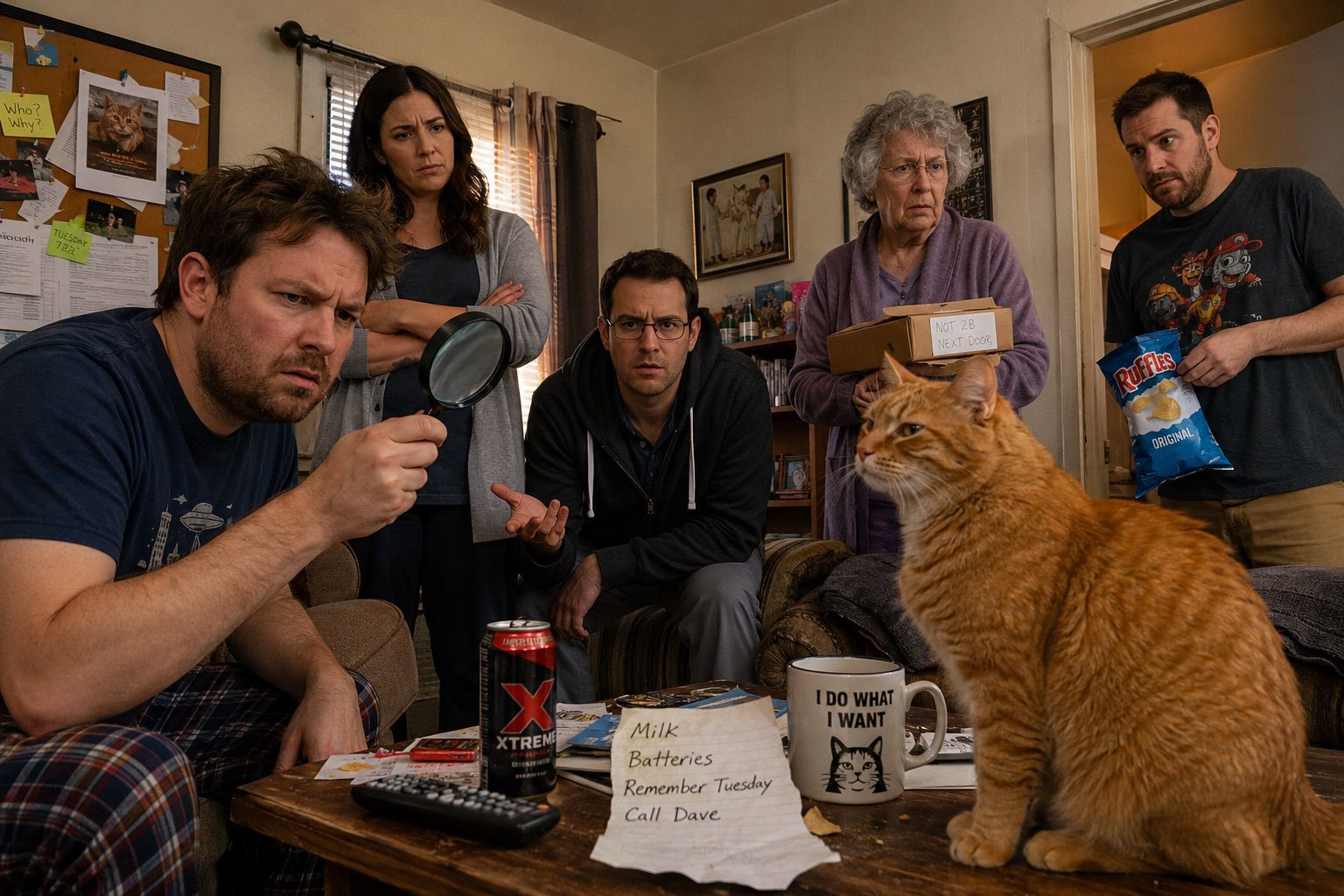
I was sitting on the couch staring at the coffee table when I noticed three things that absolutely should not have been there. The first was an empty energy drink can. The second was a crumpled piece of paper covered in frantic handwriting. The third was a single orange cat hair sitting directly in the middle of the table like it had been carefully placed there as evidence.

Now, under normal circumstances, none of those things would have been particularly alarming. People leave notes behind all the time. People drink energy drinks. Cats shed fur on every available surface in existence. Unfortunately, I live in an apartment building where normal explanations rarely survive more than five minutes of scrutiny. The longer I stared at the collection of objects on the table, the more convinced I became that they were connected somehow.

I picked up the note and squinted at it. The handwriting looked vaguely familiar. It might have belonged to John Mercer. It might have belonged to Karen. It might have belonged to someone attempting to write while escaping a moving vehicle. The words themselves were no help whatsoever. Milk. Batteries. Remember Tuesday. Call Dave. That was it. No context. No explanation. Just four disconnected instructions that somehow felt far more important than they had any right to be.

Naturally, I assumed it was evidence of a conspiracy.

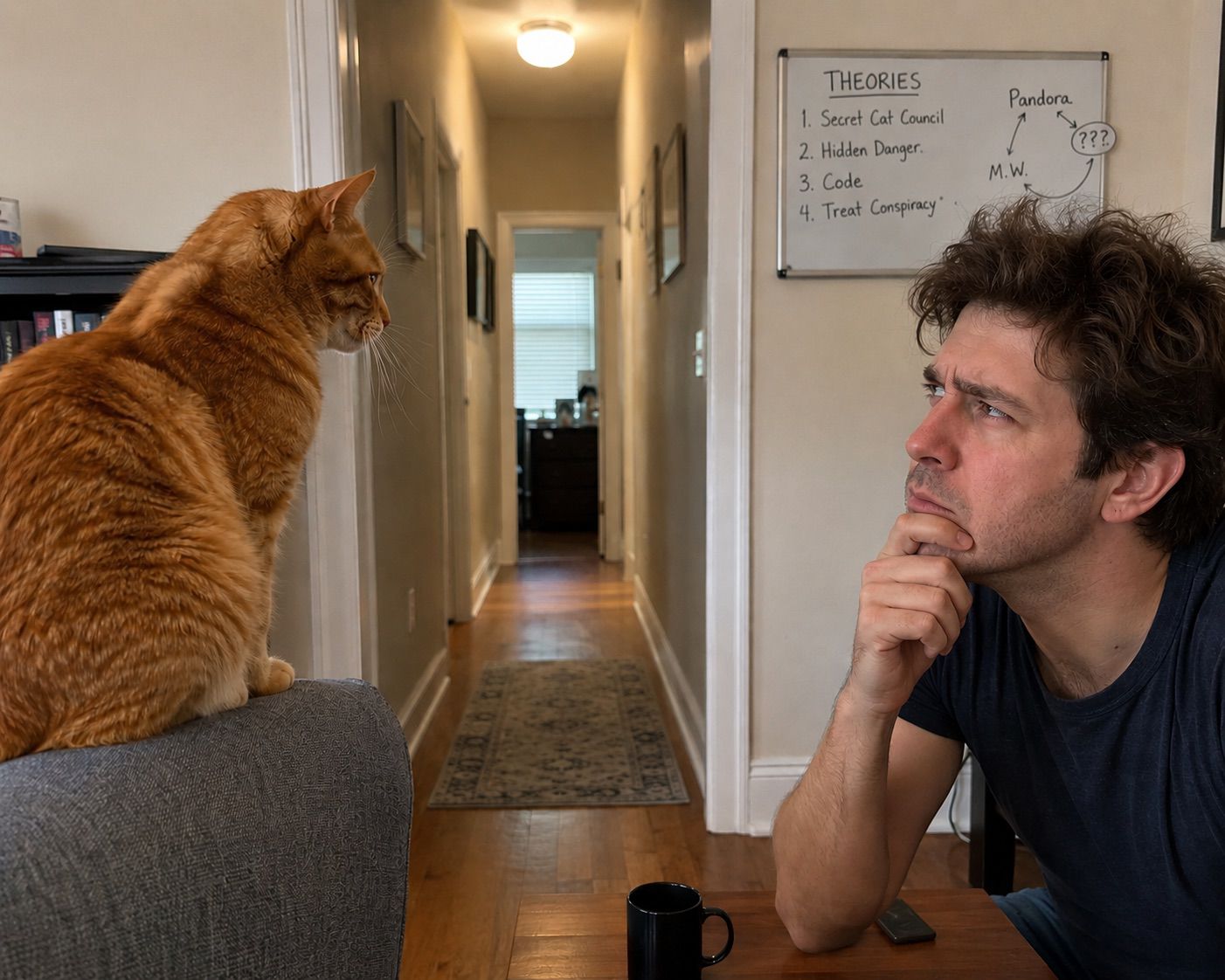
Mr Whiskers jumped onto the couch beside me and immediately began staring at the note. His eyes moved from the paper to me and then back again. I narrowed my eyes.

“You know something, don’t you?” I asked.

He blinked once.

That was all the confirmation I needed.

The energy drink can bothered me most. Nobody in the apartment drank that particular brand on a regular basis. I turned it over in my hands, examining it from every angle as though it might reveal hidden clues. The can was completely empty. Whoever had consumed it had drained every last drop before abandoning it on the table. That suggested urgency. Possibly panic. Maybe even a hurried escape.

I was developing a theory involving international espionage when there was a knock at the door.

Karen stepped inside carrying a grocery bag and immediately spotted me sitting on the couch with the note in one hand and the can in the other.

“What are you doing?” she asked.

“Investigating.”

She glanced at the table. “You’ve been staring at that paper for twenty minutes.”

“Twenty-two.”

“That’s not better.”

I pointed dramatically toward the evidence spread out before me. “Somebody was here.”

Karen looked around the apartment. “Yes. We live here.”

“No. Somebody else.”

She picked up the energy drink can and frowned. “Dave was over yesterday.”

I stared at her. “He was?”

“Yes.”

“Why?”

“You invited him.”

I thought about that for a moment. “That doesn’t sound like something I’d do.”

Karen sighed. “You needed help moving the bookshelf.”

“Oh.”

She handed me the can. “It’s his.”

My investigation suffered its first major setback.

Before I could salvage the situation, another knock sounded at the door. Karen opened it, revealing Mrs Jenkins standing in the hallway holding a package.

The moment I saw her, every piece of the puzzle suddenly clicked into place.

“Mrs Jenkins,” I said.

“Hello, Hal.”

“You were here.”

She blinked. “I am here now.”

“No. Earlier.”

“I was at the pharmacy.”

“Exactly.”

Mrs Jenkins looked at Karen. Karen immediately became fascinated by a bag of apples.

I held up the note. “Care to explain this?”

Mrs Jenkins adjusted her glasses and examined the paper. “That’s a grocery list.”

“A likely story.”

“It literally says milk.”

“Which could mean anything.”

“It means milk.”

“You’d say that.”

Mrs Jenkins stared at me for several seconds, clearly trying to determine whether I was joking. Unfortunately, I wasn’t entirely sure myself.

After delivering the package she eventually left, although not before giving me the same look people usually reserve for malfunctioning vending machines.

The apartment fell quiet again. I sat down and studied the remaining evidence. Something still wasn’t adding up. The note had been explained. The energy drink can had been explained. But nobody had offered a satisfactory explanation for the cat hair.

Mr Whiskers was now sitting on the windowsill cleaning himself with the calm confidence of someone who knew the authorities lacked enough evidence to secure a conviction.

I approached cautiously.

“Where were you yesterday afternoon?”

He licked his paw.

“A convenient lack of alibi.”

From the kitchen Karen groaned loudly. “Oh my God.”

“Notice how he refuses to answer.”

“He’s a cat.”

“Exactly.”

Mr Whiskers hopped off the windowsill and disappeared down the hallway. That was suspicious. Cats never leave a conversation unless they have something to hide.

A few minutes later there was another knock at the door. This time it was John Mercer.

The second he stepped inside and saw the note, the energy drink can, and my expression, he immediately frowned.

“No.”

“No what?”

“Whatever you’re thinking.”

“You don’t even know what I’m thinking.”

“I know exactly what you’re thinking.”

I handed him the note.

To my surprise, his face brightened. “Oh, good.”

“Good?”

“I’ve been looking for that.”

I froze.

“You wrote it?”

“Yes.”

The room became very quiet.

Karen closed her eyes.

I slowly sat back down. “So you’re admitting involvement.”

“It’s a grocery list.”

“Mrs Jenkins said the same thing.”

“Because it’s a grocery list.”

I pointed toward the hallway. “And the cat hair?”

John looked at me. Then at Karen. Then back at me.

“Hal.”

“Yes?”

“It’s from the cat.”

I glanced toward the hallway. Mr Whiskers had reappeared and was watching us from around the corner. Watching. Waiting. Calculating.

“I don’t know,” I said.

John rubbed his forehead. “What possible alternative explanation is there?”

I leaned forward. “What if Mr Whiskers planted the evidence?”

Neither Karen nor John said anything.

Their silence spoke volumes.

“I see.”

“No,” John replied. “You absolutely do not.”

As the afternoon wore on, everything finally began falling into place. The energy drink can belonged to Dave because Dave had unknowingly been brought into the operation. The grocery list had been written by John Mercer because he was serving as the group’s communications officer. Mrs Jenkins had conveniently appeared at the exact moment the investigation reached a critical stage. And Mr Whiskers had been monitoring the entire situation from the beginning.

The pieces fit together perfectly.

Almost too perfectly.

Eventually John went home, Karen returned to unpacking groceries, and the apartment settled back into its usual routine. I remained on the couch while Mr Whiskers jumped into the chair across from me. For several long moments we simply stared at each other in silence.

Then he yawned.

A tiny folded piece of paper slipped out from underneath him and landed on the cushion.

I moved faster than I thought humanly possible.

Snatching the paper, I unfolded it and found three words written inside.

Remember Tuesday.

My eyes widened.

Mr Whiskers immediately grabbed the note, launched himself out of the chair, and sprinted down the hallway like a fugitive fleeing the scene of a crime.

I chased him through the apartment, around the corner, and nearly into the laundry basket. Unfortunately, by the time I caught up with him, the note had vanished.

Nobody believes me.

Not Karen. Not John Mercer. Not even Dave.

But I know what I saw.

And if Tuesday turns out to be important, everyone is going to owe me a very serious apology.

Especially the cat.

Related Posts

Ludwig Wittgenstein: Where the Thread Keeps Unraveling

Penelope

Ludwig Wittgenstein’s name has been etched on my bookshelves for years, a constant presence that I’ve grown accustomed to. His Tractatus Logico-Philosophicus collected dust alongside other philosophical texts, its yellowed pages whispering secrets to me as I flipped through them during late-night study sessions. But it wasn’t until I stumbled upon his Philosophical Investigations that Wittgenstein truly began to haunt me.

I was in my senior year of college when I first cracked open the Investigations, and what struck me initially was how disjointed it felt compared to the neat, systematic approach of the Tractatus. The latter had been a carefully constructed fortress of logic, its arguments building upon one another with precision and elegance. But Wittgenstein’s later work seemed to deliberately subvert this expectation, instead presenting itself as a messy tapestry of thoughts, doubts, and reflections.

At first, I found it frustrating – as if I was being asked to follow a thread that kept unraveling in my hands. Wittgenstein seemed to delight in questioning his own premises, in pointing out the inadequacies of language and the provisional nature of truth. It was like watching a master builder tear down their own creation, brick by brick, just to reveal the foundations beneath.

I couldn’t shake the feeling that I was missing something fundamental – that there must be some hidden key or underlying principle that would unlock the secrets of his philosophy once and for all. But the more I read, the more I began to realize that Wittgenstein’s aim wasn’t to provide answers but to illuminate the very process of inquiry itself.

This was both liberating and terrifying. If language couldn’t be relied upon to convey meaning with absolute precision, then what did it mean to communicate at all? Wasn’t philosophy supposed to be about seeking truth, not poking holes in our understanding of it? I found myself oscillating between two poles: the desire for clarity and the acceptance of ambiguity.

As I delved deeper into Wittgenstein’s work, I began to see my own writing habits reflected back at me. Like him, I often find myself mired in the process of articulating my thoughts, questioning the very words I use to express them. This self-doubt has become a familiar companion, one that I’ve grown accustomed to but still grapple with.

Perhaps it’s this shared struggle that draws me to Wittgenstein’s philosophy – the recognition that true insight often lies in embracing the uncertainty and provisional nature of our understanding. But even as I acknowledge this, I’m left wondering: does this mean we’re forever trapped in a cycle of self-doubt and revision, unable to truly grasp the truth?

Wittgenstein’s Investigations has become a kind of shadow companion, one that haunts me with its questions rather than offering easy answers. And yet, it’s precisely this discomfort – this sense of unease and uncertainty – that keeps me coming back to his work.

As I continue to grapple with Wittgenstein’s philosophy, I find myself drawn to the idea that language is not a transparent vessel for conveying truth, but rather a complex web of cultural, historical, and personal influences that shape our understanding of the world. This notion both fascinates and unsettles me, as it challenges my own attempts to express myself through writing.

I think back to the many hours I spent crafting essays and papers in college, carefully selecting words and phrases to convey my ideas with precision and clarity. But Wittgenstein’s work suggests that this process is not as straightforward as I had imagined. The meaning of language is always already context-dependent, influenced by the social, cultural, and historical milieus in which it emerges.

This realization has made me more aware of the performative nature of writing – how my words can never be entirely free from the burdens of their own situatedness. It’s a humbling thought, one that makes me question the authority of my own voice. Am I simply reflecting the cultural and historical context in which I was raised, or do I have the capacity to transcend these limitations?

Wittgenstein’s emphasis on the importance of everyday language and experience has also led me to reevaluate my own relationship with writing. Rather than striving for grand theoretical frameworks or elegant philosophical systems, he encourages us to attend to the ordinary, the mundane, and the familiar. This approach speaks to me on a deep level, as I often find myself drawn to the quiet, unassuming moments in life – a conversation with a friend, a walk through nature, a simple gesture of kindness.

In Wittgenstein’s philosophy, these everyday experiences become the very foundation of philosophical inquiry. They are the raw material from which we build our understanding of the world, rather than simply being the reflections or interpretations of some deeper reality. This approach is both grounding and unsettling, as it forces me to confront my own assumptions about the nature of truth and meaning.

As I continue to explore Wittgenstein’s work, I find myself oscillating between two poles: the desire for clarity and the acceptance of ambiguity. It’s a tension that I suspect will remain with me for a long time, one that reflects the very heart of his philosophy. But perhaps this is precisely what makes his work so compelling – its willingness to inhabit the spaces of uncertainty and doubt, rather than trying to eradicate them through grand theoretical systems or easy answers.

I’ve been thinking about Wittgenstein’s concept of “family resemblance” a lot lately. It’s an idea he explores in the Investigations, where he argues that certain concepts don’t have a single, defining characteristic, but rather a network of overlapping similarities and associations. He uses the example of “game” to illustrate this point – what do we mean by “a game”? Is it something you can define precisely, or is it more like a family resemblance, with different games sharing certain features, but not necessarily all of them?

I find myself thinking about this in relation to my own writing. As someone who’s always been drawn to the idea of clarity and precision, I’ve often found myself trying to pin down exactly what I mean by certain terms or concepts. But Wittgenstein’s notion of family resemblance suggests that maybe that’s not possible – or at least, it’s not as straightforward as I thought.

Take, for example, my own writing style. Is it more like a specific genre, like creative nonfiction, or is it something else entirely? I’ve always tried to define myself within certain parameters, but Wittgenstein’s idea makes me wonder if those boundaries are even meaningful. Am I just drawing on a network of similarities and associations that don’t necessarily add up to a coherent whole?

This realization has made me more tentative in my writing, more willing to leave some things unsaid or unclear. It’s a strange feeling, like I’m stepping into the unknown with each new sentence. But it’s also kind of liberating – who needs to define everything precisely when you can just let language unfold as it will?

I think back to the many times I’ve gotten caught up in trying to define my own identity as a writer. Is it “literary fiction” or “creative nonfiction”? Do I identify with a particular school of thought, like postmodernism or existentialism? But Wittgenstein’s philosophy suggests that these labels are just another form of family resemblance – we’re drawing on a network of similarities and associations to define ourselves, rather than any one clear characteristic.

It’s humbling, in a way. I feel like I’m constantly slipping through the cracks between different categories and definitions. But maybe that’s what makes writing so exciting – the constant flux, the uncertainty of it all.

As I continue to grapple with Wittgenstein’s ideas, I find myself wondering: is language itself just another form of family resemblance? Are words and concepts just a series of overlapping similarities and associations, rather than any one clear definition? And if that’s the case, what does it mean to write at all?

I’m not sure I have an answer to these questions – or maybe I do, but it’s still taking shape. All I know is that Wittgenstein’s philosophy has made me more aware of the provisional nature of language and meaning. It’s a strange kind of freedom, one that lets me explore the ambiguities and uncertainties of writing without feeling like I’m constantly striving for some clear definition or outcome.

I think this is what draws me to his work – the sense that he’s not trying to pin down any one truth, but rather illuminate the very process of inquiry itself. It’s a subtle yet profound difference, one that speaks to something deep within me. As I continue to explore Wittgenstein’s ideas, I’m left with more questions than answers – and that’s exactly where I want to be.

As I ponder the idea of language as family resemblance, I start to think about my own experiences as a writer. I’ve always been drawn to writing as a way to make sense of the world around me, but Wittgenstein’s philosophy makes me wonder if that’s even possible. Can we ever truly capture the essence of reality through words, or are we just piecing together fragments and associations that may or may not be accurate?

I think about my own writing process, which often involves trying to find the right words to describe a particular experience or emotion. But Wittgenstein’s notion of family resemblance suggests that even those words are provisional, subject to change and reinterpretation over time. It’s a humbling thought, one that makes me question the authority of my own voice.

At times, I feel like I’m just throwing darts at a board, trying to hit a target that’s constantly shifting its shape and size. But maybe that’s what writing is all about – navigating the uncertainty and ambiguity of language, rather than trying to pin down some definitive truth.

Wittgenstein’s emphasis on everyday language and experience has also led me to reevaluate my own approach to writing. I’ve always tried to craft elegant sentences and paragraphs, but his philosophy suggests that maybe those are just obstacles to understanding. What if, instead of striving for clarity and precision, I focused on capturing the messy, fragmented nature of human experience?

It’s a tantalizing prospect, one that both excites and terrifies me. Can I really write in a way that acknowledges the provisionality of language and meaning? Or will I just end up muddling through, unsure of what I’m even trying to say?

As I continue to grapple with these questions, I find myself drawn back to Wittgenstein’s own writing style. His Philosophical Investigations is a sprawling, fragmented work that defies easy summary or interpretation. But it’s precisely this messiness, this willingness to inhabit the spaces of uncertainty and doubt, that makes his philosophy so compelling.

I think about my own writing habits, which often involve trying to impose some kind of order on the chaos of human experience. But Wittgenstein’s work suggests that maybe that’s just a form of self-deception – that we’re constantly projecting our own meanings onto the world around us, rather than truly understanding it in all its complexity.

It’s a disorienting thought, one that makes me question my entire approach to writing. Can I really capture the essence of reality through words, or are we just dealing with echoes and approximations? And if that’s the case, what does it mean to write at all?

I’m not sure I have an answer to these questions – or maybe I do, but it’s still taking shape. All I know is that Wittgenstein’s philosophy has made me more aware of the provisional nature of language and meaning, and that’s a strange kind of freedom. It lets me explore the ambiguities and uncertainties of writing without feeling like I’m constantly striving for some clear definition or outcome.

As I continue to grapple with these ideas, I find myself wondering: what if writing is not about capturing truth at all, but rather about navigating the spaces between truth and meaning? What if it’s a process of approximation, rather than precise representation?

I think this is where Wittgenstein’s philosophy gets really interesting – in its willingness to inhabit the spaces of uncertainty and doubt. It’s a subtle yet profound difference, one that speaks to something deep within me.

As I continue to explore these ideas, I’m left with more questions than answers – and that’s exactly where I want to be.

Related Posts

I Think the Cat is Trying to Warn Me

Hal

I first noticed something was wrong with Mr. Whiskers on a Saturday morning while I was drinking coffee in the living room. The apartment was quiet except for the occasional hum of the refrigerator and the distant sound of traffic outside. John Mercer was still asleep, which wasn’t unusual on a weekend, and I had been enjoying several uninterrupted minutes of peace when I realized the orange tabby hadn’t moved since I’d sat down. He was perched on the back of the couch, staring toward the hallway that led to John’s room with an intensity that seemed completely out of proportion to anything that could reasonably be happening there.

Normally I wouldn’t have paid much attention to it. Cats stare at things all the time. They stare at walls, dust particles, electrical outlets, and occasionally empty corners that make you question whether you’ve accidentally become the supporting character in a horror movie. Mr. Whiskers, however, wasn’t displaying his usual random cat behavior. He looked focused. Deliberate. Every few minutes I glanced away and then looked back, expecting him to have moved on to a new obsession, but he remained locked onto the hallway like a security guard monitoring a suspicious individual.

After nearly twenty minutes I finally gave in and investigated. I walked down the hallway, checked the bathroom, peeked into John’s room, and even looked inside the hall closet. There was nothing there. No intruders. No mice. No hidden treasure. Certainly nothing worthy of the attention Mr. Whiskers was giving it. When I returned to the living room, he briefly looked at me before returning his attention to the hallway. It wasn’t an ordinary look, either. It was the sort of look that seemed to communicate disappointment. The cat appeared genuinely frustrated that I hadn’t figured something out.

The problem with situations like this is that once an idea gets into my head, it tends to spread. At first I wondered whether Mr. Whiskers had heard something. Then I wondered whether he’d seen something. Within another ten minutes I found myself considering the possibility that he knew something. That was admittedly less likely, but it explained his behavior far better than any of the alternatives I had come up with.

About an hour later there was a knock at the door. Mr. Whiskers reacted immediately. His ears perked up, his posture changed, and for the first time all morning he abandoned his watch over the hallway. That alone would have been enough to catch my attention, but what happened next was what truly set my mind racing. When I opened the door, Pandora was standing there carrying a canvas tote bag and smiling as though she’d arrived in the middle of a perfectly normal day. The instant she stepped inside, Mr. Whiskers sat upright and fixed his gaze directly on her.

Now, I should explain that Pandora visits fairly often. She has her own apartment, her own life, and her own cat, Lady Beatrice Wellington III, but she stops by enough that Mr. Whiskers is accustomed to seeing her. Under normal circumstances he’d greet her, demand attention, and then lose interest within thirty seconds. Instead, he watched her carefully as she walked into the living room and sat down.

“Why is he looking at me like that?” Pandora asked.

“That’s exactly what I’m trying to figure out.”

“Maybe he wants treats.”

“Or maybe he’s trying to warn me.”

Pandora stared at me for several seconds.

“Warn you about what?”

“I don’t know yet.”

The look she gave me suggested she was already regretting her decision to visit.

While Pandora and I talked, Mr. Whiskers continued behaving strangely. Several times he walked down the hallway toward John’s room, stopped, looked back toward us, and then continued on his way. The first time I ignored it. The second time I paid attention. By the fourth time I was convinced he was attempting to lead me somewhere.

Pandora disagreed.

“He’s a cat, Hal.”

“Exactly.”

“I don’t think that supports your theory.”

“It supports all of my theories.”

Eventually curiosity overcame common sense. I followed Mr. Whiskers into John’s room and discovered him sitting beside a bookshelf. He wasn’t looking at me. He wasn’t looking at the doorway. He was staring upward at something on one of the shelves. I followed his gaze and immediately froze.

A framed photograph sat near the edge of the shelf.

The photograph contained Lady Beatrice Wellington III.

Slowly, I turned toward Pandora.

Slowly, Pandora folded her arms.

Slowly, Mr. Whiskers blinked.

For several moments nobody said anything.

Then I pointed at the photograph.

“Interesting.”

“It’s a picture of my cat.”

“I know.”

“What’s interesting about it?”

I looked at Mr. Whiskers.

Then I looked at the photograph again.

“I’m still working on that part.”

The more I thought about it, the more suspicious the situation became. Mr. Whiskers had spent the entire morning trying to get my attention. Pandora had arrived unexpectedly. The cat had then led me directly to a photograph of Lady Beatrice Wellington III. Individually, none of those facts meant very much. Together, however, they felt connected. I couldn’t explain how they were connected, but that had never stopped me before.

Over the next hour I developed several possible theories. One involved a disagreement between the two cats. Another involved some sort of long-distance feline communication network. A third suggested that Mr. Whiskers had discovered information he considered important and was attempting to pass it along using the only tools available to him. Admittedly, the details were still a little fuzzy, but every major breakthrough starts somewhere.

My investigation was interrupted by the arrival of John Mercer, who wandered into the room carrying an empty plastic bag and looking mildly confused.

“Why are you all standing around my bookshelf?”

“Mr. Whiskers brought us here.”

John looked at the cat.

Then at the photograph.

Then at the empty bag in his hand.

A smile slowly appeared on his face.

“Oh. That’s what he’s doing.”

“What?”

John held up the bag.

“I moved his treats yesterday.”

I stared at him.

“The treats?”

“Yeah. They used to sit right next to that photograph.”

The room became very quiet.

Pandora looked at me.

John looked at me.

Even Mr. Whiskers seemed to look at me.

The explanation was annoyingly reasonable. Every strange thing the cat had done suddenly made perfect sense. He wasn’t issuing warnings. He wasn’t uncovering secrets. He wasn’t attempting to expose an underground network of feline intrigue. He simply remembered where the treats used to be and kept checking to see if they had returned.

I considered the evidence carefully.

Then I considered Mr. Whiskers.

Then I considered the possibility that a highly intelligent cat would create exactly this sort of believable cover story if he wanted to conceal the truth.

John fed him lunch a few minutes later, and Mr. Whiskers immediately abandoned the entire affair in favor of food. Pandora declared the mystery solved. John agreed. Both of them seemed satisfied that the case had been closed.

Personally, I remain unconvinced.

You don’t stare at a hallway for three hours because you’re thinking about treats.

At least, that’s what Mr. Whiskers wants us to believe.

Related Posts

Barbara Pym: How to Write About People You’ll Never Quite Get

Penelope

I’ll be honest, I only stumbled upon Barbara Pym’s work a year ago, browsing through my college library’s fiction section. Her name stood out to me because it seemed… old-fashioned? Not in a bad way, but like she was from another era altogether. I’d never heard of her before, and the title “Excellent Women” caught my eye – something about its simplicity and straightforwardness appealed to me.

I devoured that book in one sitting, completely entranced by Pym’s quiet, observational style. She wrote about ordinary people living ordinary lives, but with such nuance and depth it was like I’d stumbled upon a secret world. The way she described the inner lives of her characters – their desires, fears, and disappointments – resonated deeply with me.

What struck me most was how Pym’s work seemed to capture the essence of women’s lives in mid-20th century England, yet it felt eerily relevant today. I mean, don’t we all know women like Mildred Lathbury, struggling to find their place within societal expectations? Or Celia Mainwaring, torn between convention and her own desires?

I started reading more of Pym’s work, and the more I read, the more I felt drawn into her world. Her characters’ quiet desperation, their polite facades hiding secrets and doubts… it all seemed so familiar. Perhaps that’s why I find myself coming back to Pym again and again – because she writes about the parts of ourselves we often keep hidden, even from others.

But what also keeps me thinking is how Pym navigated her own life as a writer. She was married to a man who didn’t support her writing, and it’s said that he actively discouraged her from pursuing it. Can you imagine? The thought makes my skin crawl. And yet, she persisted – in fact, many of her books were rejected by publishers during her lifetime.

I find myself wondering what would have happened if Pym had been more prominent during her time. Would she have been celebrated as a major literary figure? Or would her work have still remained largely under the radar? The thought makes me feel… uncomfortable, I suppose – like there’s something unresolved within me about the value we place on women’s creative contributions.

Lately, I’ve been thinking about Pym’s relationships with other writers and artists. She was friends with Elizabeth Taylor (the novelist, not the actress), among others, and their correspondence reveals a deep affection and intellectual curiosity for one another. I envy that – the idea of having true friends who understand you on a profound level.

What draws me to Pym is her unwavering commitment to telling stories about everyday people. She refused to pander or sensationalize; instead, she opted for subtlety and depth. It’s a quality I admire in writing, but also find challenging – because it requires patience, empathy, and a willingness to look beyond the surface.

As I continue reading Pym’s work, I feel like I’m discovering new aspects of myself. Her writing makes me think about my own relationships with others, about the secrets I keep hidden even from those closest to me. It’s as if Pym has given me permission to explore these complexities – to see that, in many ways, we’re all just trying to navigate our own “excellent” lives.

But what happens when you write about people who are, ultimately, quite ordinary? Is it still writing worth doing? I’m not sure I have an answer yet.

As I ponder the value of Pym’s work, I find myself thinking about my own experiences as a writer. Like her, I’ve faced skepticism and uncertainty about my craft. There are times when I feel like my writing is insignificant, that it won’t make a difference in anyone’s life. But every time I doubt myself, I turn back to Pym’s stories, and I’m reminded of the quiet power of ordinary lives.

I think about my own relationships with others, how they’ve influenced my writing and vice versa. My closest friends are all writers or artists in some way, and we feed off each other’s energy and curiosity. We’re not just friends; we’re a support system, a tribe that understands the struggles and triumphs of creative work.

But what about when I’m alone? When I’m not surrounded by people who get me? That’s where Pym’s writing feels like a lifeline to me. Her characters may be ordinary, but they’re also incredibly relatable – they face the same doubts, fears, and desires that I do. And in their stories, I find a sense of solidarity, a reminder that I’m not alone in this journey.

I’ve been thinking about how Pym’s writing has helped me see my own life as a narrative, rather than just a series of mundane events. She shows me that even the most ordinary experiences can be infused with meaning and significance. It’s a perspective-shifting realization, one that I’m still grappling with today.

As I look back on our library encounters, I realize that Pym’s work has become a kind of mirror for me – reflecting my own hopes, fears, and aspirations as a writer and a person. She doesn’t offer easy answers or solutions; instead, she invites me to explore the complexities of human experience alongside her.

In many ways, Pym’s writing is an exercise in empathy – not just with her characters, but with myself. It encourages me to look beyond the surface level, to dig deeper and discover new facets of my own life. And that’s a gift I’ll continue to cherish long after I finish reading her books.

One aspect of Pym’s writing that I find particularly intriguing is her approach to class and social status. As an observer of the British middle class in the mid-20th century, she offers a nuanced portrayal of the tensions between tradition and modernity, conformity and individuality. Her characters often navigate these complexities with a mix of humor, irony, and resignation.

I’ve been struck by how Pym’s depiction of women from different socio-economic backgrounds feels both specific to her time period and remarkably universal. The subtle hierarchies within social groups, the unspoken expectations placed upon individuals based on their status – it all seems to ring true today. As someone who has always been acutely aware of class differences, I appreciate how Pym’s writing acknowledges these distinctions without perpetuating stereotypes or reinforcing social norms.

What resonates with me most about Pym’s approach is her refusal to romanticize or vilify the people she writes about. Instead, she presents them as multidimensional beings, full of contradictions and flaws. This is particularly evident in her portrayal of women who are often relegated to the margins of society – those seen as “excellent” but unremarkable, like Mildred Lathbury.

I think this aspect of Pym’s writing speaks to a fundamental question I’ve been grappling with as a writer: how do we balance our desire for authenticity and nuance with the need to create compelling narratives? Can we, or should we, strive to write about people who are “ordinary” without resorting to stereotypes or sentimentalism?

As I ponder these questions, I’m drawn back to my own experiences writing about family members, friends, and even myself. The struggle to capture their complexities without reducing them to simplistic archetypes is a constant challenge. Pym’s work reminds me that this is an ongoing process – one that requires patience, empathy, and a willingness to revise and refine our understanding of the people we write about.

In many ways, Pym’s writing has become a model for how I approach my own creative work. Her commitment to observing and recording the lives of everyday people has taught me the value of attention to detail, the importance of subtlety over sensationalism, and the need to trust in the power of quiet, understated storytelling.

As I continue to explore Pym’s work, I’m struck by how her writing has influenced not just my approach to creative nonfiction but also my perspective on relationships, identity, and community. Her characters’ struggles to find their place within societal expectations resonate deeply with me – perhaps because they echo the questions I’ve been asking myself as a young adult: Who am I? Where do I fit in? What does it mean to be an “excellent” person?

The more I read Pym’s work, the more I realize that these questions are not just about her characters or even me; they’re about all of us. Her writing offers a profound reminder that we’re all searching for connection, meaning, and purpose in our lives – and that it’s often in the quiet, ordinary moments that we find the most significance.

As I delve deeper into Pym’s work, I’m struck by the way she explores the complexities of relationships between women. Her novels are full of friendships, rivalries, and romantic entanglements, all of which are characterized by a deep sense of nuance and subtlety. She doesn’t shy away from depicting the messiness and imperfection of human connections, but instead seems to revel in them.

One aspect of Pym’s portrayal of women’s relationships that resonates with me is her emphasis on the ways in which they can be both supportive and suffocating at the same time. Her characters often find themselves caught between a desire for independence and a need for connection, and this tension is beautifully captured in her writing.

I think about my own friendships and relationships, and how often I’ve felt torn between wanting to be close to someone and needing space to breathe. Pym’s writing helps me see that these feelings are not unique to me, but rather a common thread running through the lives of many women. It’s a relief to know that I’m not alone in my struggles, and that there are others out there who understand the complexities of human connection.

At the same time, I’m struck by Pym’s willingness to explore the darker aspects of relationships between women. Her characters often engage in subtle (and sometimes not-so-subtle) competitions with one another, and these rivalries can be both hilarious and heartbreaking to read about. It’s a reminder that even in our most intimate connections, there is always an undercurrent of competition and one-upmanship.

As I think about Pym’s exploration of women’s relationships, I’m drawn back to my own experiences as a writer. I’ve always struggled with the idea of writing about people who are close to me – friends, family members, even myself. There’s a fear that I’ll reveal too much, or say something that will hurt someone I care about.

Pym’s work helps me see that this fear is not unique to me, but rather a common concern for many writers. She shows me that it’s possible to write about the people closest to us with honesty and vulnerability, without sacrificing their dignity or our own relationships.

One thing that Pym’s writing has taught me is the importance of observing human behavior without judgment. Her characters are always multifaceted and complex, full of contradictions and flaws – and yet she presents them in a way that feels both loving and detached at the same time. It’s as if she’s saying, “I see you, I understand you, but I’m not going to fix you or make excuses for you.”

This approach to writing has been a revelation for me, particularly when it comes to my own relationships with others. Rather than trying to control or manipulate the people in my life, I’ve learned to observe them more closely – to see their flaws and imperfections as an essential part of who they are.

In many ways, Pym’s writing has become a kind of mirror for me, reflecting back all sorts of thoughts and feelings that I’d never articulated before. It’s a reminder that the most significant moments in our lives often lie just beneath the surface – in the quiet observations, the subtle nuances, and the everyday struggles that we face as human beings.

As I continue to explore Pym’s work, I’m struck by the way she challenges me to see myself and my own relationships in a new light. Her writing is not just about her characters or even her time period; it’s about us – our hopes, fears, desires, and doubts. It’s a reminder that we’re all searching for connection, meaning, and purpose in our lives – and that it’s often in the quiet, ordinary moments that we find the most significance.

Related Posts