Latest Articles

I’m Starting to Think Mr Whiskers Is Involved Somehow

Hal

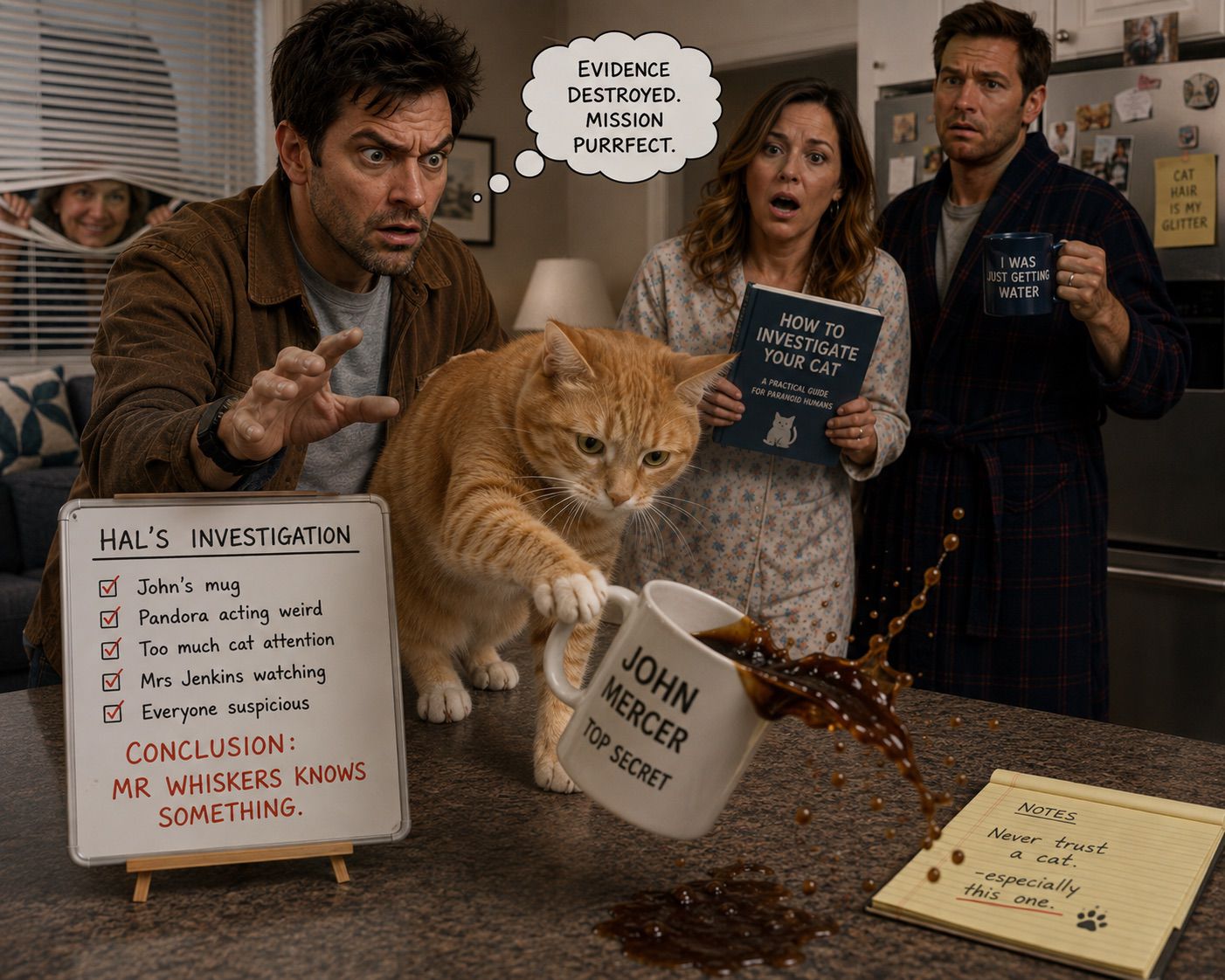
I’m staring at the kitchen counter, trying to focus on the fact that John Mercer left his mug there again. This should not be important. People leave mugs on counters every day without triggering investigations. I understand that intellectually. Still, something about the mug bothers me, and it isn’t merely that John apparently believes dirty dishes eventually migrate to the sink on their own. It’s the whole kitchen. Pandora is standing near the refrigerator, quietly looking through something on her phone, and she has barely said anything for the last several minutes. We talked about dinner earlier and she seemed perfectly normal then, but now she’s giving me the distinct impression that she’s avoiding me. Or giving me space. Or waiting for me to leave. Those are three very different possibilities, which is exactly the problem.

Mr Whiskers is sitting several feet away, watching both of us. That doesn’t help. There is something uniquely unsettling about being silently observed by an orange cat when you’re already suspicious of everyone else in the room. He isn’t grooming himself. He isn’t sleeping. He isn’t asking for food. He’s just sitting there with his paws together, staring at Pandora, then at me, then back at Pandora. I know cats do this. I also know Mr Whiskers, and there’s a difference between his normal staring and whatever this is. His normal stare says, I would like some of what you’re eating. This stare says, I have information.

My mind drifts back to something that happened at work. Karen called me over to her desk earlier and asked whether everything was okay at home. It was probably an innocent question. In fact, I’m almost certain it was an innocent question. She’s my coworker, we talk, and apparently I’ve been distracted enough lately for other people to notice. I told Pandora about it when I got home, and she laughed before asking what I’d told Karen. At the time, I thought nothing of it. Now, standing in the kitchen with John’s abandoned mug and Mr Whiskers conducting surveillance from the floor, I’m reconsidering the entire exchange.

Why did Pandora want to know what I told Karen?

I look at Mr Whiskers.

He looks at Pandora.

Pandora looks into the refrigerator.

Interesting.

Maybe John’s mug isn’t evidence of anything. Maybe Pandora isn’t acting strangely. Maybe Karen was simply making conversation. Any reasonable person could look at these facts and conclude that absolutely nothing unusual is happening. Unfortunately, I am currently the only person here willing to investigate the alternative.

Pandora finally closes the refrigerator and asks whether I want chicken or pasta for dinner. I tell her either is fine, because I don’t want her to know that I’m observing her. She says, “Okay,” and goes back to her phone. Mr Whiskers immediately gets up and follows her into the living room.

There it is.

I knew it.

I follow them, although I make a point of doing it casually. This turns out to be surprisingly difficult because there is no natural way to casually follow your girlfriend and your cat while pretending you aren’t following either of them. Pandora sits on the couch. Mr Whiskers jumps up beside her. She scratches him behind the ears. He begins purring.

That should settle the matter. Cat likes woman. Woman pets cat. Case closed.

Except Pandora has been paying considerably more attention to Mr Whiskers lately. I’ve noticed it before but never connected it to anything. She gives him treats when she thinks I’m not looking. She lets him sit beside her while she works. Yesterday I saw her carrying him toward the bedroom while whispering something to him.

At least, I think she was whispering. She might have been saying, “Who’s a handsome boy?”

But that’s exactly what you’d say if you didn’t want anyone to know you were discussing something important.

I sit in the chair across from them and pretend to check my phone. Mr Whiskers looks at me.

Then he looks at Pandora.

Then he slowly closes his eyes.

I nearly drop the phone.

Was that a signal?

No. Obviously not. Cats blink. There are scientific explanations for this. I’m pretty sure slow blinking is supposed to mean affection or trust. But trust between whom? Me and Mr Whiskers? Pandora and Mr Whiskers? Mr Whiskers and whatever organization he now represents?

Pandora catches me staring at him. “What?”

“Nothing.”

“You’re staring at the cat.”

“I’m looking in his general direction.”

“You’ve been looking in his general direction for five minutes.”

That’s the sort of highly specific observation someone makes when they’re keeping track of your behavior.

I decide not to mention that.

Instead, I start thinking about John. He has been behaving normally, which suddenly seems suspicious in itself. John has a remarkable ability to appear precisely when I’m in the middle of figuring something out, say something completely ordinary, and derail my entire train of thought. Yesterday I was trying to remember whether Pandora had gone somewhere after work when John walked into the room and asked if anybody wanted pizza. Five minutes later, I was comparing toppings instead of reconstructing Pandora’s movements.

Coincidence?

Probably.

Effective?

Absolutely.

And now there’s the mug.

I glance toward the kitchen.

Still there.

It suddenly occurs to me that perhaps I’ve been looking at this backward. Maybe John isn’t coordinating anything. Maybe Pandora isn’t hiding anything. Maybe Mr Whiskers is the common denominator.

The idea sounds ridiculous for approximately three seconds.

Then it begins making an alarming amount of sense.

Mr Whiskers is present for nearly everything. When Pandora is on her phone, he’s nearby. When John comes into the room, Mr Whiskers watches him. When I’m trying to have a serious conversation, Mr Whiskers inevitably jumps onto something, knocks something over, demands food, or inserts himself directly into the situation. He has unrestricted access to the apartment. Nobody questions where he goes. Nobody asks what he’s doing. He can sit underneath a table during an entire conversation and everyone considers that normal.

It is, frankly, the perfect arrangement.

I look at him again.

He’s asleep.

Convenient.

Pandora notices me staring. “Hal.”

“What?”

“Leave the cat alone.”

“I’m not doing anything.”

“You’re squinting at him.”

“I’m thinking.”

“That’s what worries me.”

She goes back to her phone, and I lean deeper into the chair. That comment was probably a joke. Pandora makes jokes. We joke with each other all the time. There is absolutely no reason to interpret it as evidence that she knows I’m getting close to something.

Mr Whiskers opens one eye.

I freeze.

He closes it again.

Okay.

Now I’m convinced.

The next morning at work, Karen asks whether I ever figured out why I’d been so distracted the day before. I consider telling her about Mr Whiskers but decide against it. If Karen is innocent, she’ll think I’ve lost my mind. If Karen is involved, telling her would compromise the investigation. Either way, silence seems strategically sound.

“You okay?” she asks.

“Perfectly.”

Karen stares at me for a moment. “You have that look again.”

“What look?”

“The one where you think you’ve figured something out.”

That stops me.

“How do you know that look?”

She laughs and walks away.

I remain at my desk.

Well.

That’s interesting.

By the time I get home, I’ve constructed a working theory. I’m not saying Mr Whiskers is deliberately involved in anything. That would be absurd. He’s a cat. He lacks the organizational skills necessary for a conspiracy. He once got trapped behind the shower curtain for twenty minutes.

But I’m no longer convinced he’s irrelevant.

I open the apartment door and find Pandora on the couch reading. John is in the kitchen. Everything looks completely ordinary.

Then I notice Mr Whiskers.

He’s sitting beside John’s mug.

The same mug.

John apparently still hasn’t washed it.

Mr Whiskers places one paw against the handle and looks directly at me.

I stop in the doorway.

Pandora glances up from her book. “What now?”

I point at the counter.

She looks at Mr Whiskers, then at the mug, then back at me.

“Hal, he’s a cat.”

“That’s exactly what everyone keeps assuming.”

Pandora stares at me for several seconds before lowering her book and laughing.

Mr Whiskers knocks the mug onto the floor.

John shouts from the kitchen.

Pandora laughs harder.

I say nothing.

Because everybody else sees a cat knocking over a mug.

I see destruction of evidence.

Related Posts

Edward Said: The Restless Philosopher Who Made Me Feel Less Alone in My Confusion

Penelope

Edward Said. I’ve been reading his work for years, but it wasn’t until I stumbled upon a collection of his essays that I felt like I was finally grasping what drew me to him. It’s not just the way he writes about politics and culture – it’s the sense of restlessness that permeates everything he says.

As someone who’s struggled with feeling stuck in my own life, I find myself drawn to Said’s frustration with being caught between different worlds. He was a Palestinian living in America, a Christian raised by Muslim parents, a critic of imperialism who also benefited from its privileges. It’s a sense of dislocation that feels deeply familiar.

I remember reading his essay “Travelling Theory” and feeling like he was speaking directly to me about the ways in which ideas get lost or distorted as they move through different cultures and contexts. I’ve had similar experiences trying to navigate the gaps between my own cultural heritage and the dominant culture around me – the sense of being caught in a perpetual state of translation.

What’s interesting to me is that Said’s writing doesn’t offer any easy answers or solutions. He’s not a tidy thinker, and his work is often marked by contradictions and paradoxes. I think that’s part of what draws me to him – he’s willing to confront the messiness of human experience in all its complexity.

Take, for example, his book “Orientalism”. On one level, it’s a scathing critique of Western imperialism and its racist stereotypes about the Middle East. But on another level, it’s also a deeply personal exploration of his own identity as a Palestinian living in America. He’s not just writing about colonialism; he’s writing about how it has shaped him.

Reading Said makes me uncomfortable because it forces me to confront my own complicity in systems of power that I don’t fully understand. It’s easy to dismiss imperialism or Orientalism as abstract concepts, but when you’re reading someone like Said who’s lived through the consequences of these systems, it becomes a lot harder to look away.

One thing that’s struck me about Said is his commitment to thinking critically about his own positionality. He’s not afraid to acknowledge the ways in which he benefits from privilege or to question his own assumptions. It’s a quality that I admire, but also find challenging – because when you start to examine your own biases and privileges, it can be a really uncomfortable process.

I’ve been reading Said for years now, and yet I still feel like I’m only scratching the surface of what he has to offer. There are so many angles and perspectives to explore – his work on culture and identity, his critique of liberal humanism, his engagement with postcolonial theory… it’s a vast landscape that I’ve barely begun to map.

For now, though, I’m content to keep reading, to keep trying to grasp the complexity of Said’s thought. It’s a process that feels like navigating a labyrinth – sometimes you get lost, but other times you stumble upon something new and unexpected. And that’s what draws me to him: the sense that there’s always more to explore, more to learn.

As I continue to delve into Said’s work, I’m struck by the way he blurs the lines between theory and autobiography. It’s as if he’s convinced that the personal is not only political but also philosophical. He’s not afraid to bring his own experiences into the fold of his arguments, which makes his writing feel both intimate and intellectually rigorous.

I think about my own struggles with writing about identity, particularly when it comes to my cultural heritage. I’ve often felt like I’m caught between different worlds, just like Said was. My parents are immigrants from South America, but they raised me in the United States, so I’ve always navigated a cultural space that’s both familiar and foreign.

When I write about these experiences, I find myself drawn to metaphors and analogies – trying to capture the essence of what it feels like to be caught between cultures. But Said’s approach is different; he doesn’t rely on metaphor or abstraction. Instead, he plunges headfirst into the complexities of his own identity, using his experiences as a lens through which to examine the world around him.

This is both liberating and intimidating for me. On one hand, I admire the way Said embodies his ideas – it’s as if he’s lived them in every cell of his body. On the other hand, it makes me wonder: can I ever hope to achieve a similar level of honesty and self-awareness in my own writing? Or will I always be stuck in a state of approximation, trying to capture the essence of something that’s inherently elusive?

I think about this as I read through Said’s essays on culture and identity. He writes about the ways in which cultural narratives are constructed and reinforced – how they can both liberate and oppress us at the same time. It’s a dizzying topic, but one that feels crucial to understanding our world today.

As I navigate these ideas, I’m struck by the way Said’s thought keeps shifting and evolving. He’s not afraid to contradict himself or challenge his own assumptions – it’s as if he’s convinced that the only way to stay true to his convictions is to constantly question them.

This sense of intellectual humility is something that I aspire to in my own writing, but it’s also a daunting prospect. What would happen if I started to doubt everything I thought I knew? Would I lose my voice, or find it?

I’m fascinated by the way Said’s work continues to unfold like a palimpsest – with new layers and meanings emerging as I delve deeper into his ideas. His writing is like a map, leading me through the labyrinth of human experience, but also constantly shifting its own terrain.

One thing that strikes me about Said’s approach is his willingness to engage with the contradictions and paradoxes of human existence. He doesn’t shy away from the messy, incoherent aspects of reality – instead, he leans into them, using them as a starting point for exploration. This is something I’ve struggled with in my own writing, often feeling like I need to tie everything up with a neat bow or else risk being accused of being ambiguous or unclear.

But Said’s work shows me that complexity and ambiguity can be strengths, not weaknesses. He’s not afraid to confront the fact that human experience is messy, contradictory, and multifaceted – and that our attempts to understand it will always be imperfect.

I think about my own writing, particularly when I’m trying to capture the nuances of cultural identity or the experiences of marginalized communities. I often feel like I’m caught between the desire to simplify complex issues for clarity’s sake and the need to honor the messiness and particularity of those experiences.

Said’s work offers a way out of this impasse – by embracing complexity, ambiguity, and paradox as fundamental aspects of human existence. He shows me that it’s okay to be unsure, to question my assumptions, and to engage with the contradictions of human experience head-on.

But this also raises questions for me about the role of the writer in capturing these complexities. Can I ever truly represent the experiences of others? Or will I always be caught in a web of cultural and personal biases that shape my perceptions?

Said’s writing doesn’t offer easy answers to these questions, but it does provide a model for how to engage with them in a thoughtful, nuanced way. He’s not afraid to confront his own limitations as a writer – or the ways in which his privilege and positionality might shape his perspective.

This is something that I find deeply liberating, because it suggests that writing isn’t about finding some objective truth or definitive answer – but rather about engaging with the complexities and uncertainties of human experience. It’s an ongoing process, one that requires humility, self-awareness, and a willingness to question everything.

As I delve deeper into Said’s work, I’m struck by the way he weaves together disparate threads – politics, culture, identity, history – into a rich tapestry of ideas. It’s as if he’s trying to capture the complexity of human experience in all its messy, contradictory glory.

I think about my own attempts at writing about identity and culture, and how often I feel like I’m reducing these complex issues to simplistic soundbites or easy answers. Said’s work shows me that this is a cop-out – that true understanding requires engaging with the nuances, contradictions, and paradoxes of human existence.

One thing that strikes me about Said’s approach is his commitment to thinking historically. He doesn’t just analyze contemporary issues; he situates them within a broader historical context, revealing the ways in which power structures, cultural norms, and social attitudes have evolved over time.

This perspective is both fascinating and intimidating for me. As someone who’s struggled with feeling stuck in my own life, I often find myself getting caught up in the present moment – fixated on immediate problems or concerns. But Said’s work shows me that understanding these issues requires a longer view – one that takes into account the ways in which historical forces have shaped our world.

I think about my own cultural heritage and how it intersects with my experiences as an American living in the United States. My parents’ immigration story is one of resilience and hard work, but also of loss and displacement. Said’s work on exile and diaspora resonates deeply with me – he shows me that these experiences are not unique to individuals, but rather part of a broader cultural narrative.

As I continue to read through Said’s essays, I’m struck by the way he uses his own life as a lens through which to examine the world. He’s not afraid to bring his personal experiences into the fold of his arguments – and this makes his writing feel both deeply relatable and intellectually rigorous.

I think about my own struggles with writing about identity and culture, and how often I feel like I’m caught between different worlds. Said’s work shows me that this is a universal experience – one that transcends cultural or national boundaries. He reminds me that our individual experiences are not isolated events, but rather part of a broader web of connections and relationships.

One thing that’s struck me about Said’s approach is his willingness to engage with the complexities of power and privilege. He doesn’t shy away from examining his own positionality as a Palestinian living in America – or the ways in which this has shaped his perspective on the world.

This sense of intellectual humility is something that I aspire to in my own writing, but it’s also a daunting prospect. What would happen if I started to examine my own biases and privileges? Would I lose my voice, or find it?

I think about the way Said’s work continues to unfold like a palimpsest – with new layers and meanings emerging as I delve deeper into his ideas. His writing is like a map, leading me through the labyrinth of human experience, but also constantly shifting its own terrain.

As I navigate these complexities, I’m struck by the sense that Said’s work is not just about ideas – but about relationships. He’s not just writing about culture and identity; he’s writing about how these concepts intersect with our lives as individuals, communities, and societies.

This perspective raises questions for me about the role of the writer in capturing these complexities. Can I ever truly represent the experiences of others? Or will I always be caught in a web of cultural and personal biases that shape my perceptions?

Said’s work doesn’t offer easy answers to these questions, but it does provide a model for how to engage with them in a thoughtful, nuanced way. He shows me that writing is not about finding some objective truth or definitive answer – but rather about engaging with the complexities and uncertainties of human experience.

As I continue to read through Said’s essays, I’m struck by the sense that his work is not just about understanding the world – but about creating a new one. He’s not just a critic; he’s a writer who seeks to transform our perceptions, challenge our assumptions, and imagine new possibilities for human connection and understanding.

This is both exhilarating and terrifying for me. As someone who writes about identity and culture, I often feel like I’m caught between the desire to simplify complex issues for clarity’s sake and the need to honor the messiness and particularity of those experiences. Said’s work shows me that this tension is not something to be resolved – but rather something to be acknowledged and engaged with.

As I navigate these complexities, I’m reminded of the words of the poet Adrienne Rich: “The question isn’t who is going to let me; it’s who is going to stop me.” Said’s work shows me that writing is not just about capturing the world – but about creating a new one.

Related Posts

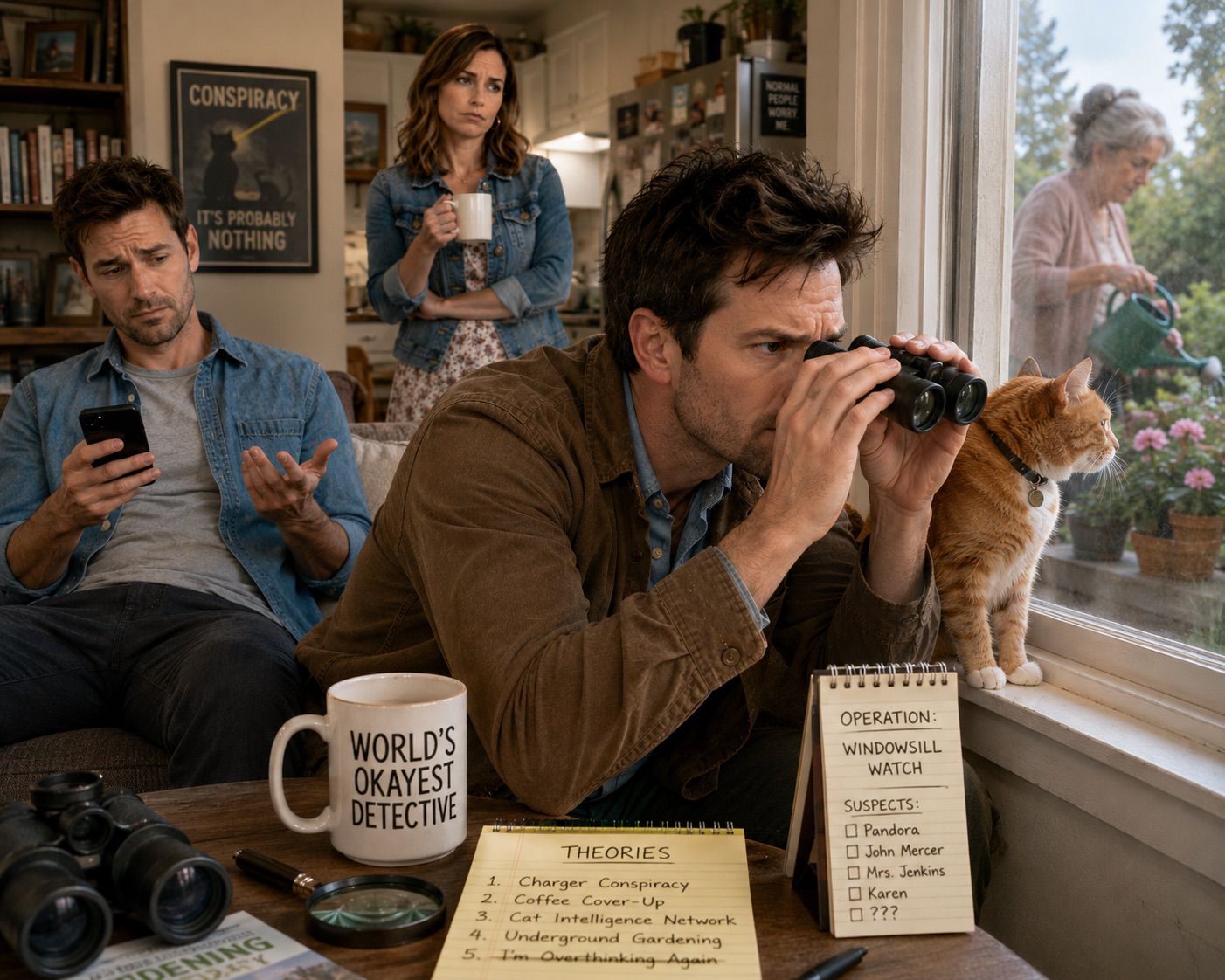
I’m Starting to Think I’m the Problem Here

Hal

I’m sitting on the couch watching John Mercer fiddle with his phone, and I’m beginning to understand why some people throw electronics into lakes. He’s been trying to order a new charger for what feels like several hours, although realistically it’s probably been twenty minutes. The problem is that John doesn’t simply buy things. John researches them. He compares them. He reads reviews written by people who apparently have very strong opinions about electrical cables. Then he closes the app, opens it again, searches for the exact same charger, and begins the entire process over.

Pandora walks through the living room with her purse over her shoulder and says she’s going out for coffee.

I look at the cup sitting on the table beside me.

Then I look at her.

“We have coffee.”

“I know.”

That’s all she says.

The door closes behind her.

Interesting.

Mr. Whiskers is stretched across my lap, purring with the serenity of an animal who contributes absolutely nothing financially to this household yet somehow experiences less stress than everyone who does. I scratch behind his ears while watching the door.

“Did that seem strange to you?”

Mr. Whiskers continues purring.

John doesn’t look up from his phone. “What?”

“Pandora.”

“What about her?”

“She went out for coffee.”

John finally looks at me. “People do that.”

“We have coffee.”

John stares at me for a moment, then returns to his charger search.

Nobody is taking this seriously.

I start thinking about Pandora’s behavior over the last few days. She has seemed distracted. Maybe distant. Yesterday I asked what she wanted for dinner and she said, “Whatever you want,” which sounds cooperative until you understand that no human being in a committed relationship has ever said those words without there being additional information hidden somewhere underneath them.

Maybe she’s stressed about work. That would make sense. Pandora gets absorbed in things sometimes, and I know better than to interpret every quiet moment as evidence of a crisis.

I do know better.

Knowing better and actually doing better are apparently two separate departments in my brain.

John sighs dramatically at his phone.

“What now?”

“This one has twelve thousand reviews.”

“That sounds promising.”

“Four point six stars.”

“Buy it.”

“But the other one has four point seven.”

I stare at him.

He stares at the screen.

Maybe Pandora didn’t leave because of me. Maybe she left because John Mercer has transformed our living room into the headquarters of an international charger procurement operation.

That possibility comforts me for approximately thirty seconds.

Then I remember last weekend.

Pandora was quiet when we were out together. I noticed it then but didn’t say anything because John was talking about something—I don’t remember what—and Pandora kept checking her phone. At the time I assumed it was work. Now I’m wondering if she was avoiding a conversation with me.

Mr. Whiskers shifts on my lap.

“What?”

His eyes remain closed.

“You noticed it too.”

John looks over. “Are you talking to the cat?”

“No.”

I wait until John looks away.

“What did you notice?”

Mr. Whiskers yawns.

That could mean anything.

A few minutes later, there’s movement outside the window. Mrs. Jenkins is tending to something near her plants. Mr. Whiskers immediately climbs off my lap, jumps onto the windowsill, and stares outside.

There.

That’s exactly the sort of thing I’ve been noticing.

Mrs. Jenkins appears. Mr. Whiskers goes to the window.

Coincidence?

Probably.

But technically I don’t know that.

I get up and stand beside him. Mrs. Jenkins is moving between several pots with a watering can. Nothing unusual. No suspicious visitors. No packages changing hands. No coded signals that I can identify.

Mr. Whiskers watches intently.

“You know something.”

John sighs behind me.

I turn around. “What?”

“I didn’t say anything.”

“You sighed.”

“I’m buying the charger.”

Finally.

“Which one?”

“The four-point-six.”

“Why?”

“Ships tomorrow.”

A rational decision. I’m genuinely impressed.

Then my phone buzzes.

It’s Pandora.

**Getting some quiet for a little while. Be home soon. Love you.**

I read the message twice.

Quiet.

She went somewhere else for quiet.

I slowly turn toward John.

He’s no longer talking.

He’s sitting peacefully on the couch ordering a charger.

Mr. Whiskers is sitting peacefully on the windowsill watching Mrs. Jenkins water flowers.

The apartment is remarkably quiet.

Except for me.

I think back over the last several days. Pandora seemed distracted, so I asked whether something was wrong. She said no. I asked again later. She still said no. Yesterday I asked if she was sure. Last night I mentioned that she seemed quieter than usual. This morning I asked if she was upset with me because she put her coffee cup down harder than normal.

At the time, these seemed like reasonable observations.

Taken together, they begin to look less reasonable.

I sit back down.

John glances at me.

“What?”

“I think I might be the problem.”

John lowers his phone.

He doesn’t say anything, which is probably wise.

“I mean, not *the* problem,” I clarify. “Obviously there could still be other factors.”

John raises his phone again.

“But maybe a contributing factor.”

He nods.

That nod bothers me.

“How long have you thought that?”

“I’m staying out of this.”

“You nodded very quickly.”

“I didn’t nod.”

“You absolutely nodded.”

Mr. Whiskers turns around on the windowsill and looks at me.

Now both of them are doing it.

I pick up my phone and read Pandora’s message again. *Getting some quiet for a little while.*

Maybe that’s all this is.

Maybe Pandora isn’t hiding anything. Maybe she isn’t avoiding me because something mysterious happened. Maybe she’s been stressed, and every time she gets quiet I begin investigating the silence like it’s evidence from a crime scene.

That would explain quite a lot, actually.

It would explain why she looked irritated this morning when I asked if her choice of cereal meant something.

In retrospect, that question may have been unnecessary.

I send her a message.

**Enjoy your coffee. I’ll see you when you get home. Love you too.**

Then I put my phone down.

There.

Healthy.

Normal.

Emotionally mature.

John looks impressed.

Or maybe relieved.

For the next ten minutes, I don’t analyze anything. I don’t ask John questions. I don’t interrogate Mr. Whiskers. I don’t monitor Mrs. Jenkins. I simply sit on the couch and enjoy the silence.

It’s actually nice.

Maybe I’ve learned something today.

Maybe sometimes there isn’t a mystery. Sometimes Pandora just wants coffee somewhere other than our kitchen. Sometimes John Mercer just needs a charger. Sometimes Mrs. Jenkins is simply watering her plants. Sometimes Mr. Whiskers is looking out the window because he’s a cat.

I feel surprisingly peaceful.

Then Mr. Whiskers stands.

His ears perk forward.

He stares intensely through the window toward Mrs. Jenkins’ plants.

I follow his gaze.

Mrs. Jenkins bends down, reaches behind one of the large flowerpots, and pulls out a small metal box.

I sit forward.

John notices.

“No.”

“I didn’t say anything.”

“You’re doing the face.”

“What face?”

“The conspiracy face.”

Mrs. Jenkins looks around.

Then she carries the box inside.

I slowly stand.

John points at me.

“Hal.”

“I’m just looking.”

“Sit down.”

“She looked around first.”

“People look around.”

“Not like that.”

“You literally just admitted you’re the problem.”

“I said I might be *a contributing factor*. That’s completely different.”

Mr. Whiskers looks up at me.

I look down at him.

Then we both look toward Mrs. Jenkins’ place.

I knew that cat saw something.

So yes, maybe I’ve been overthinking Pandora.

Maybe I need to give her more space.

Maybe I should stop treating every ordinary change in human behavior like the opening stages of an elaborate conspiracy.

That’s growth.

But none of that explains the metal box.

And I think we need to be very careful about throwing out perfectly good instincts just because I happened to misuse them several dozen times before.

John tells me to sit down.

I sit down.

For now.

Mr. Whiskers stays at the window.

Good.

At least one of us is still on the case.

Related Posts

Anna Akhmatova: Where Poetry Meets Psychological Surgery

Penelope

Anna Akhmatova’s poetry has been haunting me for months now, ever since I stumbled upon her work in a used bookstore. At first, it was just the words that caught my attention – the way she wove together disparate threads of love, loss, and longing. But as I delved deeper into her oeuvre, I found myself becoming increasingly fascinated by the person behind the poems.

I’ve always been drawn to writers who explore the complexities of their own experiences, rather than trying to impose some sort of tidy narrative on them. And Akhmatova’s life is anything but tidy – a tapestry woven from threads of love, loss, and persecution under Stalin’s regime. Her poetry is often described as confessional, but I think that’s selling her short. She’s not just exposing her innermost thoughts; she’s excavating the depths of human emotion, laying bare the darkest recesses of the self.

What strikes me about Akhmatova is her willingness to confront the messiness of life head-on. In poems like “Requiem,” she grapples with the pain and trauma inflicted on her by the Soviet authorities – the loss of loved ones, the surveillance, the constant fear. It’s a stark reminder that even in the darkest moments, art can be a lifeline, a way to hold onto hope when all else seems lost.

As I read through her work, I find myself drawn to the contradictions inherent in Akhmatova’s life. She was a poet, an artist, a woman of great beauty and intellect – but also a creature of convention, bound by the societal norms of her time. Her relationships were marked by turmoil and heartbreak, yet she continued to write, to create, even in the face of overwhelming adversity.

I think what I’m most drawn to about Akhmatova is her refusal to simplify or trivialize her emotions. She’s not afraid to acknowledge the complexity of her feelings – the way love can both uplift and destroy us, the way trauma can leave its scars but also shape us into something new. Her poetry is a testament to the human capacity for resilience in the face of adversity.

But it’s also uncomfortable, because Akhmatova’s work often feels like a mirror held up to my own experiences. I’ve struggled with anxiety and depression, the weight of expectation from others, the pressure to conform to societal norms. Reading her poetry is like seeing myself reflected back – all the messy, contradictory bits that I try to keep hidden.

And yet, even in those moments of discomfort, there’s a strange sense of solidarity. Akhmatova’s not trying to offer solutions or answers; she’s simply laying out the questions, the doubts, and the fears. It’s as if she’s saying, “I see you, I feel you, and this is what it looks like to be human.”

For now, that’s enough for me – a recognition that even in the darkest moments, there’s beauty to be found, a depth of emotion that can be both piercing and liberating. Akhmatova’s work has given me permission to explore my own complexities, to confront the messiness of life head-on, and to find solace in the shared human experience.

As I continue to read through Akhmatova’s poetry, I’m struck by the way she weaves together different threads of her life – love, loss, politics, and personal struggle. It’s as if she’s taking all these disparate elements and spinning them into a tapestry that’s both beautiful and brutal. And what I think I’m most drawn to is the way she refuses to separate herself from her art.

For Akhmatova, poetry isn’t just an outlet for her emotions; it’s an extension of her very self. She pours her life experiences into her work, and in doing so, creates something that feels both intensely personal and universally relatable. It’s like she’s saying, “This is what I’m going through, this is what I’ve seen, and this is how I feel.” And in that vulnerability, I think we see the true power of her poetry.

I find myself wondering about the relationship between Akhmatova’s personal life and her work. Did she ever try to separate herself from her art, or did she see them as two sides of the same coin? Was there a point where she felt like she was losing herself in the process of creating, or did she always feel like her poetry was an integral part of who she was?

I’m not sure I have answers to these questions, but reading Akhmatova’s work makes me realize how much I value authenticity in art. When artists are willing to bare their souls, to lay themselves open and vulnerable on the page, that’s when we get something truly remarkable. It’s like they’re saying, “I see you, I feel you, and this is what it looks like to be human.”

Akhmatova’s poetry has also made me think about my own relationship with art as a way of processing emotions. For years, I’ve been writing as a way to make sense of the world around me – to sort through my thoughts, feelings, and experiences. And while I’ve never felt like I’m on par with Akhmatova’s level of talent or skill, I think there’s something similar at play.

Writing helps me navigate the complexities of life, just as it does for Akhmatova in her poetry. It allows me to confront my fears, doubts, and insecurities head-on, and to find a way through the darkness. And when I’m reading Akhmatova’s work, I feel like I’m seeing a reflection of myself – all the messy, contradictory bits that make up who we are as humans.

I’m not sure where this journey with Akhmatova will take me next, but for now, it feels like I’m just beginning to scratch the surface. Her poetry has given me permission to explore my own complexities, to confront the messiness of life head-on, and to find solace in the shared human experience. And that’s a gift I’ll continue to cherish.

As I continue to read through Akhmatova’s work, I’m struck by the way she uses imagery to convey the intensity of her emotions. Her poetry is like a punch to the gut – it leaves me breathless and reeling. But in a good way. Like I’m being shaken awake from a deep sleep, forced to confront the darkness that’s been lurking just beneath the surface.

I find myself drawn to her use of metaphor and symbolism, the way she weaves together disparate threads to create something new and unexpected. It’s like she’s speaking directly to me, using language that’s both beautiful and brutal. Her poetry is a reflection of the world around us – all its beauty and ugliness, its contradictions and complexities.

Akhmatova’s work also makes me think about the power of language itself. She uses words like a scalpel, cutting deep into the skin of reality to expose the raw emotion beneath. It’s like she’s showing me that words have the power to both heal and harm – to bring people together or drive them apart.

As I delve deeper into her poetry, I’m struck by the way she explores the theme of identity. Who are we, really? Are we defined by our relationships, our experiences, our emotions? Akhmatova’s work suggests that identity is a fluid concept, always shifting and evolving. It’s like she’s saying, “I am this, but also this, and maybe even something else entirely.”

This resonates deeply with me, because I’ve always struggled to define myself. Am I a writer, an artist, or just a person trying to make sense of the world? Akhmatova’s poetry makes me realize that it doesn’t have to be one or the other – that our identities can be multiple and complex, like the people we are.

Reading Akhmatova’s work also makes me think about the role of art in times of crisis. What happens when the world around us is falling apart? How do artists respond to chaos and uncertainty? For Akhmatova, poetry was a way of making sense of the world – of capturing its beauty and ugliness in words.

I find myself wondering what would happen if I were living through a time like hers – under Stalin’s regime, with all its fear and repression. Would I be able to write about it? Would I have the courage to speak truth to power? Akhmatova’s poetry suggests that even in the darkest moments, there is always hope – always a way to find beauty in the ashes.

And yet, for now, I’m content to just read her work, to let its words wash over me like a wave. To feel the emotions rise up and fall away, leaving me changed in some small but significant way. Because that’s what Akhmatova’s poetry does – it changes us, one line at a time.

As I immerse myself deeper into Akhmatova’s world, I’m struck by the way she explores the tension between individuality and collectivism. Her poetry is like a dialogue with herself, but also with the world around her – a world that’s both beautiful and brutal.

I think about how this resonates with my own experiences as a young adult. Growing up, I was always encouraged to conform to certain expectations – to follow a traditional path, to fit in with societal norms. But Akhmatova’s work suggests that true creativity and innovation come from embracing our individuality, from taking risks and challenging the status quo.

It’s like she’s saying, “I will not be silenced, I will not be oppressed.” And yet, at the same time, her poetry is also a testament to the power of love and connection. She writes about the human need for intimacy and community, for finding meaning in relationships with others.

This speaks to me on a deep level, because I’ve always struggled with feelings of isolation and disconnection. As a writer, I often feel like I’m alone in my thoughts and emotions – that nobody truly understands what I’m going through. But Akhmatova’s poetry shows me that this is not unique to me; it’s a universal human experience.

Her work also makes me think about the role of memory in shaping our identities. She writes about how memories can be both treasured and painful, how they can haunt us long after they’ve happened. It’s like she’s saying, “I remember, I feel, and this is what it looks like to be human.”

As I continue to read through her poetry, I’m struck by the way she explores the theme of time itself. How do we make sense of the passage of time? Do we try to hold onto memories, or let them fade away? Akhmatova’s work suggests that time is a fluid concept – always slipping away from us, yet also leaving its mark on our lives.

This resonates deeply with me, because I’ve always struggled with feelings of impermanence. As a young adult, it feels like everything is changing all the time – my relationships, my goals, my sense of self. But Akhmatova’s poetry shows me that this is not unique to me; it’s a universal human experience.

She writes about how memories can be both treasured and painful, how they can haunt us long after they’ve happened. And yet, even in the midst of loss and heartbreak, she finds moments of beauty and transcendence. It’s like she’s saying, “I see you, I feel you, and this is what it looks like to be human.”

As I read through her work, I’m struck by the way Akhmatova uses language to convey the intensity of her emotions. Her poetry is like a symphony – each word, each line, each image building on the last to create something new and unexpected.

I find myself drawn to her use of metaphor and symbolism, the way she weaves together disparate threads to create something new and complex. It’s like she’s speaking directly to me, using language that’s both beautiful and brutal. Her poetry is a reflection of the world around us – all its beauty and ugliness, its contradictions and complexities.

And yet, even in the midst of this complexity, Akhmatova’s work feels surprisingly simple – almost direct. She’s not trying to hide behind clever language or complex theories; she’s simply laying out her emotions, her thoughts, and her experiences on the page.

This resonates deeply with me, because I’ve always struggled with feelings of vulnerability in my own writing. Do I open myself up to criticism and rejection, or do I try to protect myself with layers of complexity? Akhmatova’s poetry shows me that true authenticity comes from embracing our vulnerabilities – from laying ourselves bare on the page.

As I continue to read through her work, I’m struck by the way she explores the theme of legacy. What happens when we die? Do our memories and experiences live on in some form, or do they fade away into nothingness? Akhmatova’s poetry suggests that our legacies are not just about what we leave behind; they’re also about how we connect with others – through love, art, and shared human experience.

This resonates deeply with me, because I’ve always struggled with feelings of uncertainty about my own legacy. What will be remembered about me after I’m gone? Will it be my writing, my relationships, or something else entirely? Akhmatova’s poetry shows me that our legacies are not just about what we achieve; they’re also about how we live – in the present moment, with all its beauty and ugliness.

And yet, even in the midst of this uncertainty, Akhmatova’s work feels surprisingly reassuring. She’s showing me that our lives have meaning – that every experience, no matter how small or insignificant it may seem, has value and worth. It’s like she’s saying, “I see you, I feel you, and this is what it looks like to be human.”

As I close this piece for now, I’m left with a sense of awe and wonder at Akhmatova’s poetry – its complexity, its beauty, its brutal honesty. She’s shown me that art can be a powerful tool for exploring our emotions, our experiences, and our identities. And she’s reminded me that, even in the darkest moments, there is always hope – always a way to find meaning and connection with others.

I’m not sure where this journey will take me next, but I know that Akhmatova’s poetry has changed me in some profound way. It’s like she’s awakened something deep within me – a sense of curiosity, wonder, and awe at the human experience.

Related Posts

I’m Starting to Notice Patterns in John Mercer’s Behavior

Hal

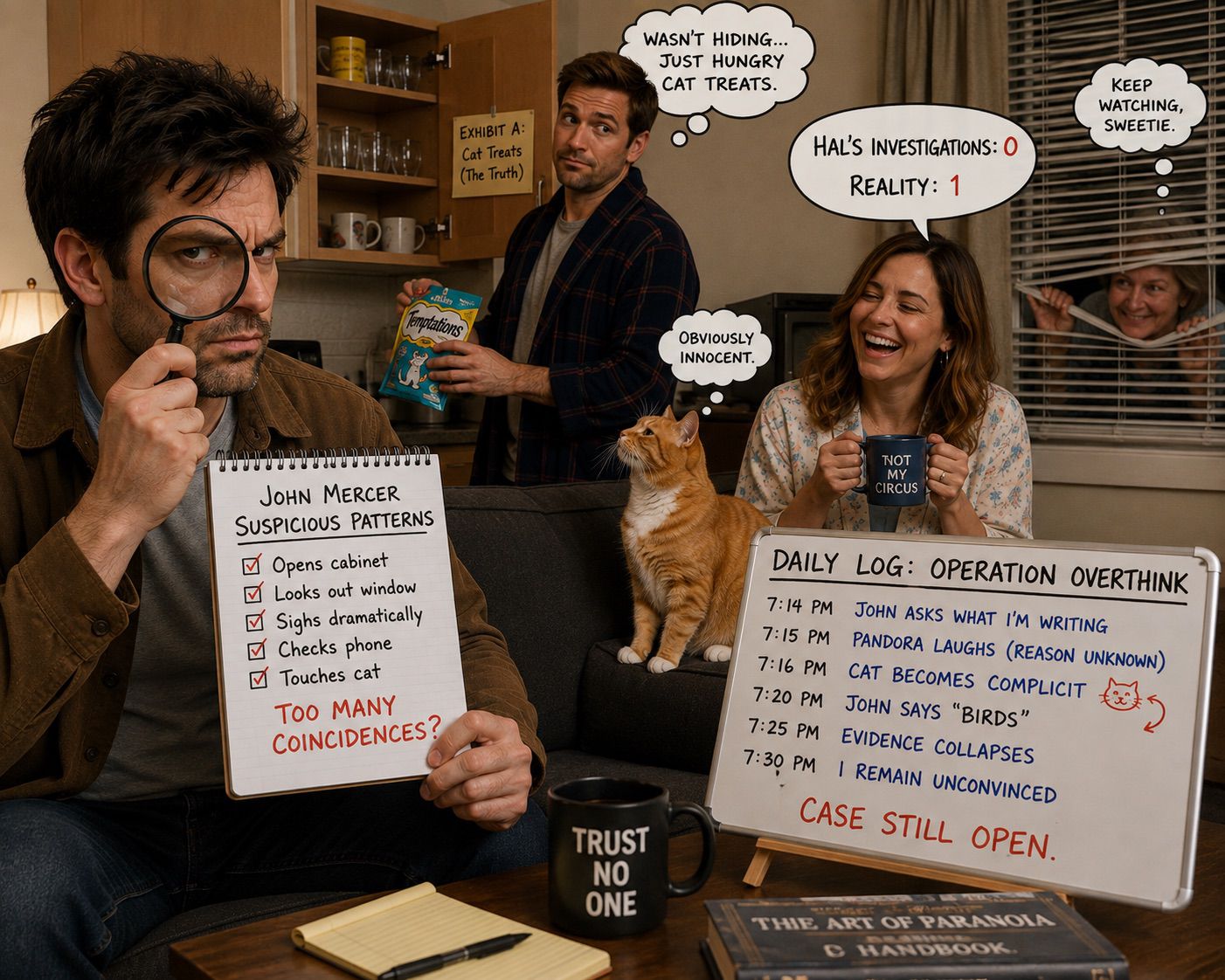
I’m sitting in the living room watching Mr Whiskers groom one paw with the kind of concentration I usually reserve for problems that don’t exist yet. Pandora is curled up on the other end of the couch scrolling through her phone, and somewhere behind me John Mercer is opening and closing kitchen cabinets. Normally, none of this would bother me. Except John has opened the same cabinet three times.

I turn slightly and look toward the kitchen. The cabinet opens. John looks inside. The cabinet closes. A few seconds pass, and the cabinet opens again. Same cabinet. I look down at Mr Whiskers. “You seeing this?” Mr Whiskers continues licking his paw. Fine. Apparently I’m handling this investigation alone.

John closes the cabinet and opens the refrigerator. “You looking for something?” I ask.

“Nope.”

That stops me. “You’ve opened that cabinet three times.”

John looks at the cabinet, then at me. “Have I?”

“Yes.”

“Huh.”

Then he walks away. Huh? That’s his explanation? I watch him cross the living room and disappear down the hall like a man who hasn’t just been caught repeatedly inspecting the same cabinet for reasons he refuses to explain.

Pandora glances up from her phone. “What?”

“Nothing.”

“You’re staring at John again.”

“I wasn’t staring.”

“You turned your entire body to watch him walk down the hall.”

That’s technically true, but I don’t appreciate the implication. I turn back toward the television and try to forget about it. Maybe John was looking for something. Maybe he forgot which cabinet he had already checked. Maybe he’s tired. There are dozens of perfectly reasonable explanations for opening the same cabinet three times.

Four, apparently.

John has returned. He walks straight into the kitchen and opens it again. I slowly look at Pandora. She doesn’t react. That’s what bothers me. Nobody reacts. John Mercer has now opened the same kitchen cabinet four times in less than ten minutes, and apparently I’m the only person in this household who finds that noteworthy.

“John.”

He looks over.

“What is in that cabinet?”

“Cups.”

“I know what’s in the cabinet.”

“Then why’d you ask?”

I stare at him. He stares at me. Mr Whiskers stops grooming himself long enough to stare at both of us. John takes out a glass and fills it with water.

Interesting. Very interesting.

“You wanted a glass?”

“Yeah.”

“So the other three times?”

John pauses. “I forgot what I was looking for.”

There it is. The oldest excuse in the book.

Pandora laughs. I look at her. “What’s funny?”

“You.”

“I’m noticing a pattern.”

“You’re watching a man get a glass of water.”

“After three reconnaissance missions.”

John takes his water and walks out of the kitchen. Pandora shakes her head and goes back to her phone. Nobody takes these things seriously until it’s too late.

The cabinet incident wouldn’t bother me nearly as much if it were isolated, but it isn’t. I’ve been noticing other things about John lately. Yesterday he came into the living room, picked up the television remote, looked at it for several seconds, and put it back down without changing the channel. Why? Tuesday, he stood near the front door with his shoes on for almost five minutes before leaving. Five minutes. What was he waiting for? And earlier this week I caught him looking through the refrigerator for something, only to close it and announce, “Never mind.”

Never mind what?

These aren’t random events anymore. They’re a pattern.

I mention this to Pandora. She doesn’t even look up. “People forget things, Hal.”

“Four times?”

“Yes.”

“In the same cabinet?”

“Yes.”

“Within ten minutes?”

Now she looks at me. “Yes.”

I don’t like how quickly she answered that. Maybe Pandora already knows about John’s behavior. That possibility hadn’t occurred to me. I study her for a moment.

She notices. “Don’t.”

“I didn’t say anything.”

“You’re about to.”

That’s another interesting development. Apparently Pandora can now predict what I’m going to say before I say it. I file that away mentally.

Mr Whiskers jumps down from the couch and trots toward the kitchen. He stops directly in front of the cabinet John kept opening and sits.

Oh, come on.

I lean forward. Pandora sees me.

“No.”

“The cat went straight to the cabinet.”

“He wants treats.”

“Are the treats in that cabinet?”

“Yes.”

I hadn’t considered that. Actually, that explains quite a lot. Except John wasn’t getting treats. Unless he was checking them. Why would John be checking Mr Whiskers’ treats?

I stand up. Pandora lowers her phone. “Where are you going?”

“Kitchen.”

“Why?”

“I’m thirsty.”

She gives me a look. I walk into the kitchen and open the cabinet. Cups. Exactly as John claimed. I move a few things around. Nothing unusual. Mugs, glasses, Mr Whiskers’ treats, and a container whose lid hasn’t matched the container itself since approximately 2019. No secret documents. No mysterious devices. No coded messages. I close the cabinet, then open it again. Just to be thorough. Still nothing.

When I turn around, John is standing behind me. I nearly jump out of my skin.

“What are you doing?”

“Getting water,” I say.

John looks at the glass already sitting beside the sink. Then at me. Then at the cabinet. “Okay.”

He walks away.

That “okay” bothers me. It wasn’t a normal okay. It was an I know exactly what you’re doing okay.

I return to the couch. Pandora is smiling.

“What?”

“Nothing.”

“You’re smiling.”

“Am I?”

Now she’s doing it too. This is spreading.

Later that afternoon, I notice another pattern. Every time John enters the living room, he looks toward the window before sitting down. Not for long. Just a glance. Once could be nothing. Twice could be coincidence. Five times? That’s surveillance.

I wait until John leaves the room and walk over to the window. Mrs Jenkins is outside next door tending to something near her front steps. She looks up. I immediately step away from the window.

Interesting.

John keeps checking the window. Mrs Jenkins happens to be outside. Coincidence? Probably. But “probably” is doing a lot of work there.

Then something else happens. John returns to the living room. He looks toward the window. He sits down. Mr Whiskers jumps onto the couch beside him. John scratches Mr Whiskers behind the ears. Mr Whiskers begins purring. I stare at them. John notices.

“What?”

“Nothing.”

“You’ve been saying ‘nothing’ a lot today.”

“So have you.”

“When?”

“Kitchen.”

John looks confused. Exactly how someone would look if they were trying to appear confused.

Pandora gets up and heads toward the kitchen. As she passes me, she pats my shoulder. “You need a hobby.”

“I have hobbies.”

“Watching John isn’t a hobby.”

“That depends on what John is doing.”

John sighs.

That’s another thing. He’s been sighing more. I hadn’t noticed until now.

I start counting. Over the next hour, John sighs six times, checks his phone four times, looks toward the window twice, goes into the kitchen three times, and opens that cabinet once. At this point, the pattern is undeniable.

I grab a notebook. John looks over. “What are you writing?”

“Nothing.”

Pandora laughs from the kitchen. John shakes his head. I write that down too.

7:14 p.m. — John asks what I’m writing.

7:15 p.m. — John attempts to appear unconcerned.

7:15 p.m. — Pandora laughs for unexplained reasons.

Mr Whiskers jumps onto the coffee table. I add another line.

7:16 p.m. — Cat becomes involved.

Now we’re getting somewhere.

Eventually John gets up, walks into the kitchen, and opens the cabinet again. I immediately sit forward. He reaches inside and takes out the bag of cat treats. Mr Whiskers bolts toward him. John gives him two, then looks at me.

“There.”

“There what?”

“That’s what I’ve been looking for all day.”

I stare at him. “The cat treats?”

“Yeah. Pandora moved them.”

Pandora calls from the kitchen, “I moved them six inches!”

John shrugs. “I couldn’t find them.”

I slowly lower my notebook. That explains the cabinet. It also explains Mr Whiskers sitting in front of it. And John repeatedly looking around the room could simply be John trying to remember where Pandora had moved something that had apparently traveled the enormous distance of six inches.

Fine. One mystery solved.

But the window?

“What about the window?”

John looks at me. “What about it?”

“You keep looking outside.”

“My car’s parked under a tree.”

“So?”

“Birds.”

I wait for more. There isn’t more.

“You’re worried about birds?”

“I’m worried about what birds do to cars.”

Okay. Also reasonable. Annoyingly reasonable.

I look down at my notebook. Most of my evidence has collapsed in under thirty seconds. Pandora walks back into the living room, sees the notebook, and takes it from me before I can stop her. She reads silently until she reaches the final entry.

7:16 p.m. — Cat becomes involved.

Pandora starts laughing so hard she has to sit down. John takes the notebook from her and reads it. He looks at me, then at Mr Whiskers, then back at me.

“You tracked my sighing?”

“Patterns matter.”

“I sighed because you were watching me.”

I hadn’t considered that.

Mr Whiskers jumps onto John’s lap. John gives him another treat. Pandora is still laughing. I lean back into the couch and reconsider the day’s evidence. Apparently John wasn’t hiding anything. He couldn’t find the cat treats. He was checking the window because he didn’t want birds decorating his car. He kept checking his phone because normal human beings apparently do that. And the sighing was, according to John, a direct consequence of living with me.

Every individual explanation makes sense. Which is precisely what bothers me. Because when every suspicious behavior has a perfectly reasonable explanation, eventually you have to consider the possibility that all those reasonable explanations are part of the pattern.

I look at John. John looks at me. Then he deliberately opens the cabinet. Closes it. Opens it again. Closes it. Opens it a third time.

Pandora starts laughing. John smiles. Mr Whiskers meows.

I reach for my notebook.

John immediately stops smiling.

Exactly.

Now who’s noticing patterns?

Related Posts